
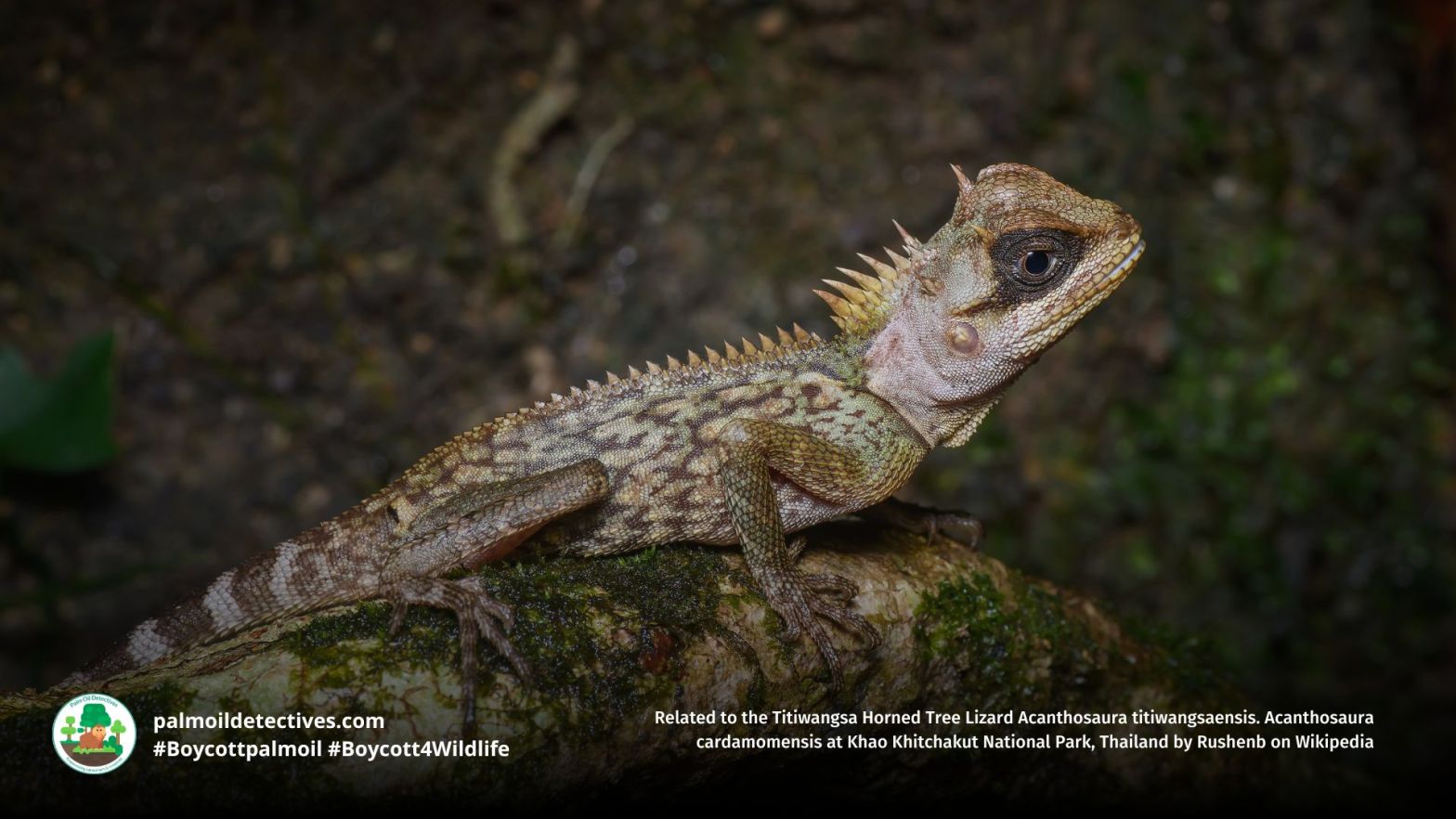
Titiwangsa Horned Tree Lizard Acanthosaura titiwangsaensis
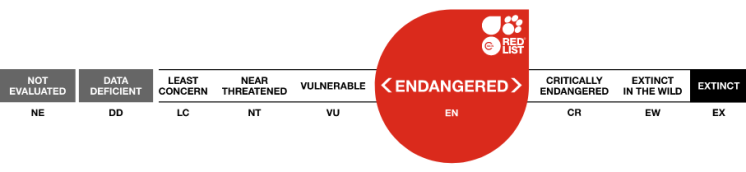
Endangered
Malaysia
Extant (resident): Peninsular Malaysia
The Titiwangsa Horned Tree Lizard is a stunning and elusive reptile found exclusively in the cool montane forests of Peninsular Malaysia’s Titiwangsa Mountain Range. First described in 2009, they are known for their striking spines and intricate camouflage, which allow them to blend seamlessly into their forested environment. They are threatened by palm oil deforestation and urban expansion in Peninsular Malaysia. Help them to survive when you #BoycottPalmOil #Boycott4Wildlife in the supermarket!
As insectivores these lizards help regulate populations of insects and other small invertebrates. By preying on herbivorous insects, they prevent overgrazing of vegetation, which helps maintain the health and diversity of the forest undergrowth. They are a vital part of Malaysia’s biodiversity. Protecting their habitat ensures the survival of this precious lizard along with other irreplaceable species within these montane ecosystems.
With their eye-like patterns called oceli and olive green scales 🦎💚🐉, the Titiwangsa Horned Tree #Lizard cuts a striking figure in Peninsular #Malaysia 🇲🇾 They’re #endangered by #palmoil #deforestation. #BoycottPalmOil #Boycott4Wildlife @palmoildetect https://palmoildetectives.com/2021/02/08/titiwangsa-horned-tree-lizard-acanthosaura-titiwangsaensis/
Once thriving now #endangered #herps 🐍🦎🐸 Titiwangsa Horned Tree #Lizards 🐉💚 are a critical part of #Malaysia’s #rainforests keeping the insects in balance. Fight back for their survival and #BoycottPalmOil 🌴🤮⛔️ #Boycott4Wildlife @palmoildetect https://palmoildetectives.com/2021/02/08/titiwangsa-horned-tree-lizard-acanthosaura-titiwangsaensis/
Appearance and Behaviour
The Titiwangsa Horned Tree Lizard is easily recognisable by the prominent spines above their eyes, giving them a “horned” appearance, and smaller spines along their back. Their bodies are adorned with yellow-brown to olive-green scales, complemented by eye-like patterns (ocelli) for camouflage.
Typically, they perch on tree trunks at heights of no more than two metres during the day, remaining motionless to evade predators. Their arboreal lifestyle and striking features make them well-adapted to life in the dense undergrowth of montane forests.
Habitat
Endemic to Peninsular Malaysia, this species thrives in the montane forests of the Titiwangsa Mountain Range at elevations above 1,000 metres. These cooler, moist habitats are rich in vegetation and provide the perfect environment for shelter and foraging.
However, habitat loss from deforestation and land development poses a growing threat to their survival.
Diet
While direct studies on their diet are limited, the Titiwangsa Horned Tree Lizard likely feeds on insects and small invertebrates, similar to other species in their genus. By controlling insect populations, they play a key role in maintaining the balance of their ecosystem.
Reproduction and Mating
Little is known about the reproduction of this specific species. However, like other agamid lizards, they are oviparous, laying eggs that incubate in soil or leaf litter. Field research is needed to better understand their breeding habits and population dynamics.
Threats
The Titiwangsa Horned Tree Lizard classified as endangered due to them being an endemic species to Malaysia’s rainforests and with a limited range. This range is consistently under threat by palm oil deforestation and urban development. Conservation measures are needed to protect them and their montane forest habitats.
• Habitat Loss: Deforestation for palm oil agriculture.
Urban development: Tourism and urban development of the Cameron Highlands is a growing risk for this lizard.
Illegal Wildlife Trade: Collection for local wildlife trade, local zoos and private collections pose a significant risk to wild populations.
Boycott Palm Oil to Protect the Titiwangsa Horned Tree Lizard Acanthosaura titiwangsaensis
Protecting the montane forests of the Titiwangsa Mountain Range is crucial for the survival of this species. Advocate for habitat preservation and responsible land-use policies. Support initiatives that combat deforestation and regulate wildlife trade.
Join the #BoycottPalmOil and #Boycott4Wildlife movements to safeguard the biodiversity of Malaysia’s unique forests.
The rapid conversion of rainforest for agricultural use and tourist development in the Cameron Highlands is a threat to this species’ habitat (L. Grismer and E. Quah pers. comm. 2017).
IUCN Red LIst
Support the conservation of this species
This animal has no protections in place. Read about other forgotten species here. Create art to support this forgotten animal or raise awareness about them by sharing this post and using the #Boycottpalmoil #Boycott4Wildlife hashtags on social media. Also you can boycott palm oil in the supermarket.
Further Information
Ecology Asia. (n.d.). Titiwangsa Horned Tree Lizard. Retrieved from ecologyasia.com
Grismer, L. & Quah, E. 2018. Acanthosaura titiwangsaensis. The IUCN Red List of Threatened Species 2018: e.T99928409A99928418. https://dx.doi.org/10.2305/IUCN.UK.2018-2.RLTS.T99928409A99928418.en. Downloaded on 08 February 2021.
Species New to Science. (2012). Acanthosaura titiwangsaensis. Retrieved from Novataxa
The Reptile Database. (n.d.). Acanthosaura titiwangsaensis. Retrieved from Reptile Database

How can I help the #Boycott4Wildlife?
Take Action in Five Ways
1. Join the #Boycott4Wildlife on social media and subscribe to stay in the loop: Share posts from this website to your own network on Twitter, Mastadon, Instagram, Facebook and Youtube using the hashtags #Boycottpalmoil #Boycott4Wildlife.
2. Contribute stories: Academics, conservationists, scientists, indigenous rights advocates and animal rights advocates working to expose the corruption of the palm oil industry or to save animals can contribute stories to the website.





3. Supermarket sleuthing: Next time you’re in the supermarket, take photos of products containing palm oil. Share these to social media along with the hashtags to call out the greenwashing and ecocide of the brands who use palm oil. You can also take photos of palm oil free products and congratulate brands when they go palm oil free.
4. Take to the streets: Get in touch with Palm Oil Detectives to find out more.
5. Donate: Make a one-off or monthly donation to Palm Oil Detectives as a way of saying thank you and to help pay for ongoing running costs of the website and social media campaigns. Donate here
Discover more from Palm Oil Detectives
Subscribe to get the latest posts sent to your email.
 Palm Oil Detectives