
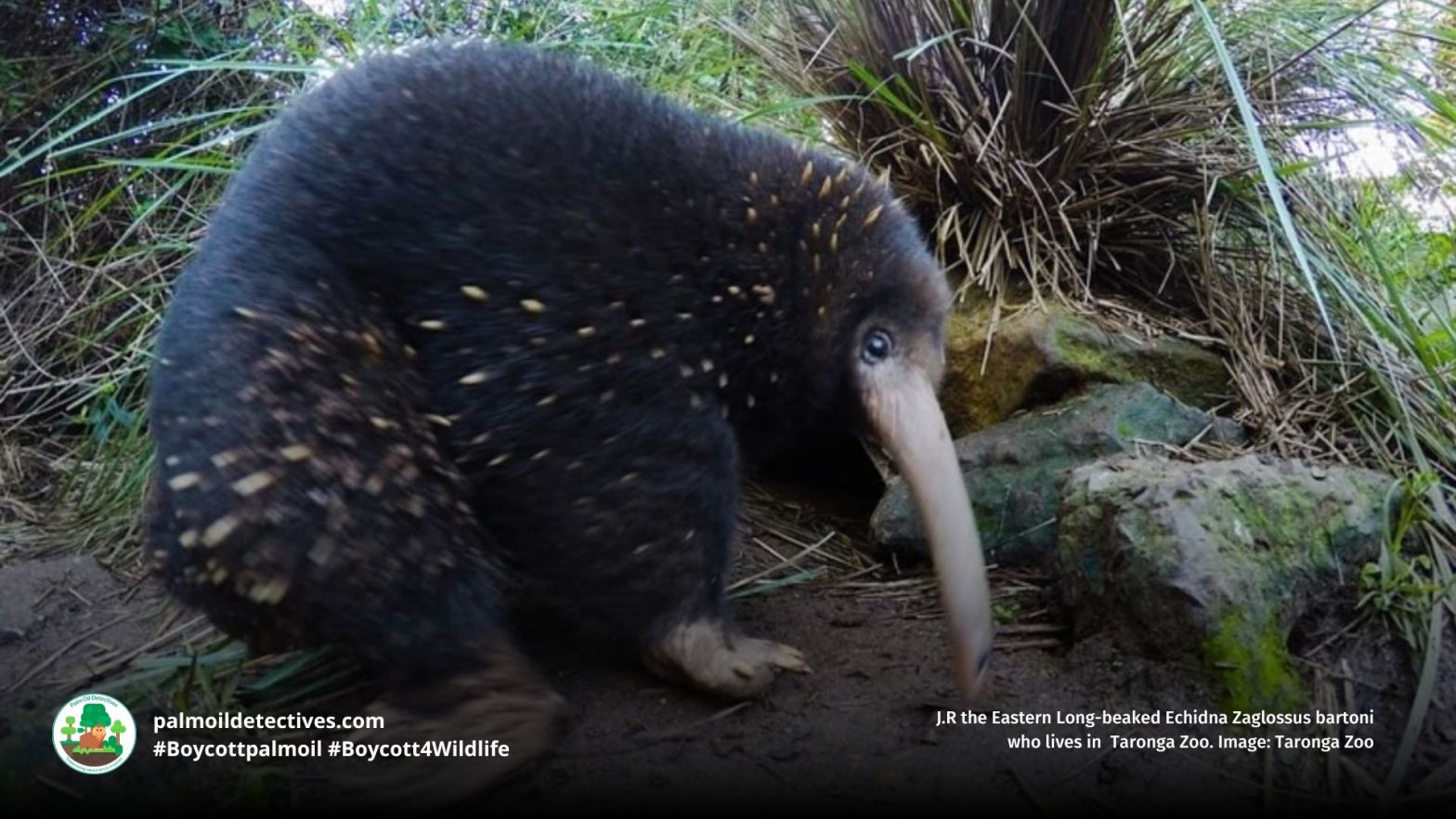
Eastern Long-beaked Echidna Zaglossus bartoni
Status: Vulnerable
Location: Endemic to the highlands of Papua New Guinea.
The Eastern long-beaked echidna Zaglossus bartoni is one of the planet’s most extraordinary mammals—a living relic from the dawn of mammalian evolution. Found only in the rugged, remote mountains of New Guinea, this remarkable creature is genetically and physically unlike any other animal alive today. Their existence bridges ancient evolutionary traits with the survival needs of modern species, representing a fascinating link to the distant past.
Tragically, these rare monotremes face the threat of extinction due to hunting and habitat loss for palm oil, timber and gold mining. Support indigenous-led conservation and fight for their survival. Use your wallet as a weapon and #BoycottPalmOil #Boycott4Wildlife.
Eastern Long-beaked #Echidnas are the oldest mammals on earth. They’re #vulnerable in #PapuaNewGuinea 🇵🇬 due to #mining and #palmoil #deforestation. Say NO to their #extinction 🌴🔥💀🙊⛔️ #BoycottPalmOil #Boycott4Wildlife @palmoildetect https://palmoildetectives.com/2021/02/03/eastern-long-beaked-echidna-zaglossus-bartoni/
Eastern Long-beaked #Echidnas are rare egg-laying #mammals 🥚🦔 They are a prehistoric fever dream with a tube-like beak and hedgehog like spines. Help them survive in #NewGuinea 🇵🇬 when you #BoycottPalmOil 🌴🪔🤮🙊🚫 #Boycott4Wildlife @palmoildetect https://palmoildetectives.com/2021/02/03/eastern-long-beaked-echidna-zaglossus-bartoni/
Appearance and Behaviour
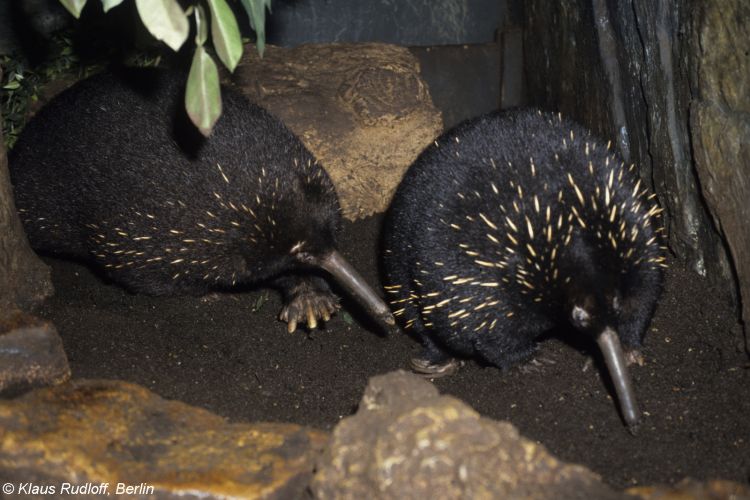
The Eastern long-beaked echidna looks like something out of a prehistoric dream. They weigh between 5 and 9 kilograms (10–20 pounds) and are covered in coarse fur interspersed with hedgehog-like spines that offer protection from predators. Their most distinctive feature is their elongated, tube-like beak, which is a marvel of evolutionary adaptation. Unlike most mammals, they lack teeth and a conventional jaw; instead, their beak is lined with electro-receptors, allowing them to detect the faintest electrical signals from underground prey. This unique “beak” functions as a tool for slurping up earthworms and insects, much like a child sucking up spaghetti.
These shy creatures are primarily nocturnal, spending their days hidden in burrows or dense undergrowth. A remarkable trait observed is their limb preference during digging activities, with some individuals demonstrating clear “handedness” (Limb Preferences in Monotremes, 2015).
Their gait and behaviour further highlight their primitive charm. With a shuffling, deliberate walk, they use powerful claws to dig through soil and leaf litter. Despite their armour-like exterior and prehistoric lineage, these echidnas are docile and shy, avoiding confrontation whenever possible. Each movement and adaptation offers a glimpse into a time when mammals first emerged, making them not just a species, but a living connection to the evolutionary history of life on Earth.
Threats
IUCN Status: Vulnerable

Palm oil, timber and gold mining deforestation:
The destruction of montane forests due to timber deforestation, palm oil monoculture, and gold mining has significantly reduced the Eastern long-beaked echidna’s habitat (IUCN Red List, 2021).
Hunting Pressures:
These echidnas are heavily hunted for bushmeat, even in areas where hunting them is prohibited, posing a critical threat to their survival (IUCN Red List, 2021).
Across New Guinea, more than 800 tribal cultures rely on hunting for protein, with echidnas often targeted as a prized food source (Mongabay, 2015).
Habitat Fragmentation:
Habitat fragmentation from human activities isolates populations, reducing genetic diversity and limiting their ability to adapt to environmental changes (IUCN Red List, 2021).
Limited research into their population trends complicates conservation efforts, highlighting the need for greater scientific focus on this species (Mongabay, 2015).
Diet
The Eastern long-beaked echidna is insectivorous, with a particular fondness for earthworms. They use their specialised snout and long, sticky tongue to extract prey from soil and rotting logs. This foraging behaviour is an essential part of their ecological role, as it contributes to soil aeration and nutrient cycling (Academic OUP, 2009).
Reproduction and Mating
As a monotreme, the Eastern long-beaked echidna lays eggs rather than giving birth to live young. Females lay a single leathery egg, which they incubate in a pouch for approximately 10 days. Once hatched, the puggle remains in the pouch for up to two months, feeding on milk secreted from specialised mammary glands (IUCN Red List, 2016).
Geographic Range
The Eastern long-beaked echidna is endemic to the montane forests of Papua New Guinea, thriving at elevations between 2,000 and 3,000 metres. Their range is limited to remote, forested highlands, with populations scattered across the island (AP Science Foundation, 2009).
FAQ
What is the Eastern long-beaked echidna?
The Eastern long-beaked echidna (Zaglossus bartoni) is one of the most unique mammals on Earth. As an egg-laying monotreme, they are part of an ancient lineage that has survived for millions of years. Endemic to Papua New Guinea, they are known for their elongated snout and nocturnal habits (Mongabay, 2015).
Why is the Eastern long-beaked echidna Vulnerable?
Their primary threats include habitat destruction from palm oil and timber deforestation and mining, as well as hunting for bushmeat. Despite legal protections, enforcement is weak, and their populations are in decline (IUCN Red List, 2016).
What does the Eastern long-beaked echidna eat?
Earthworms form the majority of their diet, along with other soil-dwelling invertebrates. They forage using their long snout and sticky tongue, an adaptation perfect for extracting prey from soil and decaying wood (Academic OUP, 2009).
How does the Eastern long-beaked echidna reproduce?
Females lay a single egg, incubating it in a pouch for about 10 days. Once the young hatches, it stays in the pouch for up to two months before becoming independent (IUCN Red List, 2016).
Where is the Eastern long-beaked echidna found?
They inhabit the remote montane forests of Papua New Guinea, at elevations between 2,000 and 3,000 metres. These habitats are increasingly threatened by human activities (AP Science Foundation, 2009).
Take Action!
Protect the Eastern long-beaked echidna by advocating for habitat preservation and supporting indigenous-led conservation efforts. Use your purchasing power to demand palm oil free and vegan instead! #BoycottPalmOil #Boycott4Wildlife
Support the conservation of this species
This animal has no protections in place. Read about other forgotten species here. Create art to support this forgotten animal or raise awareness about them by sharing this post and using the #Boycottpalmoil #Boycott4Wildlife hashtags on social media. Also you can boycott palm oil in the supermarket.
Further Information

Giljov, A., Karenina, K., Hawkins, M. R., & Malashichev, Y. (2015). First record of limb preferences in monotremes (Zaglossus spp.). Australian Journal of Zoology, 63(5), Article ZO15043. https://doi.org/10.1071/ZO15043
Leary, T., Seri, L., Flannery, T., Wright, D., Hamilton, S., Helgen, K., Singadan, R., Menzies, J., Allison, A., James, R., Aplin, K., Salas, L. & Dickman, C. 2016. Zaglossus bartoni. The IUCN Red List of Threatened Species 2016: e.T136552A21964496. https://dx.doi.org/10.2305/IUCN.UK.2016-2.RLTS.T136552A21964496.en. Downloaded on 03 February 2021.
Mack, A. L. (2015). The Long-beaked Echidna: Can we save the earth’s oldest living mammal? Mongabay. Retrieved from https://news.mongabay.com/2015/10/the-long-beaked-echidna-can-we-save-the-earths-oldest-living-mammal/
Opiang, M. D. (2009). Home ranges, movement, and den use in long-beaked echidnas, Zaglossus bartoni, from Papua New Guinea. Journal of Mammalogy, 90(2), 340–346. https://doi.org/10.1644/08-MAMM-A-108.1
The Australia and Pacific Science Foundation. (2009). Reproductive ecology of the eastern long-beaked echidna, Zaglossus bartoni (APSF 09-1). APSF Project Report. Retrieved from http://www.apscience.org.au/apsf_09_1/
Wikipedia contributors. (2021). Eastern long-beaked echidna (Zaglossus bartoni). Wikipedia. Retrieved from https://en.wikipedia.org/wiki/Eastern_long-beaked_echidna

How can I help the #Boycott4Wildlife?
Take Action in Five Ways
1. Join the #Boycott4Wildlife on social media and subscribe to stay in the loop: Share posts from this website to your own network on Twitter, Mastadon, Instagram, Facebook and Youtube using the hashtags #Boycottpalmoil #Boycott4Wildlife.
2. Contribute stories: Academics, conservationists, scientists, indigenous rights advocates and animal rights advocates working to expose the corruption of the palm oil industry or to save animals can contribute stories to the website.




3. Supermarket sleuthing: Next time you’re in the supermarket, take photos of products containing palm oil. Share these to social media along with the hashtags to call out the greenwashing and ecocide of the brands who use palm oil. You can also take photos of palm oil free products and congratulate brands when they go palm oil free.
4. Take to the streets: Get in touch with Palm Oil Detectives to find out more.
5. Donate: Make a one-off or monthly donation to Palm Oil Detectives as a way of saying thank you and to help pay for ongoing running costs of the website and social media campaigns. Donate here
Discover more from Palm Oil Detectives
Subscribe to get the latest posts sent to your email.
 Palm Oil Detectives
One thought on “Eastern Long-beaked Echidna Zaglossus bartoni”