
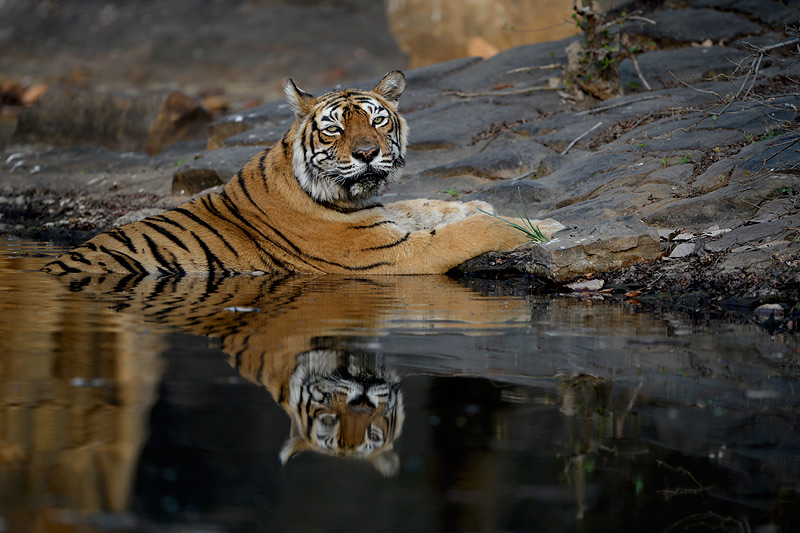
#India‘s fifty year long Project #Tiger has been a successful conservation project. A new research study finds that protecting tigers and their rainforest home has additional benefits to #carbonemissions, saving 1 million tonnes of CO2 from being spewed into the atmosphere. Conserving tigers as an iconic and legendary species is deeply ingrained into the world’s collective imagination. #BoycottPalmOil #Boycott4Wildlife
Cover Image: Tiger in Rajasthan, India by Craig Jones Wildlife Photography
The growing population of #India’s mighty #tiger 🐯🐅is lauded as a conservation success story. However more remains to be done to safeguard India’s #forests #animals and #mangroves for the future 🙏🇮🇳🪷 #Boycottpalmoil #Boycott4Wildlife @palmoildetect https://wp.me/pcFhgU-8V5
Good news 📰 #Tigers 🐯🐅🧡 have increased in population in #India 🇮🇳 due to successful #conservation. Extending these protections to areas where #palmoil encroaches on #rainforest #ecosystem is essential. #Boycottpalmoil #Boycott4Wildlife @palmoildetect https://wp.me/pcFhgU-8V5
Written by Simon Evans, Principal Lecturer in Ecotourism, Anglia Ruskin University. This article is republished from The Conversation under a Creative Commons license. Read the original article.

The year 2023 coincided with the 50th anniversary of India’s groundbreaking Project Tiger, an innovative programme designed to rescue the country’s iconic big cat from the precipice of extinction. In April, as part of these celebrations, prime minister Narendra Modi announced that tiger numbers in India have now surpassed 3,000, representing more than 70% of the wild tigers in the world.
From an initial investment in 1973 of just nine dedicated tiger reserves, India now protects 54 such areas. It adds up to an area in excess of 75,000 sq kilometres, or about 2% of the country.
Now, new research in the journal Nature Ecology and Evolution has identified a link between tiger conservation and the fight against climate change. Tigers are very adaptable and the exact same subspecies, the Bengal tiger, can be found scattered across India in jungles, mangroves and so-called “dry forests”. These habitats might seem very different, but the common link is of course lots of trees.
According to the authors of the new study, the strict protection provided within India’s network of tiger reserves has avoided huge amounts of deforestation. And by preserving forests that would have otherwise been chopped down, between 2007 and 2020, tiger protection may have contributed to over 1 million tonnes of avoided carbon emissions.
A million tonnes of carbon might sound like a lot, though it won’t put a huge dent in climate change. India alone emits about 2.7 billion tonnes each year (albeit very little per capita). But that isn’t the point.
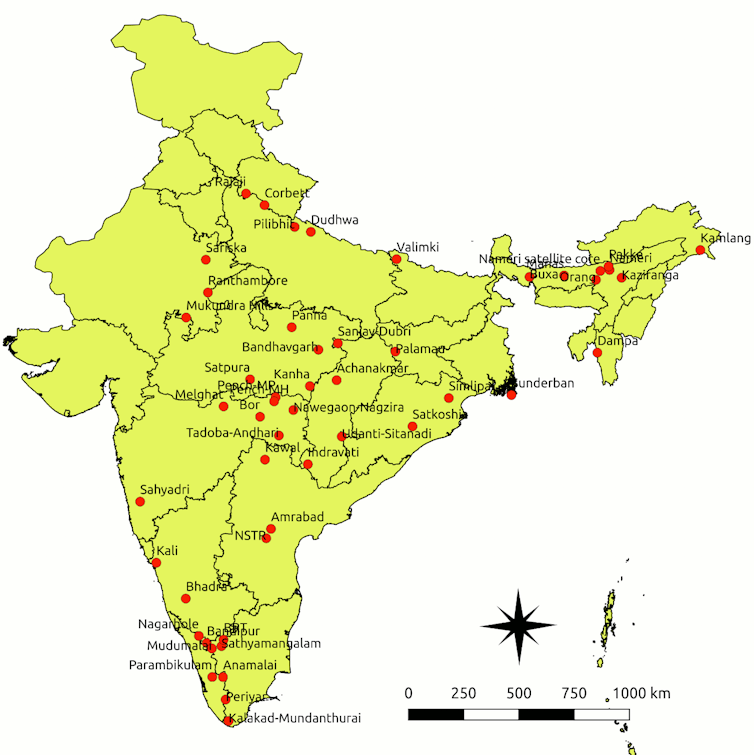
In a monetary sense, that avoided deforestation and saved carbon can be equated to US$6.24 million (£5.06 million) in direct carbon offsets and, if wider “ecosystem services” such as watershed management and the provision of fuel and firewood are considered, this figure could rise to as much as US$92 million (£75m). The authors of the new research suggest that this could be a gamechanger for tiger protection, as it could be funded through carbon offset schemes.
There are critics who view India expanding its tiger reserves as an economic extravagance, one that brings the animals into conflict with humans and criminalises local communities (some of whom have been moved out of reserves) for living as they have always done. But in a neoliberal world where everything has a price tag, the future of vulnerable wildlife often depends on its ability to justify its own survival. And if carbon storage can be added to the list of reasons to protect tiger habitat, this in turn may provide fresh impetus for conservation.

Still lots of habitat left
Even after centuries of deforestation and an expansion of farmland to feed a billion people, there still seems to be land available. In a recent interview in The Hindu newspaper the prominent tiger biologist Ullas Karanth made it clear that India has the potential, on paper at least, to quadruple its wild tiger numbers over the longer term. According to Karanth, there is still an estimated 380,000 sq kilometres of potential habitat available, just 20% of which is currently under strict protection and containing tigers.

The loss of their forests is still the main reason why tigers are threatened. But this meant there are habitats available that have been emptied of tigers by hunting, and which cannot be colonised by new populations since there are no safe “wildlife corridors” connecting one patch of forest to another.
If these vacant forests were given their proper value and managed with both (reintroduced) big cats and the climate in mind, India could further cement its position as the world leader in tiger conservation. Eventually it could start exporting surplus tigers to repopulate sites in neighbouring countries where Bengal tigers have declined (the many tigers in captivity, especially in the US, are too used to humans to be released into the wild).
This is a win-win situation. It would also help India to re-establish its green credentials during an era in which the country’s emphasis on development and business has conflicted with parallel efforts to protect its natural environment.
Written by Simon Evans, Principal Lecturer in Ecotourism, Anglia Ruskin University. This article is republished from The Conversation under a Creative Commons license. Read the original article.
ENDS
Learn about other animals endangered by palm oil and other agriculture




Learn about “sustainable” palm oil greenwashing
Read more about RSPO greenwashing
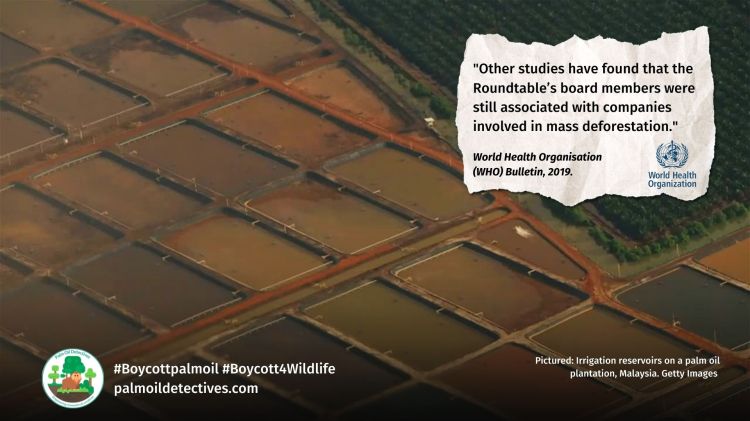
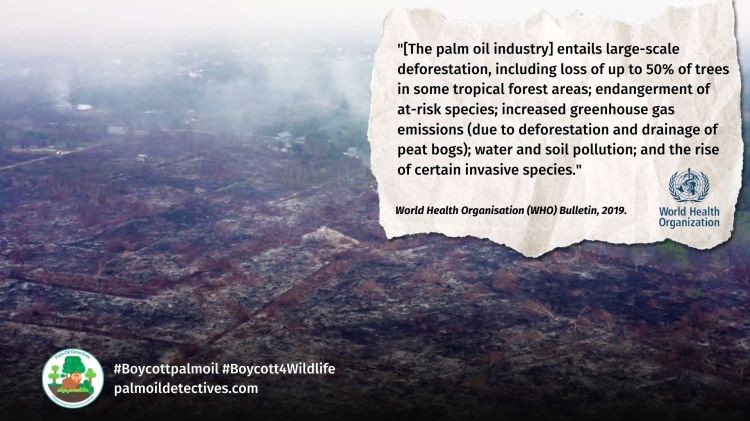
A 2019 World Health Organisation (WHO) report into the palm oil industry and RSPO finds extensive greenwashing of palm oil deforestation and the murder of endangered animals (i.e. biodiversity loss)



Take Action in Five Ways
1. Join the #Boycott4Wildlife on social media and subscribe to stay in the loop: Share posts from this website to your own network on Twitter, Mastadon, Instagram, Facebook and Youtube using the hashtags #Boycottpalmoil #Boycott4Wildlife.
2. Contribute stories: Academics, conservationists, scientists, indigenous rights advocates and animal rights advocates working to expose the corruption of the palm oil industry or to save animals can contribute stories to the website.






3. Supermarket sleuthing: Next time you’re in the supermarket, take photos of products containing palm oil. Share these to social media along with the hashtags to call out the greenwashing and ecocide of the brands who use palm oil. You can also take photos of palm oil free products and congratulate brands when they go palm oil free.
4. Take to the streets: Get in touch with Palm Oil Detectives to find out more.
5. Donate: Make a one-off or monthly donation to Palm Oil Detectives as a way of saying thank you and to help pay for ongoing running costs of the website and social media campaigns. Donate here
Discover more from Palm Oil Detectives
Subscribe to get the latest posts sent to your email.
 Palm Oil Detectives