
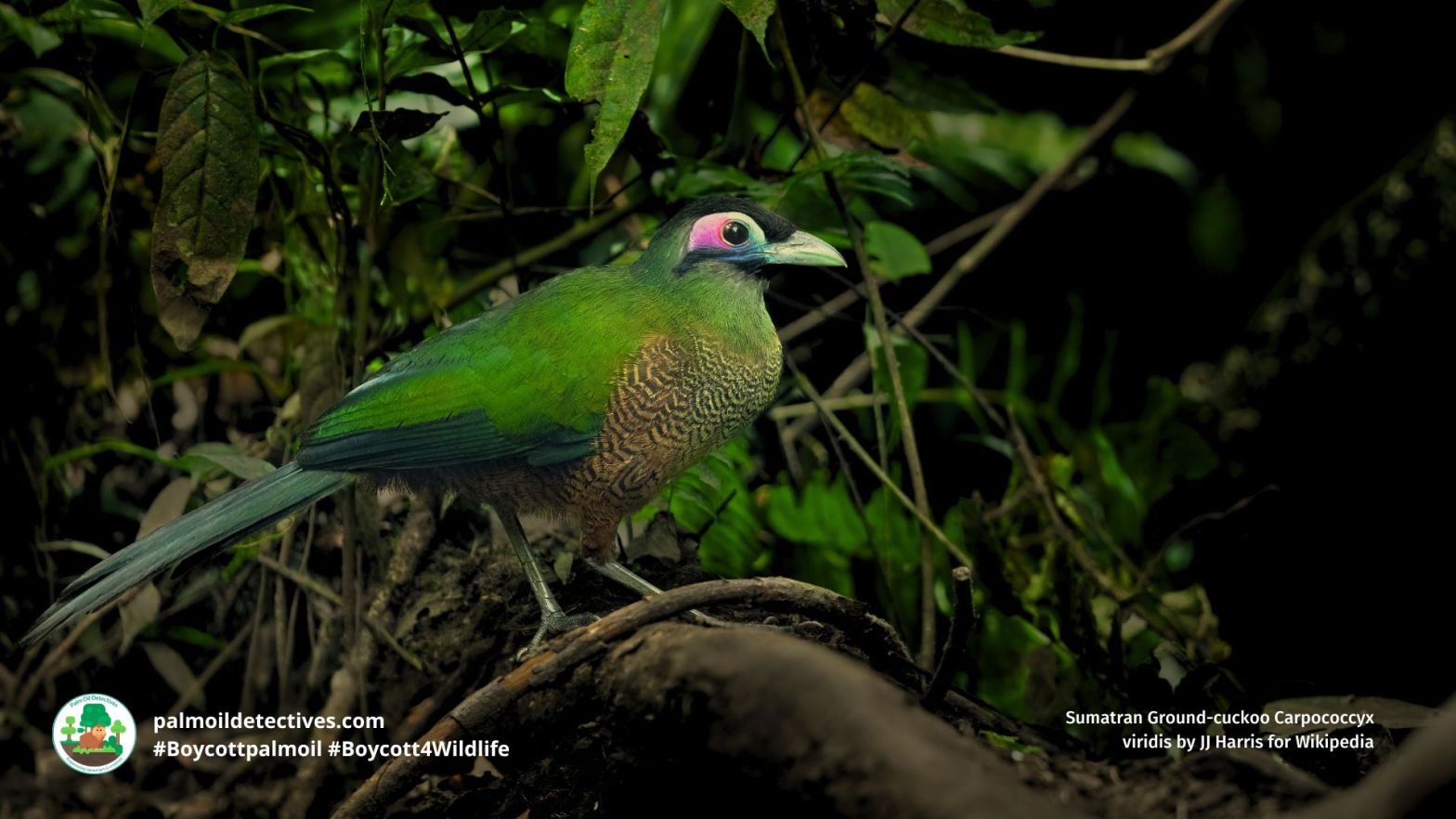
Sumatran Ground-cuckoo Carpococcyx viridis
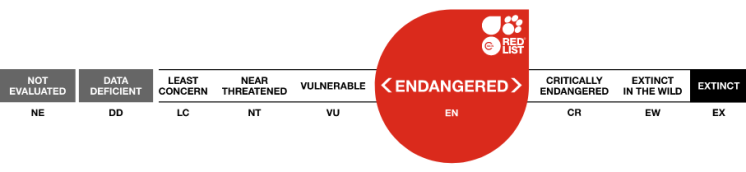
Critically Endangered
Extant (resident): Sumatra, Indonesia
The Sumatran Ground Cuckoo, a reclusive bird endemic to Sumatra’s dense forests who captivate with their distinctive iridescent plumage. They lived peacefully in the rainforest until its decimation over the past several decades for palm oil took its toll on populations – they are now critically endangered. Fewer than 250 mature individuals remain, and their population is declining. Immediate conservation efforts are critical. These stunning birds symbolise the fragile and rich biodiversity of Sumatra’s montane rainforests. Take action and use your wallet as a weapon every time you shop, #BoycottPalmOil #Boycott4Wildlife
In #rainforests of #Sumatra is a rare melody of “eee-wow eee-wow” by the Sumatran Ground Cuckoo – long thought #extinct. Now critically endangered by #palmoil #deforestation. Fight for them when you #BoycottPalmOil #Boycott4Wildlife 🌴💩☠️ @palmoildetect https://palmoildetectives.com/2021/01/21/sumatran-ground-cuckoo-carpococcyx-viridis/
With shimmering lilac, green and blue plumage, the Sumatran Ground Cuckoo 🦜 is an enigmatic songstress of #Sumatra #Indonesia. Critically endangered from #palmoil #ecocide. Help them survive when you #BoycottPalmOil #Boycott4Wildlife 🌴⛔️ @palmoildetect https://palmoildetectives.com/2021/01/21/sumatran-ground-cuckoo-carpococcyx-viridis/
The Sumatran Ground Cuckoo is a rare and enigmatic bird found only in the montane rainforests of Sumatra. Known for their striking plumage and elusive nature, they are among the most endangered species in the world, with fewer than 250 mature individuals estimated to remain.
Their survival is critically dependent on the preservation of Sumatra’s rapidly disappearing rainforests. Protecting them requires urgent action to halt deforestation and hunting. Support their conservation by joining the #BoycottPalmOil and #Boycott4Wildlife movements.
Appearance and Behaviour
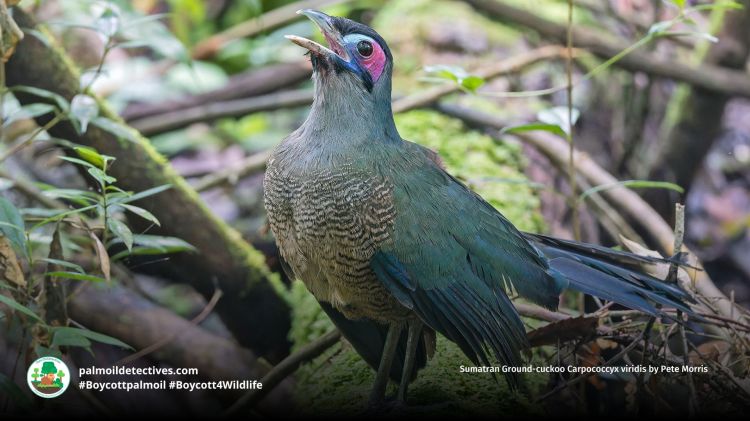
Around 55 cm in length, these mesmerising birds possess vibrant facial markings in shades of green, lilac, and blue set off against a black feathered crown. Their glossy greenish-black upper body contrast with cinnamon-buff underside. A long tail enhances their striking appearance.
The Sumatran Ground Cuckoo prefers the dense undergrowth of primary forests and is rarely seen. They are quiet and elusive, but their call, recorded for the first time in 2007, featured soft whistles in a melodic rising and falling song.
Habitat
Endemic to Sumatra, the Sumatran Ground Cuckoo inhabits primary montane rainforests at elevations between 300 and 1,400 metres. They are primarily found in the Barisan Mountains, including Kerinci Seblat and Bukit Barisan Selatan National Parks.
These forests are a critical haven for thousands of different animal and plant species. However, even protected areas are under threat from logging and palm oil expansion, leaving their habitat increasingly fragmented and in peril.
Diet
Sumatran Ground Cuckoos forage along the forest floor, using their sturdy bills to capture prey, contributing to the balance of their ecosystem. Direct observations of these birds are scarce and they are believed to feed on invertebrates, small mammals, and reptiles.
Take action!
Support conservation initiatives to protect Sumatra’s remaining rainforests. Advocate for the protection of critical habitats by rejecting products linked to deforestation, such as palm oil and meat. #BoycottPalmOil #Boycott4Wildlife
Threats
The Sumatran Ground Cuckoo is classified as Critically Endangered on the IUCN Red List. With fewer than 250 mature individuals remaining, their population is in sharp decline due to habitat destruction and human activity.
Deforestation has been extensive on Sumatra and this is probably the main threat. At least two-thirds to four-fifths of original lowland forest cover and at least one-third of montane forest have been lost, primarily to agricultural encroachment by shifting cultivators, which is currently affecting large areas of lower montane forest, even within protected areas.
Deforestation has been extensive on Sumatra and this is probably the main threat to the Sumatran Ground-cuckoo
IUCN Red List
• Deforestation for palm oil: Rainforests are cleared for palm oil plantations, leading to the destruction of their habitat.
• Logging: Both legal and illegal logging activities fragment their forest home.
• Bycatch in hunting snares: Ground snares set for other species, such as Red Junglefowl, often trap and kill these birds.
• Human encroachment: Agricultural and infrastructure expansion degrade the forests they depend on.
Help save the Sumatran Ground Cuckoo by boycotting palm oil products and supporting conservation organisations working to protect Sumatra’s forests. Advocate for policies that prioritise habitat preservation and sustainable alternatives like agroecology. Join the #BoycottPalmOil and #Boycott4Wildlife movements to ensure these birds can thrive once again.

Support the conservation of this beautiful animal
There are no known conservation activities for this forgotten animal. You can help by creating art about them or by joining the Boycott4Wildlife
Further Information
BirdLife International. 2017. Carpococcyx viridis (amended version of 2016 assessment). The IUCN Red List of Threatened Species 2017: e.T22724459A112393882. https://dx.doi.org/10.2305/IUCN.UK.2017-1.RLTS.T22724459A112393882.en. Downloaded on 21 January 2021.
Wikipedia contributors. (n.d.). Sumatran Ground Cuckoo. Retrieved from Wikipedia.

How can I help the #Boycott4Wildlife?
Take Action in Five Ways
1. Join the #Boycott4Wildlife on social media and subscribe to stay in the loop: Share posts from this website to your own network on Twitter, Mastadon, Instagram, Facebook and Youtube using the hashtags #Boycottpalmoil #Boycott4Wildlife.
2. Contribute stories: Academics, conservationists, scientists, indigenous rights advocates and animal rights advocates working to expose the corruption of the palm oil industry or to save animals can contribute stories to the website.



3. Supermarket sleuthing: Next time you’re in the supermarket, take photos of products containing palm oil. Share these to social media along with the hashtags to call out the greenwashing and ecocide of the brands who use palm oil. You can also take photos of palm oil free products and congratulate brands when they go palm oil free.
4. Take to the streets: Get in touch with Palm Oil Detectives to find out more.
5. Donate: Make a one-off or monthly donation to Palm Oil Detectives as a way of saying thank you and to help pay for ongoing running costs of the website and social media campaigns. Donate here
Discover more from Palm Oil Detectives
Subscribe to get the latest posts sent to your email.
 Palm Oil Detectives