
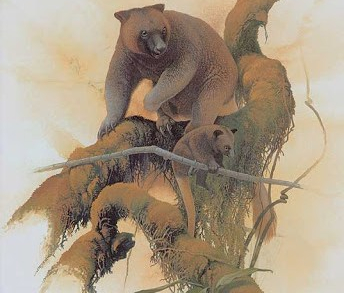
Seri’s Tree Kangaroo Dendrolagus stellarum
Red List: Vulnerable
Locations: Upper montane forests of Papua New Guinea and the highlands of West Papua—an Indigenous Melanesian region under Indonesian military occupation since the 1960s, where local people have faced decades of violence, land dispossession, and cultural erasure.
The Seri’s Tree Kangaroo is a large tree kangaroo that needs primary upper montane tropical forests. This species is threatened by heavy hunting pressure, this includes hunting with dogs (trophy jaws were still very much in evidence in 2000; T. Flannery pers. comm. 2008). The Seri’s Tree Kangaroo is hunted for food by local people. A large part of the species’ range is in uninhabited areas. Populations in the eastern parts of the range were impacted by the fires during the El Niño period in 1998-1999. Listed as Vulnerable because they have suspected to have undergone at least a 30% population reduction in the last three generations (i.e., 30 years) that has not ceased, due to hunting and destruction of habitat (i.e., impacts of El Niño).
Seri’s Tree Kangaroos 🦘🧸 are #teddybear-like #marsupials who bounce around in #WestPapua #PapuaNewGuinea forests. They’re #vulnerable from #hunting 🏹 #palmoil #deforestation 🌴🚜🔥 and #gold #mining. Resist and #Boycottpalmoil #Boycott4Wildlife 🌴🪔🚫https://palmoildetectives.com/2021/02/03/seris-tree-kangaroo-dendrolagus-stellarum/
Seri’s #TreeKangaroo is one of the world’s most elusive #marsupials of the genus #Dendrolagus surviving only in the remote mountains of #PapuaNewGuinea and the contested territory of #WestPapua. In these highlands, Indigenous Papuans have resisted Indonesian rule for over half a century, while the forests themselves are threatened by commercial logging, palm oil, and hunting. The Seri’s Tree Kangaroo’s silvery coat and secretive habits help them blend into the forest, but not even the tallest trees can shield them from bulldozers. When you shop ensure that you BoycottPalmOil, Boycott4Wildlife to fight for their protection.
Appearance and Behaviour
Mist drapes the ancient cloud forests of Papua New Guinea and the highlands of West Papua, a region long denied self-determination and now scarred by extractive industries and military control. Here, Seri’s Tree Kangaroo moves quietly among moss and orchids, rarely glimpsed by outsiders.
Seri’s Tree Kangaroo is striking, with a dark brown coat frosted with silver, especially as they age. Youngsters have bright yellow tails that darken over time. Males reach up to 9.5 kg, females up to 6.8 kg. Their thick fur and powerful limbs are perfect for life in the cold, damp upper montane forests. Like other Dendrolagus species, Seri’s Tree Kangaroo is highly adapted for tree life, with strong forelimbs, long claws, and rough footpads for gripping branches. They are expert climbers, able to leap several metres between trees, but slow and awkward on the ground. Most sightings are of solitary animals or mothers with young, and their silvery coats blend perfectly with moss and lichen. Seri’s Tree Kangaroo is thought to be mostly nocturnal and crepuscular, emerging at dawn and dusk to feed. Their world is one of filtered light, damp air, and the hush of wind through the high mountain forest—a landscape now fractured by roads and mining extraction.
Threats
There are now logging concessions over almost 75% of the species inferred range. There has presumably been significant habitat disturbance and reduction in habitat quality as a result of logging
IUCN Red List
Deforestation and habitat loss
Seri’s Tree Kangaroo is threatened by logging and forest clearance for palm oil and other industrial agriculture, even in the high mountain forests of West Papua—land taken by force and now exploited for foreign profit. Chainsaws and bulldozers fragment their habitat, making it harder to find food and mates. As the forest shrinks, Seri’s Tree Kangaroo is forced into smaller, isolated patches, where survival becomes more difficult. Logging roads open up the mountains to hunters and poachers, increasing the risk of being killed for bushmeat. The loss of old-growth trees removes vital shelter and feeding sites, and the forest grows quieter as more animals disappear. Every year, the scars of deforestation reach higher into the mountains, leaving Seri’s Tree Kangaroo with fewer places to hide. The impact is not just physical—noise, pollution, and the presence of outsiders disrupt the delicate balance of these Indigenous lands.
Hunting and poaching
The Seri’s Tree Kangaroo now faces their greatest threat in Papua New Guinea and occupied West Papua from commercial poaching and outside exploitation, not Indigenous hunting. Logging roads and land grabs by outsiders have opened forests to hunting for profit. Indigenous Papuans have lost their land and rights that drives today’s crisis. Protecting Seri’s Tree Kangaroo means restoring Indigenous control and stopping external exploitation.
Climate change
Climate change threatens Seri’s Tree Kangaroo by altering the cool, wet conditions of their mountain home. Rising temperatures and shifting rainfall patterns may push suitable habitat even higher, shrinking their range further. Drought and extreme weather can reduce food availability and make the forest more vulnerable to fire. As the climate warms, lowland species may move into the highlands, bringing new diseases and competition. Seri’s Tree Kangaroo, already living at the edge of their range, may have nowhere left to go.
Diet
Very little is known about the diet of Seri’s Tree Kangaroo, but like other Dendrolagus species, they likely feed on leaves, fruits, flowers, bark, and possibly fungi. Tree kangaroos are known to forage in the canopy, using their strong limbs and dexterous forepaws to reach for food. Some species will also eat eggs, small birds, or insects, but plant material is thought to make up most of their diet. Their feeding helps to disperse seeds and maintain the health of the forest.
Reproduction and Mating
Breeding biology is poorly understood, but Seri’s Tree Kangaroo may breed year-round, with females giving birth to a single young each year. Like other marsupials, the tiny newborn crawls into the mother’s pouch, where it develops for several months. The young later rides on the mother’s back as they explore the trees. Extended maternal care is likely, with mothers teaching their young how to climb and find food. Longevity is unknown, but related tree kangaroos can live over a decade in the wild.
Geographic Range
Seri’s Tree Kangaroo is found only in the upper montane forests of Papua New Guinea and the highlands of West Papua—a Melanesian region that has been under Indonesian military occupation since the 1960s, following a widely condemned annexation. Their range is patchy, with populations scattered across about 30,000 square kilometres of mossy, cloud-draped forest. These highlands are remote and difficult to access, but logging, mining, and hunting are reaching even these isolated areas. The species is not found below 2,600 metres, and their habitat is shrinking as the climate warms and forests are cleared for resource extraction and plantations.
FAQs
How many Seri’s Tree Kangaroos are left in the wild?
Population numbers are unknown, but Seri’s Tree Kangaroo is considered extremely rare and declining. Their secretive habits and remote habitat in the highlands of Papua New Guinea and West Papua—where Indigenous Papuans have faced decades of occupation and violence—make surveys difficult. Sightings are infrequent, and local reports suggest numbers are falling due to habitat loss, hunting, and the opening of forests to outsiders.
How long do Seri’s Tree Kangaroos live?
Exact lifespan is unknown, but related tree kangaroos can live 10–15 years in the wild. Seri’s Tree Kangaroo may have a similar lifespan, but high mortality from hunting and habitat loss likely reduces their average age, especially in areas affected by military occupation and resource extraction.
What are the threats to Seri’s Tree Kangaroo’s survival?
Major threats include deforestation for logging and agriculture, hunting for meat, and climate change. In West Papua, the presence of Indonesian military and extractive industries accelerates habitat loss and increases the risk of poaching. Fragmented forests make it harder for Seri’s Tree Kangaroo to find food and mates, and new roads bring more outsiders into their range.
What is unique about Seri’s Tree Kangaroo’s behaviour?
Seri’s Tree Kangaroo is highly adapted to life in the canopy, with strong limbs, long claws, and a silvery coat that blends with moss and lichen. They are mostly solitary, moving quietly through the misty forest. Like other Dendrolagus species, they can leap several metres between trees and are much more agile in the canopy than on the ground.
Do Seri’s Tree Kangaroos make good pets?
No. Seri’s Tree Kangaroo suffers extreme stress and early death in captivity. The pet trade destroys wild populations and tears apart families. These rare marsupials belong in the wild, not in cages.
Take Action!
Fight for Seri’s Tree Kangaroo every time you shop. BoycottPalmOil. Boycott4Wildlife. Support Indigenous-led protection of the highland forests of Papua New Guinea and West Papua, a Melanesian land still denied self-determination.
Further Information

Csevár, S., & Rugarli, Y. (2025). Greasing the wheels of colonialism: Palm oil industry in West Papua. Global Studies Quarterly, 5(2), https://doi.org/10.1093/isagsq/ksaf026
Flannery, T., Martin, R., & Szalay, A. (1996). Tree kangaroos: A curious natural history. Reed Books. https://www.publish.csiro.au/book/2117
Flannery, T. (1995). Mammals of New Guinea. Reed Books. https://www.publish.csiro.au/book/2116
Gerrard, D. (2024, November 22). Putting West Papua back into history. Office of Benny Wenda. https://www.bennywenda.org/2024/putting-west-papua-back-into-history/
Knobloch, B. (2021, January 12). Indonesia’s repression hasn’t broken the West Papuan freedom struggle. Jacobin. https://jacobin.com/2021/01/indonesia-west-papua-colonialism-occupation
Leary, T., Seri, L., Flannery, T., Wright, D., Hamilton, S., Helgen, K., Singadan, R., Menzies, J., Allison, A., James, R., Aplin, K., Salas, L. & Dickman, C. 2016. Dendrolagus stellarum. The IUCN Red List of Threatened Species 2016: e.T136812A21956889. https://dx.doi.org/10.2305/IUCN.UK.2016-2.RLTS.T136812A21956889.en. Downloaded on 03 February 2021.
MacLeod, J. (2021). The struggle for self-determination in West Papua (1969–present). International Center on Nonviolent Conflict. https://www.nonviolent-conflict.org/struggle-self-determination-west-papua-1969-present/
Tenkile Conservation Alliance. (2023, March 15). Seri’s Tree Kangaroo Dendrolagus stellarum. https://tenkile.com/seris-tree-kangaroo/
Wikipedia. (2024, June 13). Seri’s tree-kangaroo. In Wikipedia. https://en.wikipedia.org/wiki/Seri%27s_tree-kangaroo
You can support the conservation of this animal:

How can I help the #Boycott4Wildlife?
Take Action in Five Ways
1. Join the #Boycott4Wildlife on social media and subscribe to stay in the loop: Share posts from this website to your own network on Twitter, Mastadon, Instagram, Facebook and Youtube using the hashtags #Boycottpalmoil #Boycott4Wildlife.
2. Contribute stories: Academics, conservationists, scientists, indigenous rights advocates and animal rights advocates working to expose the corruption of the palm oil industry or to save animals can contribute stories to the website.
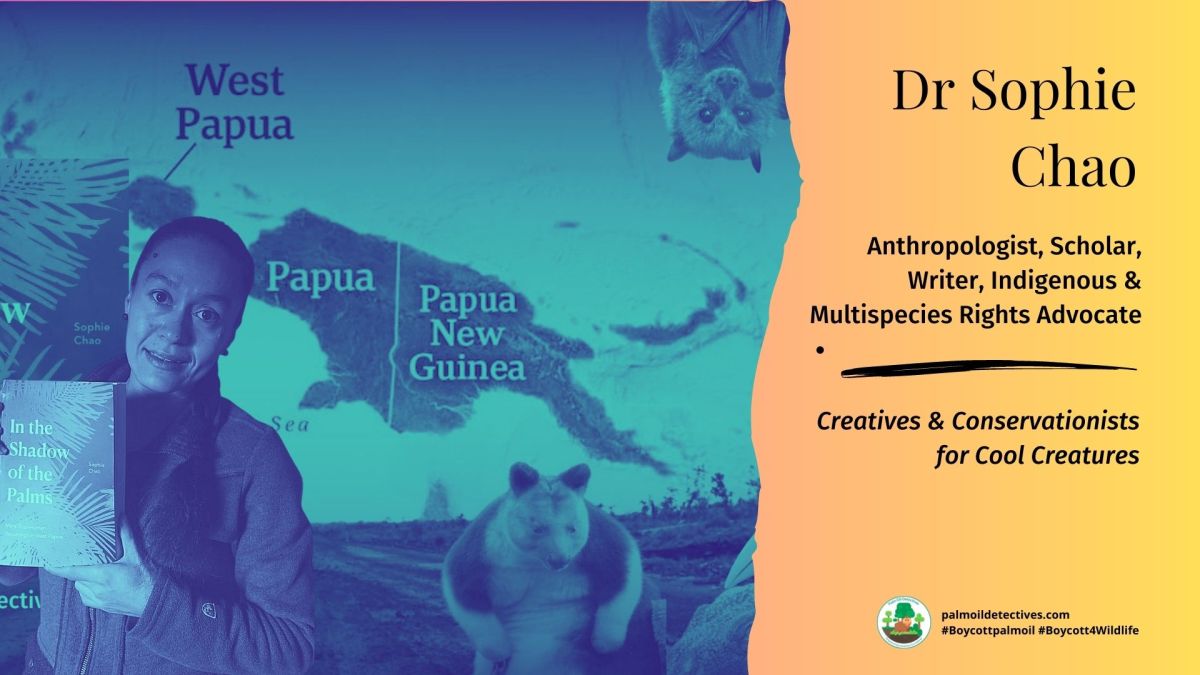



3. Supermarket sleuthing: Next time you’re in the supermarket, take photos of products containing palm oil. Share these to social media along with the hashtags to call out the greenwashing and ecocide of the brands who use palm oil. You can also take photos of palm oil free products and congratulate brands when they go palm oil free.
4. Take to the streets: Get in touch with Palm Oil Detectives to find out more.
5. Donate: Make a one-off or monthly donation to Palm Oil Detectives as a way of saying thank you and to help pay for ongoing running costs of the website and social media campaigns. Donate here
Discover more from Palm Oil Detectives
Subscribe to get the latest posts sent to your email.
 Palm Oil Detectives