
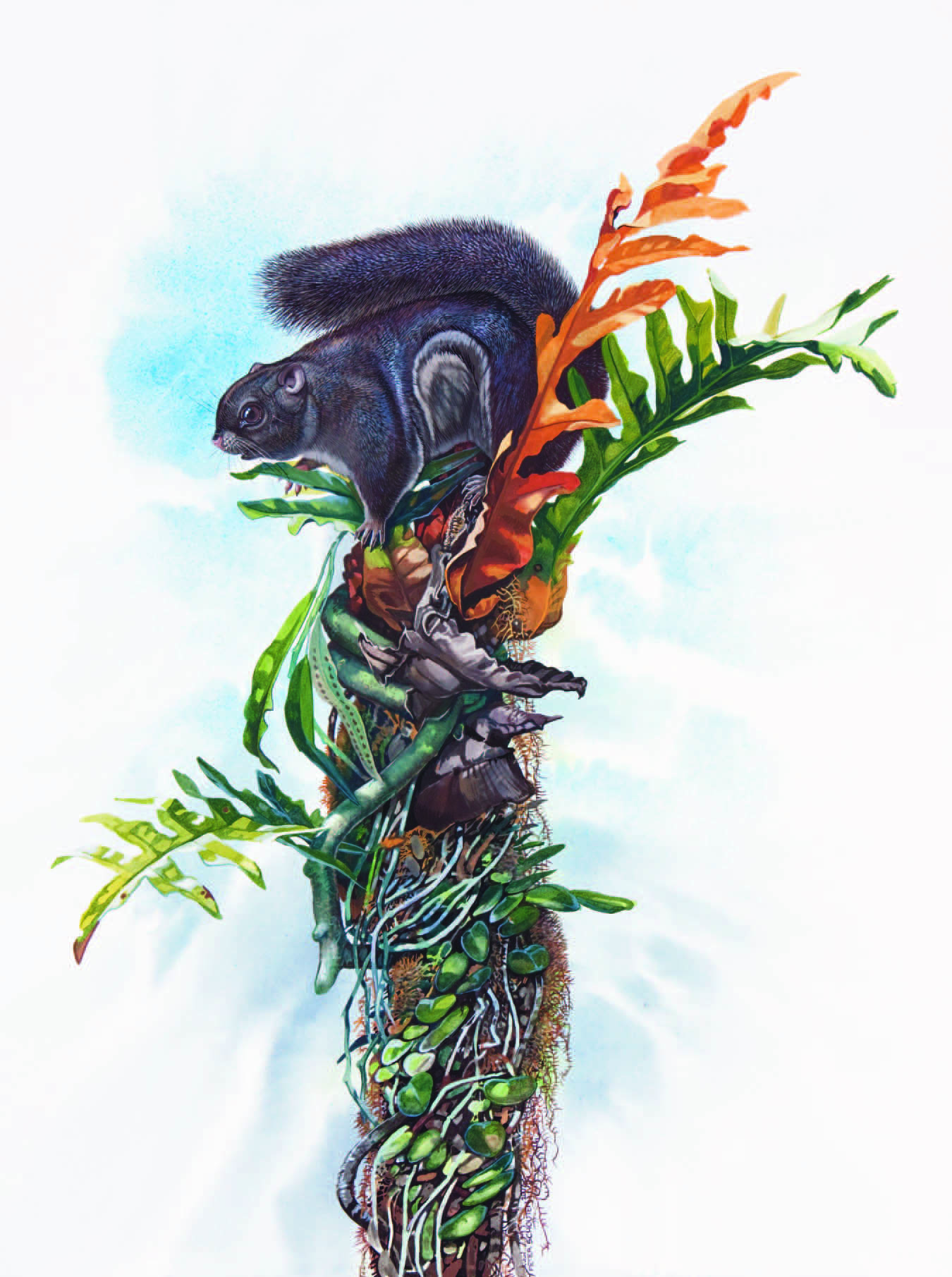
Siberut Flying Squirrel Petinomys lugens
Red List Status: Vulnerable (Red List)
Locations: Mentawai Archipelago, Indonesia: Siberut, Sipora, and North Pagai islands. The Siberut Flying Squirrel is found only on these three islands off the west coast of Sumatra, gliding through the last remnants of subtropical and tropical dry forest.
The Siberut Flying Squirrel is one of the world’s most elusive gliders, found only in the #Mentawai Archipelago’s humid forests. At dusk, the Siberut Flying Squirrel launches from high branches, spreading their soft, square-shaped patagium to drift silently between ancient trees. The air is thick with the scent of damp earth and moss, and the only sound is the faint rustle of leaves as the Siberut Flying #Squirrel lands. Their world is shrinking fast—logging and #palmoil plantations are destroying the last forests on #Siberut, #Sipora, and North Pagai. No conservation actions protect the Siberut Flying Squirrel. Stand with indigenous communities and use your wallet as a weapon. #BoycottPalmOil #Boycott4Wildlife
The Siberut Flying #Squirrel 🦦🩷 is part of a rare group of gliding #mammals of #Indonesia 🇮🇩 living on islands in #Mentawai archipelago. Forests are rapidly disappearing for #palmoil. Help them to survive when you #BoycottPalmOil 🌴🚫 #Boycott4Wildlife https://palmoildetectives.com/2021/02/05/siberut-flying-squirrel-petinomys-lugens/
Appearance and Behaviour
The Siberut Flying Squirrel is a small, nocturnal mammal with a body length of around 20–25 cm and a bushy tail nearly as long as their body. Their fur is dense and soft, with a muted brown colour that blends into the bark and shadows of the forest. The Siberut Flying Squirrel’s most remarkable feature is their gliding membrane, or patagium, which stretches from wrist to ankle and allows them to glide up to 50 metres between trees. Their large, dark eyes are adapted for night vision, and their long whiskers help them navigate in the dark. The Siberut Flying Squirrel is a silent, agile climber, using their tail as a rudder to steer and brake mid-glide. Unlike other squirrels, the Siberut Flying Squirrel rarely descends to the ground, spending almost all their life in the canopy.
Threats
The Mentawai Islands in which this species occurs are severely threatened by legal and illegal logging, conversion of commercial oil palm plantations, and product extraction by local people (Whittaker 2006).
IUCN Red list
Palm oil and logging deforestation
The Red List classifies the Siberut Flying Squirrel as Vulnerable due to rapid habitat loss across their tiny range. Logging and palm oil expansion are the main threats, destroying the last patches of forest on Siberut, Sipora, and North Pagai. Bulldozers clear ancient trees for plantations, leaving only small fragments of forest for the Siberut Flying Squirrel to survive. Even protected areas are under threat, and the Siberut Flying Squirrel has no legal protection or conservation actions in place. As the forest disappears, the Siberut Flying Squirrel faces an uncertain future, with nowhere left to glide (Clayton & Kennerley, 2016).
Habitat fragmentation and population collapse
Forest loss has split the Siberut Flying Squirrel’s habitat into isolated fragments. The Siberut Flying Squirrel is now found only in a few remaining patches, and populations are declining as trees fall and corridors vanish. Fragmentation increases the risk of inbreeding and local extinction, especially as the Siberut Flying Squirrel cannot easily cross open ground. Without urgent action, the Siberut Flying Squirrel may disappear from entire islands (Clayton & Kennerley, 2016).
Diet
The Siberut Flying Squirrel feeds on a variety of seeds, fruits, leaves, and possibly insects, foraging at night among the highest branches. Their sharp teeth crack open tough seeds, and their sensitive nose helps them locate ripe fruit in the darkness. The Siberut Flying Squirrel’s diet may shift with the seasons, depending on what the shrinking forest can provide (Palm Oil Detectives, 2021).
Reproduction and Mating
Little is known about the Siberut Flying Squirrel’s reproduction. Like other flying squirrels, they likely nest in tree hollows or dense foliage, raising one or two young at a time. The Siberut Flying Squirrel’s young are born helpless and depend on their mother for warmth and protection until they can glide and forage on their own. The Siberut Flying Squirrel’s secretive habits and shrinking population make it difficult for researchers to study their breeding in the wild (Clayton & Kennerley, 2016).
Geographic Range
The Siberut Flying Squirrel is endemic to the Mentawai Archipelago, Indonesia, and is found only on Siberut, Sipora, and North Pagai islands. Their range is limited to subtropical and tropical dry forests, which are rapidly disappearing due to logging and palm oil expansion. The Siberut Flying Squirrel’s habitat is now highly fragmented, and their populations are declining on all three islands (Clayton & Kennerley, 2016).
FAQs
How does the Siberut Flying Squirrel glide?
The Siberut Flying Squirrel uses a furry membrane called a patagium, stretching from their wrists to ankles, to glide between trees. They leap from high branches, spread their limbs, and steer with small movements of their legs and tail. The Siberut Flying Squirrel can glide up to 50 metres in a single leap, using their tail as a rudder to control direction and speed. This adaptation allows the Siberut Flying Squirrel to move efficiently through the canopy without descending to the ground, where they would be vulnerable to predators (Palm Oil Detectives, 2021).
Why is the Siberut Flying Squirrel threatened by palm oil?
Palm oil plantations are replacing the Siberut Flying Squirrel’s natural forest habitat. As forests are cleared for palm oil, the Siberut Flying Squirrel loses the trees they need for gliding, nesting, and feeding. The Siberut Flying Squirrel cannot survive in monoculture plantations and is forced into ever-smaller fragments of forest. Without urgent action to protect and restore their habitat, the Siberut Flying Squirrel faces extinction (Clayton & Kennerley, 2016).
Take Action!
Use your wallet as a weapon and #BoycottPalmOil #Boycott4Wildlife. Support indigenous-led conservation and agroecology in the Mentawai Islands. Fight for the Siberut Flying Squirrel’s survival every time you shop.
Support the conservation of this species
This animal has no protections in place. Read about other forgotten species here. Create art to support this forgotten animal or raise awareness about them by sharing this post and using the #Boycottpalmoil #Boycott4Wildlife hashtags on social media. Also you can boycott palm oil in the supermarket.
Further Information

Clayton, E. & Kennerley, R. 2016. Petinomys lugens. The IUCN Red List of Threatened Species 2016: e.T16737A22242011. https://dx.doi.org/10.2305/IUCN.UK.2016-2.RLTS.T16737A22242011.en. Downloaded on 04 February 2021.
Wikipedia contributors. (n.d.). Siberut flying squirrel. Wikipedia. https://en.wikipedia.org/wiki/Siberut_flying_squirrel
Wilson, D. E., Lacher, T. E. Jr., & Mittermeier, R. A. (2016). Sciuridae, Handbook of the Mammals of the World – Volume 6 Lagomorphs and Rodents I. Lynx Edicions. https://doi.org/10.5281/zenodo.6818840
Caption: This beautiful painting is by My YM

How can I help the #Boycott4Wildlife?
Take Action in Five Ways
1. Join the #Boycott4Wildlife on social media and subscribe to stay in the loop: Share posts from this website to your own network on Twitter, Mastadon, Instagram, Facebook and Youtube using the hashtags #Boycottpalmoil #Boycott4Wildlife.
2. Contribute stories: Academics, conservationists, scientists, indigenous rights advocates and animal rights advocates working to expose the corruption of the palm oil industry or to save animals can contribute stories to the website.




3. Supermarket sleuthing: Next time you’re in the supermarket, take photos of products containing palm oil. Share these to social media along with the hashtags to call out the greenwashing and ecocide of the brands who use palm oil. You can also take photos of palm oil free products and congratulate brands when they go palm oil free.
4. Take to the streets: Get in touch with Palm Oil Detectives to find out more.
5. Donate: Make a one-off or monthly donation to Palm Oil Detectives as a way of saying thank you and to help pay for ongoing running costs of the website and social media campaigns. Donate here
Discover more from Palm Oil Detectives
Subscribe to get the latest posts sent to your email.
 Palm Oil Detectives