
Pernambuco Pygmy-owl Glaucidium mooreorum
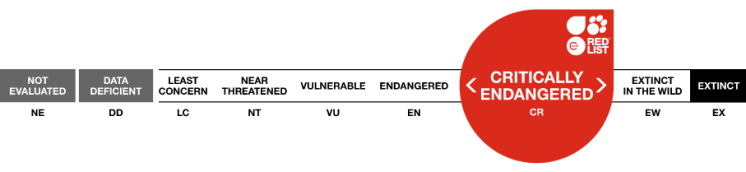
IUCN Red List Status: Critically Endangered, Possibly Extinct
Location: Brazil
Found only in Pernambuco state, Brazil, this elusive owl inhabits the lowland humid forests of the Atlantic Forest biome in the Pernambuco Endemism Centre.
The Pernambuco Pygmy Owl Glaucidium mooreorum is among the rarest birds on Earth, known from just two museum specimens and a few recorded vocalisations. Officially described in 2002, this tiny owl is no larger than 13 cm and is likely the rarest bird in the world. They have not been sighted since 2001, and may already be extinct. Rampant #deforestation for sugarcane plantations, #palmoil, #soy and #meat and ongoing habitat destruction have decimated their native range. If this species still survives, fewer than 50 adults remain. The continued decimation of #Brazil’s Atlantic Forest leaves no margin for error. Act now to protect what remains. Help them every time you shop and #BoycottPalmOil #Boycott4Wildlife #Vegan #BoycottMeat
The rarest owl in the world is the Pernambuco Pygmy #owl. Maybe now #extinct due to massive forest loss in #Brazil 🇧🇷 from #meat 🥩 #palmoil 🌴 #soy 🥜 and #sugarcane #deforestation Help them and be #vegan #BoycottPalmOil #Boycott4Wildlife @palmoildetect https://palmoildetectives.com/2021/02/20/pernambuco-pygmy-owl-glaucidium-mooreorum/
There’s only a few dozen Pernambuco Pygmy #owls 🦉🤎who hold on for survival in #Brazil 🇧🇷 from #meat 🥩 #palmoil 🌴 #soy 🥜 and #sugarcane #deforestation Resist and fight for them! Be #vegan #BoycottPalmOil 🌴🪔🧐🙊⛔️ #Boycott4Wildlife @palmoildetect https://palmoildetectives.com/2021/02/20/pernambuco-pygmy-owl-glaucidium-mooreorum/
Appearance and Behaviour
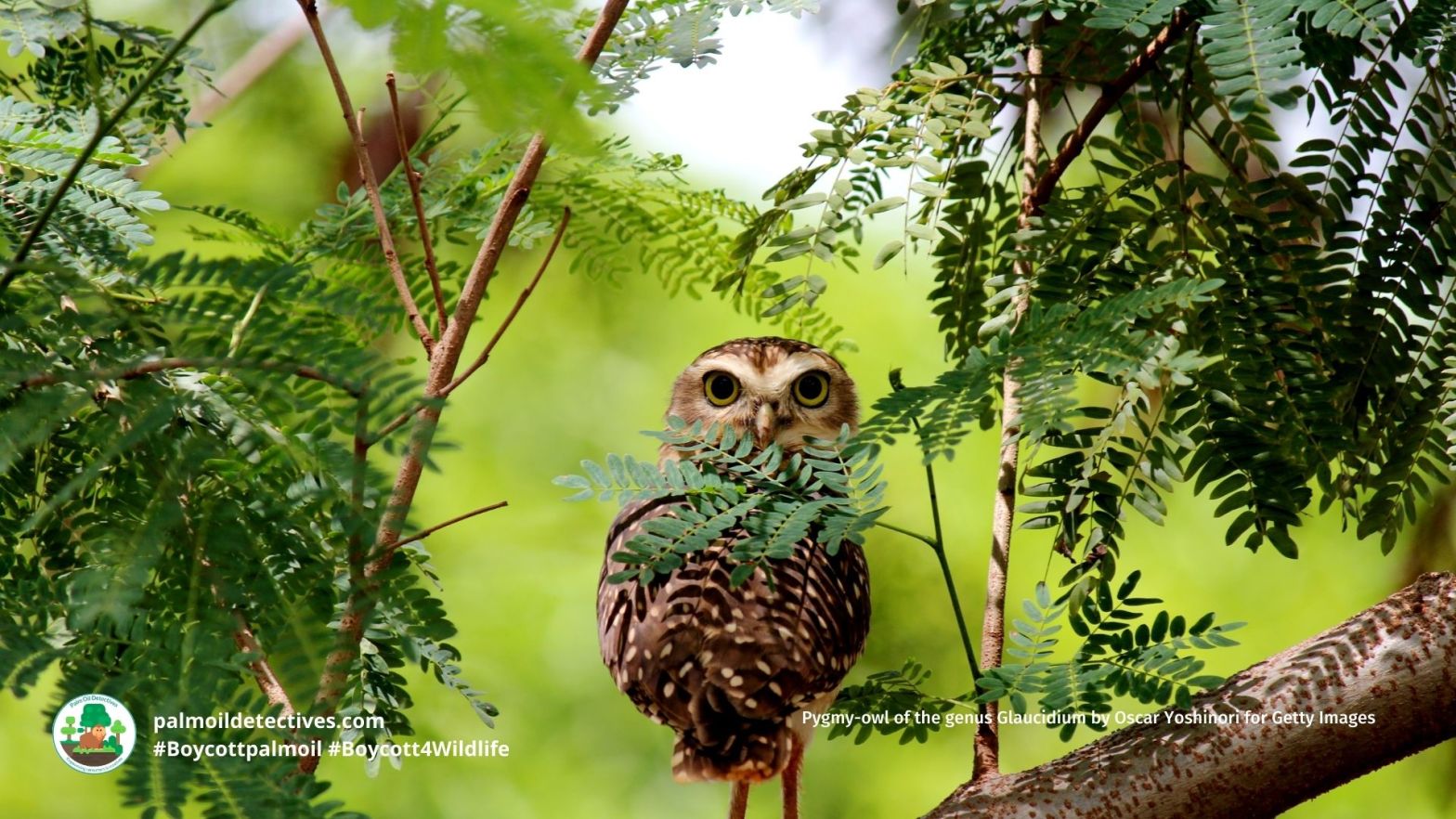
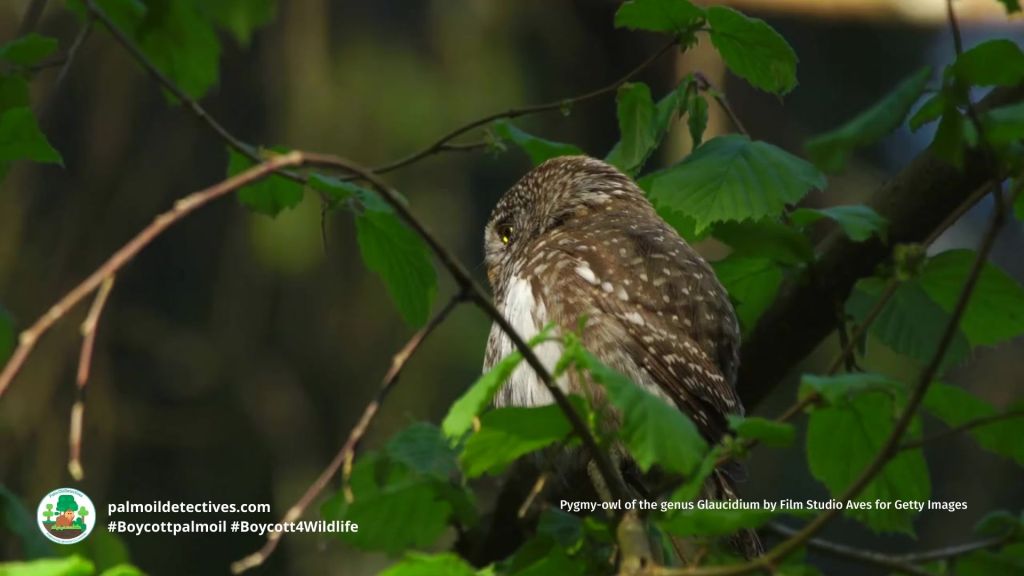
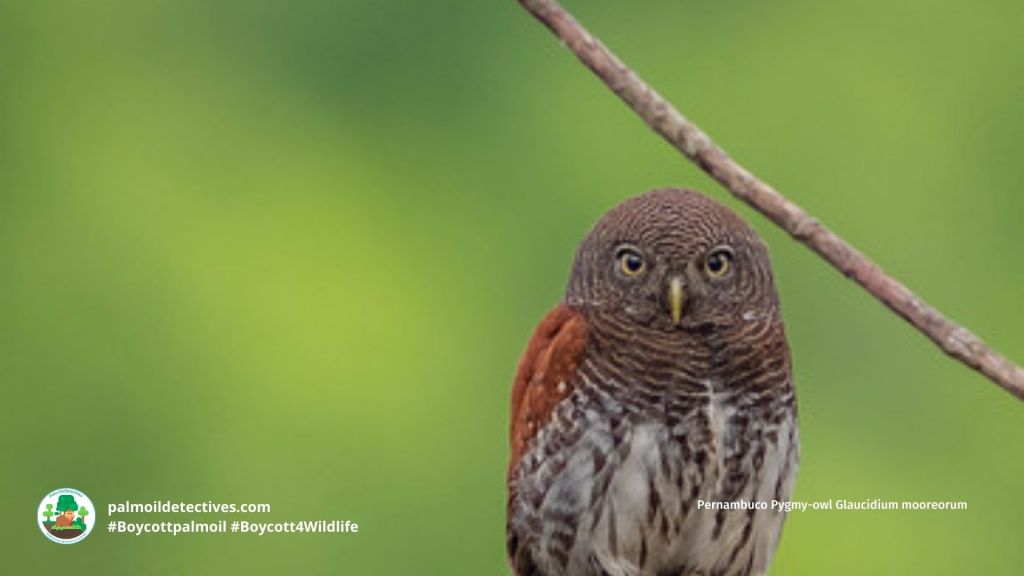
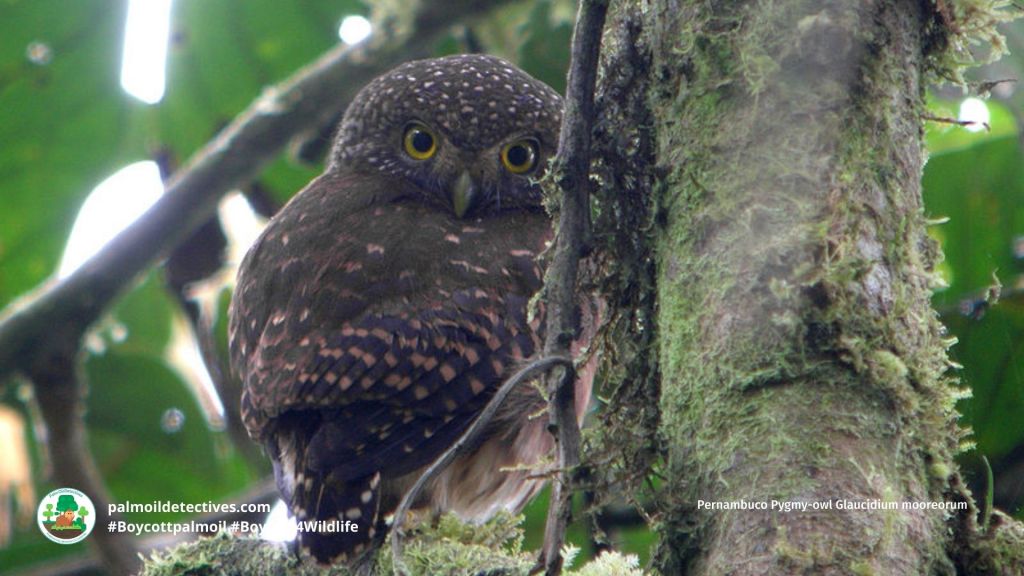
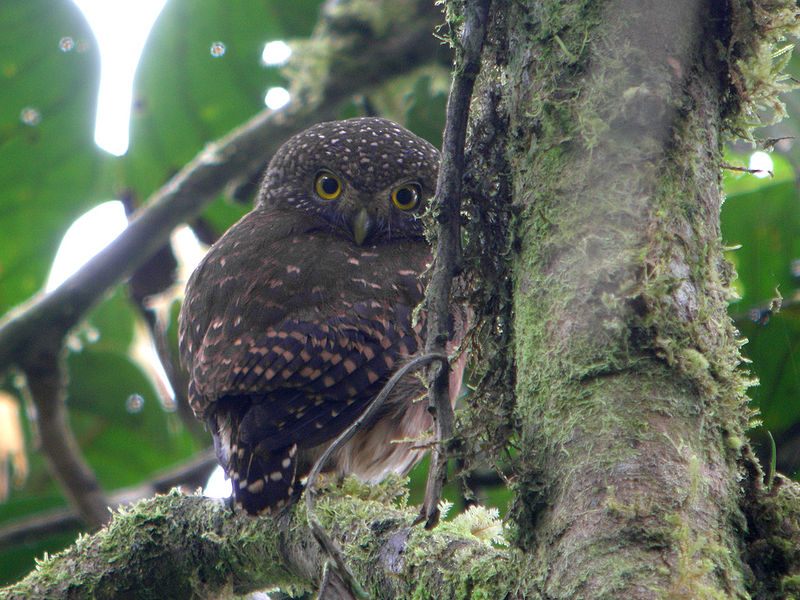
Also known as the caburé-de-pernambuco, the Pernambuco Pygmy Owl is a delicately patterned raptor with a light grey-chestnut crown and chestnut back. Their face and head are speckled with brilliant white spots, giving them an alert, watchful look, while their white collar and white underparts are streaked with rufous. Their short tail is dark with distinct broken white bars. The species emits a short series of 5–7 sharp notes, rising in pitch—its call echoing faintly through the forest. They are most vocally active during the rainy season in April and May.


Diet
The only documented observation of the Pernambuco Pygmy Owl feeding describes one individual eating a large cicada. Like other pygmy owls, their diet likely includes insects, small reptiles, amphibians, and perhaps small birds and mammals.
Reproduction and Mating
Very little is known about the breeding habits of this elusive owl. Their peak vocal activity during April and May suggests this could be their mating season, aligned with the onset of the wet season in the Atlantic Forest. No nests or juveniles have ever been observed.
Geographic Range
This owl is endemic to the Pernambuco state of northeastern Brazil. All known records come from lowland secondary forest within the Reserva Biológica de Saltinho and another site nearby, both below 150 metres in elevation. These forests are part of the Atlantic Forest’s Pernambuco Endemism Centre—a region that has lost over 95% of its native vegetation. No confirmed sightings have occurred since 2001 despite extensive targeted surveys.
Threats
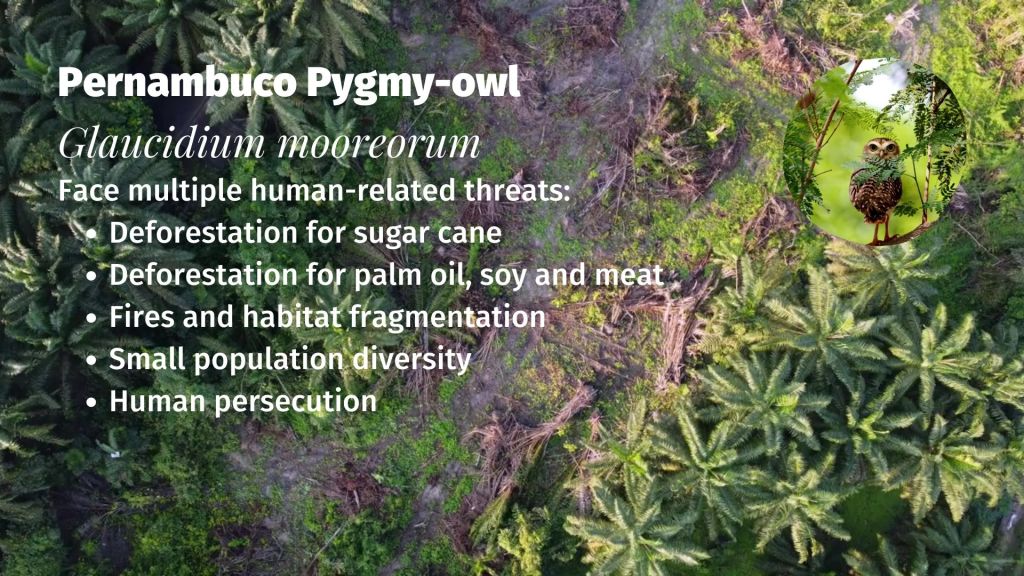
• Complete destruction of native lowland Atlantic Forest in Pernambuco due to palm oil, soy, sugar cane and meat agriculture.
• Sugarcane plantations have replaced vast areas of habitat.
• Ongoing illegal logging, fire, and habitat fragmentation despite legal protections.
• Hunting and human persecution may still pose a threat.
• The species’ extremely limited range makes them highly vulnerable to extinction.
Take Action!
Help stop the extinction of rare and beautiful species like the Pernambuco Pygmy Owl. Boycott palm oil and industrial agriculture that fuel deforestation across South America. Support indigenous-led agroecology efforts and forest restoration projects. Speak out against deforestation and habitat loss in Brazil.
#BoycottPalmOil #Boycott4Wildlife #Vegan #BoycottMeat
FAQs
How many Pernambuco Pygmy Owls are left?
If the species is still extant, the IUCN estimates there are fewer than 50 mature individuals. Extensive surveys between 2001 and 2019 have failed to confirm any new sightings, raising the possibility of extinction (BirdLife International, 2021).
What is the lifespan of the Pernambuco Pygmy Owl?
While there are no specific studies on this species’ lifespan, similar pygmy owls in the Glaucidium genus live between 6 to 10 years in the wild. However, intense threats and habitat degradation significantly shorten survival rates for any remaining individuals.
Why is the Pernambuco Pygmy Owl so endangered?
Their home—the Pernambuco Centre of Endemism—has suffered one of the worst deforestation rates in the entire Atlantic Forest. By 2002, just 1,900 km² of forest remained, down from nearly 40,000 km². Much of this forest has been fragmented or destroyed by sugarcane monocultures. Logging, fire, and inadequate legal enforcement continue to devastate the landscape (Silva et al., 2002; Butchart et al., 2018).
What can be done to save the Pernambuco Pygmy Owl?
Protecting and restoring remaining forest patches is crucial. The original researchers proposed creating ecological corridors to connect isolated forest fragments and implementing regional land planning focused on biocultural preservation. Agroecological approaches led by local communities may offer the best hope for long-term recovery.
The Pernambuco Center, where this species was described, is by far the most modified region of Atlantic Forest, having declined in extent from c. 39,500 km2 to c. 1,900 km2 by 2002. Most of the 52 remaining reserves are less than 5 km2 in size and almost none of this truly lowland (Butchart et al. 2018). Large amounts of forest were cleared to make way for plantations and agriculture (Pereira et al. 2014). The remainder is severely fragmented and legal restrictions have proven inadequate in halting deforestation from fire and illegal logging.
IUCN Red List
Support the conservation of this species
Further Information
BirdLife International. 2019. Glaucidium mooreorum. The IUCN Red List of Threatened Species 2019: e.T22733081A156084939. https://dx.doi.org/10.2305/IUCN.UK.2019-3.RLTS.T22733081A156084939.en. Downloaded on 15 February 2021.
Peregrine Fund. (2024). Pernambuco Pygmy Owl. Explore Raptors. Retrieved from https://peregrinefund.org/explore-raptors-species/owls/pernambuco-pygmy-owl
Silva, J. M. C., Coelho, G., & Gonzaga, L. P. (2002). Discovered on the brink of extinction: A new species of Pygmy-Owl (Strigidae: Glaucidium) from Atlantic Forest of northeastern Brazil. Retrieved from https://www.researchgate.net/publication/254805348
Wikipedia contributors. (2024). Pernambuco pygmy owl. In Wikipedia, The Free Encyclopedia. Retrieved March 22, 2025, from https://en.wikipedia.org/wiki/Pernambuco_pygmy_owl

How can I help the #Boycott4Wildlife?
Take Action in Five Ways
1. Join the #Boycott4Wildlife on social media and subscribe to stay in the loop: Share posts from this website to your own network on Twitter, Mastadon, Instagram, Facebook and Youtube using the hashtags #Boycottpalmoil #Boycott4Wildlife.
2. Contribute stories: Academics, conservationists, scientists, indigenous rights advocates and animal rights advocates working to expose the corruption of the palm oil industry or to save animals can contribute stories to the website.






3. Supermarket sleuthing: Next time you’re in the supermarket, take photos of products containing palm oil. Share these to social media along with the hashtags to call out the greenwashing and ecocide of the brands who use palm oil. You can also take photos of palm oil free products and congratulate brands when they go palm oil free.
4. Take to the streets: Get in touch with Palm Oil Detectives to find out more.
5. Donate: Make a one-off or monthly donation to Palm Oil Detectives as a way of saying thank you and to help pay for ongoing running costs of the website and social media campaigns. Donate here
Discover more from Palm Oil Detectives
Subscribe to get the latest posts sent to your email.
 Palm Oil Detectives
One thought on “Pernambuco Pygmy-owl Glaucidium mooreorum”