

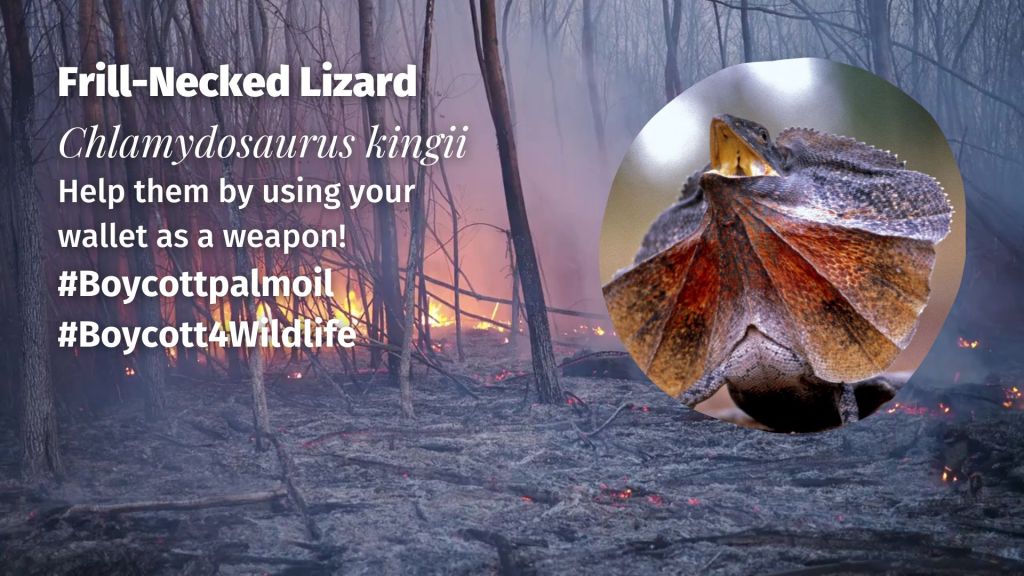
Frill-Necked Lizard Chlamydosaurus kingii
Location: Papua New Guinea, West Papua, Australia
Region: Trans-Fly ecosystem of southern Papua New Guinea and West Papua along with northern parts of Australia.
The frill-necked lizard Chlamydosaurus kingii, also known as the frilled dragons or frill-neck lizards, are famous for their impressive neck frill that fans out dramatically when they feel threatened. The Trans-Fly savannahs of southern Papua New Guinea and Indonesian-occupied West Papua, have come increasingly under threat over the past decade by climate change-related extreme weather and deforestation. Anthropogenic threats include habitat destruction for timber and palm oil, climate change-related fires, expanding agricultural zones, road and infrastructure building and capture for the exotic pet trade. In Australia, these lizards eat poisonous cane toads that are deadly once ingested. This along with large-scale bushfires pose threats to Frill-necked #Lizards. Once abundant, these striking reptiles are now losing their ecosystems. Use your wallet as a weapon for them by defending New Guinea’s forests. Choose palm oil-free products and boycott the pet trade. #BoycottPalmOil #Boycott4Wildlife
The Frilled-Neck #Lizard 🦎💚 is an icon of #Australia 🇦🇺. Their #PapuaNewGuinea 🇵🇬 and #WestPapua populations are under threat from #deforestation 🌴🩸⛔️ along with #ClimateChange. Protect their home and #BoycottPalmOil #Boycott4Wildlife @palmoildetect https://palmoildetectives.com/2025/11/09/frill-necked-lizard-chlamydosaurus-kingii/
With their dramatic frilled necks 🦎😻✨ and ability to run on two legs, Frilled-Neck #Lizards are arguably the most spectacular lizards in all of #Melanesia 🇵🇬 Help protect their #NewGuinea population #BoycottPalmOil #Boycott4Wildlife @palmoildetect https://palmoildetectives.com/2025/11/09/frill-necked-lizard-chlamydosaurus-kingii/
Appearance & Behaviour
With their iconic neck frill, long limbs and ability to sprint upright on two legs, frill-necked lizards are one of the most distinctive reptiles in the world. New Guinean individuals typically feature vivid yellow frills that flare outward like a sunburst when they feel threatened—often accompanied by a hiss and an open mouth to appear larger than life. Their frill can reach up to 30 cm across, supported by hyoid bones and cartilage that fan the skin out in a flash. Colouration is variable, and in New Guinea, these lizards lean towards paler hues with distinctive white markings accenting their yellow frills.

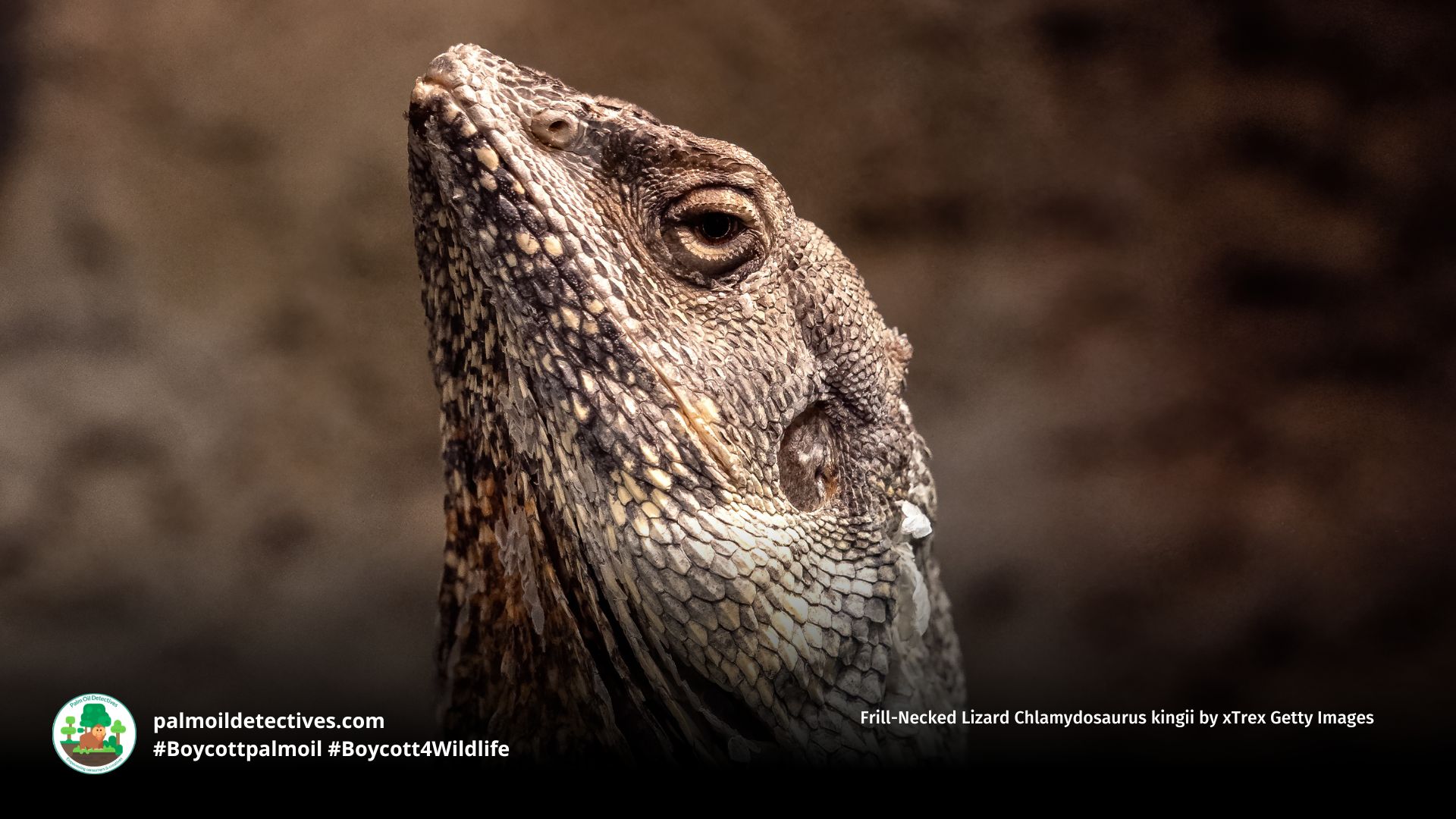


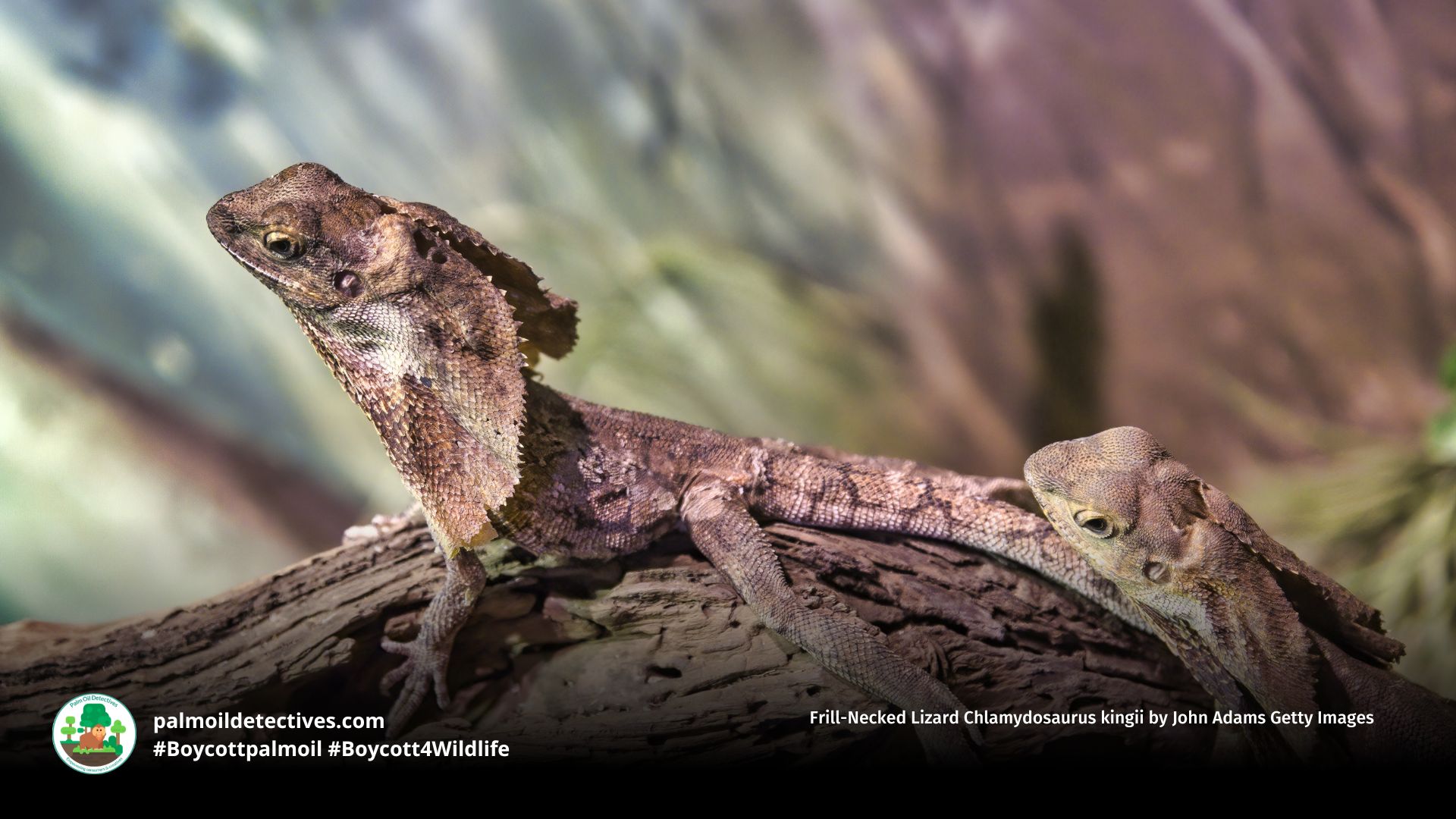

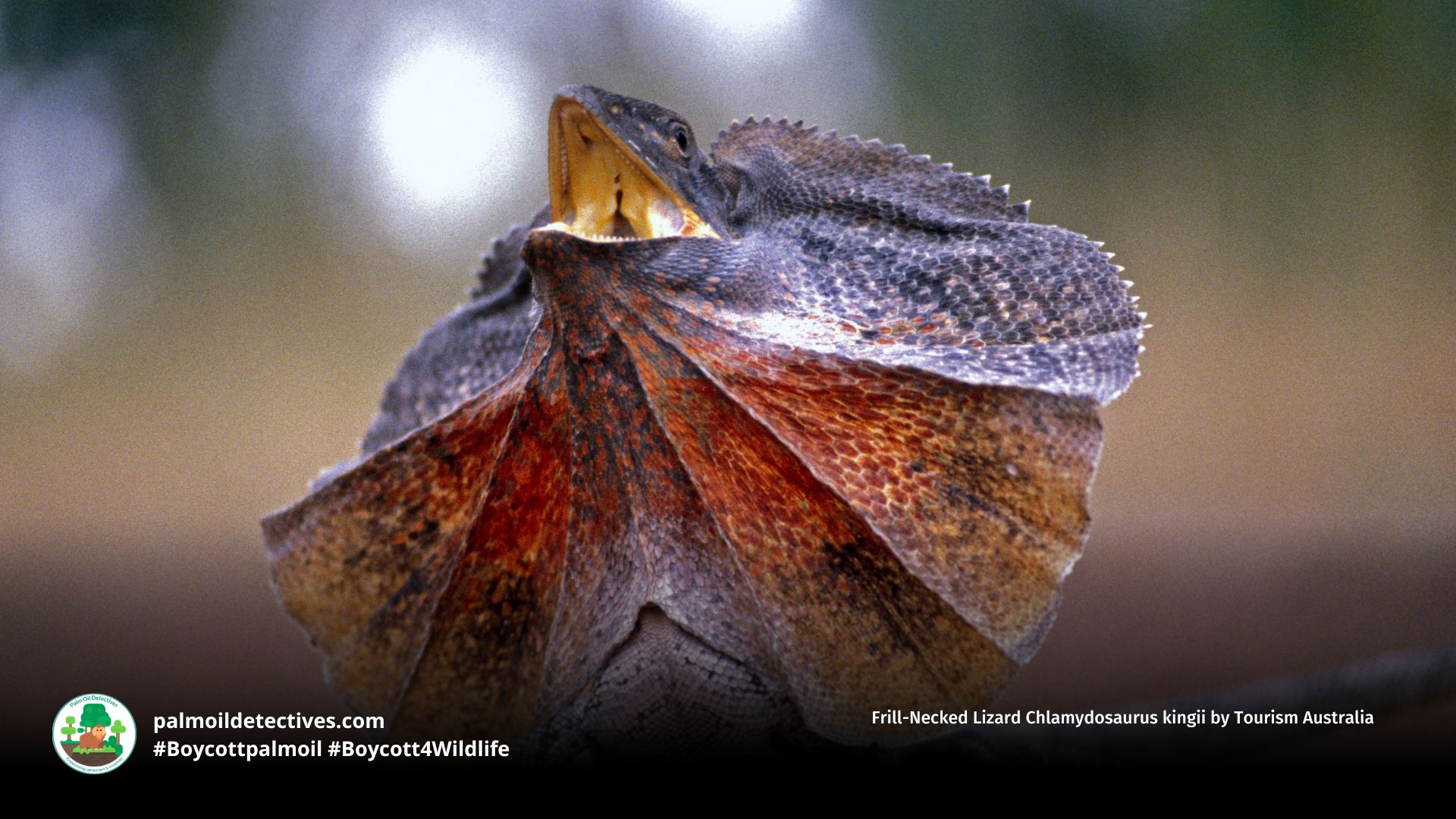
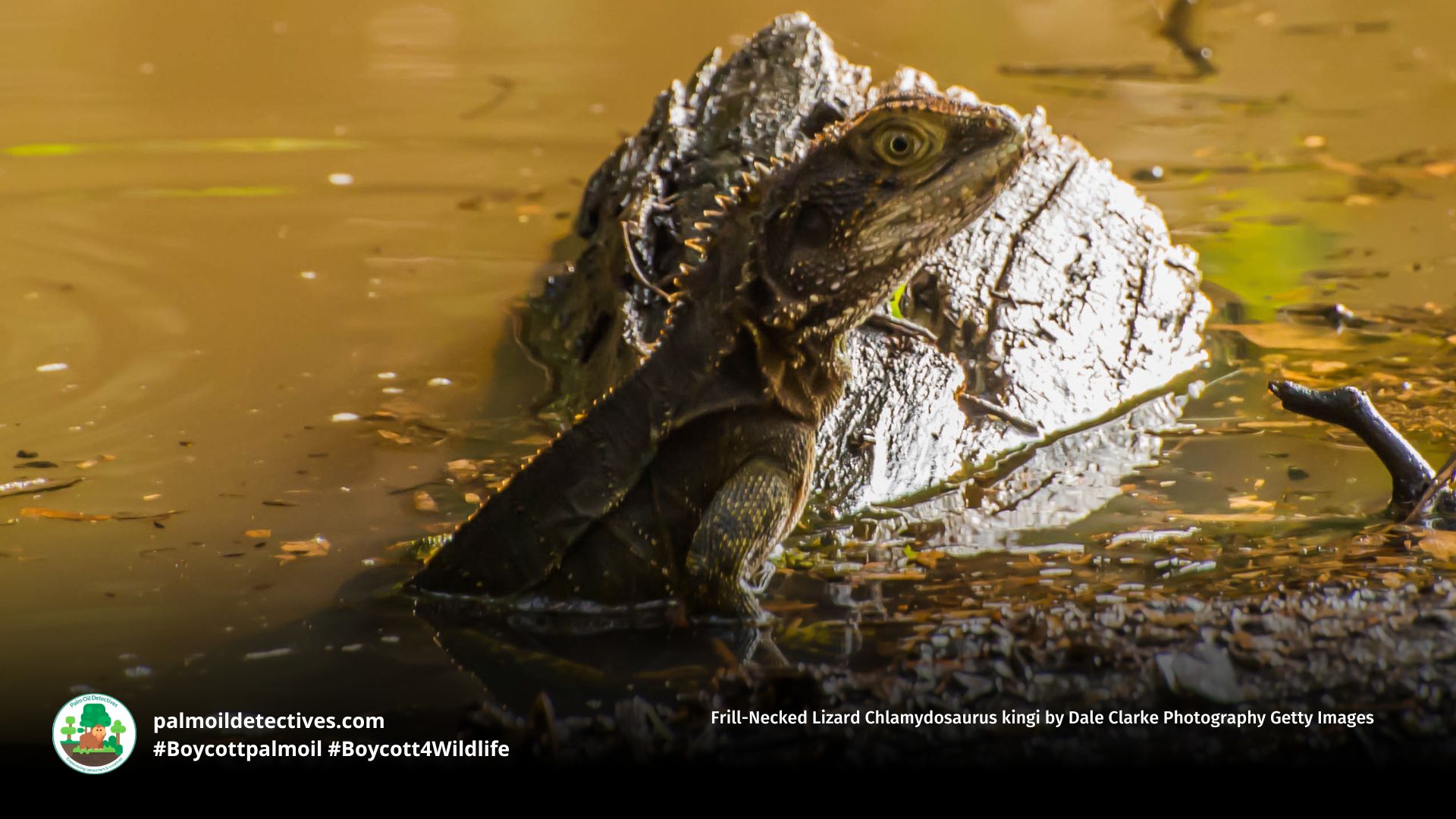

Primarily arboreal, they spend over 90% of their time in the trees. They are solitary, territorial, and highly dependent on their frill to communicate and intimidate. During the wet season, they descend closer to the ground in search of food, only to retreat to the higher canopy during the dry months when food is scarce.
Threats

- Deforestation for palm oil plantations is rapidly fragmenting their native woodlands in the Trans-Fly region of West Papua and Papua New Guinea.
- Illegal capture for the pet trade—many specimens claimed to be ‘captive bred’ are actually wild-caught in Papua New Guinea.
- Late dry season fires increase mortality rates and reduce food availability.
- Predation by feral cats is an ongoing issue in some parts of their range.
- Climate change related extreme weather may impact their reproduction, as temperature influences sex ratios and growth rates.
Geographic Range
This species is found in northern Australia and across southern New Guinea, including both Papua New Guinea and Indonesian-occupied West Papua. In New Guinea, they inhabit the Trans-Fly savannah region—a unique landscape of seasonal woodlands and dry forests. These lizards avoid low-lying Melaleuca-dominated swamps and prefer elevated areas with well-drained soils and diverse tree species. However, their range in New Guinea is far more restricted than in Australia, making local threats far more significant to their survival.
Diet
Frill-necked lizards are insectivorous ambush predators. They rely on their sharp eyesight and camouflage to spot prey from high in the trees. Their diet consists mainly of insects like termites, cicadas, beetles, ants, and centipedes. During the dry season, termites are especially important, while the wet season sees them shifting to moth larvae. Occasionally, they will consume spiders, small rodents, and other lizards.
Mating and Reproduction
Mating occurs during the late dry and early wet seasons. Males engage in dramatic frill displays and combat to win over females. Females dig a shallow burrow where they lay 1–2 clutches of 4–20 eggs. Temperature plays a critical role in determining the sex of hatchlings—warmer nests produce more males, while cooler ones yield more females. Young frillies are independent within 10 days of hatching and can deploy their frills almost immediately.
FAQs
How many Frill-necked lizards are left in New Guinea?
There is no precise population estimate for New Guinea, but while the species is locally common in parts of Australia, their populations in the Trans-Fly region are under pressure. Their limited range, coupled with the impacts of deforestation and trade, may mean local declines are already occurring.
How long do Frill-necked lizards live in the wild?
Frill-necked lizards in the wild can live up to 6 years for males and around 4 years for females. Hatchlings grow rapidly during the wet season and reach sexual maturity by about two years of age.
Do Frill-necked lizards make good pets?
Absolutely not. These sensitive reptiles are wild animals with complex needs. They are difficult to breed in captivity, meaning many sold in pet markets are likely wild-caught, contributing directly to population declines. Keeping them as pets fuels this harmful trade and leads to suffering. If you care about frill-necked lizards, do not support the exotic pet industry.
Take Action!
Support local and indigenous-led resistance to palm oil deforestation in West Papua and Papua New Guinea. Boycott palm oil products entirely—there is no such thing as “sustainable” palm oil, all of it causes deforestation. Say no to the exotic pet trade, which is stripping these unique lizards from the wild and pushing them towards decline. #BoycottPalmOil #Boycott4Wildlife
Support Frill-Necked Lizards by going vegan and boycotting palm oil in the supermarket, it’s the #Boycott4Wildlife
Support the conservation of this species
This animal has no protections in place. Read about other forgotten species here. Create art to support this forgotten animal or raise awareness about them by sharing this post and using the #Boycottpalmoil #Boycott4Wildlife hashtags on social media. Also you can boycott palm oil in the supermarket.
Further Information
O’Shea, M., Allison, A., Tallowin, O., Wilson, S. & Melville, J. 2017. Chlamydosaurus kingii. The IUCN Red List of Threatened Species 2017: e.T170384A21644690. https://dx.doi.org/10.2305/IUCN.UK.2017-3.RLTS.T170384A21644690.en. Accessed on 06 April 2025.
Harlow, P. S., & Shine, R. (1999). Temperature-dependent sex determination in reptiles: insights from frillneck lizards. Biological Journal of the Linnean Society, 68(3), 197–211. https://www.jstor.org/stable/3893081
Wikipedia contributors. (n.d.). Frilled lizard. Wikipedia. Retrieved 7 April 2025, from https://en.wikipedia.org/wiki/Frilled_lizard


How can I help the #Boycott4Wildlife?
Take Action in Five Ways
1. Join the #Boycott4Wildlife on social media and subscribe to stay in the loop: Share posts from this website to your own network on Twitter, Mastadon, Instagram, Facebook and Youtube using the hashtags #Boycottpalmoil #Boycott4Wildlife.
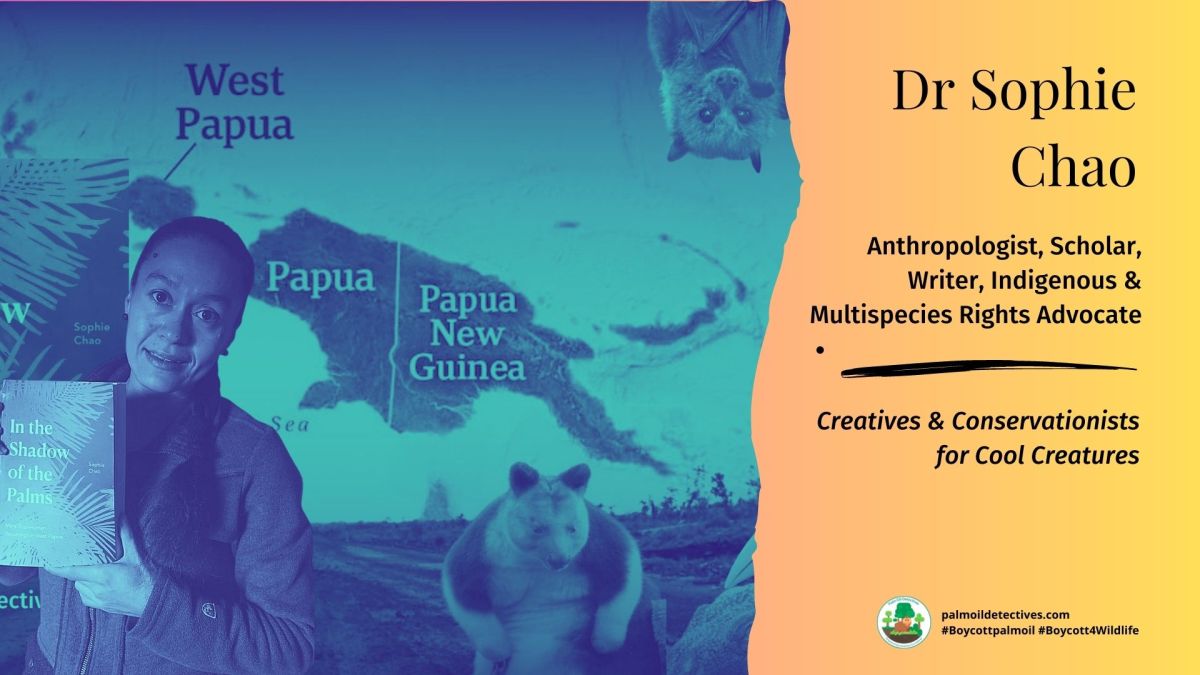
2. Contribute stories: Academics, conservationists, scientists, indigenous rights advocates and animal rights advocates working to expose the corruption of the palm oil industry or to save animals can contribute stories to the website.


3. Supermarket sleuthing: Next time you’re in the supermarket, take photos of products containing palm oil. Share these to social media along with the hashtags to call out the greenwashing and ecocide of the brands who use palm oil. You can also take photos of palm oil free products and congratulate brands when they go palm oil free.
4. Take to the streets: Get in touch with Palm Oil Detectives to find out more.
5. Donate: Make a one-off or monthly donation to Palm Oil Detectives as a way of saying thank you and to help pay for ongoing running costs of the website and social media campaigns. Donate here
Learn about other animals endangered by palm oil and other agriculture
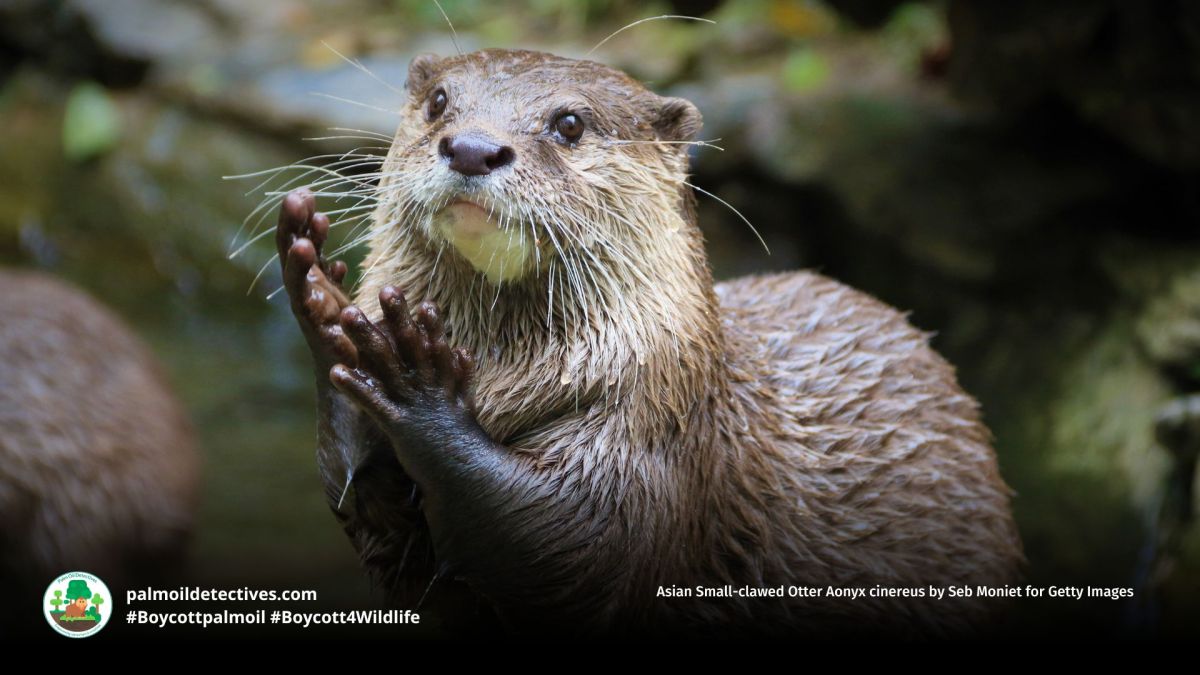
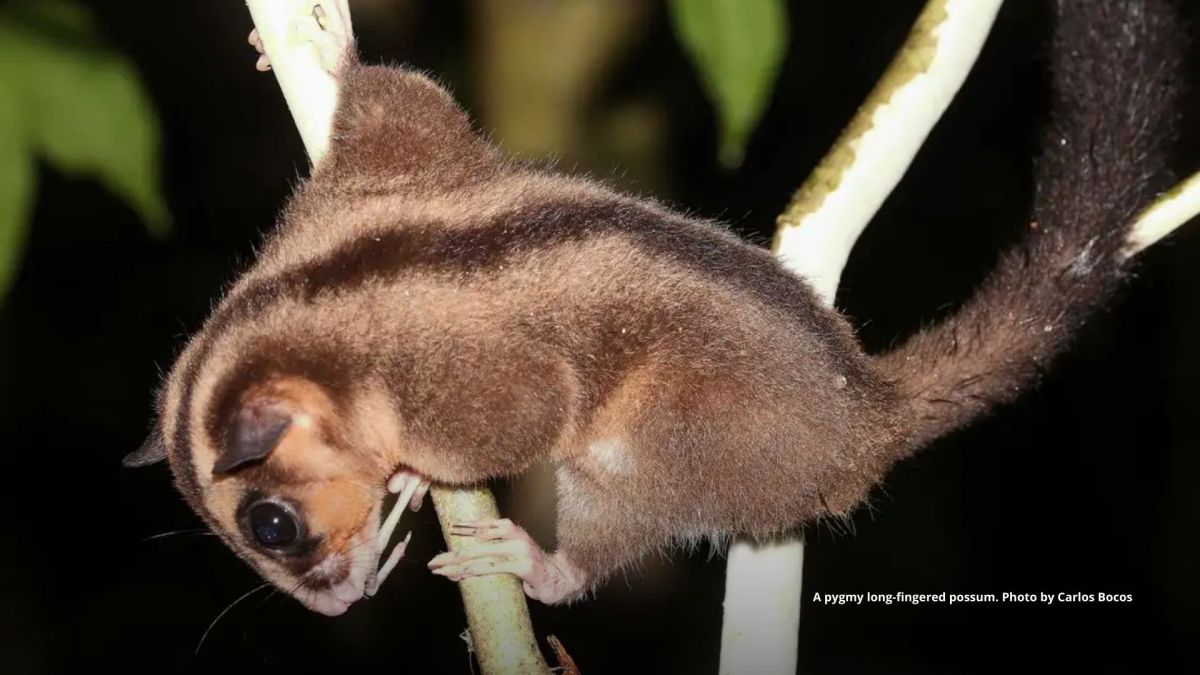
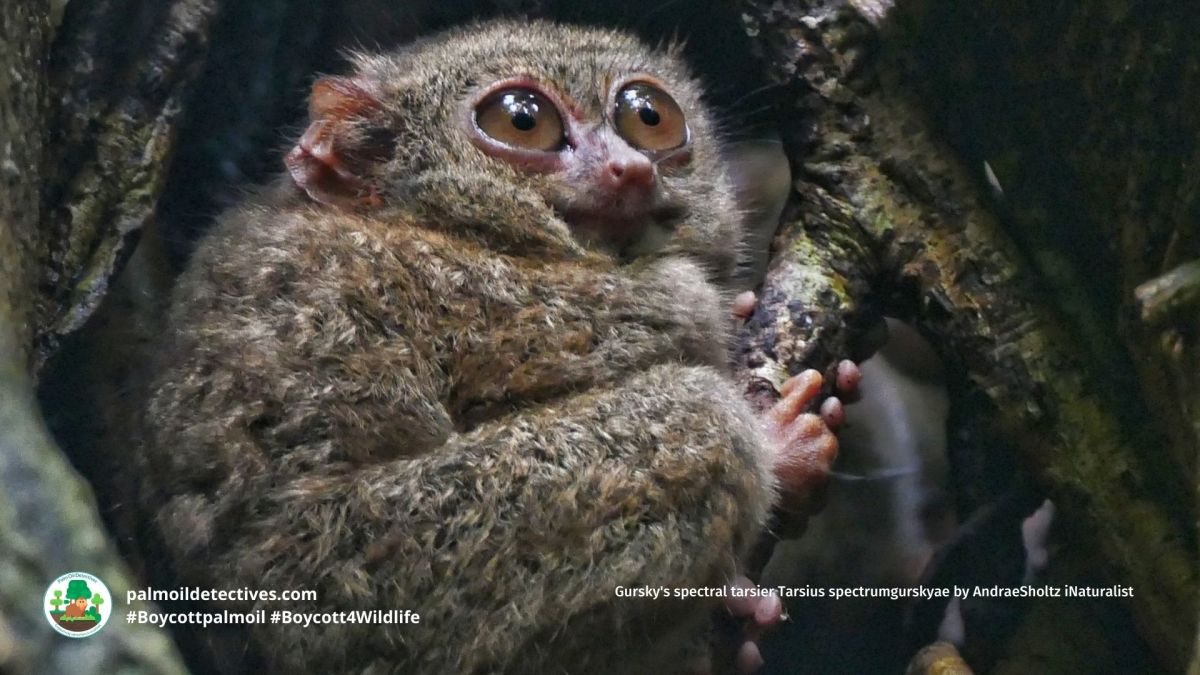
Learn about “sustainable” palm oil greenwashing
Read more about RSPO greenwashing
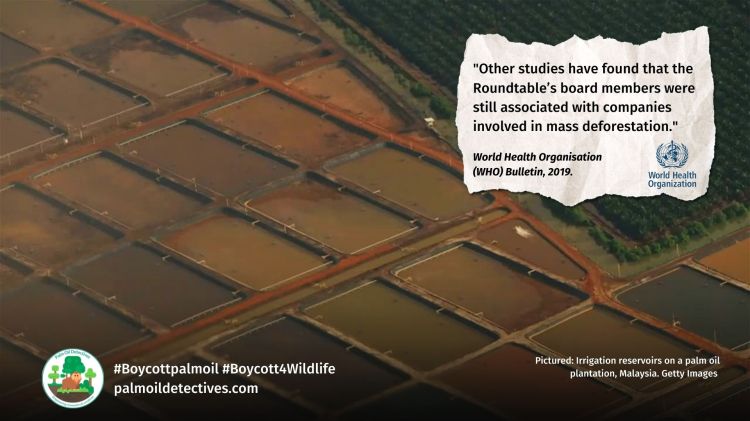
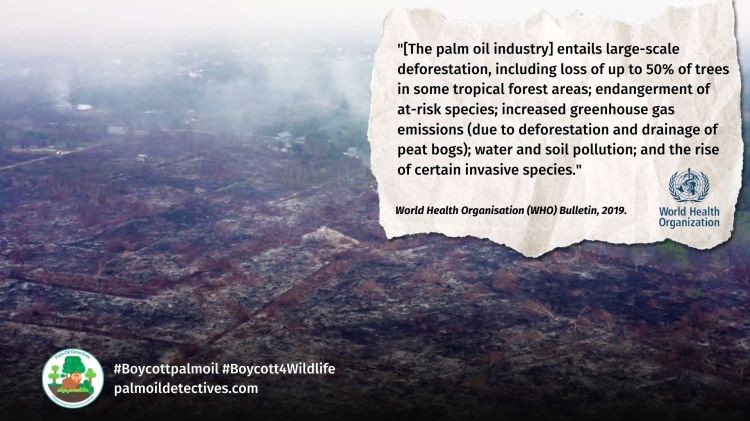
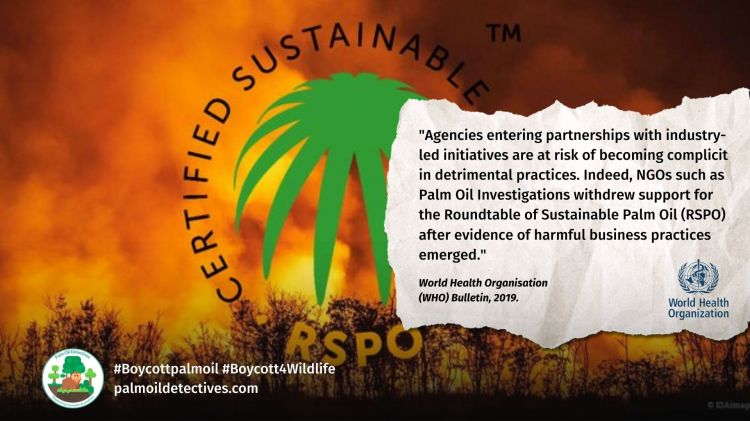
A 2019 World Health Organisation (WHO) report into the palm oil industry and RSPO finds extensive greenwashing of palm oil deforestation and the murder of endangered animals (i.e. biodiversity loss)


Discover more from Palm Oil Detectives
Subscribe to get the latest posts sent to your email.
 Palm Oil Detectives