
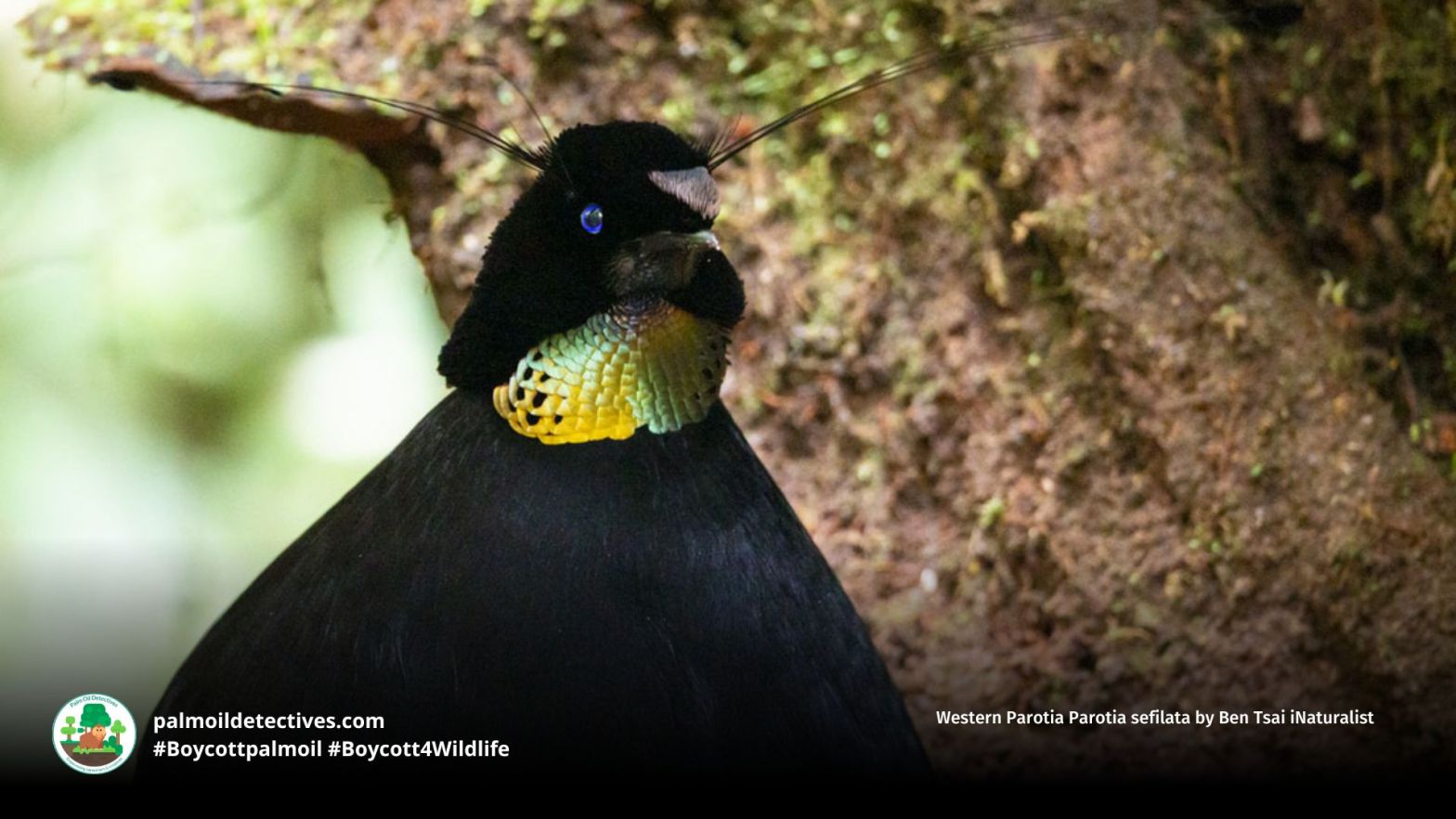
Western Parotia Parotia sefilata
Location: West Papua (Illegally occupied by Indonesia)
Found exclusively in the montane forests of the Vogelkop Peninsula and Wandammen Mountains in Indonesian-occupied West Papua, this species is confined to isolated pockets of ancient, cloud-draped rainforest.
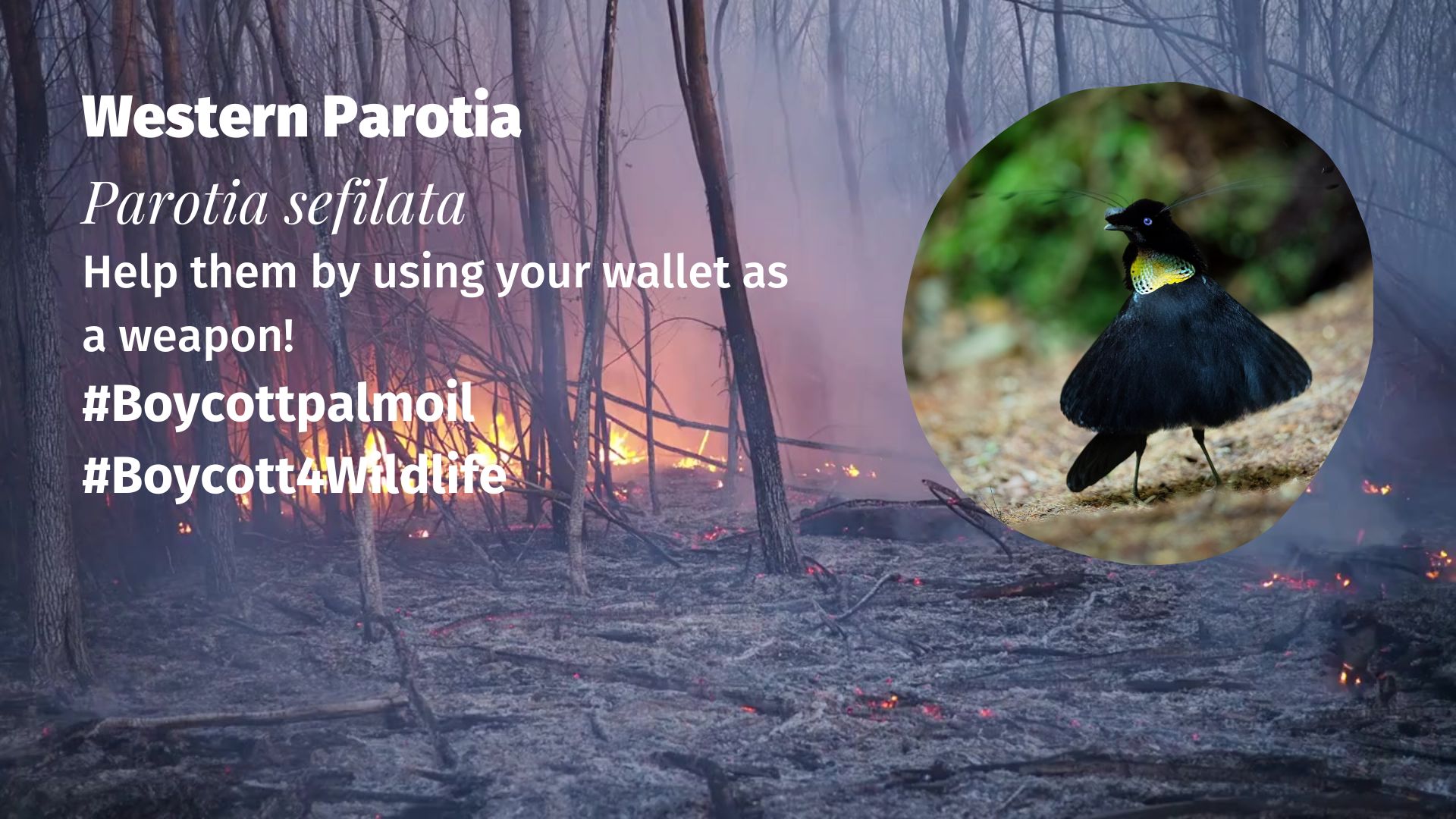
The Western Parotia Parotia sefilata, also called the Arfak Parotia, is a stunning bird-of-paradise of #WestPapua known for their mesmerising, ballerina-like courtship dance. Male #birds fan their iridescent flank plumes into a skirt and dazzle females with precise steps and shimmering throat shields. Although listed as Least Concern in 2016, this designation is dangerously outdated. The forests these rare birds call home have suffered catastrophic #deforestation in recent years due to the explosion of #palmoil plantations. These once-pristine regions are now fragmented and rapidly vanishing. Immediate action is needed to protect the Western Parotia from becoming the next victim of extinction.#BoycottPalmOil #Boycott4Wildlife
Unusual behaviours like mounting reveal complexity to the lives of Western #Parotia, thrilling #birds of paradise in #WestPapua. #Palmoil is a major threat. Fight for them and indigenous peoples #Boycottpalmoil #Boycott4Wildlife @palmoildetect https://palmoildetectives.com/2026/01/25/western-parotia-parotia-sefilata/
With jet black plumage 🖤 and bright green 💚 wattles, male Western Parotia #birds 🐦🦜🦚 of paradise gleam like scaly armour when they dance 🎶 Resist against their #extinction in #WestPapua when you #Boycottpalmoil 🌴🚫 #Boycott4Wildlife @palmoildetect https://palmoildetectives.com/2026/01/25/western-parotia-parotia-sefilata/
Appearance & Behaviour
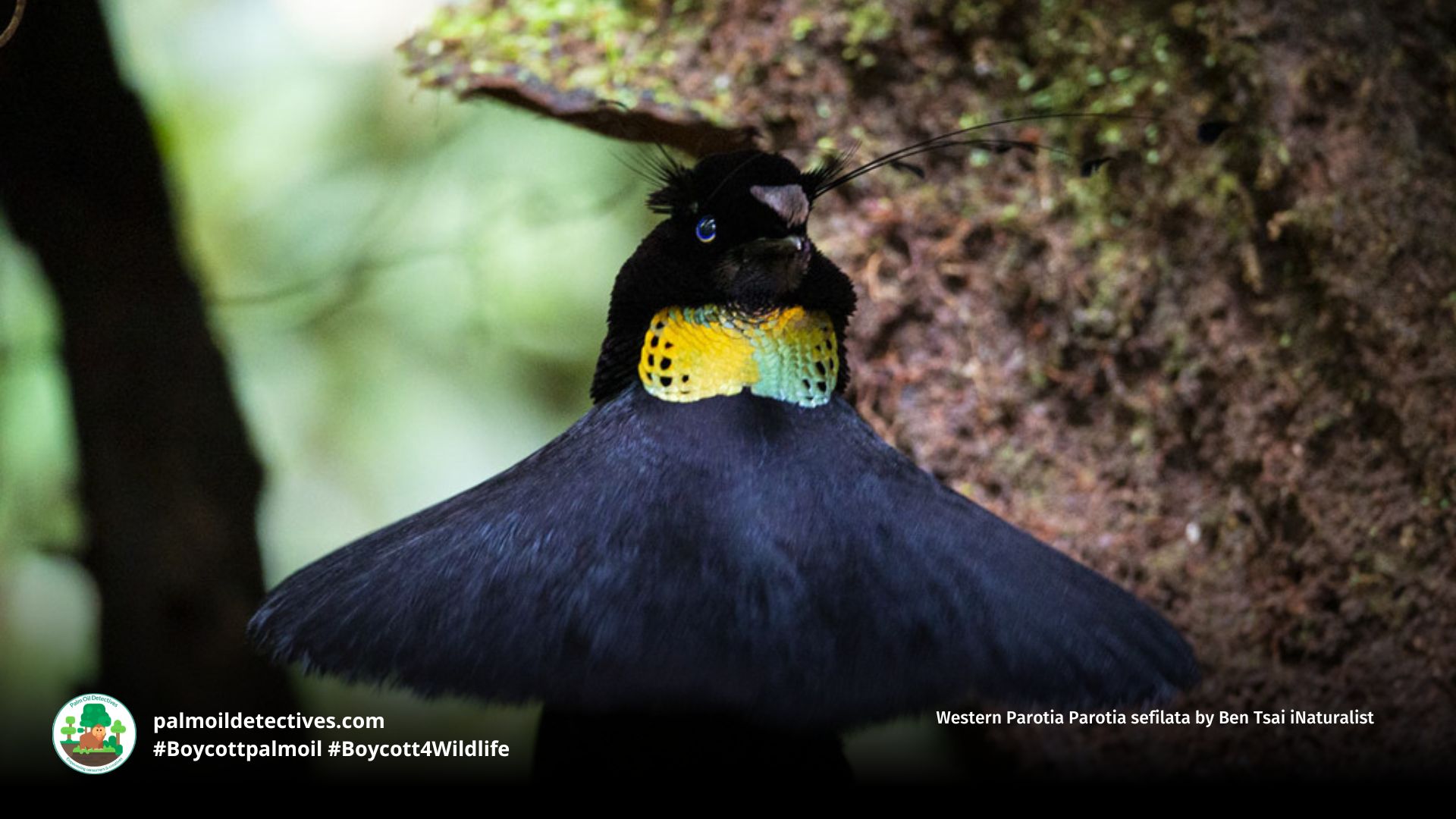
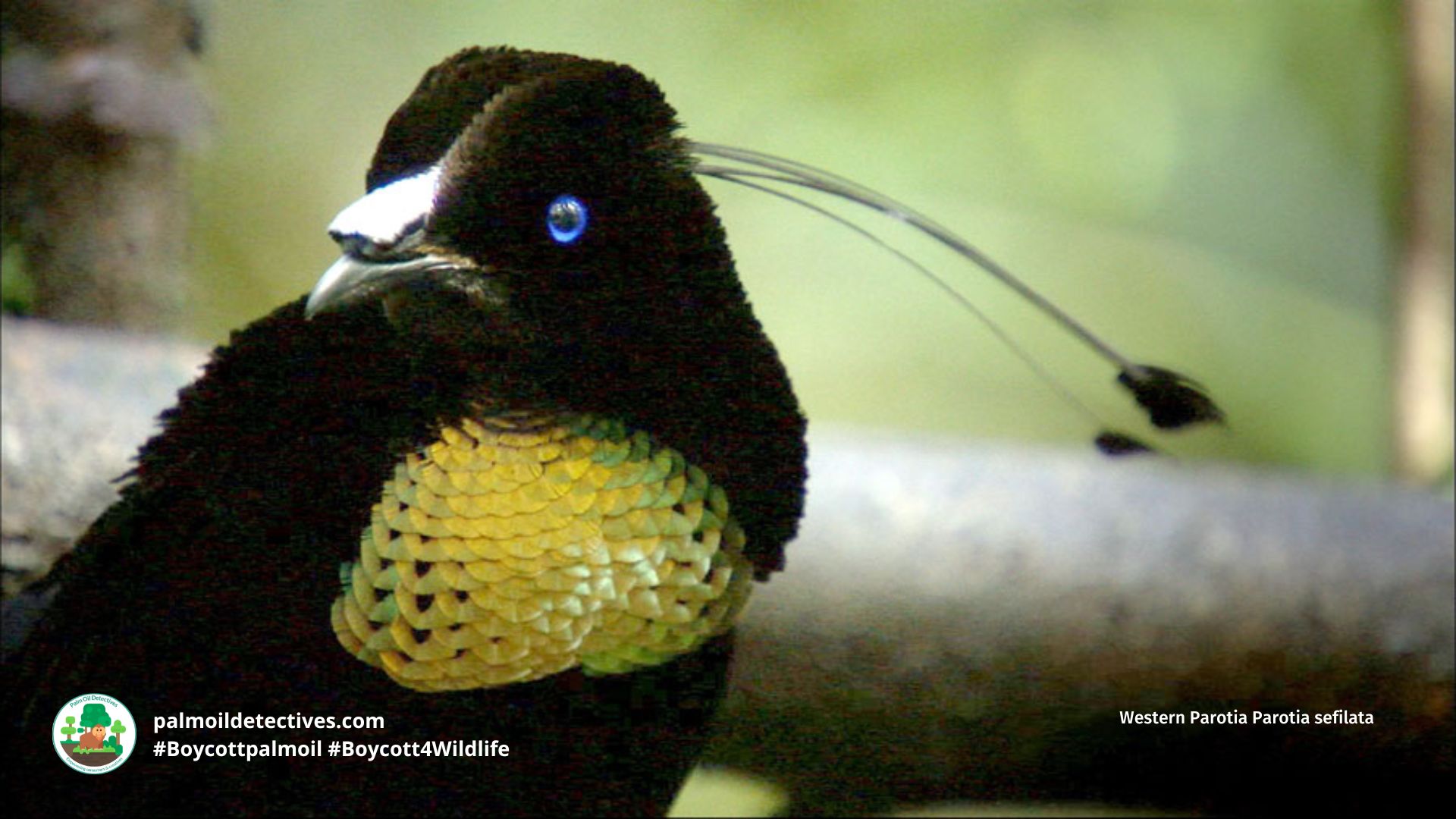
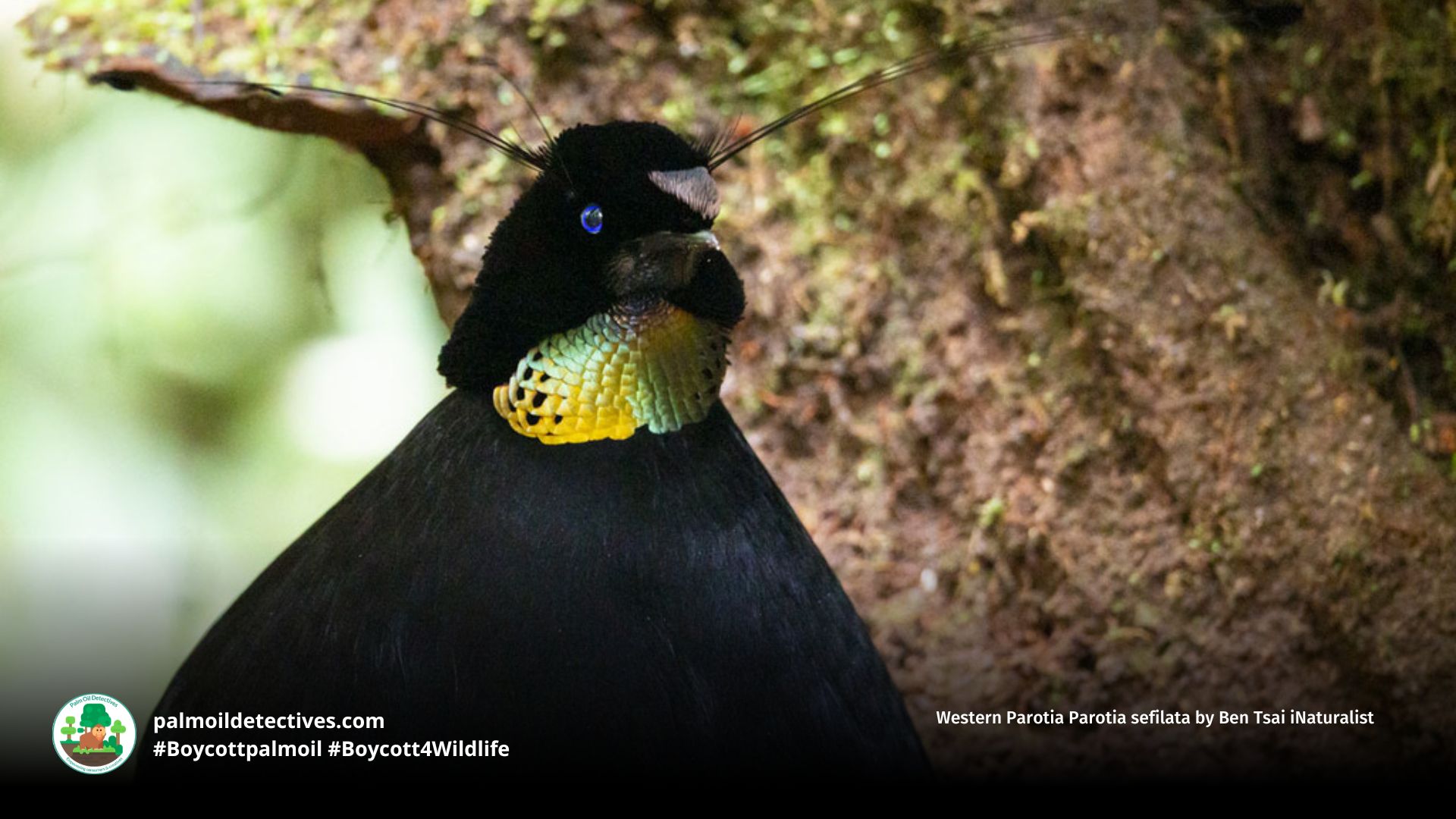
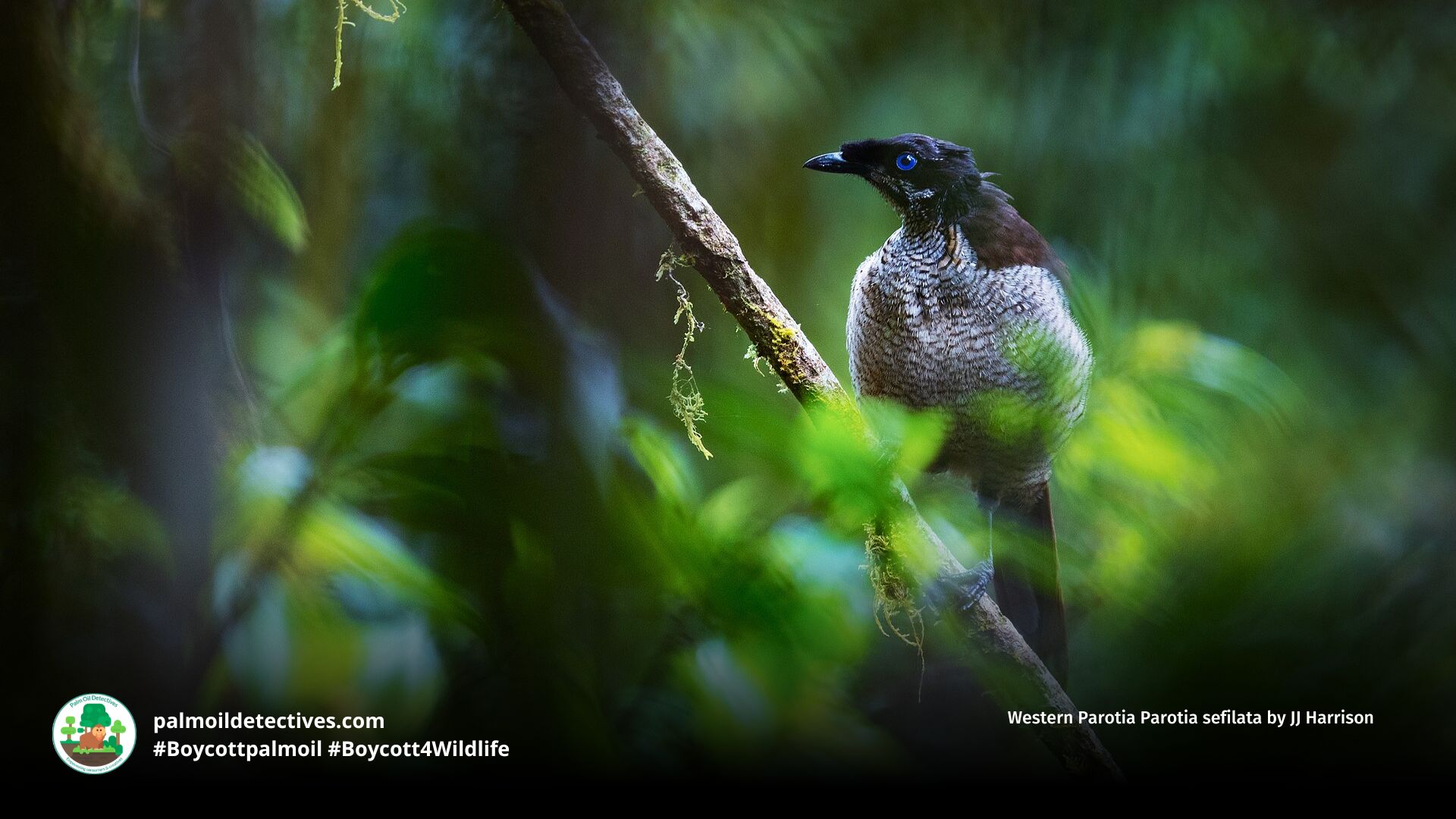
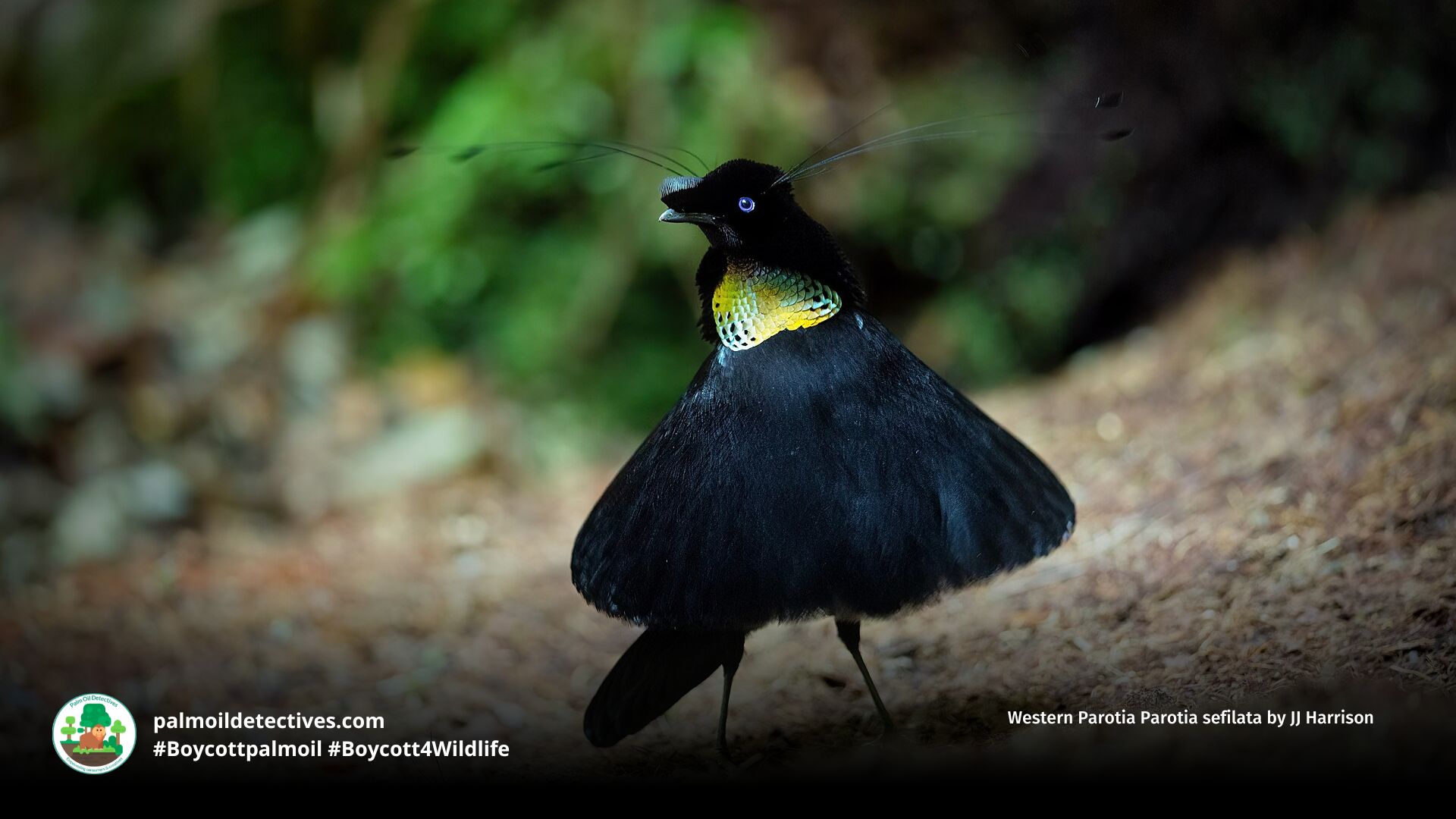
Male Western Parotias are instantly recognisable by their jet-black plumage, metallic green wattles that gleam like scaled armour, and three distinctive wire-like head plumes that curl outward from each side of the crown—features that inspired the species name, derived from the Latin sex filum, meaning ‘six threads.’ A dazzling inverted silver triangle on their head flashes during display, perfectly offset by their elegant black flank plumes which form a flared skirt in courtship. Females are more subdued, clad in streaky brown feathers, allowing them to blend into the forest understorey.
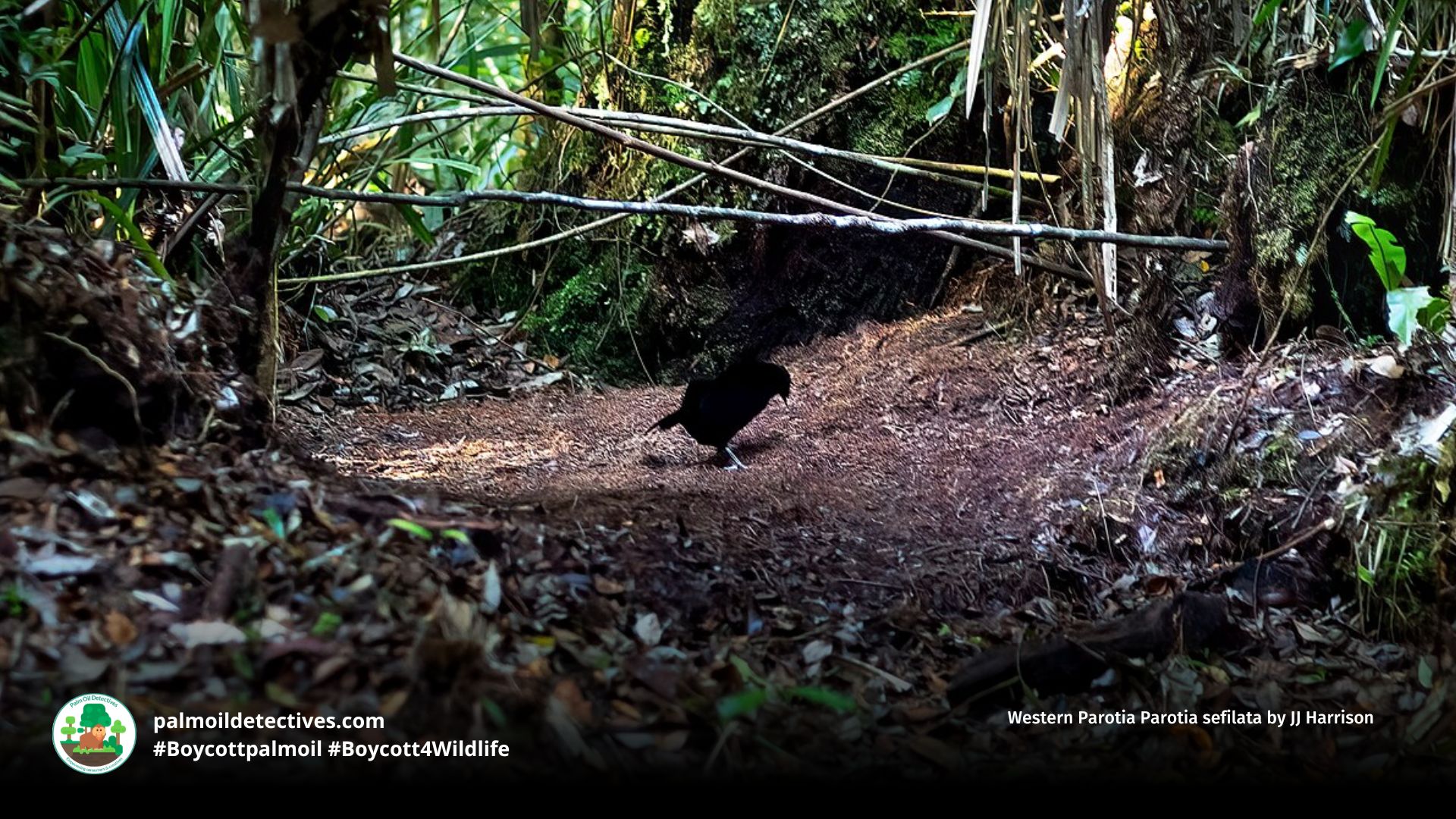
This species of bird-of-paradise is polygynous. Males gather in exploded leks—loosely spaced display grounds—where they clear leaf-littered forest floors to create courts. On these makeshift stages, they perform intricate displays to attract females, combining pirouettes, head bobs, feather shimmers, and rapid shakes. A 2024 behavioural study also observed rare alternative mating tactics, including homosexual mounting and sneak copulation attempts by female-plumaged birds, suggesting untapped behavioural complexity (MacGillavry et al., 2024).
Threats
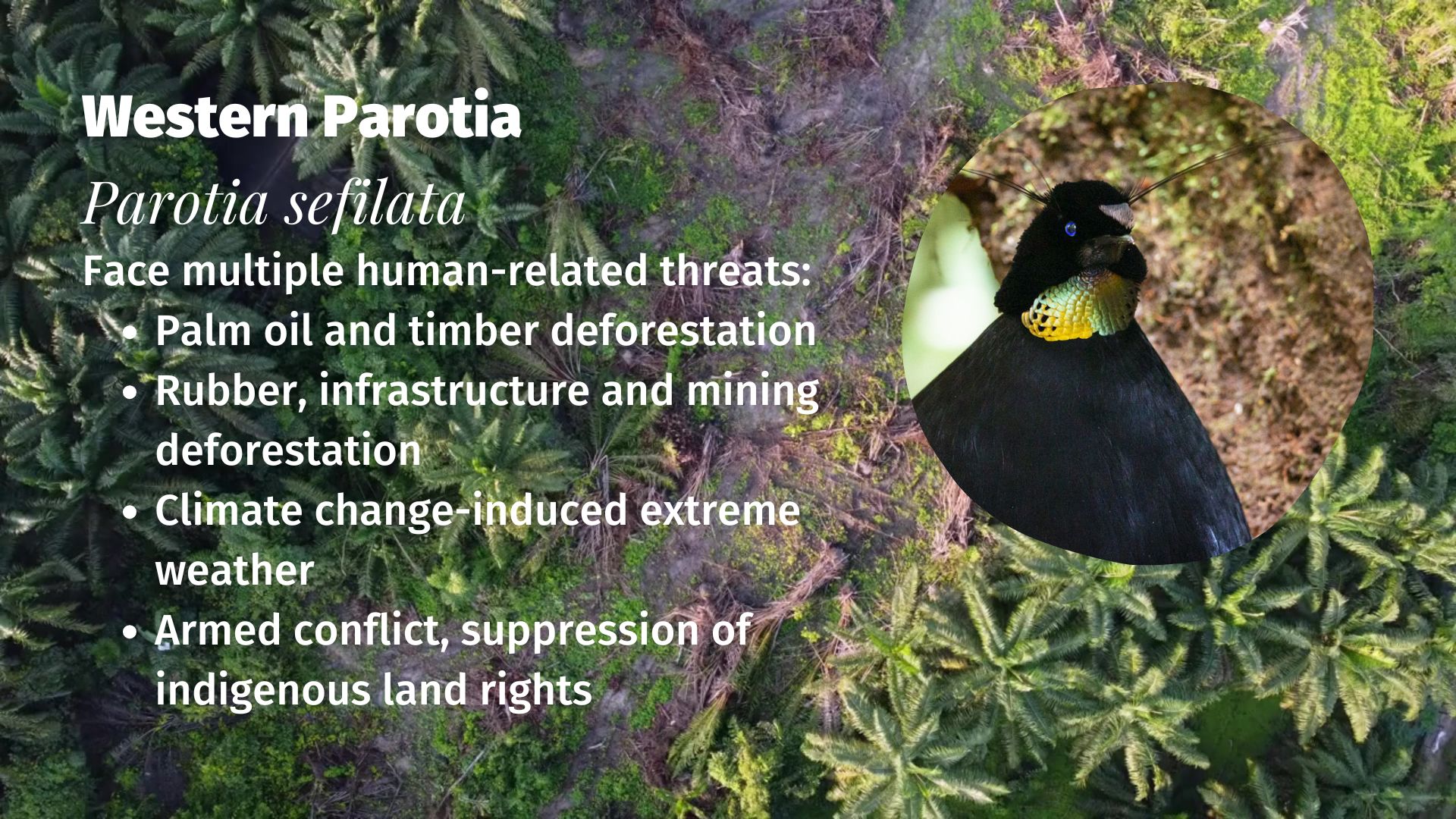
The Western Parotia is officially listed as Least Concern, but this 2016 classification dangerously underrepresents their current reality. Since that assessment, massive deforestation for timber and palm oil has devastated much of their limited range, particularly across the Vogelkop Peninsula and Wandammen Mountains. The threats are mounting and accelerating due to the following drivers:
Palm oil deforestation
Large-scale clearing of primary rainforest to make way for industrial palm oil plantations is now rampant across the Bird’s Head (Vogelkop) Peninsula. Even remote montane forests where Western Parotias lek and nest are not safe, as new roads are cut to expand plantation frontiers.
Timber deforestation
Commercial timber extraction is removing centuries-old forest giants that the Western Parotia depends on for fruit, foraging and nesting. Logging roads also fragment habitat, increase fire risk, and provide access to previously undisturbed ecosystems.
Deforestation for mining, rubber and infrastructure projects
Government-backed agribusiness schemes are encouraging monocultures such as oil palm and rubber, which completely erase the forest understory and tree canopy vital for the Parotia’s food and shelter.
Mining concessions in West Papua—often enforced with military support—are rapidly opening up forests in the Wandammen Mountains, overlapping with the Parotia’s habitat. Road construction to access mines and plantations is fragmenting the landscape irreparably.
Climate change-induced extreme weather
The species is restricted to highland forest. As temperatures rise and human pressures encroach from below, their montane habitat may shrink to mountaintop fragments, leaving no room for retreat.
Colonial exploitation, military conflict and suppression of Indigenous land rights:
Indigenous Melanesians have stewarded Papuan forests for millennia. Today, state and corporate projects continue to override Indigenous consent, leading to ecological destruction and social injustice hand-in-hand.
These combined threats pose a serious and immediate danger to the survival of the Western Parotia. Without urgent action to halt deforestation and recognise Indigenous land sovereignty, the species could slide rapidly toward extinction unnoticed.
Geographic Range
Western Parotias are found exclusively in the montane and submontane rainforests of the Vogelkop Peninsula and the Wandammen Mountains in West Papua. They are forest specialists, requiring old-growth rainforest to support their complex courtship behaviour and nesting needs. Since their last assessment in 2016, widespread forest loss has occurred across these regions, particularly from illegal logging and palm oil expansion, putting their long-term survival in serious jeopardy.
Diet
Western Parotias primarily feed on fruits—especially figs—and supplement their diet with arthropods. Their foraging occurs at various forest levels, but they prefer mid-canopy and understorey, where fruiting trees and insect-rich foliage are abundant.
Mating and Reproduction
Courtship and nesting behaviour are marked by sexual division of labour. Only the female builds the nest and raises the chick. Nests are often camouflaged in dense foliage. Although the precise breeding season remains unclear, it is believed to vary by elevation and fruiting cycles. Male courtship is heavily influenced by evolutionary modularity in display traits, which have diverged over time, giving rise to the extravagant variety seen across the Parotia genus (Scholes, 2008).
FAQs
How many Western Parotias are left in the wild?
There are no exact population estimates for the Western Parotia. The IUCN has classified them as Least Concern, but this was based on assessments from 2016. Since then, vast tracts of their habitat have been lost. Without a recent survey, the current population trend is unknown, but it is likely decreasing due to ongoing deforestation (BirdLife International, 2016).
How long do Western Parotias live?
In the wild, birds-of-paradise often live between 5 to 10 years, though lifespan data for this species is limited. In captivity, related species have reached over 15 years, but no long-term studies exist for Parotia sefilata specifically.
What challenges do conservationists face protecting this species?
Conservation of the Western Parotia is complicated by a lack of recent data and the remoteness of their habitat. The Vogelkop and Wandammen regions are undergoing rapid transformation due to illegal logging and palm oil expansion, often facilitated by state-backed infrastructure projects. These forests also fall within contested indigenous lands, and conservation solutions must be rooted in indigenous sovereignty to be effective.
Is the Western Parotia affected by the exotic pet trade?
Unlike parrots and smaller songbirds, Western Parotias are not commonly targeted for the exotic pet trade, likely due to their remote habitat and specialised diet. However, increased accessibility due to road construction could change this. It is essential to remain vigilant and oppose any wildlife trafficking.
Take Action!
Use your wallet as a weapon to stop extinction by boycotting palm oil. Always choose products that are 100% palm oil-free to avoid contributing to the deforestation that is pushing the Western Parotia closer to extinction. Support indigenous-led conservation efforts in West Papua and call for greater transparency around the spread of monoculture plantations. Protect the mesmerising courtship rituals of these remarkable birds by fighting to keep their forests standing. #BoycottPalmOil #Boycott4Wildlife #Vegan #BoycottMeat
Support the Western Parotia by going vegan and boycotting palm oil in the supermarket, it’s the #Boycott4Wildlife
Support the conservation of this species
This animal has no protections in place. Read about other forgotten species here. Create art to support this forgotten animal or raise awareness about them by sharing this post and using the #Boycottpalmoil #Boycott4Wildlife hashtags on social media. Also you can boycott palm oil in the supermarket.
Further Information
BirdLife International. (2016). Parotia sefilata. The IUCN Red List of Threatened Species 2016: e.T22706181A93913206. Retrieved 6 April 2025, from https://www.iucnredlist.org/species/22706181/93913206
MacGillavry, T., Janiczek, C., & Fusani, L. (2024). Video evidence of mountings by female-plumaged birds of paradise (Aves: Paradisaeidae) in the wild: Is there evidence of alternative mating tactics? Ethology. https://doi.org/10.1111/eth.13451
Scholes, E. (2008). Evolution of the courtship phenotype in the bird of paradise genus Parotia (Aves: Paradisaeidae): homology, phylogeny, and modularity. Biological Journal of the Linnean Society, 94(3), 491–504. https://doi.org/10.1111/j.1095-8312.2008.01012.x
Wikipedia contributors. (n.d.). Western parotia. Wikipedia. Retrieved 6 April 2025, from https://en.wikipedia.org/wiki/Western_parotia

How can I help the #Boycott4Wildlife?
Take Action in Five Ways
1. Join the #Boycott4Wildlife on social media and subscribe to stay in the loop: Share posts from this website to your own network on Twitter, Mastadon, Instagram, Facebook and Youtube using the hashtags #Boycottpalmoil #Boycott4Wildlife.
2. Contribute stories: Academics, conservationists, scientists, indigenous rights advocates and animal rights advocates working to expose the corruption of the palm oil industry or to save animals can contribute stories to the website.

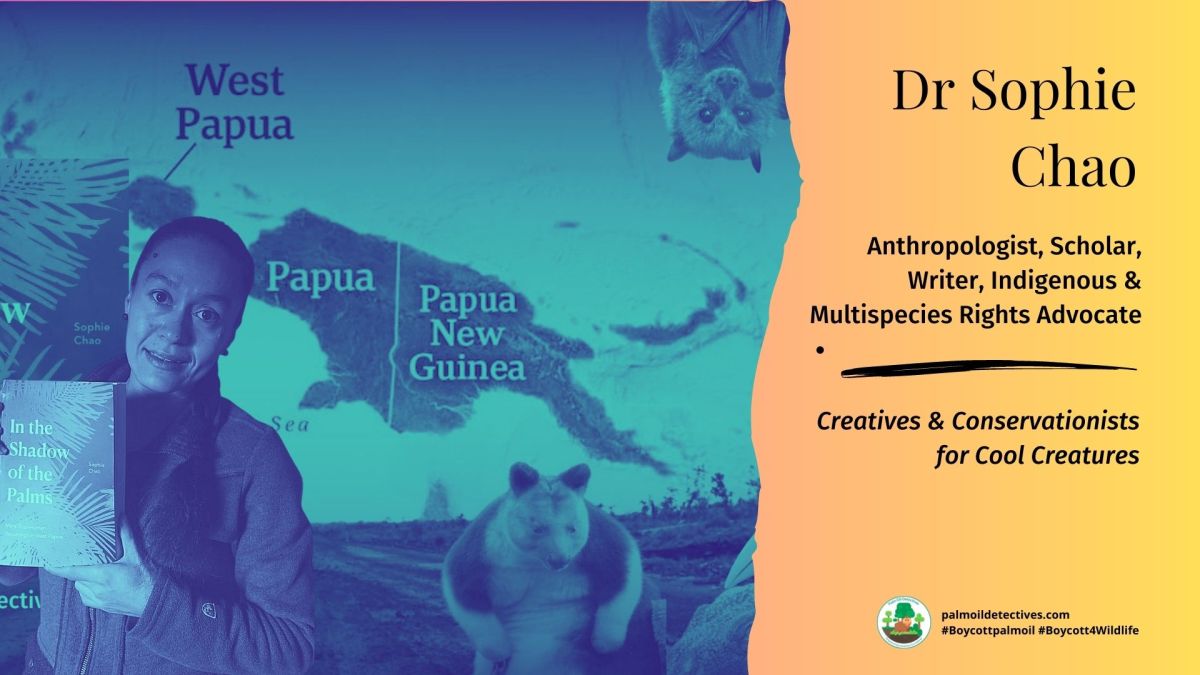



3. Supermarket sleuthing: Next time you’re in the supermarket, take photos of products containing palm oil. Share these to social media along with the hashtags to call out the greenwashing and ecocide of the brands who use palm oil. You can also take photos of palm oil free products and congratulate brands when they go palm oil free.
4. Take to the streets: Get in touch with Palm Oil Detectives to find out more.
5. Donate: Make a one-off or monthly donation to Palm Oil Detectives as a way of saying thank you and to help pay for ongoing running costs of the website and social media campaigns. Donate here
Learn about other animals endangered by palm oil and other agriculture
Learn about “sustainable” palm oil greenwashing
Read more about RSPO greenwashing
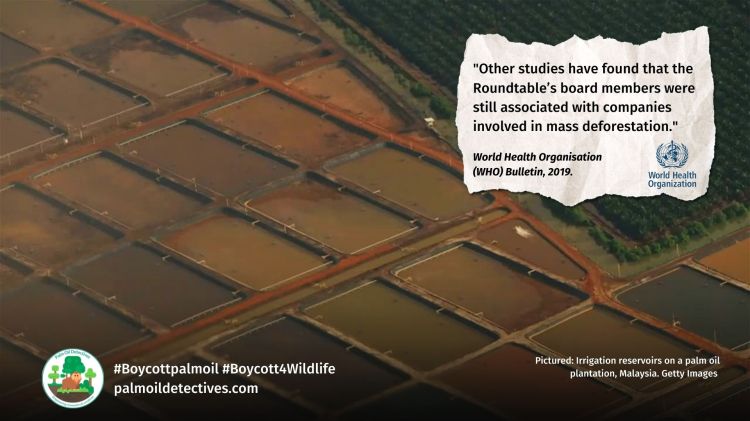
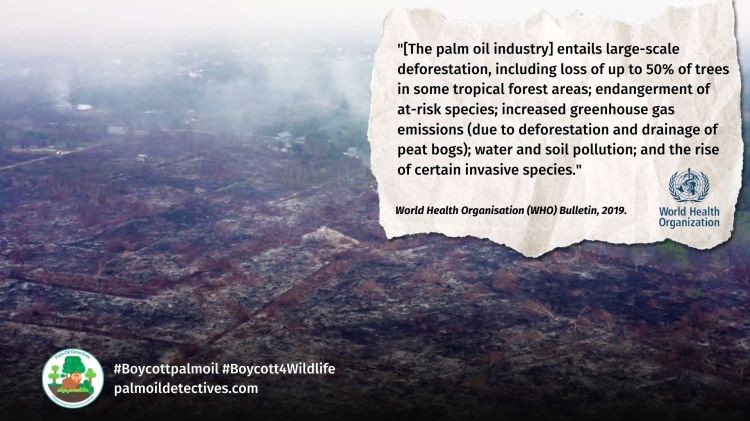
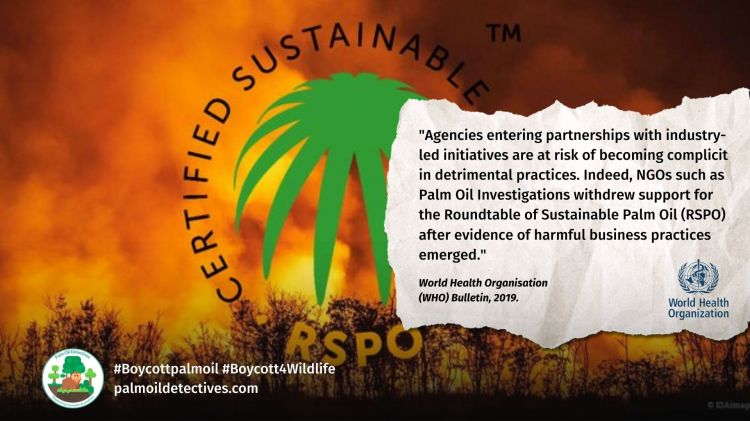
A 2019 World Health Organisation (WHO) report into the palm oil industry and RSPO finds extensive greenwashing of palm oil deforestation and the murder of endangered animals (i.e. biodiversity loss)


Discover more from Palm Oil Detectives
Subscribe to get the latest posts sent to your email.
 Palm Oil Detectives