
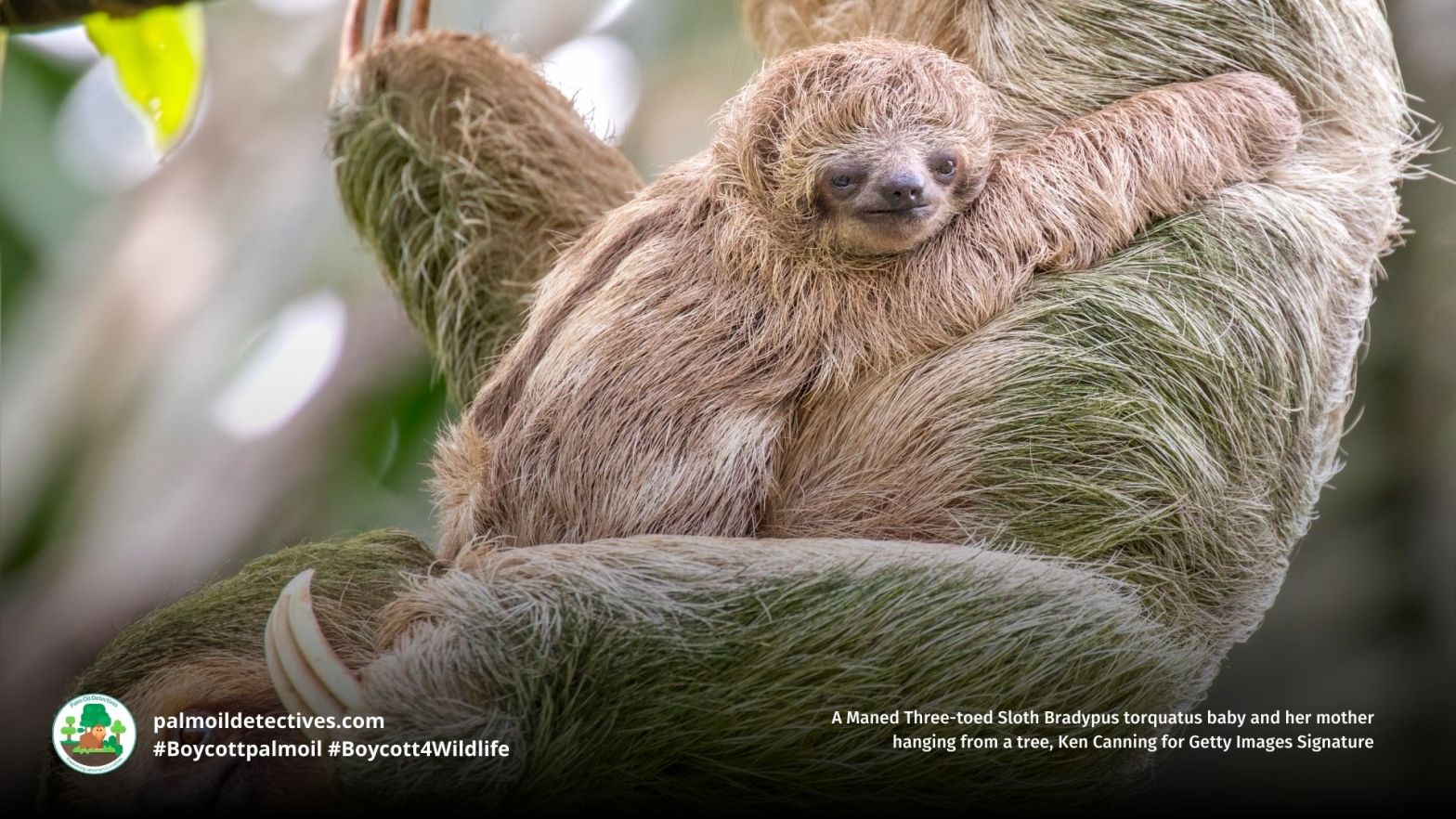
Adorable and fuzzy-haired Maned Three-toed #Sloths 🦥 are so slow they gather algae. Vulnerable in #Brazil 🇧🇷 due to #cocoa 🍫 #palmoil 🌴 meat 🥩 #deforestation. Help them to survive, be #vegan #BoycottPalmOil 🌴🪔☠️⛔️ #Boycott4wildlife @palmoildetect https://wp.me/pcFhgU-192
Just 10% of their home the Atlantic Forest of #Brazil remains intact 💔🇧🇷 The world’s slowest mammal Maned Three-toed #Sloths 🦥🤎 are rapidly vanishing due to #PalmOil #Gold #cocoa and #meat #deforestation. Help them! Be #vegan and #BoycottPalmOil 🌴⛔️ https://wp.me/pcFhgU-192
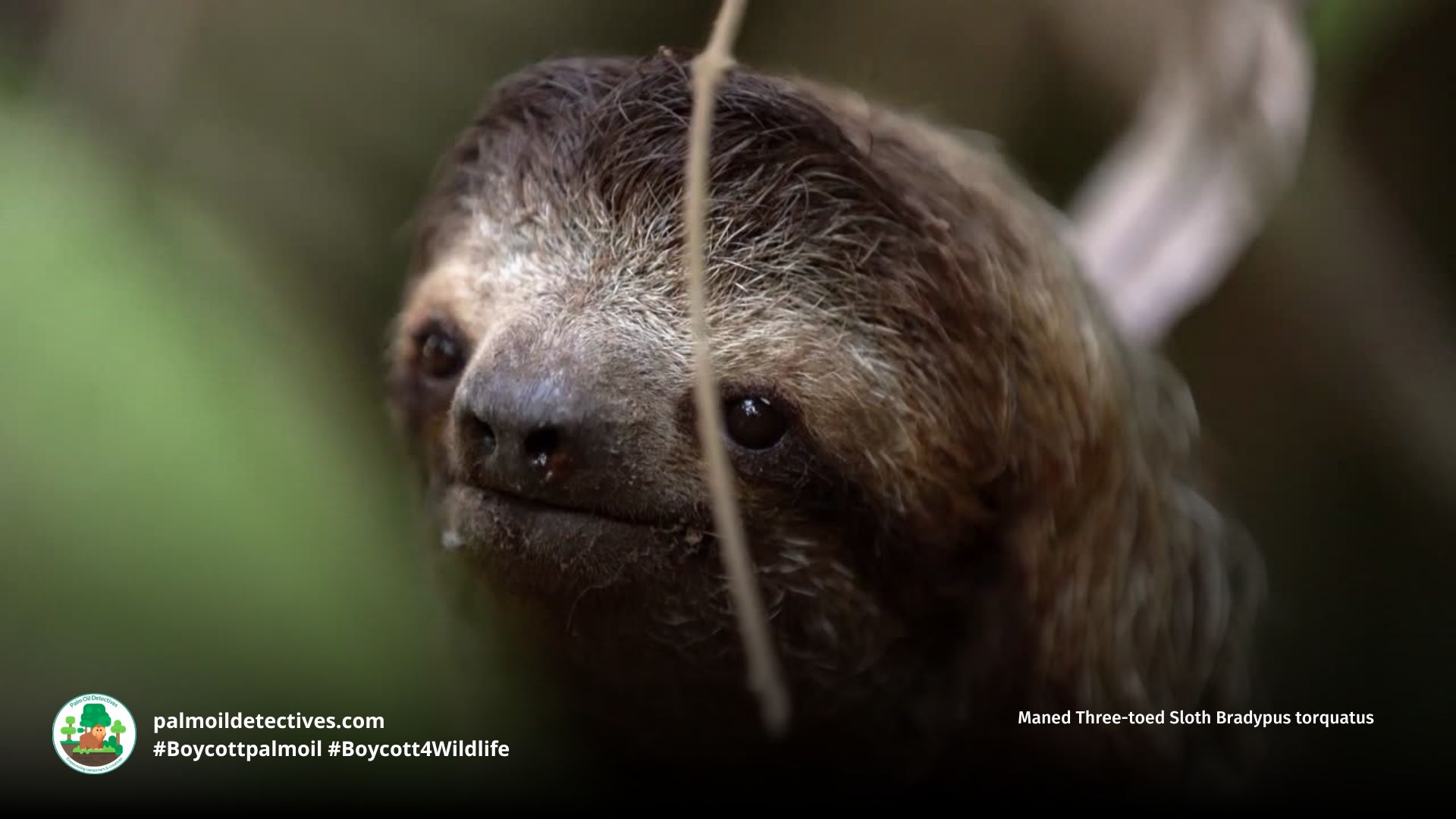
Maned Three-toed Sloth Bradypus torquatus
Vulnerable
Locations: Brazil’s Atlantic Forest
Maned Three-toed Sloths are famous for being one of the slowest moving mammals on the planet. They live in the Atlantic coastal forests of eastern Brazil possess short and course hair giving them a bedraggled appearance. They are smaller and more delicate than other sloth species and thrive in areas with high rainfall and no dry season.
As palm oil, cocoa and meat deforestation along with gold mining expands across their range – many of their lives are at risk and they are classified as Vulnerable. Help protect these gentle and wondrous creatures and use your wallet as a weapon. #BoycottGold4Yanomami #BoycottPalmOil and #Boycott4Wildlife. 🦥🌳
The maned three-toed sloth Bradypus torquatus is a rare and enigmatic creature, endemic to Brazil’s shrinking Atlantic Forest. Named for the striking black mane of coarse hair running down their neck and shoulders, these sloths are smaller and more delicate than their relatives, with unique adaptations for their arboreal lifestyle.
Maned three-toed sloths are among the slowest-moving mammals on Earth, spending their lives hanging from trees and subsisting on a diet of tough leaves. Their survival is closely tied to the rainforest, which provides both food and protection from predators. Tragically, their habitat has been reduced to less than 10% of its original range due to deforestation, agriculture, and urban expansion. Classified as Vulnerable, fewer than 10,000 individuals remain, making conservation efforts critical. Support indigenous-led conservation to help protect their fragile ecosystems. #BoycottPalmOil #Boycott4Wildlife





Appearance and Behaviour
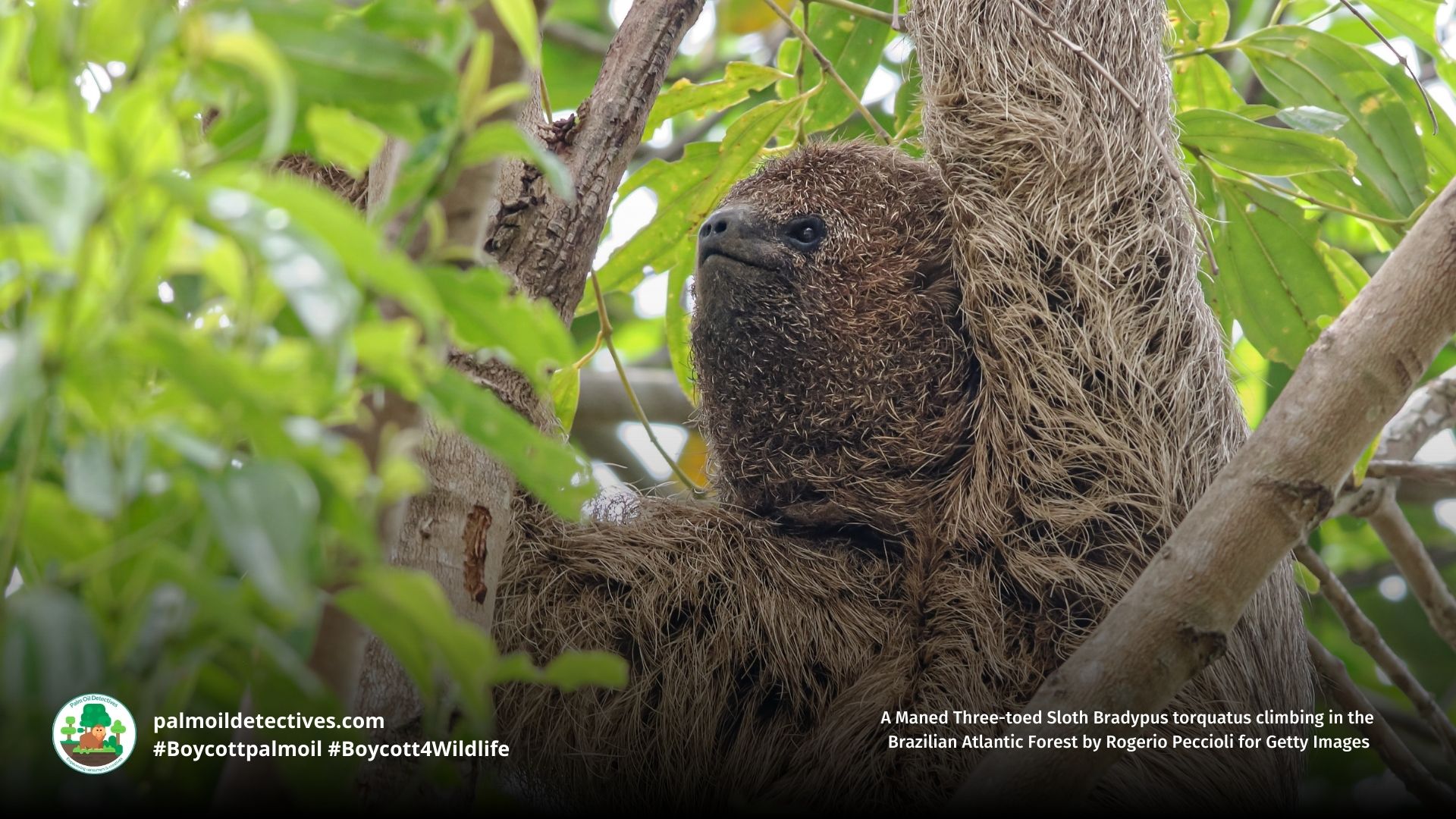
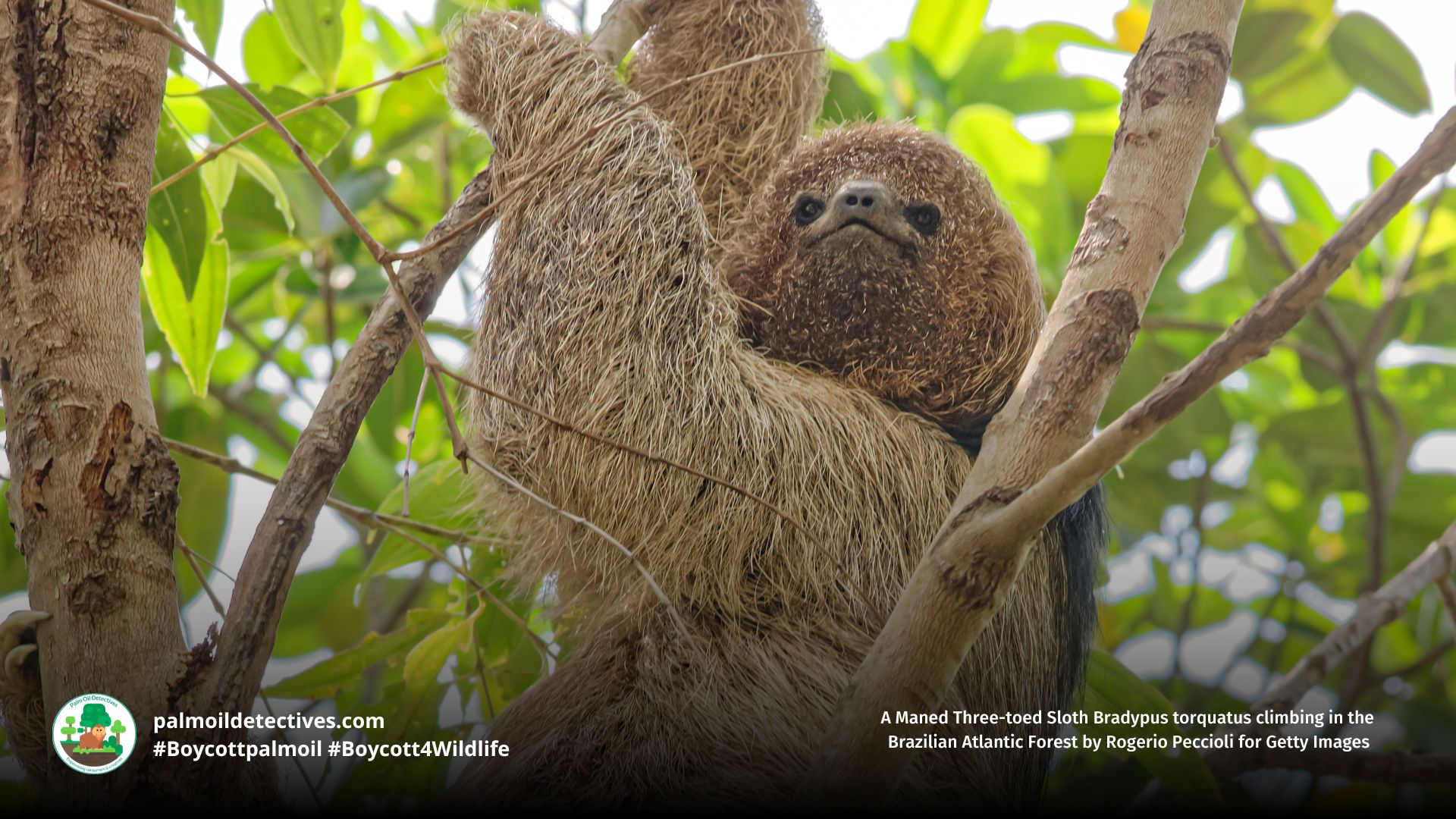
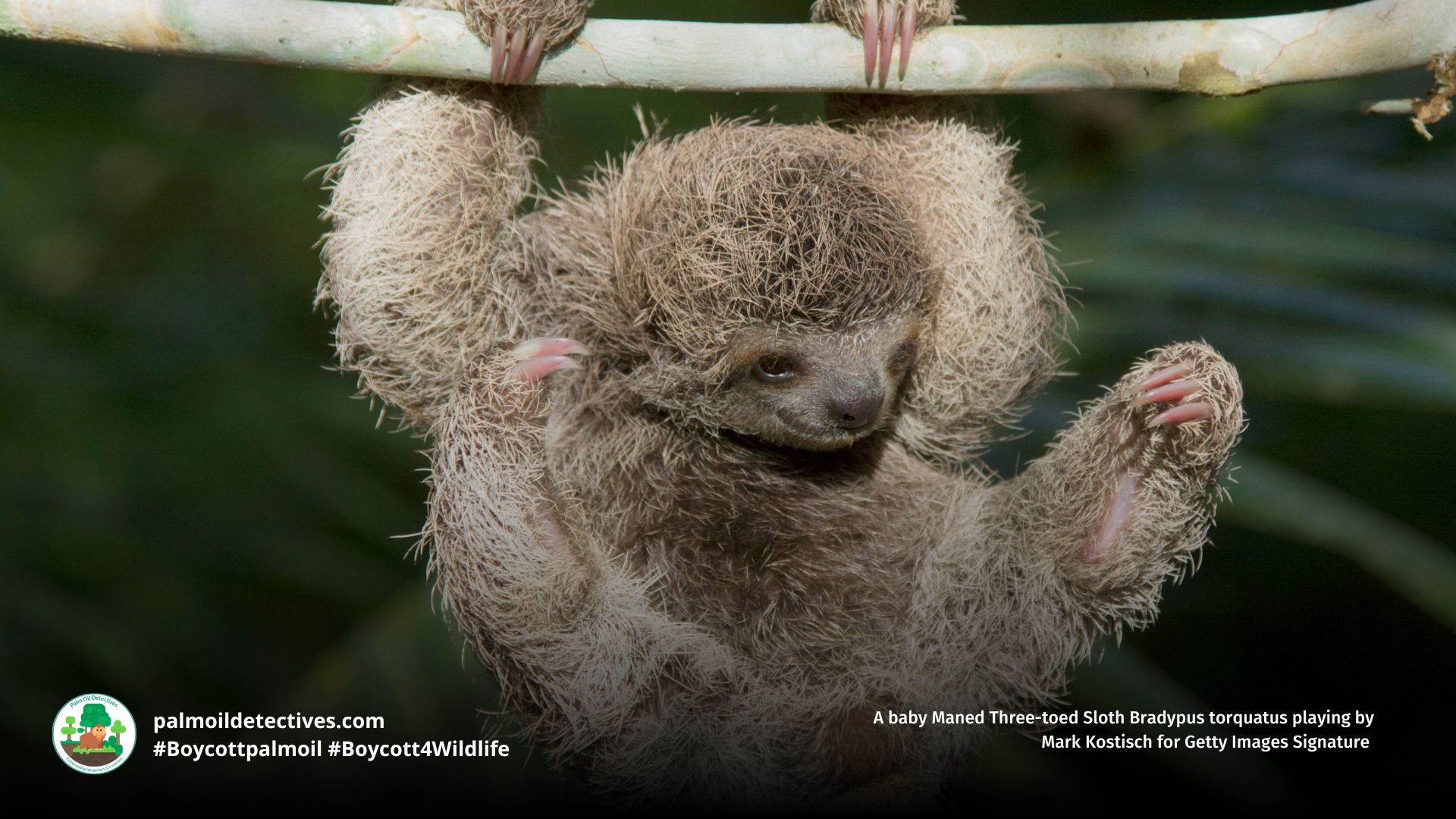
Maned three-toed sloths are small, weighing just 4–7 kg and measuring approximately 55 cm in length. Their most distinctive feature is the mane of coarse, black hair encircling their neck, giving them a shaggy and bedraggled appearance. Their shaggy fur often harbours green algae. This provides a natural camouflage against the leafy canopy.
These sloths are uniquely adapted to their arboreal lifestyle. Their long, hook-like claws allow them to grip branches securely, while their specialised muscles enable them to hang upside down for extended periods without exertion. Despite their slow movements, they can swim surprisingly well, using their strong limbs to navigate flooded areas in their rainforest habitat.
Known for their gentle and solitary nature, maned three-toed sloths are most active during the day, spending hours feeding on leaves high in the trees. They rarely descend to the ground, doing so only to defecate or switch trees, which exposes them to predators such as jaguars, harpy eagles, and humans.
Threats
IUCN Status: Endangered
Palm oil, soy and meat deforestation
Brazil’s Atlantic Forest has been reduced to less than 10% of its original size, with significant losses due to logging, agriculture, and urbanisation. This has fragmented maned three-toed sloth populations, isolating them in small pockets of forest where survival is precarious.
Habitat Fragmentation:
Forest fragmentation prevents gene flow between populations, leading to inbreeding and reduced genetic diversity. A 2023 study revealed that maned sloths show genomic signs of adaptation to historical forest changes, but their resilience is now critically threatened (Authorea, 2023).
Expansion of cattle grazing and palm oil:
The expansion of palm oil plantations and cattle pastures has destroyed critical habitats for maned sloths, forcing them into ever-smaller ranges.
Hunting and Road Mortality:
Although not typically hunted, sloths are increasingly at risk of road collisions as their fragmented habitats bring them closer to human activity.
Geographic Range
Maned three-toed sloths are endemic to the Atlantic Forest along the eastern coast of Brazil, spanning the states of Bahia, Espírito Santo, and Rio de Janeiro. They are highly habitat-specific, relying on dense rainforest for food, camouflage, and protection. Once widespread, their range is now highly fragmented due to deforestation, with populations restricted to isolated forest patches.
Diet
Maned three-toed sloths are folivores, subsisting almost exclusively on a diet of tough, fibrous leaves. They are highly selective, feeding on leaves from specific tree species that provide the nutrients they need. Their slow metabolism and low-energy diet result in an unhurried lifestyle, with digestion taking up to a month for a single meal.
Reproduction and Mating
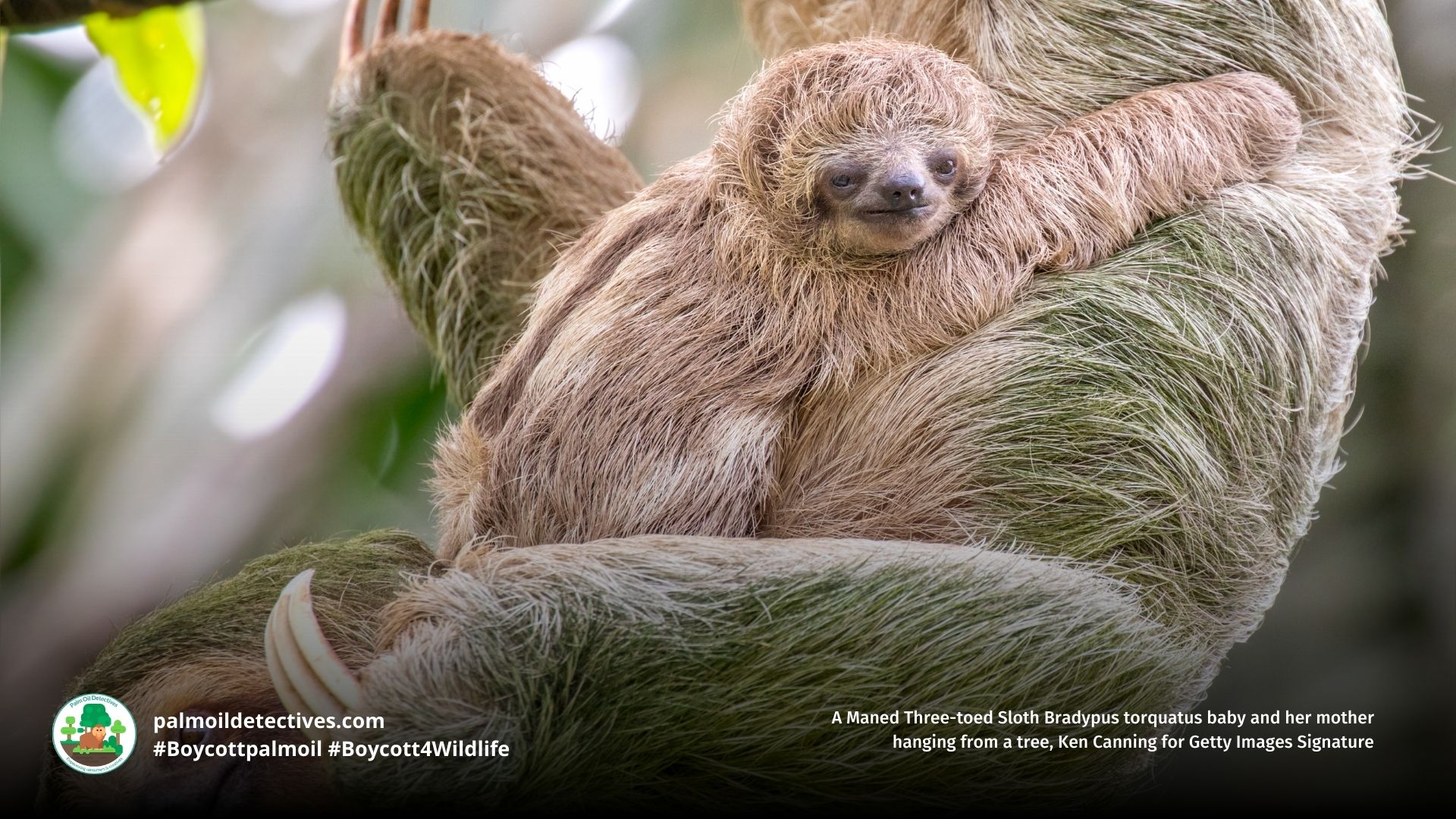
Females typically give birth to a single offspring after a gestation period of six months. Newborn sloths cling to their mothers’ fur for several months, learning to navigate the canopy before becoming independent. Maned sloths have a low reproductive rate, with females giving birth only once every one to two years, making population recovery slow and difficult.
Take Action!
To protect maned three-toed sloths, support indigenous-led conservation initiatives and advocate for stronger protections of the Atlantic Forest. Fight for their survival by boycotting palm oil and supporting ethical consumer choices. #BoycottPalmOil #Boycott4Wildlife
FAQ
What is the etymology or origins of the maned three-toed sloth’s name?
The name Bradypus torquatus comes from the Greek word “Bradypus,” meaning “slow-footed,” and the Latin word “torquatus,” meaning “collared,” a nod to the black mane that distinguishes them. Locally, they are often referred to as “preguiça-de-coleira” in Portuguese, which translates to “collared sloth.”
How do maned three-toed sloths move?
Maned three-toed sloths are known for their exceptionally slow movements, averaging just 0.15 miles per hour. Their long, curved claws allow them to hang securely from branches, and they move by dragging themselves along vines and branches with deliberate effort. On the rare occasions they descend to the forest floor, they move awkwardly but can swim with surprising agility, often using this skill to cross rivers or escape predators.
Who are the predators of the maned three-toed sloth?
Maned three-toed sloths face threats from several natural predators in the dense Atlantic Forest of Brazil. Their primary predators include:
• Harpy Eagles (Harpia harpyja): These powerful raptors are one of the most significant threats to sloths. Harpy eagles use their exceptional eyesight and strong talons to pluck sloths from tree branches.
• Ocelots (Leopardus pardalis): As opportunistic hunters, ocelots may prey on sloths when they descend to the ground, where they are most vulnerable.
• Jaguars (Panthera onca): Although rare, jaguars may prey on sloths if the opportunity arises, particularly when sloths are on the forest floor.
Sloths are particularly at risk during their infrequent trips to the ground for defecation or when moving to a new tree. However, their slow movements, excellent camouflage provided by algae-covered fur, and ability to cling tightly to branches make them challenging targets for predators. Despite these adaptations, the greatest threats to maned three-toed sloths come from habitat destruction and human activities rather than natural predation.
How are maned three-toed sloths protected from predators?
Maned three-toed sloths employ several strategies to evade predators:
• Camouflage: Their fur, often covered with algae, blends seamlessly with the mossy canopy.
• Slow Movement: By moving slowly and deliberately, they avoid detection by visually oriented predators like harpy eagles.
• Claws and Strength: They use their strong claws and grip to cling tightly to branches, making it nearly impossible for predators to pull them away.
How are maned three-toed sloths threatened?
Maned three-toed sloths are primarily threatened by deforestation. Over 90% of the Atlantic Forest has been lost, with remaining patches under continuous threat from palm oil, soy and meat agriculture, and urban expansion. This habitat destruction isolates populations, leading to genetic bottlenecks and reduced survival chances.

Support the conservation of this species
Further Information

Authorea contributors. (2023). Genomic signatures in maned three-toed sloths from historical to contemporary shifts in Brazil’s threatened Atlantic Forest. Authorea.
Chiarello, A. G. (1998). The endangered maned sloth Bradypus torquatus of the Brazilian Atlantic Forest: A review and update of geographical distribution and habitat preferences. Mammal Review, 28(1), 51–61.
hiarello, A. & Moraes-Barros, N. 2014. Bradypus torquatus. The IUCN Red List of Threatened Species 2014: e.T3036A47436575. https://dx.doi.org/10.2305/IUCN.UK.2014-1.RLTS.T3036A47436575.en. Downloaded on 08 March 2021.
Moraes-Barros, N., & Arteaga, M. C. (2015). Ecology and distribution of Bradypus torquatus in Brazil. Mammalian Biology, 80(1), 1–7.
Wikipedia contributors. (n.d.). Maned Sloth. Wikipedia.

How can I help the #Boycott4Wildlife?
Take Action in Five Ways
1. Join the #Boycott4Wildlife on social media and subscribe to stay in the loop: Share posts from this website to your own network on Twitter, Mastadon, Instagram, Facebook and Youtube using the hashtags #Boycottpalmoil #Boycott4Wildlife.
2. Contribute stories: Academics, conservationists, scientists, indigenous rights advocates and animal rights advocates working to expose the corruption of the palm oil industry or to save animals can contribute stories to the website.



3. Supermarket sleuthing: Next time you’re in the supermarket, take photos of products containing palm oil. Share these to social media along with the hashtags to call out the greenwashing and ecocide of the brands who use palm oil. You can also take photos of palm oil free products and congratulate brands when they go palm oil free.
4. Take to the streets: Get in touch with Palm Oil Detectives to find out more.
5. Donate: Make a one-off or monthly donation to Palm Oil Detectives as a way of saying thank you and to help pay for ongoing running costs of the website and social media campaigns. Donate here
Discover more from Palm Oil Detectives
Subscribe to get the latest posts sent to your email.
 Palm Oil Detectives
One thought on “Maned Three-toed Sloth Bradypus torquatus”