

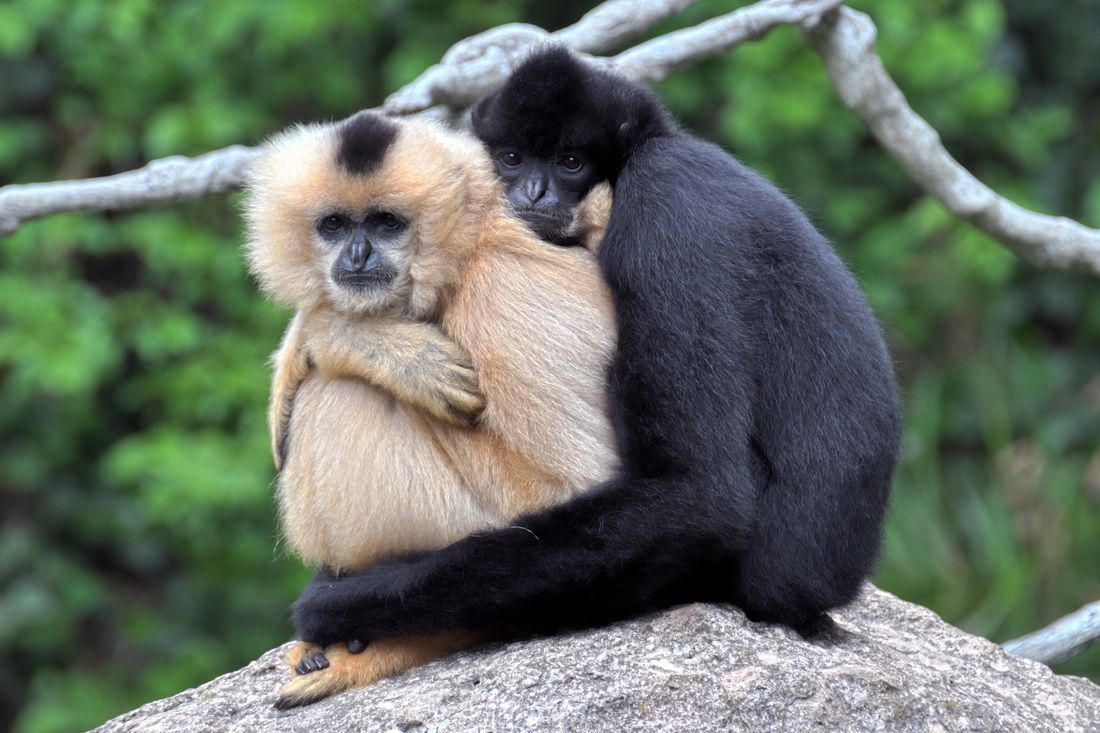
Hainan Gibbon Nomascus hainanus
Critically Endangered
Location: China.
These small apes belong to genus Nomascus which are found in Vietnam, Laos, Cambodia and southern China. The Hainan Gibbon is known to live in a restricted area of less than 100 km2 in southern China. They are known to communicate in species-specific song when defining territory or attracting mates. They sing in regional accents to each other and they form polygamous relationships.
The Hainan Gibbon is critically endangered in #China due to #deforestation and #hunting. You can help them by joining the #Boycott4Wildlife on brands destroying #rainforests! Find out more
Tweet
The Hainan Gibbon lives in montane rainforest, at altitudes ranging from 650 to 1,200 m (Chan et al. 2005), although specimens were collected at lower elevations prior to the complete clearance of lowland forest on Hainan. It is diurnal, arboreal, and mostly frugivorous. The Hainan Gibbon is listed as Critically Endangered because of an observed decline of at least 80% over the past 45 years (three generations), primarily due to hunting and habitat loss (Mootnick et al. 2012, Turvey et al. 2015); its extent of occurrence is less than 100 km2 (Bryant et al. 2016)
Support the conservation of this beautiful animal
Kadoorie Farm & Botanical Garden
Further Information

Geissmann, T. & Bleisch, W. 2020. Nomascus hainanus. The IUCN Red List of Threatened Species 2020: e.T41643A17969392. https://dx.doi.org/10.2305/IUCN.UK.2020-2.RLTS.T41643A17969392.en. Downloaded on 28 January 2021.

How can I help the #Boycott4Wildlife?
Take Action in Five Ways
1. Join the #Boycott4Wildlife on social media and subscribe to stay in the loop: Share posts from this website to your own network on Twitter, Mastadon, Instagram, Facebook and Youtube using the hashtags #Boycottpalmoil #Boycott4Wildlife.
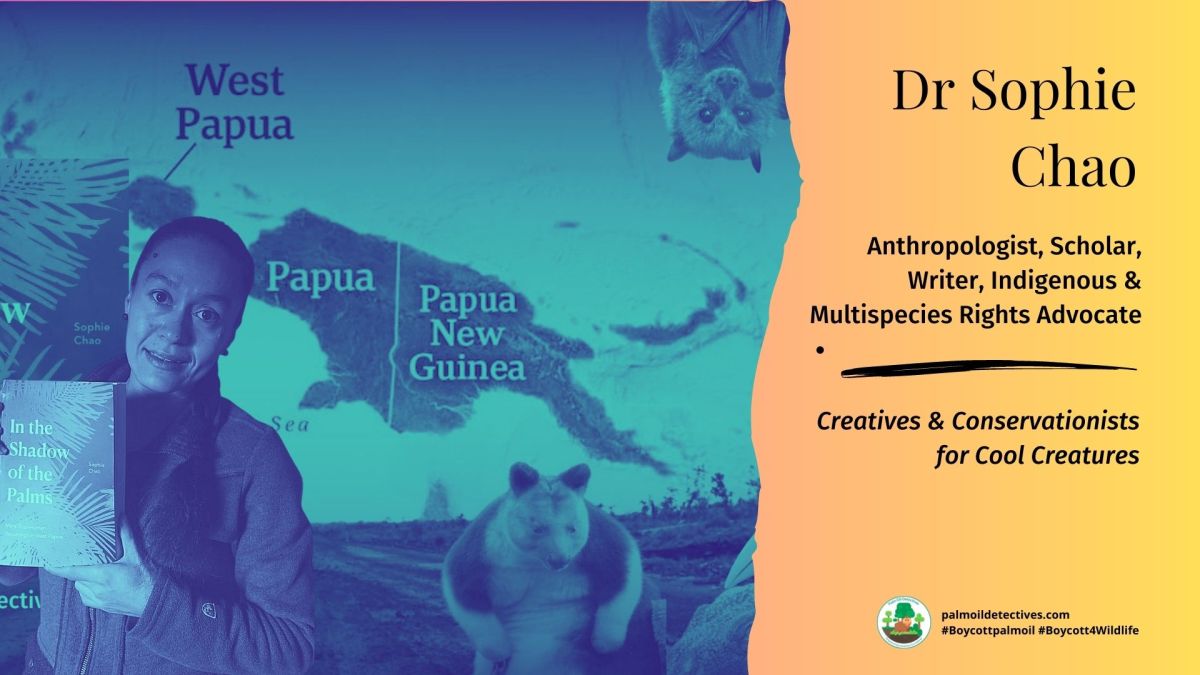
2. Contribute stories: Academics, conservationists, scientists, indigenous rights advocates and animal rights advocates working to expose the corruption of the palm oil industry or to save animals can contribute stories to the website.



3. Supermarket sleuthing: Next time you’re in the supermarket, take photos of products containing palm oil. Share these to social media along with the hashtags to call out the greenwashing and ecocide of the brands who use palm oil. You can also take photos of palm oil free products and congratulate brands when they go palm oil free.
4. Take to the streets: Get in touch with Palm Oil Detectives to find out more.
5. Donate: Make a one-off or monthly donation to Palm Oil Detectives as a way of saying thank you and to help pay for ongoing running costs of the website and social media campaigns. Donate here
Discover more from Palm Oil Detectives
Subscribe to get the latest posts sent to your email.
 Palm Oil Detectives
One thought on “Hainan Gibbon Nomascus hainanus”