
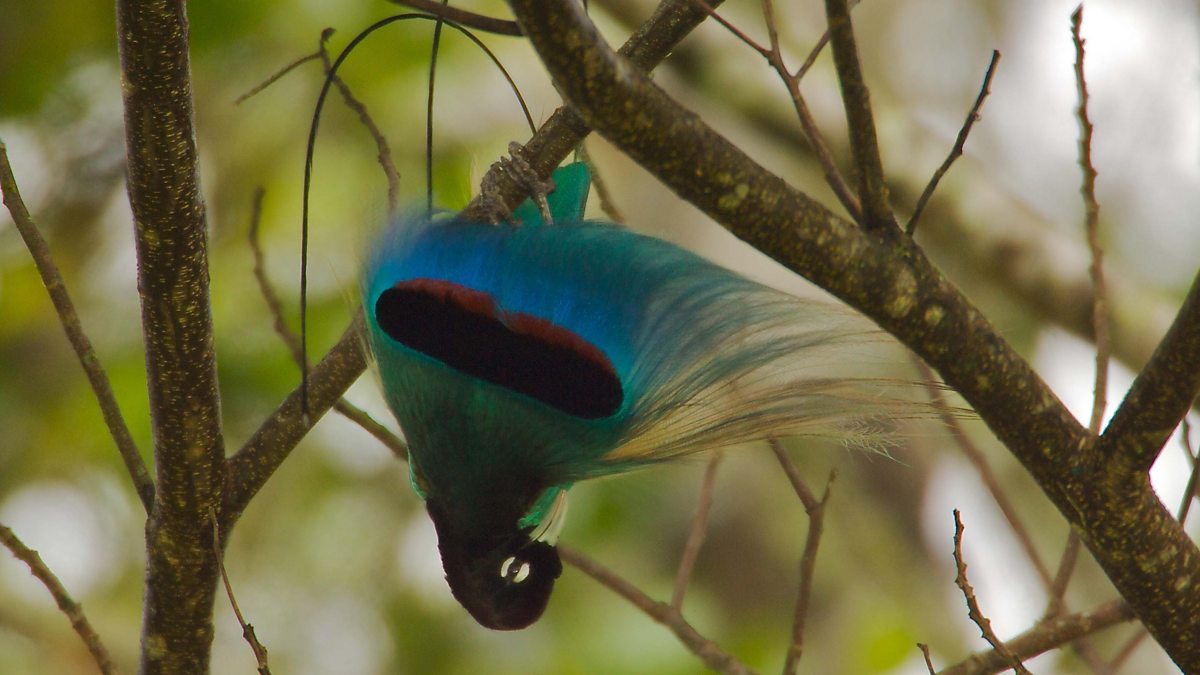
Blue Bird-of-paradise Paradisornis rudolphi
IUCN Red List: Vulnerable
Location: Papua New Guinea (Owen Stanley Range, Central Ranges, Tari Valley, Mt Sisa)
This jewel-toned forest dweller, the Blue Bird-of-Paradise Paradisornis rudolphi, is one of nature’s most visually arresting #bird species—found only in the misty mountain ranges of Papua New Guinea. Yet their mesmerising beauty comes with a high cost. Males are hunted for their shimmering plumes, prized in traditional regalia. More insidiously, their montane rainforest habitat is vanishing due to logging, subsistence agriculture, and the relentless expansion of palm oil monoculture. Despite showing some tolerance for degraded landscapes, they rely on remaining forest patches for food, breeding, and safety. If we fail to act, their haunting calls may be silenced forever. Use your voice and your wallet to stand with them. #BoycottPalmOil #Boycott4Wildlife
Blue Birds of Paradise belong to a vibrant and unique genus 🦜🦚 living only in #PapuaNewGuinea 🇵🇬 They are vulnerable due to #palmoil #deforestation and #mining. Protect and #Boycottpalmoil 🌴🩸🚜🔥❌ #Boycott4Wildlife @palmoildetect https://palmoildetectives.com/2021/02/03/blue-bird-of-paradise-paradisornis-rudolphi/
Male Blue Bird of Paradise do fancy dances, 🦚🪺✨ electric-blue feathers morph into glowing discs. Swaying like lanterns they make eerie calls that echo in the forest. They must not be silenced! #Boycottpalmoil 🌴🩸🚜🔥❌ #Boycott4Wildlife @palmoildetect https://palmoildetectives.com/2021/02/03/blue-bird-of-paradise-paradisornis-rudolphi/
Appearance and Behaviour
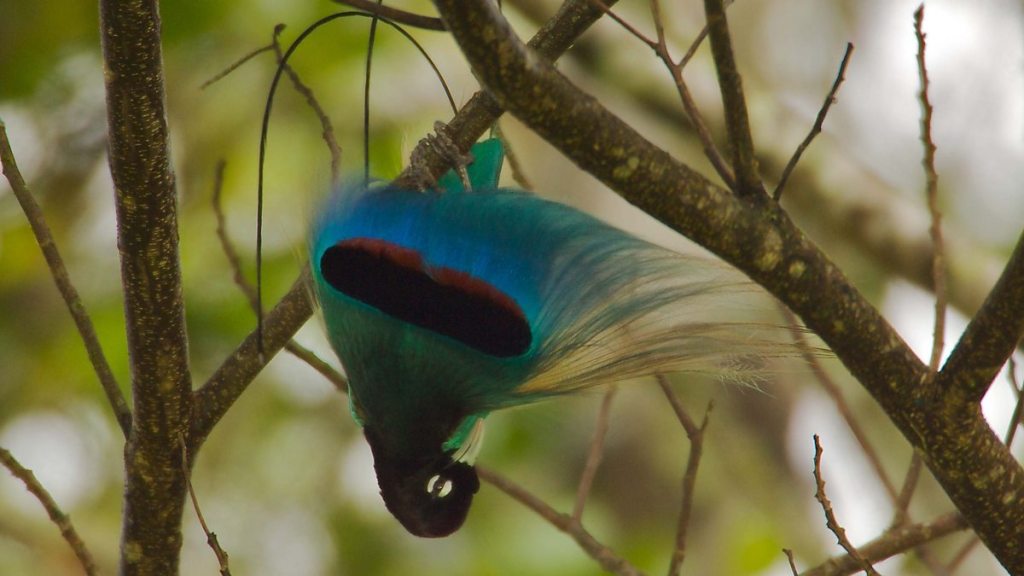
Displaying males are unforgettable: they fan their electric-blue pectoral feathers into glowing discs, sway from branches like feathered lanterns, and produce eerie, fluting calls that echo through the canopy. Their long, streamer-like tail feathers ripple like silk, catching light as they dance to win the attention of rather drabber females.
Blue Birds-of-Paradise are mostly canopy-dwelling and favour lower montane forests between 1,100 and 2,000 metres. Males are fiercely territorial, and each individual typically maintains a home range of 5 to 100 hectares depending on forest quality and human disturbance (Pruett-Jones & Pruett-Jones, 1988; Whiteside, 1998). Their diet is mainly fruit and arthropods, which they skillfully extract from bark and epiphytes in the upper canopy.
Diet
They primarily consume fruits and insects—making them important seed dispersers in their upland forest ecosystems. Their ability to adapt to patchy, human-modified landscapes suggests some behavioural flexibility, but only if fruiting trees and sufficient canopy cover remain.
Reproduction and Mating
The breeding ritual of the Blue Bird-of-Paradise is one of nature’s most theatrical. Males invest huge energy in display courts—favourite perches within primary or semi-degraded forest—where they call and dance for days on end. A single chick is usually raised per nesting attempt, in a shallow nest positioned on low branches. Nestlings have even been recorded surviving in heavily modified garden landscapes, although predation risks in these areas are much higher (van den Bergh et al., 2013).
Geographic Range
Found only in Papua New Guinea, this bird ranges from Mt Sisa south of Tari to the Owen Stanley Range. It is highly patchy in distribution and absent from many seemingly suitable areas. Significant populations persist in Tari Valley and Ambua Lodge, though hunting and land clearance have fragmented formerly connected ranges (Beehler & Pratt, 2016).
Threats
The elevational zone is under pressure from clearance for subsistence gardens by the increasing human population.
IUCN Red List
Palm oil expansion
Montane rainforest in Papua New Guinea is rapidly being cleared for oil palm plantations, particularly in lower elevation areas adjacent to the Blue Bird-of-Paradise’s habitat. As new palm oil developments push upslope, they destroy crucial breeding and feeding habitat for this canopy-dependent species. These plantations not only reduce canopy cover but also fragment populations, making survival harder in degraded forests.
Subsistence agriculture and logging
Forest clearance for gardens and shifting cultivation by a growing rural population is a direct threat to this species. Even degraded forest remnants are under pressure, with critical microhabitats being lost every year.
Hunting for plumes
Adult males are hunted for their ornate feathers used in traditional ceremonies. Although the Fauna Act of Papua New Guinea offers legal protection, enforcement is weak, and feather collecting continues—especially around cultural festivals like Independence Day and Christmas (van den Bergh et al., 2013).
Youth poaching with slingshots
A more recent threat is the increase in nest poaching by children using slingshots. This unsustainable removal of chicks further reduces recruitment in already small populations.
Take Action!
Speak up for the Blue Bird-of-Paradise by refusing to support the industries destroying their rainforest homes. Choose 100% palm oil-free products, support indigenous land stewardship, and push for an end to illegal wildlife trade. These birds are the heartbeat of New Guinea’s mountain forests—do not let them fade into silence. #BoycottPalmOil #Boycott4Wildlife
FAQs
How many Blue Birds-of-Paradise are left?
Current estimates suggest a population of 2,500 to 9,999 mature individuals. Subpopulations are small and likely fragmented, with few exceeding 1,000 birds (IUCN, 2024). Habitat loss and hunting continue to push this number downwards.
Where do Blue Birds-of-Paradise live?
This species is endemic to Papua New Guinea’s eastern Central Ranges, favouring montane forest at elevations between 1,100–2,000 metres. Important locations include Mt Sisa, Tari Valley, and the Owen Stanley range. While some tolerate degraded forest, primary canopy is crucial for breeding displays.
Are Blue Birds-of-Paradise threatened by palm oil plantations?
Yes. Although much attention has been focused on palm oil in Southeast Asia, Papua New Guinea is one of the fastest-growing producers. Palm oil deforestation is accelerating near the altitudinal ranges of Paradisornis rudolphi, particularly in fragmented upland areas where the species survives. This adds yet another pressure on their already limited and degraded habitat.
Why are Blue Birds-of-Paradise hunted?
Males are hunted for their distinctive feathers, worn in traditional dress and ceremonies. Despite legal protection under PNG’s Fauna Act, enforcement is weak, and feathers are sometimes sold to tourists. Cultural celebrations have increased demand in recent years.
Do Blue Birds-of-Paradise make good pets?
Absolutely not. These birds require specific habitat, a rich canopy, and complex social cues to survive and breed. The illegal pet trade is cruel and devastating. Taking them from the wild accelerates extinction. Instead, advocate against exotic pets and support habitat conservation.
Further Information
BirdLife International. 2016. Paradisornis rudolphi. The IUCN Red List of Threatened Species 2016: e.T22706266A94059137. https://dx.doi.org/10.2305/IUCN.UK.2016-3.RLTS.T22706266A94059137.en. Downloaded on 03 February 2021.
John P. Dumbacher, Birds of New Guinea: Distribution, Taxonomy, and Systematics, The Condor: Ornithological Applications, Volume 120, Issue 1, 1 February 2018, Pages 245–246, https://doi.org/10.1650/CONDOR-17-226.1

Support the conservation of this species
There are currently no conservation activities in place.
Create art to support this forgotten animal.

How can I help the #Boycott4Wildlife?
Take Action in Five Ways
1. Join the #Boycott4Wildlife on social media and subscribe to stay in the loop: Share posts from this website to your own network on Twitter, Mastadon, Instagram, Facebook and Youtube using the hashtags #Boycottpalmoil #Boycott4Wildlife.
2. Contribute stories: Academics, conservationists, scientists, indigenous rights advocates and animal rights advocates working to expose the corruption of the palm oil industry or to save animals can contribute stories to the website.






3. Supermarket sleuthing: Next time you’re in the supermarket, take photos of products containing palm oil. Share these to social media along with the hashtags to call out the greenwashing and ecocide of the brands who use palm oil. You can also take photos of palm oil free products and congratulate brands when they go palm oil free.
4. Take to the streets: Get in touch with Palm Oil Detectives to find out more.
5. Donate: Make a one-off or monthly donation to Palm Oil Detectives as a way of saying thank you and to help pay for ongoing running costs of the website and social media campaigns. Donate here
Discover more from Palm Oil Detectives
Subscribe to get the latest posts sent to your email.
 Palm Oil Detectives