
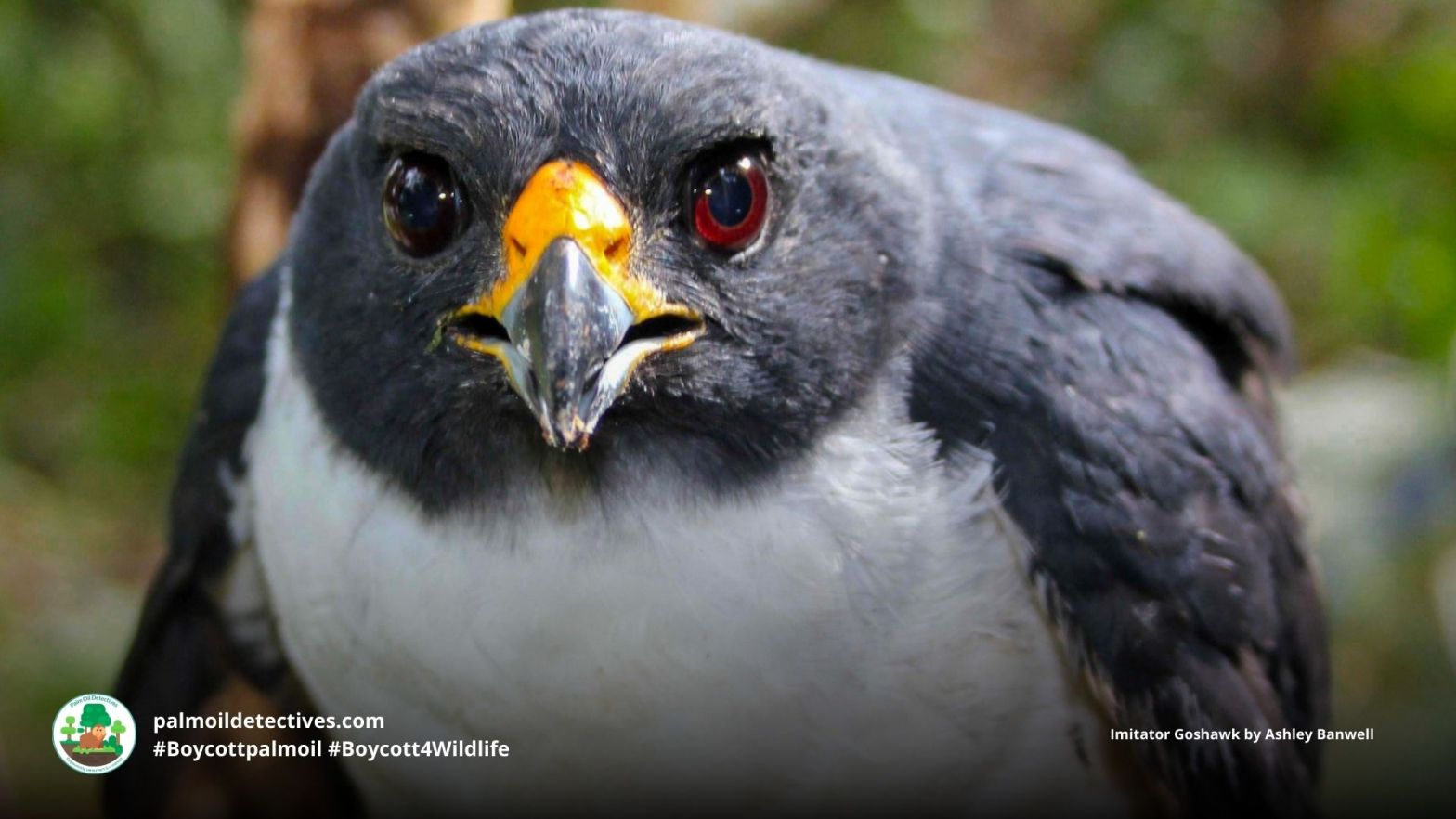
Imitator Goshawk Accipiter imitator
Red List Status: Vulnerable
Locations: Bougainville (Papua New Guinea), Choiseul and Santa Isabel (Solomon Islands)
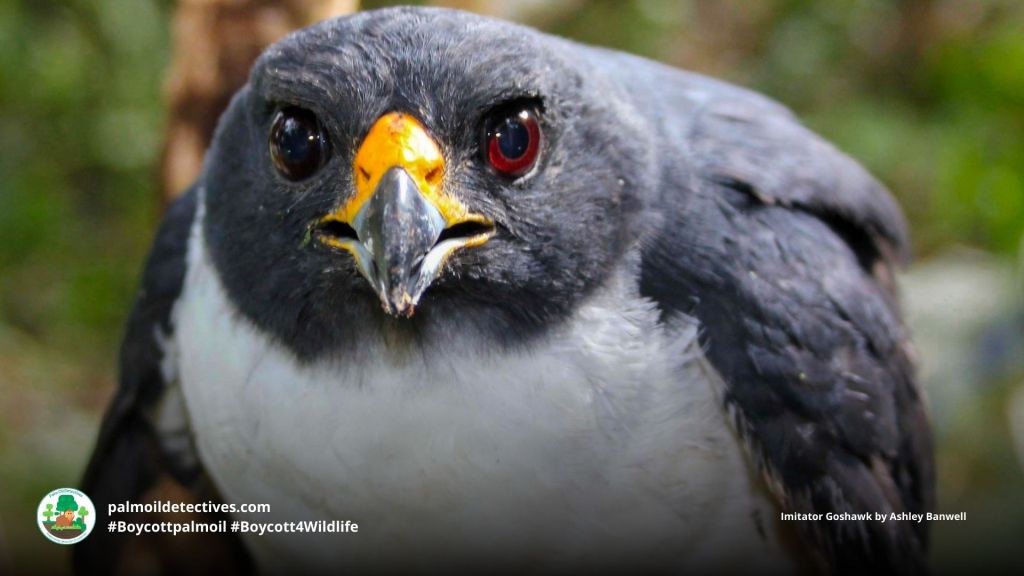
Deep within the old-growth forests of Papua New Guinea and Solomon Islands, lives a shrewd and magnificent hunter the Imitator Goshawk Tachyspiza imitator. One of the region’s most elusive and beautiful birds of prey. With only 250-999 mature individuals estimated across three islands, this vulnerable species faces mounting pressure from palm oil and timber deforestation. Their preference for pristine interior forest makes them particularly susceptible to habitat destruction as chainsaws carve through their ancient hunting grounds. Fight for their survival every time you shop #BoycottPalmOil #Boycott4Wildlife.
Imitator Goshawks 🦅🦉💗 are shrewd #raptors who are vulnerable in #PapuaNewGuinea 🇵🇬 #SolomonIslands 🇸🇧 due to #palmoil #deforestation and #mining. Help them every time you shop and #Boycottpalmoil 🌴🪔☠️🧐⛔️ #Boycott4Wildlife @palmoildetect https://palmoildetectives.com/2021/02/03/imitator-goshawk-accipiter-imitator/
Appearance and Behaviour
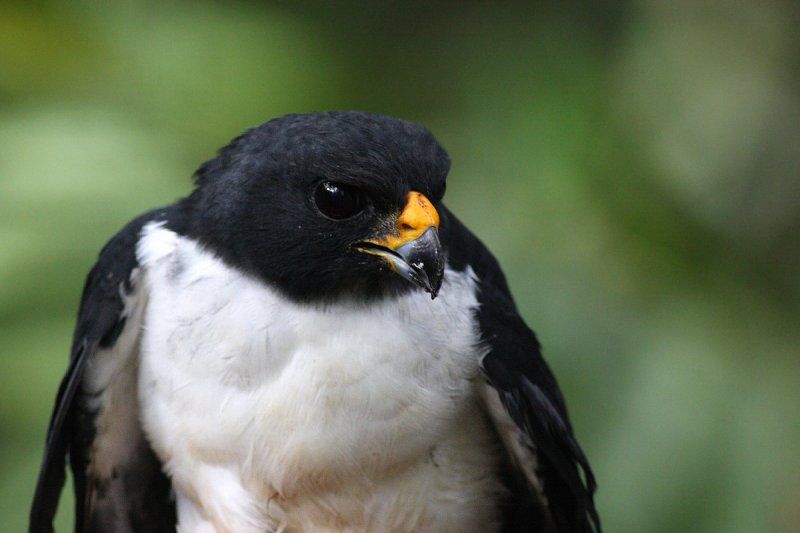
The Imitator Goshawk’s compact frame reflects perfect adaptation to dense forest hunting in Solomon Islands and New Guinea. Their shorter wings and tail, combined with notably longer legs, distinguish them from relatives and enable swift navigation through tangled branches. These forest phantoms move with fluid precision through the understory. These raptors lack the distinctive calls of their relatives, adding to their mysterious presence in the forest depths.
Their piercing eyes scan the forest floor and middle canopy with predatory focus, every sense attuned to subtle movements that betray prey. Unlike relatives who prefer forest edges, these raptors have evolved to claim the heart of the forest as their domain.
Diet
The secretive nature of Imitator Goshawks means their dietary preferences remain largely unknown. One remarkable observation captured them feeding on a smaller bird Chestnut-bellied Monarch Monarcha castaneiventris, demonstrating their ability to catch agile forest birds. Their longer legs suggest they may hunt from low perches, potentially targeting prey on the forest floor as well as in the canopy.
Reproduction and Mating
The breeding ecology of the Imitator Goshawk remains shrouded in mystery. Their nesting habits, courtship behaviours, and family structure have yet to be documented by researchers. This knowledge gap of birds of prey in Papua represents one of the most significant challenges in developing effective protection strategies for this vulnerable species.
Geographic Range
The Imitator Goshawk inhabits three islands across the Solomon Sea: Bougainville in Papua New Guinea, and Choiseul and Santa Isabel in the Solomon Islands. They occupy lowland forests and forest edges from sea level to at least 400 metres elevation, with possible sightings extending to 1,000 metres. Known from scattered specimens and rare sightings, the total population of 350-1,500 individuals appears to have declined on Choiseul and remains extremely rare throughout their range.
As a lowland and hill species with almost all records from old-growth forest, Imitator Goshawks are likely to be threatened by forest loss and degradation. Industrial logging continues on Choiseul and Santa Isabale (G. Dutson in litt. 2016) and logging may become a problem on Bougainville when the island opens up to development.
IUCN Red List
Threats
Timber and palm oil deforestation
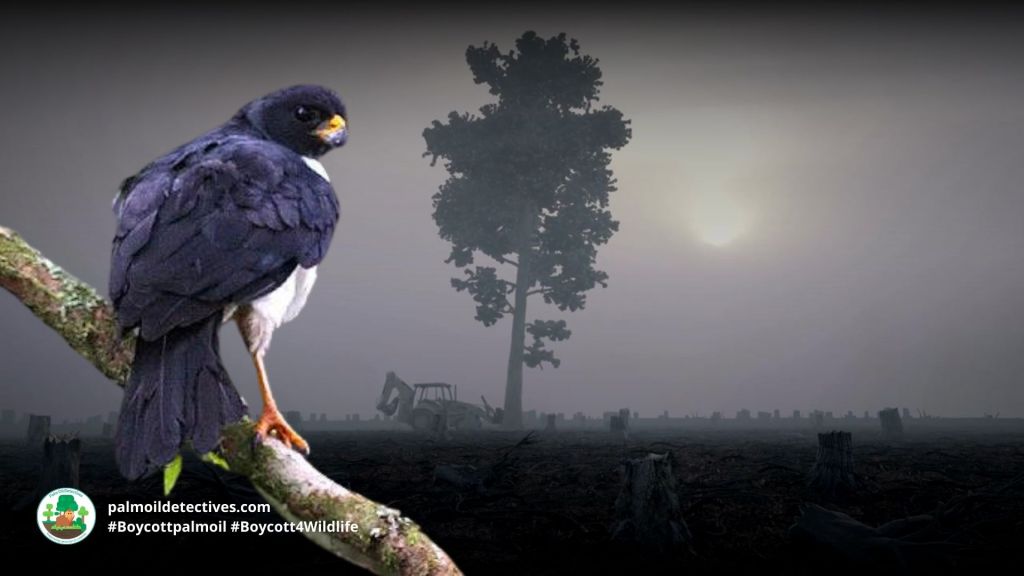
Industrial timber and palm oil operations continue across Choiseul and Santa Isabel, systematically removing the old-growth forests that Imitator Goshawks require. As chainsaws bite into centuries-old trees, the complex forest structure essential for these raptors disappears. The species shows clear preference for pristine forest and is rarely found in degraded areas, making them extremely vulnerable to ongoing timber and palm oil deforestation. Future development plans for Bougainville threaten to extend this destruction to their last stronghold.
Competition from Related Species
The Imitator Goshawk possibly faces competition from the closely related Accipiter albogularis, particularly in degraded forest areas where habitat quality has declined This interspecific competition may force Imitator Goshawks into suboptimal territories.
Limited Scientific Knowledge
The poorly understood ecology of this species creates challenges for effective protection strategies. Without detailed knowledge of their breeding requirements, population dynamics, and specific habitat needs, targeted protection efforts remain difficult to implement.
Take Action!
The Imitator Goshawk’s survival hangs by a thread with around 250-999 mature individuals left alive. Protect these enigmas of the rainforest every time you shop. Use your wallet as a weapon and #BoycottPalmOil #Boycott4Wildlife to reduce pressure on the forest ecosystems that these magnificent birds desperately need to survive.
FAQs
What is the current population of Imitator Goshawks?
Recent assessments estimate the global population at 250-999 mature individuals, equivalent to 350-1,500 total individuals across all three islands. This extremely small population makes the species highly vulnerable to extinction.
How long do Imitator Goshawks live?
The lifespan of Imitator Goshawks in the wild has not been documented due to limited research. We can hazard a guess from other medium-sized raptors, they likely live several years, but without detailed studies of marked individuals, their exact longevity remains unknown. Understanding their lifespan is crucial for developing effective protection strategies and assessing long-term viability of fragmented populations.
What makes Imitator Goshawks different from other goshawks?
The Imitator Goshawk’s distinctive shorter wings and tail combined with notably longer legs set them apart from related species and reflects their specialisation for hunting in dense forests. Their unique bodies mean they can manoeuvre through branches and foliage.
Further Information
BirdLife International. (2016). Accipiter imitator. The IUCN Red List of Threatened Species e.T.A. https://dx.doi.org/10.2305/IUCN.UK.2016-3.RLTS.T22695553A93515433.en
Bildstein, K. L., & Zalles, J. I. (2001). Conservation status of tropical raptors. Journal of Raptor Research, (1), 3-18. https://sora.unm.edu/sites/default/files/journals/jrr/v032n01/p00003-p00018.pdf
Griffiths, C. S., Barrowclough, G. F., Groth, J. G., & Mertz, L. A. (2007). Phylogeny, diversity, and classification of the Accipitridae based on DNA sequences of the RAG-gene. Journal of Raptor Research, (), 253-301.
Kane, S. A., Fulton, A. H., & Rosenthal, L. J. (2015). When hawks attack: animal-borne video studies of goshawk pursuit and prey-evasion strategies. Journal of Experimental Biology, (), 212-222. https://pmc.ncbi.nlm.nih.gov/articles/PMC4302165/
Lerner, H. R., & Mindell, D. P. (2005). Phylogeny of eagles, Old World vultures, and other Accipitridae based on nuclear and mitochondrial DNA. Molecular Phylogenetics and Evolution, (), 577-584.
Webb, M. (1997). Additional notes on the birds of Bougainville Island, Papua New Guinea. Muruk, 7(2), 37-56.
Support the conservation of this species
This animal has no protections in place. Read about other forgotten species here. Create art to support this forgotten animal or raise awareness about them by sharing this post and using the #Boycottpalmoil #Boycott4Wildlife hashtags on social media. Also you can boycott palm oil in the supermarket.



Further Information
BirdLife International. 2016. Accipiter imitator. The IUCN Red List of Threatened Species 2016: e.T22695553A93515433. https://dx.doi.org/10.2305/IUCN.UK.2016-3.RLTS.T22695553A93515433.en. Downloaded on 03 February 2021.


How can I help the #Boycott4Wildlife?
Take Action in Five Ways
1. Join the #Boycott4Wildlife on social media and subscribe to stay in the loop: Share posts from this website to your own network on Twitter, Mastadon, Instagram, Facebook and Youtube using the hashtags #Boycottpalmoil #Boycott4Wildlife.
2. Contribute stories: Academics, conservationists, scientists, indigenous rights advocates and animal rights advocates working to expose the corruption of the palm oil industry or to save animals can contribute stories to the website.




3. Supermarket sleuthing: Next time you’re in the supermarket, take photos of products containing palm oil. Share these to social media along with the hashtags to call out the greenwashing and ecocide of the brands who use palm oil. You can also take photos of palm oil free products and congratulate brands when they go palm oil free.
4. Take to the streets: Get in touch with Palm Oil Detectives to find out more.
5. Donate: Make a one-off or monthly donation to Palm Oil Detectives as a way of saying thank you and to help pay for ongoing running costs of the website and social media campaigns. Donate here
Discover more from Palm Oil Detectives
Subscribe to get the latest posts sent to your email.
 Palm Oil Detectives