
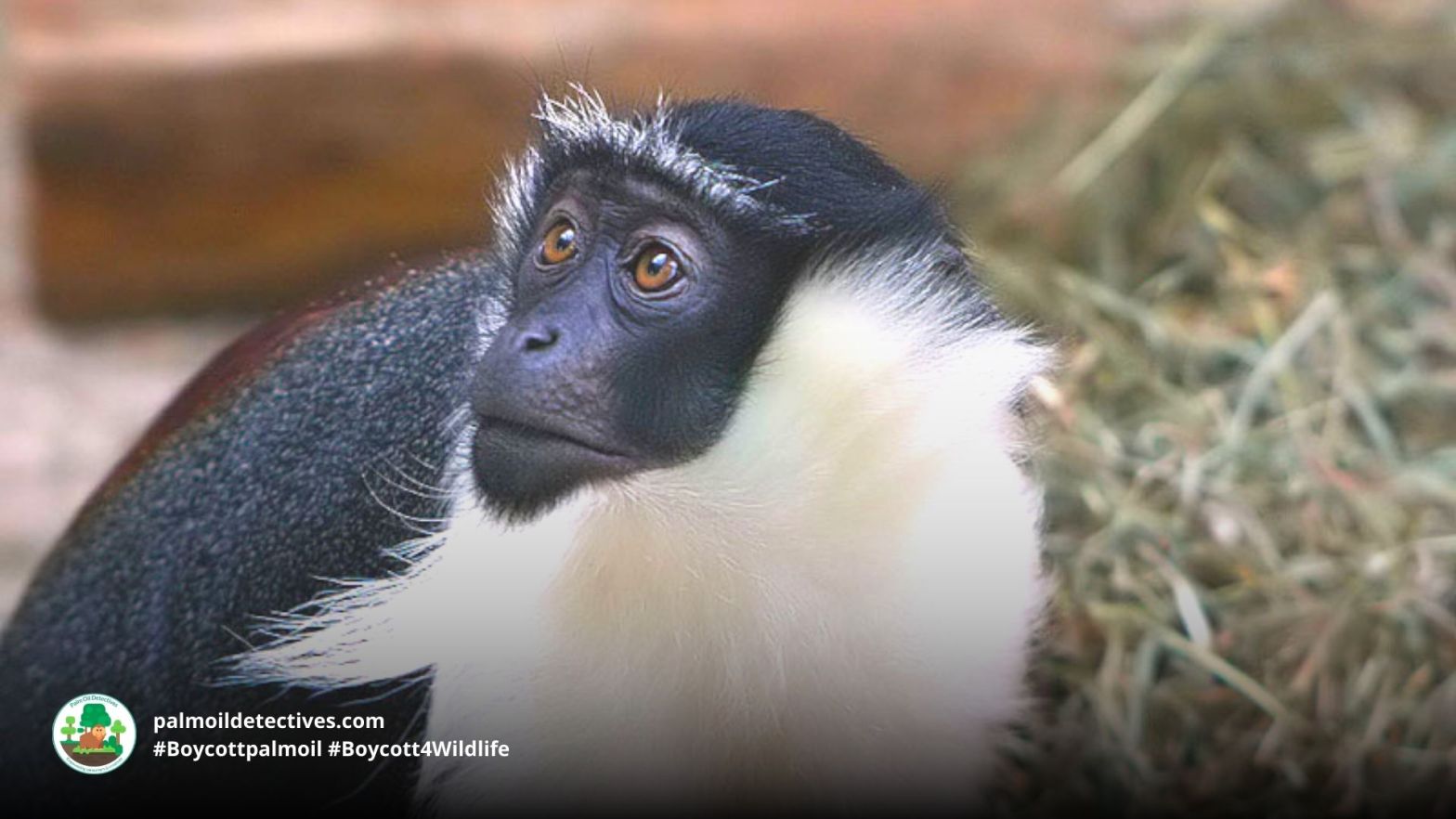
Roloway Monkey Cercopithecus roloway
Red List Status: Critically Endangered
Locations: Ghana (notably in the Kwabre and Ankasa forests) and south-eastern Côte d’Ivoire (especially Tanoé forest). The Roloway Monkey lives in the dense, humid canopies of the Upper Guinean rainforest, a region once stretching from the Sassandra River in Côte d’Ivoire to the Pra River in Ghana, now reduced to scattered fragments by logging, agriculture, and roads.
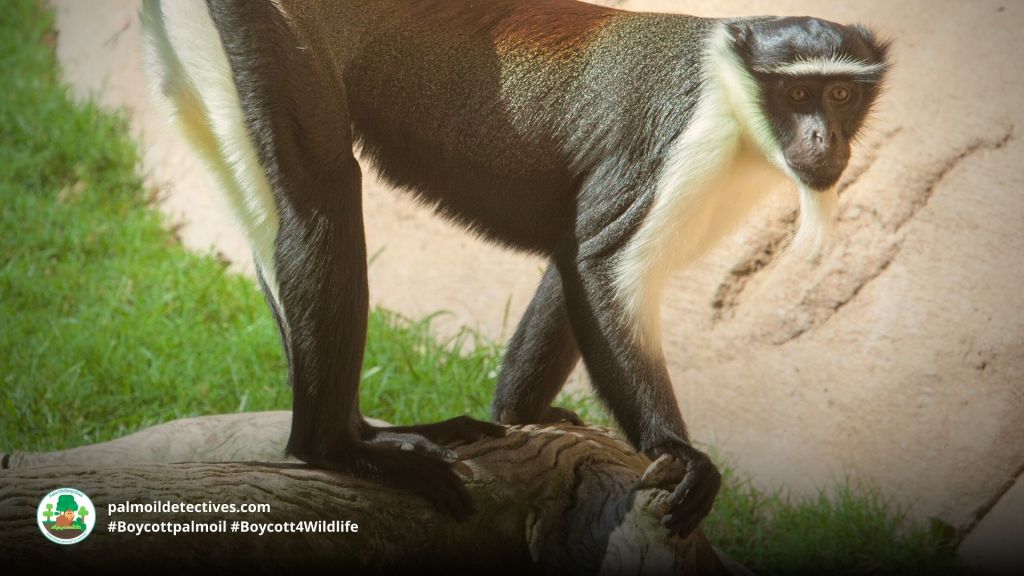
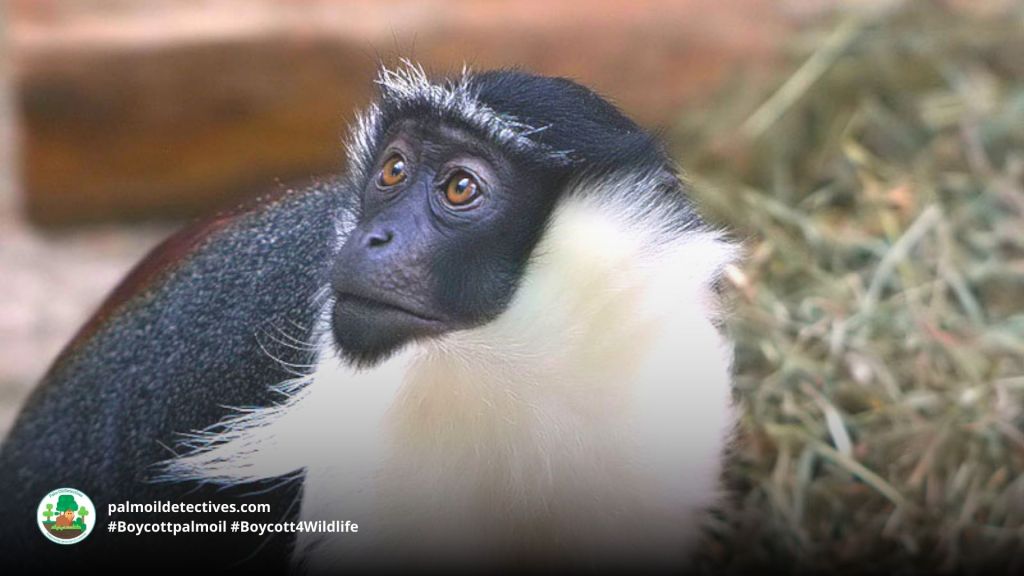
The Roloway Monkey is one of West Africa’s rarest primates, instantly recognisable by their elegant white beard and striking brow band. Once common in the lush rainforests of Ghana and Côte d’Ivoire, the Roloway Monkey now survives only in isolated pockets of old-growth forest. The Roloway Monkey’s world is shrinking rapidly—palm oil, cocoa, and logging companies clear the last ancient trees, while hunters target the Roloway Monkey for bushmeat. The air is thick with the scent of damp earth and the distant echo of chainsaws. With fewer than 2,000 Roloway Monkeys left, their future hangs by a thread. Stand with indigenous communities defending the last forests. Use your wallet as a weapon. #BoycottPalmOil #Boycott4Wildlife #Vegan
The Roloway #Monkeys of #IvoryCoast, #Ghana are 1 of the most threatened monkeys in the 🌍 Critically endangered 😿🐒🙈🙉🙊 their main threat is #palmoil and #mining #deforestation. Fight for them!! #Boycottpalmoil #Boycott4Wildlife @palmoildetect https://palmoildetectives.com/2021/02/15/roloway-monkey-cercopithecus-roloway/
Roloway #Monkeys of #IvoryCoast, #Ghana are encircled by #palmoil, #mining and #poaching threats. Critically endangered, they’re the cute #primate you have never heard of 🙉 Fight back and #Boycottpalmoil 🌴💩🔥👎 #Boycott4Wildlife! @palmoildetect https://palmoildetectives.com/2021/02/15/roloway-monkey-cercopithecus-roloway/
Appearance and Behaviour
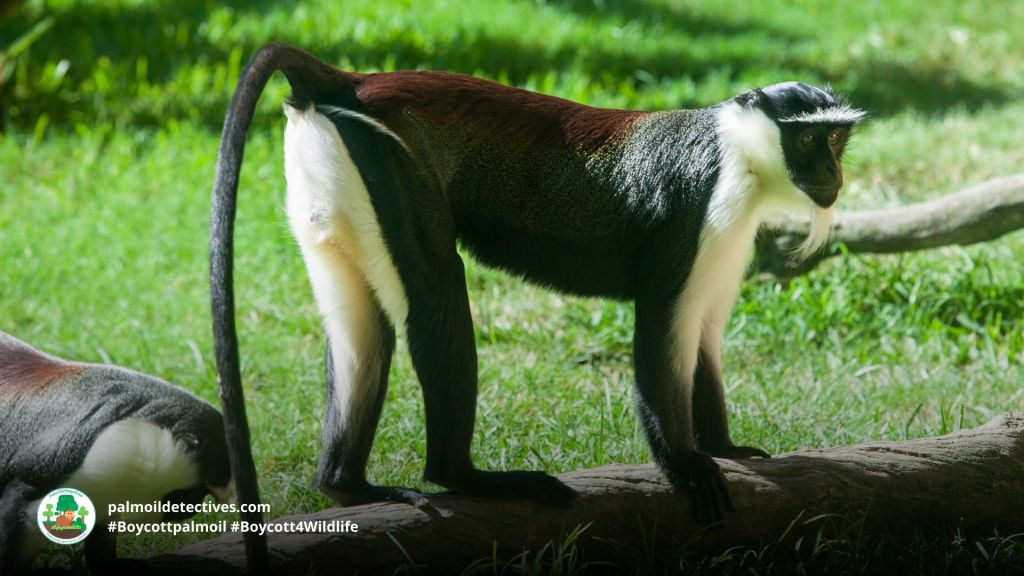
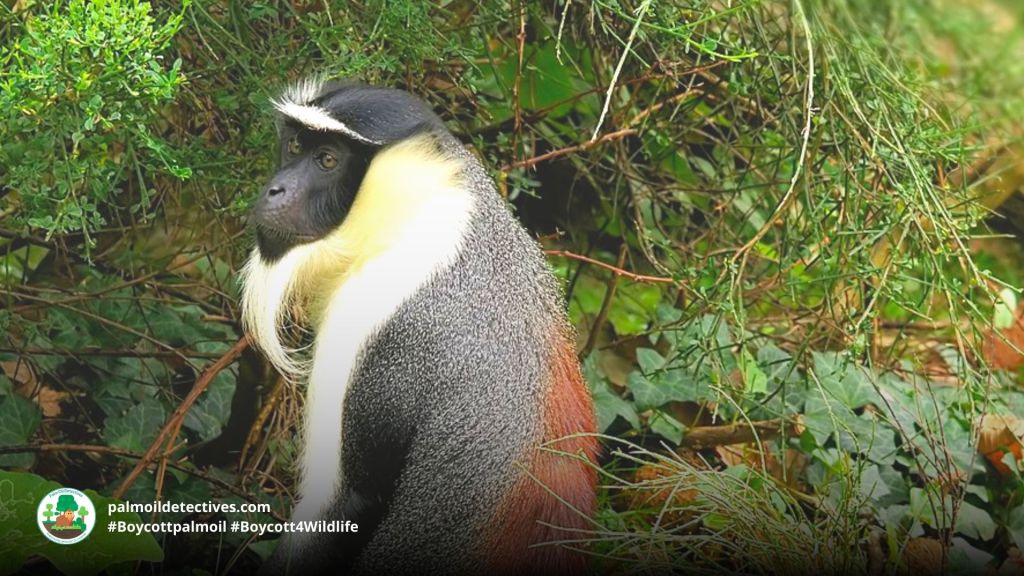
The Roloway Monkey is a medium-sized, long-limbed primate, weighing 4–7 kg and measuring 40–55 cm, with a tail that can reach 70 cm. The Roloway Monkey’s fur is glossy black with a white chest, throat, and a dramatic, bushy beard that frames their expressive face. Their brow is marked by a bold white band, and their long tail aids in balance as they leap and run through the high canopy. The Roloway Monkey is a high-canopy specialist, rarely descending to the ground. Troops of 6–30 individuals move quietly through the treetops, led by a single male and several females with their young. The Roloway Monkey is highly social, spending hours grooming, playing, and reinforcing family bonds. Their calls ring through the forest at dawn and dusk—a chorus of barks, trills, and alarm calls that warn of danger and keep the group together. The Roloway Monkey’s agility is unmatched, foraging among the terminal branches of emergent trees and using their keen eyesight to spot fruit and insects.
Threats
Large-scale deforestation in the region, through logging, conversion to agricultural land and charcoal production, continues to reduce the habitat available to this species, especially in Côte d’Ivoire (McGraw 1998, McGraw and Oates 2007, Bitty et al. 2015).
IUCN Red List
Palm oil, cocoa, and logging deforestation
The Red List classifies the Roloway Monkey as Critically Endangered due to catastrophic habitat loss. Over 80% of the Roloway Monkey’s original forest has been destroyed in the past three generations. Palm oil and cocoa plantations, logging, and road-building have stripped away the ancient canopy, leaving only fragments for the Roloway Monkey to survive. The Roloway Monkey cannot adapt to secondary or degraded forest and disappears quickly when humans encroach. Ghana alone has lost nearly 90% of its forests in the last century. The Roloway Monkey’s need for old-growth, undisturbed forest makes them especially vulnerable. As the forest vanishes, so do the Roloway Monkey’s food sources and safe nesting sites. Even within protected areas, illegal logging and land conversion continue, and the Roloway Monkey’s world grows ever smaller.
Bushmeat hunting and illegal wildlife trade
Bushmeat hunting is the greatest direct threat to the Roloway Monkey. Hunters target the Roloway Monkey for their meat, which is highly valued in local markets. The Roloway Monkey’s loud calls and social nature make them easy targets, and entire troops can be wiped out in a single hunt. Infants are sometimes captured alive for the illegal pet trade, suffering extreme stress and early death in captivity. The bushmeat trade in Ghana alone moves nearly 1,000 tons of meat annually, and the Roloway Monkey is among the most prized species. As populations dwindle, hunting pressure remains relentless, pushing the Roloway Monkey closer to extinction. Weak enforcement and poverty drive continued poaching, even in reserves.
Forest fragmentation and climate change
The Roloway Monkey’s habitat is now reduced to a handful of forest fragments in Ghana and Côte d’Ivoire. Populations are isolated, and inbreeding threatens genetic health. Roads and farms cut through the last forests, making it nearly impossible for the Roloway Monkey to move between fragments. Climate change brings longer dry seasons and unpredictable fruiting, further stressing the Roloway Monkey’s small, scattered groups. Surveys in once-occupied reserves now report zero sightings. The Roloway Monkey’s numbers have dropped by more than 90% in Ghana in recent decades, and fewer than 2,000 are thought to survive in the wild.
Diet
The Roloway Monkey is an omnivore, feeding on over 130 species of trees, climbers, and epiphytes. Their diet includes ripe fruit pulp, seeds (especially oil-rich seeds from Pycnanthus angolensis), young leaves, flowers, and a wide range of insects, larvae, and eggs. The Roloway Monkey’s diet shifts with the seasons—more fruit and seeds in the dry season, more insects and flowers in the wet. Their foraging helps disperse seeds and control insect populations, playing a vital role in the forest ecosystem.
Reproduction and Mating
The Roloway Monkey is polygynous, with one male leading a group of up to 30 females and their young. Females have a 30-day oestrus cycle and can breed at any time of year. After a gestation of about six months, the Roloway Monkey gives birth to a single infant, rarely twins. The mother is the primary carer, nursing the infant for about six months before introducing them to fruit, nuts, and seeds. Young Roloway Monkeys reach maturity at 3–4 years. Males leave to find new groups, while females remain with their birth troop. In the wild, the Roloway Monkey may live up to 20 years, but life expectancy is much lower due to hunting and habitat loss.
Geographic Range
This highly arboreal species was once confined to moist evergreen and moist semi-deciduous primary and old secondary lowland forests and swamp forests.
The Roloway Monkey is one of the most threatened monkeys of the Upper Guinean Forest block (Oates 1996). They have previously been recorded from a number of protected areas across the region. However, tragically recent surveys failed to confirm the presence of Roloway monkeys in several forest reserves in Côte d’Ivoire and Ghana. There is no known conservation project in place to protect them.
The Roloway Monkey was once found from the Sassandra River in Côte d’Ivoire east to the Pra River in Ghana. Today, the Roloway Monkey is confined to a few forest patches in south-eastern Côte d’Ivoire (notably Tanoé forest) and south-western Ghana (Kwabre forest). Recent surveys have found Roloway Monkeys in Dassioko Sud Forest Reserve and Petit Jacqueville, but their numbers are extremely low. The Roloway Monkey cannot survive in secondary forest or plantations, and their range continues to contract as forests are cleared.
FAQs
How many Roloway Monkeys remain in the wild?
Fewer than 2,000 Roloway Monkeys are thought to survive in the wild, with the largest populations in Tanoé forest (Côte d’Ivoire) and Kwabre forest (Ghana). Surveys in once-occupied reserves now report zero sightings, and the Roloway Monkey’s numbers have dropped by over 80% in three generations. The Red List lists the Roloway Monkey as Critically Endangered, and their population continues to decline. Without urgent action, the Roloway Monkey could vanish within a decade.
Why is the Roloway Monkey so threatened by palm oil and cocoa?
Palm oil and cocoa plantations have replaced vast areas of the Roloway Monkey’s old-growth forest. The Roloway Monkey cannot survive in monoculture plantations or secondary forest and disappears quickly when humans encroach. As the forest vanishes, the Roloway Monkey loses food sources, nesting sites, and safe corridors to move between groups. The expansion of palm oil and cocoa is the main driver of habitat loss for the Roloway Monkey.
Do Roloway Monkeys make good pets?
No. The Roloway Monkey suffers extreme stress, loneliness, and early death in captivity. The illegal pet trade rips families apart and fuels extinction. Captive Roloway Monkeys rarely survive long, and their removal from the wild further endangers the species. Keeping the Roloway Monkey as a pet is illegal and unethical
Take Action!
Use your wallet as a weapon and #BoycottPalmOil #Boycott4Wildlife. Support indigenous-led conservation and agroecology. Adopt a #vegan lifestyle and #BoycottMeat to protect wild and farmed animals alike. Fight for the Roloway Monkey’s survival every time you shop.
Support the conservation of this species
This animal has no protections in place. Read about other forgotten species here. Create art to support this forgotten animal or raise awareness about them by sharing this post and using the #Boycottpalmoil #Boycott4Wildlife hashtags on social media. Also you can boycott palm oil in the supermarket.
Further Information

Koné, I., Oates, J.F., Dempsey, A., Gonedelé Bi, S., McGraw, S. & Wiafe, E. 2019. Cercopithecus roloway. The IUCN Red List of Threatened Species 2019: e.T4232A92384429. https://dx.doi.org/10.2305/IUCN.UK.2019-1.RLTS.T4232A92384429.en. Downloaded on 15 February 2021.
Emmanuel Danquah1 and Elvis Hackman Tetteh Logging Activity Adversely Impacts Primate Diversity and Density in the Kwabre Rainforest of Ghana. International Journal of Ecology. https://doi.org/10.1155/2016/7497326
Curtin, S. (2002). The diet of the Roloway monkey (Cercopithecus diana roloway) in Bia National Park, Ghana. Journal of Tropical Ecology, 18(6), 789–797. https://www.cambridge.org/core/journals/journal-of-tropical-ecology/article/diet-of-the-roloway-monkey-cercopithecus-diana-roloway-in-bia-national-park-ghana/9E1E4E7F6E6A4A8A8B1E3C3E7B4B8A6C
Curtin, S. H. (2002). Diet of the Roloway Monkey, Cercopithecus diana roloway, in Bia National Park, Ghana. In M. E. Glenn & M. Cords (Eds.), The Guenons: Diversity and Adaptation in African Monkeys (pp. 351–371). Developments in Primatology: Progress and Prospects. Springer. https://link.springer.com/chapter/10.1007/978-1-4615-0893-4_16
Osei, D., Horwich, R. H., & Pittman, J. M. (2015). First sightings of the Roloway Monkey (Cercopithecus diana roloway) in Ghana in ten years and the status of other endangered primates in southwestern Ghana. African Primates, 10, 25–40. https://static1.1.sqspcdn.com/static/f/1200343/26671901/1447439294470/African+Primates+Vol+10+2015+Osei+et+al.pdf
Wikipedia contributors. (n.d.). Roloway monkey. Wikipedia. https://en.wikipedia.org/wiki/Roloway_monkey

How can I help the #Boycott4Wildlife?
Take Action in Five Ways
1. Join the #Boycott4Wildlife on social media and subscribe to stay in the loop: Share posts from this website to your own network on Twitter, Mastadon, Instagram, Facebook and Youtube using the hashtags #Boycottpalmoil #Boycott4Wildlife.
2. Contribute stories: Academics, conservationists, scientists, indigenous rights advocates and animal rights advocates working to expose the corruption of the palm oil industry or to save animals can contribute stories to the website.



3. Supermarket sleuthing: Next time you’re in the supermarket, take photos of products containing palm oil. Share these to social media along with the hashtags to call out the greenwashing and ecocide of the brands who use palm oil. You can also take photos of palm oil free products and congratulate brands when they go palm oil free.
4. Take to the streets: Get in touch with Palm Oil Detectives to find out more.
5. Donate: Make a one-off or monthly donation to Palm Oil Detectives as a way of saying thank you and to help pay for ongoing running costs of the website and social media campaigns. Donate here
Discover more from Palm Oil Detectives
Subscribe to get the latest posts sent to your email.
 Palm Oil Detectives