
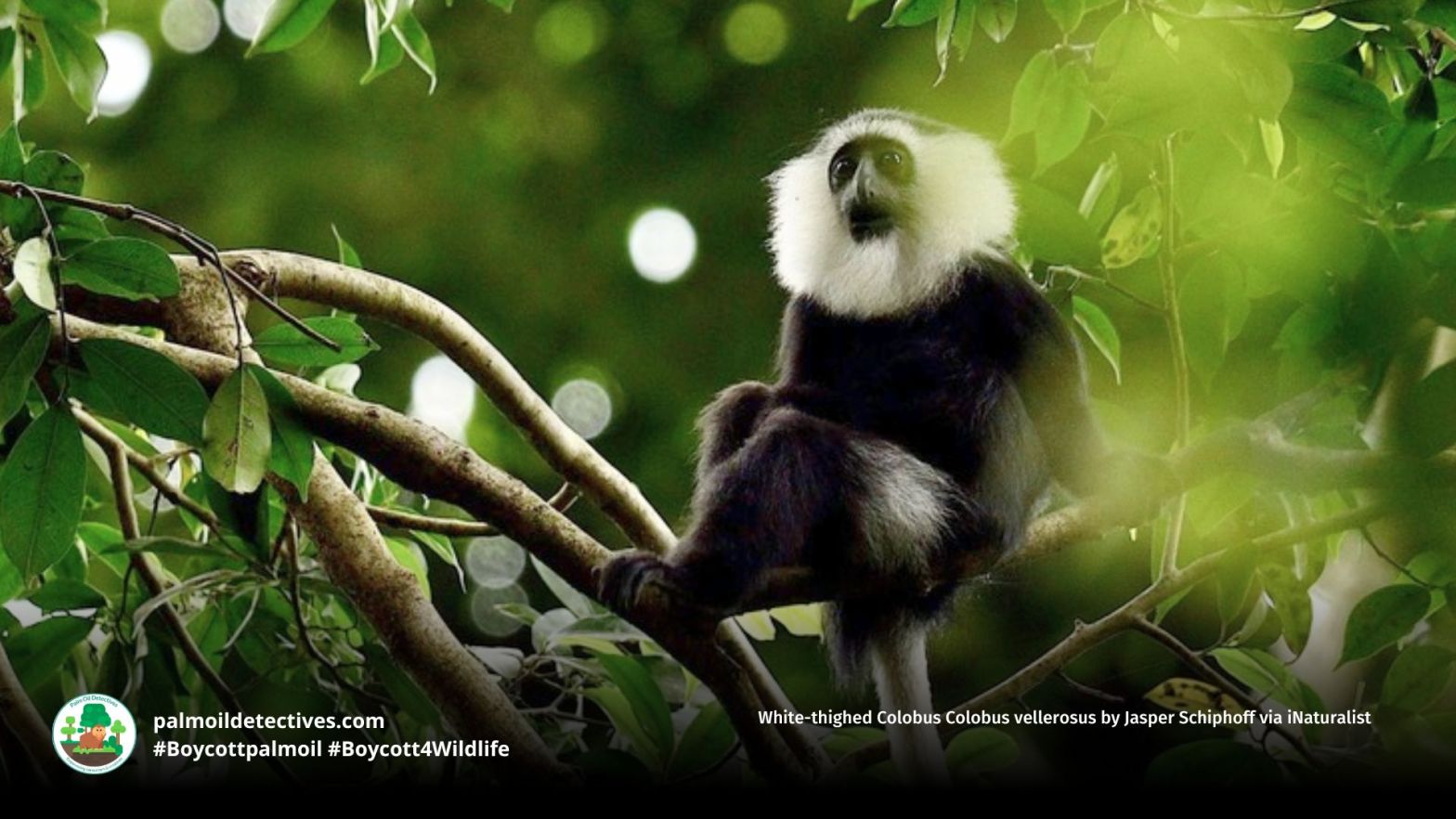
White-thighed Colobus Colobus vellerosus
IUCN Red List Status: Critically Endangered
Location: Ghana, Côte d’Ivoire, Benin, Togo, Nigeria, Burkina Faso
The White-thighed Colobus is found in the forests of West Africa, including lowland rainforest, semi-deciduous forest, gallery forest, and swamp forest. Key strongholds include the Boabeng-Fiema Monkey Sanctuary in Ghana and Kikélé Sacred Forest in Benin.
The White-thighed Colobus (Colobus vellerosus), also known as the Ursine Colobus or Geoffroy’s Black-and-White Colobus, is a striking primate of West Africa and is currently listed as Critically Endangered on the IUCN Red List. Their numbers have plummeted by over 80% in just three generations due to rampant deforestation driven by logging, agriculture, and expanding palm oil plantations. Intense bushmeat hunting and weakening traditional taboos have further accelerated their decline. With fewer than 1,500 individuals thought to remain in the wild, urgent action is needed to save them. Use your wallet as a weapon—boycott products that contain palm oil and support ethical, indigenous-led conservation. BoycottPalmOil #Boycott4Wildlife #Vegan #BoycottMeat
The White-thighed #Colobus of #Ghana are critically endangered #monkeys 🐒🙈🧐🙊 Big brands are destroying their home for #palmoil, edging them towards #extinction. Take action! #Boycottpalmoil 🌴🚫 #Boycott4Wildlife @palmoildetect https://palmoildetectives.com/2021/02/15/white-thighed-colobus-colobus-vellerosus/
With complex vocalisations and striking halos of white hair, the White-thighed #Colobus 🐵🐒🩷 are arguably rarest #primates in #WestAfrica 🇨🇮 🇬🇭 Help them to survive when you #BoycottPalmOil 🌴🪔🔥🧐⛔️ #Boycott4Wildlife in the supermarket! @palmoildetect https://palmoildetectives.com/2021/02/15/white-thighed-colobus-colobus-vellerosus/
Appearance and Behaviour
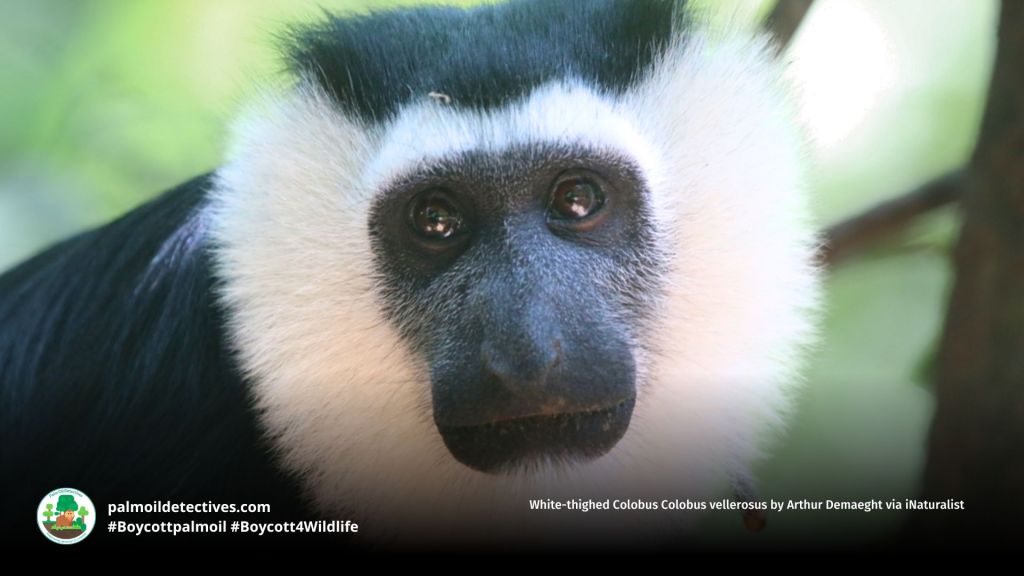
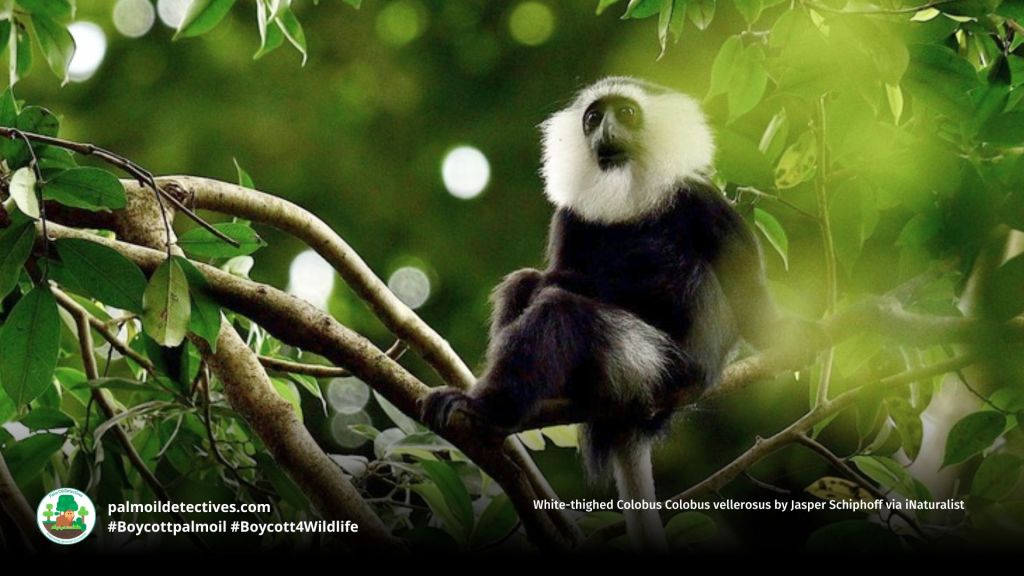
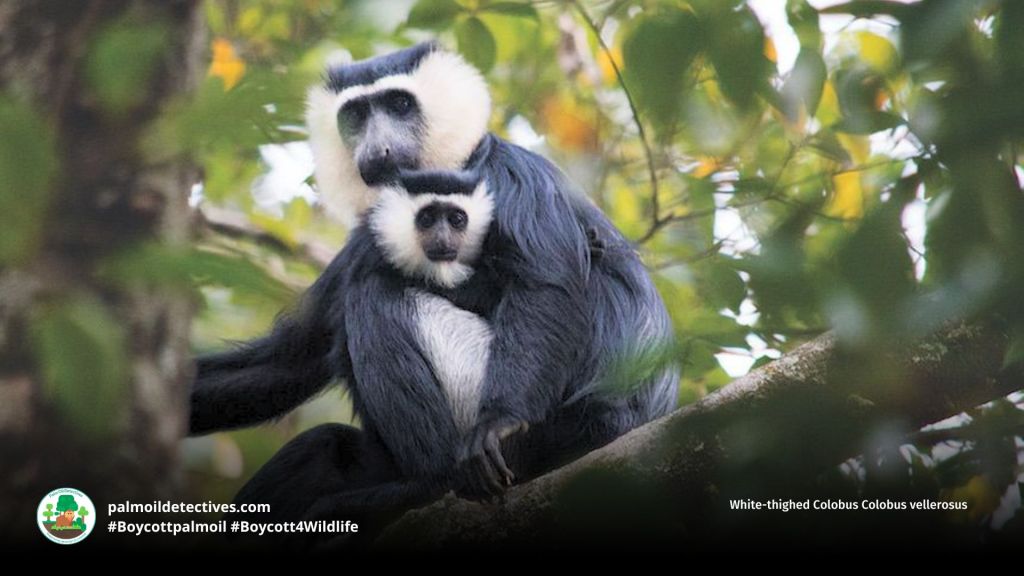
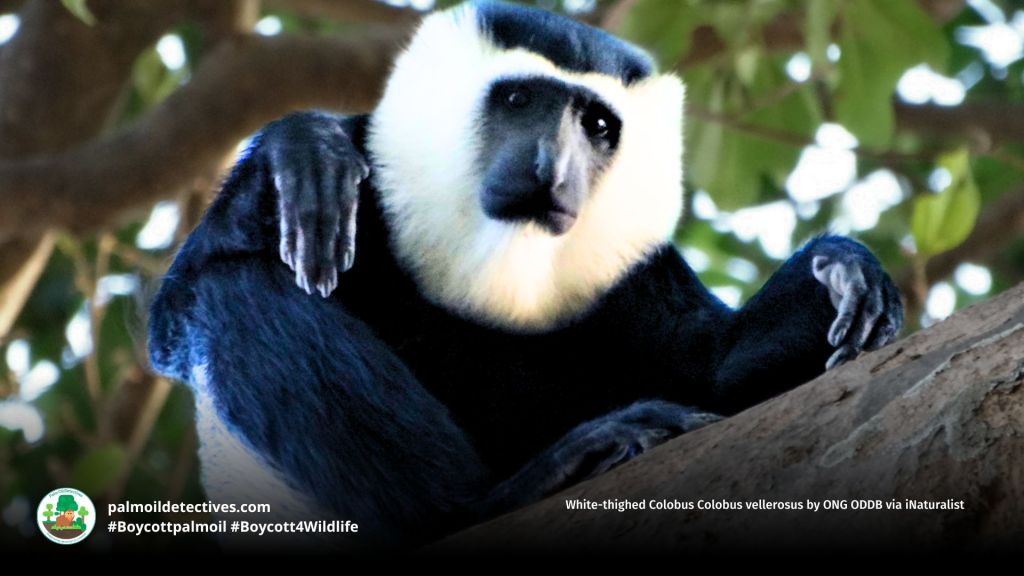
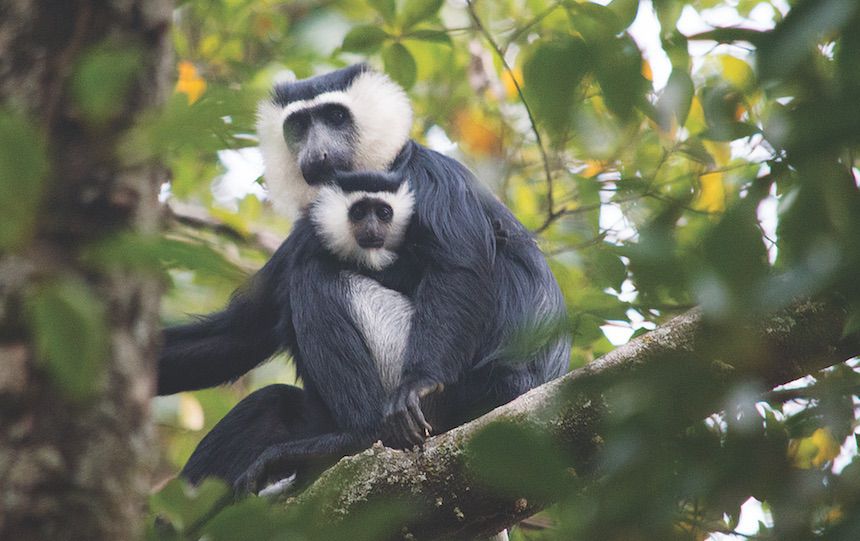
The White-thighed Colobus is instantly recognisable by its black fur offset with bright white patches on the thighs and a halo of thick white fur surrounding their bare black face. Their long, fully white tail and slender body give them a unique silhouette among colobines. Infants are born completely white and darken to adult colouration by around three months.
In both Côte d’Ivoire and Ghana, more than half of the closed forest in the forest reserves has been converted to plantation or farmland, or cleared and left bare (Bitty et al. 2015).
IUCN Red List
These monkeys are highly arboreal, agile, and diurnal, moving through the canopy with grace. Their complex vocal repertoire includes deep roaring calls to defend territories and sharp snorts as alarm signals. Group structure typically includes one territorial male with multiple females and their offspring, though multi-male groups are also observed.


Diet
Primarily folivorous, the White-thighed Colobus feeds on young leaves, seeds, fruits, buds, flowers, and bark. Their diet includes more than 30 plant species and varies with seasonal availability. In Kikélé Sacred Forest, they consume large amounts of leaves (over 60%), followed by fruits and other plant parts. They occasionally supplement their diet with termite clay.
Reproduction and Mating
Groups of these colobuses typically include one or more adult males, several females, and their offspring. Group sizes range from 10 to 25 individuals. Breeding occurs year-round, with a likely peak during the dry season. Infants are closely cared for by mothers and other females, fostering a strong social structure. Males often disperse upon reaching sexual maturity.
Geographic Range
The species is found in Ghana, Côte d’Ivoire, Benin, Nigeria, Togo, and possibly the southernmost tip of Burkina Faso. It has been extirpated from many forest reserves in Ghana and Côte d’Ivoire due to extreme hunting and forest clearance. Populations remain in Boabeng-Fiema Monkey Sanctuary (Ghana), Comoé National Park (Côte d’Ivoire), Fazao-Malfakassa National Park (Togo), and Kikélé Sacred Forest (Benin). It is likely extinct in Burkina Faso.
Threats
The White-thighed Colobus is threatened primarily by hunting and secondarily by habitat loss (McGraw 2005). Accelerated hunting pressure is discernible from reported changes in hunters’ behaviour in the species’ range countries. Thirty years ago, hunters in Ghana and Côte d’Ivoire almost always hunted only larger-bodied animals, but now they are mostly hunting smaller-bodied animals because of the depletion of large primates like C. vellerosus (Decher and Kpelle 2005, Gonedelé Bi et al. 2016).
In Comoé National Park in Côte d’Ivoire, several groups remain, but hunting pressure and mining occur although some patrol is in place.
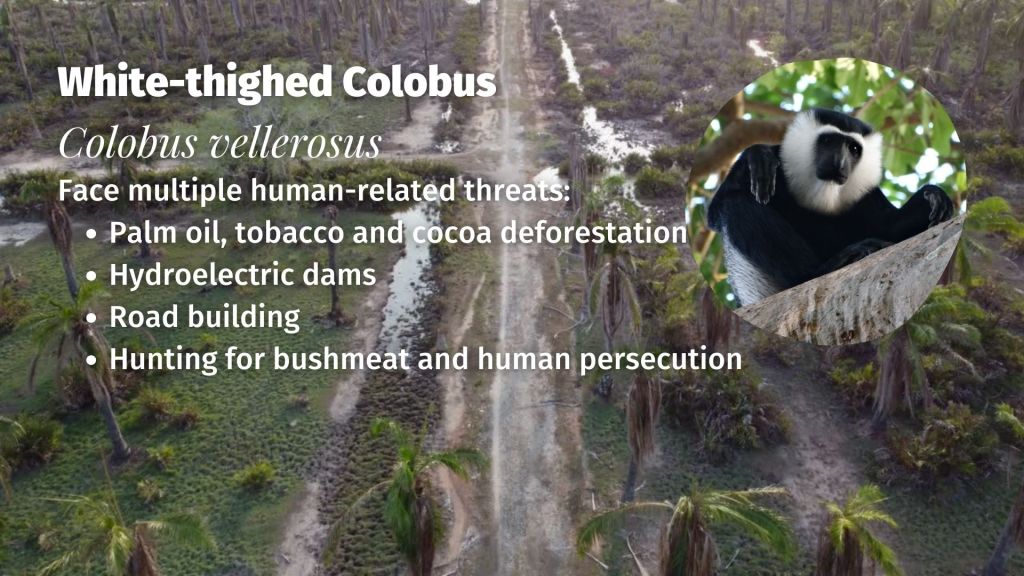
- Deforestation from logging, agriculture, road building, and palm oil plantations has fragmented and destroyed their habitat.
- Palm oil, tobacco and cocoa expansion and industrial production is a major driver of forest clearance across West Africa, particularly in Ghana and Côte d’Ivoire.
- Hunting for bushmeat is rampant, including in protected areas and sacred groves.
- Collapse of traditional taboos that once protected the species has made them vulnerable to killing by local communities.
- Hydropower development, such as the proposed Adjarala dam on the Mono River, threatens forests in Benin and Togo.
- Infrastructure expansion and human settlement continue to encroach on remaining habitats.
Take Action!
Use your wallet as a weapon. Boycott products that contain palm oil—this is one of the leading causes of deforestation that is destroying the forests of the White-thighed Colobus. Avoid meat and dairy, which drive land clearing for grazing and feed crops. Support indigenous-led conservation and community-based sanctuaries like Boabeng-Fiema. Demand governments halt infrastructure projects in critical habitat areas. Take action every time you shop BoycottPalmOil #Boycott4Wildlife be #Vegan and #BoycottMeat
FAQs
How many White-thighed Colobus are left in the wild?
Recent estimates suggest fewer than 1,500 individuals remain across their entire range (IUCN, 2020). In some places, only a few isolated groups survive, such as in Kikélé Sacred Forest (Benin) and Boabeng-Fiema Monkey Sanctuary (Ghana).
What is the average lifespan of the White-thighed Colobus in the wild?
While specific data are scarce, similar species of colobus monkeys live up to 20 years in the wild. In captivity, they may live slightly longer under optimal care.
How are White-thighed Colobuses affected by palm oil?
Palm oil plantations are expanding rapidly in West Africa, replacing biodiverse forests with monocultures. This directly destroys the colobus monkeys’ food sources, sleeping trees, and corridors between forest patches. Products with palm oil continue to drive this destruction.
What are the biggest threats to the White-thighed Colobus?
Besides palm oil, the main threats include logging, conversion of forest to farmland, hunting for bushmeat, infrastructure development (roads and dams), and the erosion of traditional beliefs that once protected them.
Are White-thighed Colobuses sacred to local communities?
Yes, in areas like Boabeng-Fiema and Kikélé, they are considered sacred and are given burial rites. However, these traditions are fading, and poaching still occurs.
Support the conservation of this species
Further Information

Arseneau-Robar, T. J., Teichroeb, J. A., Macintosh, A. J. J., Saj, T. L., Glotfelty, E., Lucci, S., Sicotte, P., & Wikberg, E. C. (2024). When population growth intensifies intergroup competition, female colobus monkeys free-ride less. Scientific Reports, 14, Article 14363. https://doi.org/10.1038/s41598-024-64188-0
Djègo-Djossou, S., Koné, I., Fandohan, A. B., Djègo, J. G., Huynen, M. C., & Sinsin, B. (2015). Habitat Use by White-Thighed Colobus in the Kikélé Sacred Forest: Activity Budget, Feeding Ecology and Selection of Sleeping Trees. Primate Conservation, 2015(29), 97–105. https://doi.org/10.1896/052.029.0106
Kankam, B. O., Antwi-Bosiako, P., Addae-Wireko, L., & Dankwah, C. (2023). Growing population of the critically endangered white-thighed colobus monkey (Colobus vellerosus) from forest fragments in Ghana. Journal of Tropical Ecology, 39, e33. doi:10.1017/S0266467423000214
Matsuda Goodwin, R., Gonedelé Bi, S., Nobimè, G., Koné, I., Osei, D., Segniagbeto, G. & Oates, J.F. 2020. Colobus vellerosus. The IUCN Red List of Threatened Species 2020: e.T5146A169472127. https://dx.doi.org/10.2305/IUCN.UK.2020-2.RLTS.T5146A169472127.en. Downloaded on 15 February 2021.
Mohamed bin Zayed Species Conservation Fund. (2021). White-thighed Colobus – Project No. 202525581. https://www.speciesconservation.org/case-studies-projects/white-thighed-colobus/25581

How can I help the #Boycott4Wildlife?
Take Action in Five Ways
1. Join the #Boycott4Wildlife on social media and subscribe to stay in the loop: Share posts from this website to your own network on Twitter, Mastadon, Instagram, Facebook and Youtube using the hashtags #Boycottpalmoil #Boycott4Wildlife.
2. Contribute stories: Academics, conservationists, scientists, indigenous rights advocates and animal rights advocates working to expose the corruption of the palm oil industry or to save animals can contribute stories to the website.


3. Supermarket sleuthing: Next time you’re in the supermarket, take photos of products containing palm oil. Share these to social media along with the hashtags to call out the greenwashing and ecocide of the brands who use palm oil. You can also take photos of palm oil free products and congratulate brands when they go palm oil free.
4. Take to the streets: Get in touch with Palm Oil Detectives to find out more.
5. Donate: Make a one-off or monthly donation to Palm Oil Detectives as a way of saying thank you and to help pay for ongoing running costs of the website and social media campaigns. Donate here
Discover more from Palm Oil Detectives
Subscribe to get the latest posts sent to your email.
 Palm Oil Detectives
3 thoughts on “White-thighed Colobus Colobus vellerosus”