

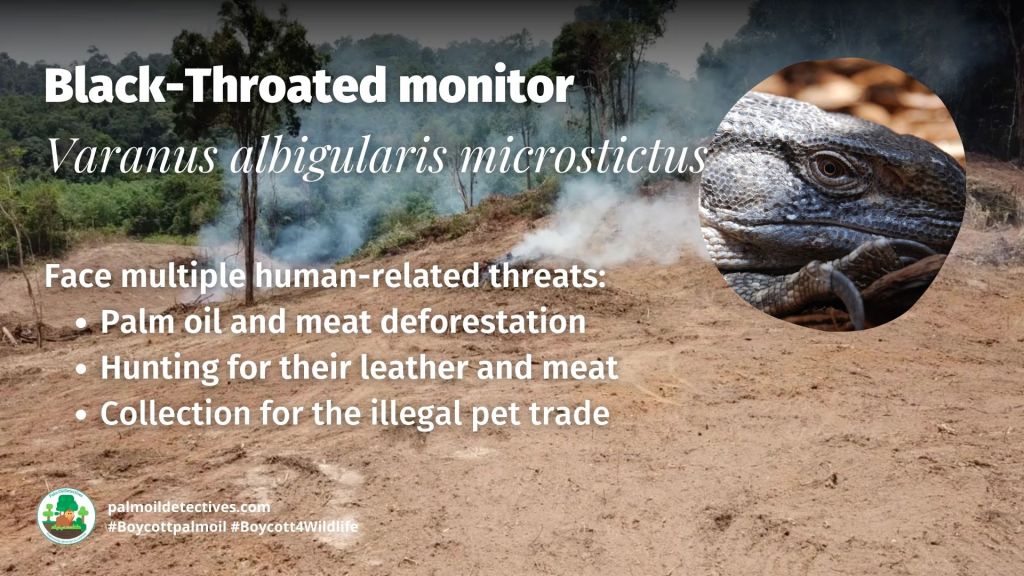
Black-Throated monitor Varanus albigularis microstictus
Data Deficient
Tanzania
The Black-Throated Monitor is a mighty and large lizard reaching over 2 metres long. They are threatened by agriculture deforestation and #hunting for their leather and meat in Tanzania, Africa. Help them every time you shop and #Boycottpalmoil #Boycott4Wildlife
The Black-Throated Monitor is a mighty lizard 🦎💚 reaching over 2 metres long in #Tanzania 🇹🇿 Threatened by #agriculture #deforestation and #hunting for the #leather trade in #Tanzania #Africa. Help them and #Boycott4Wildlife 🌴🪔🧐⛔️ @palmoildetect https://palmoildetectives.com/2021/08/07/black-throated-monitor-varanus-albigularis-microstictus/
The Black-throated Monitor, also known as the Rock Monitor Varanus albigularis is a species of monitor lizard in the family Varanidae. The species is endemic to Central, East, and southern Africa and live in Tanzania. Black-throated Monitors are usually a dark gray-brown with yellowish or white markings, and can reach up to 2.1 m in total length (including tail) and weigh more than 27 kilos. They are the largest of the four subspecies of rock monitor, V. Albigularis.
Monitors are periodically killed from the wild for various reasons, which can include for the leather and pet trade, and also as food by native human populations. An additional threat is non-timber crops and agroforestry.
IUCN red list



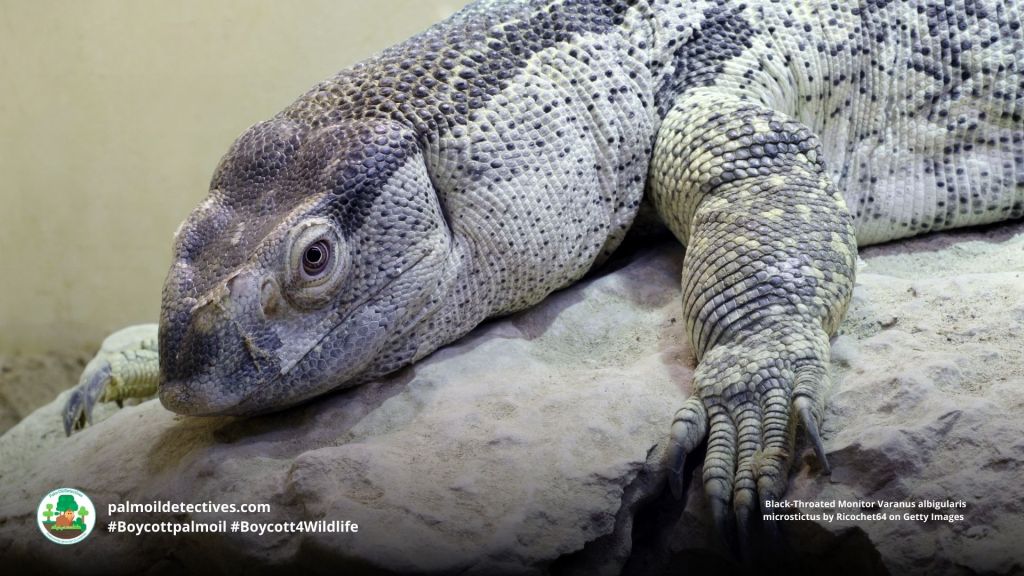
In captivity, Black Throated Monitors eat whole prey, such as mice, rats, snakes, lizards, freshwater mollusks, small birds, large roaches, crustaceans, fish, and eggs. They will commonly accept cat and dog food, which is not acceptable as a staple diet due to an improper nutrient profile and high caloric content. In the wild, they will eat anything that they can catch.
Presently, all of the 58 or more species of monitors are classified by the Convention on International Trade in Endangered Species of Wild Fauna and Flora (CITES) as at least Appendix II, which indicates that they are considered potentially threatened and could become vulnerable if trade in these lizards is not regulated. Some monitor species have been or still are classified as Appendix I (endangered).
The ruthless exploitation of many monitor species is very likely causing their populations to decline, and because the population dynamics for monitor species are largely unknown, it is impossible to say just how many individuals can be safely harvested from wild populations without seriously affecting their long-term sustainability.
You can support this beautiful animal
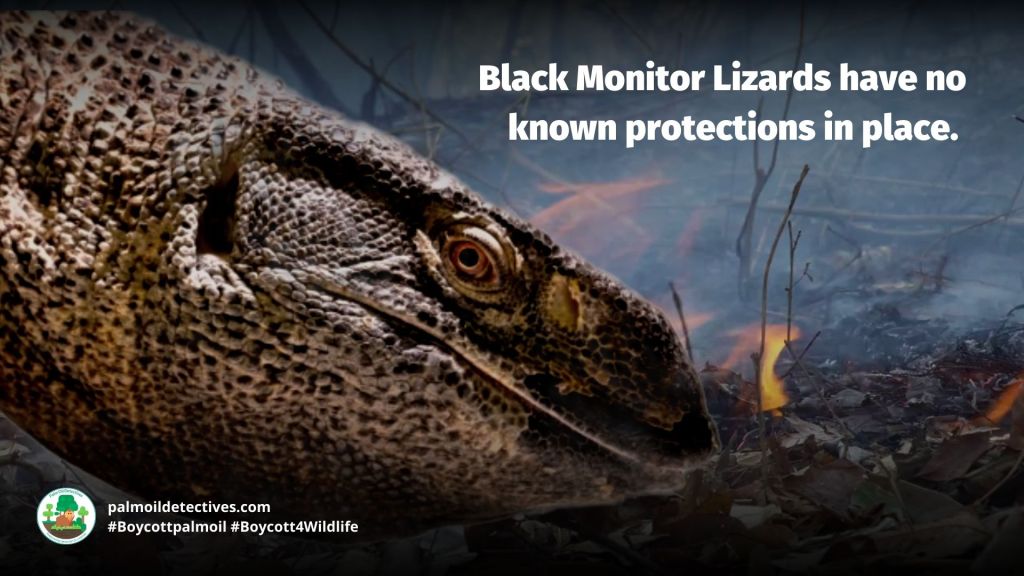
There are no known conservation activities for this animal. Share out this post to social media and join the #BoycottPalmOil #Boycott4Wildlife on social media to raise awareness
Further Information

How can I help the #Boycott4Wildlife?
Take Action in Five Ways
1. Join the #Boycott4Wildlife on social media and subscribe to stay in the loop: Share posts from this website to your own network on Twitter, Mastadon, Instagram, Facebook and Youtube using the hashtags #Boycottpalmoil #Boycott4Wildlife.
2. Contribute stories: Academics, conservationists, scientists, indigenous rights advocates and animal rights advocates working to expose the corruption of the palm oil industry or to save animals can contribute stories to the website.



3. Supermarket sleuthing: Next time you’re in the supermarket, take photos of products containing palm oil. Share these to social media along with the hashtags to call out the greenwashing and ecocide of the brands who use palm oil. You can also take photos of palm oil free products and congratulate brands when they go palm oil free.
4. Take to the streets: Get in touch with Palm Oil Detectives to find out more.
5. Donate: Make a one-off or monthly donation to Palm Oil Detectives as a way of saying thank you and to help pay for ongoing running costs of the website and social media campaigns. Donate here
Discover more from Palm Oil Detectives
Subscribe to get the latest posts sent to your email.
 Palm Oil Detectives
What an incredible creature! Thank you for sharing this.
LikeLiked by 1 person
You’re welcome Kaleigh I’m glad you enjoyed hearing about this beautiful lizard, it would be amazing to see one in real life, but in a forest not in a Zoo!
LikeLiked by 1 person