
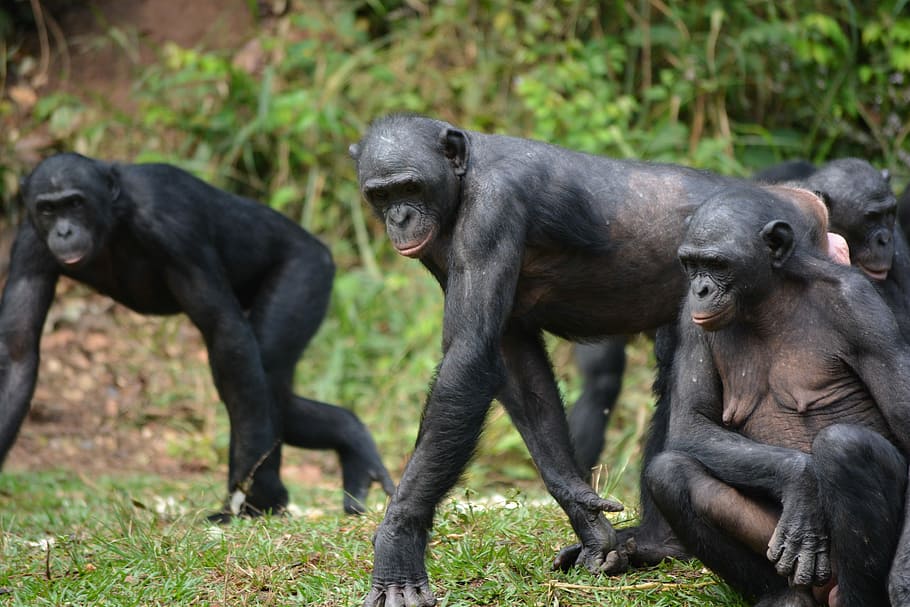
New research shows that for #bonobos, sex really is often a family affair. What’s more, rather than being an embarrassing hindrance, motherly presence greatly benefits bonobo sons during the deed.
Along with #chimpanzees (Pan troglodytes), bonobos (Pan paniscus) are our closest living relatives. Restricted to a 500,000 km² thickly-forested zone of the #Congo Basin, these endangered great apes were only formally discovered in 1928, which until 2017 made them the most recently-described living great ape species.
Operating in female-led social systems, bonobos are capable of showing a wide range of what were long held as human-specific feelings and emotions, such as sensitivity, patience, compassion, kindness, empathy and altruism. Help them to survive every time you shop #BoycottPalmOil #Boycott4Wildlife
#Bonobos are the ‘make love not war’ #ape 🩷🦍 One #study found #bonobo mothers who meddle in their son’s sex lives help them father children. Protect these precious intelligent beings #BoycottPalmOil 🌴🪔🙊⛔️ #Boycott4Wildlife @palmoildetect https://palmoildetectives.com/2022/03/27/bonobo-mothers-meddle-in-their-sons-sex-lives-making-them-three-times-more-likely-to-father-children/

They’re also perhaps the most promiscuous non-human species on the planet. While chimpanzee sex is tied closely to reproduction, up to 75% of bonobo sexual behaviour is purely for pleasure. From saucy greetings and social bonding to conflict resolution and post-conflict make-up sex, sex serves hugely important functions in most aspects of bonobo social behaviour. Even the mere discovery of a new food source or feeding ground is enough to spark a wave of communal sexual activity.
It seems that the number of reasons for a bonobo to have sex is surpassed only by the number of forms in which they do it. Indiscriminate of sex and age, the only combination strictly off limits in bonobo society is between a mother and her mature son.
In addition to standard penetrative encounters, they frequently engage in manual genital massage and oral sex. These positionally creative apes are also the only animal (other than us) to practice tongue-on-tongue kissing or face-to-face penetrative sex. The prominence of bonobos’ sexual behaviour in social life has led researchers to brand bonobos as the “make-love-not-war apes”.
Meddling mothers
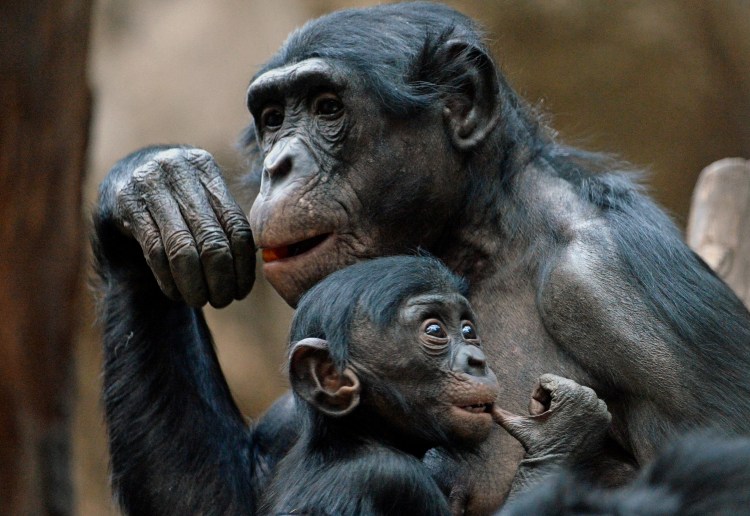
Bonobo mothers, however, seem to make a war out of seeing their sons successfully make love. They’ve frequently been observed to form coalitions with their sons to help them acquire and maintain high dominance rank, protect their sons’ mating attempts from interference by other males and even interfere in the mating attempts of other, unrelated males.
The new research, published in Current Biology, shows that these strategies pay off. Males who had a mother present in their social group engaging in these behaviours were about three times more likely to produce offspring than males whose mothers were no longer part of the group.
Mothers of successful bonobo fathers were present more than twice as frequently during conception than in chimpanzees, a species in which males are socially dominant, and in which maternal presence provided no benefit to sons. Thus, it appears that the dominance of females in bonobo social systems allows mothers to exert behavioural influence to boost the sexual fitness of their sons.
This elevated female social power doesn’t just let bonobo mums get involved in their families’ sex lives, but is likely responsible for a host of peaceful and progressive traits rarely seen in the mammal world. Females practice sex even when not ovulating, male-male competition is much reduced, and the species is remarkably tolerant to bonobos from outside of their social group. Perhaps us humans ought to take note of how positively society can change when females are in positions of influence. It’s probably better if we keep our sex lives parent-free, though.
Ben Garrod, Professor of Evolutionary Biology and Science Engagement, University of East Anglia
This article is republished from The Conversation under a Creative Commons license. Read the original article.
How can I help the #Boycott4Wildlife?
1. Join the #Boycott4Wildlife: Share posts from this website to your own network on Twitter, Instagram and Facebook using the hashtags #Boycottpalmoil #Boycott4Wildlife.
2. Contribute stories: Academics, conservationists, scientists, indigenous rights advocates and animal rights advocates working to expose the corruption of the palm oil industry or to save animals can contribute stories to the website.
3. Supermarket sleuthing: Next time you’re in the supermarket, take photos of products containing palm oil. Share these to social media along with the hashtags to call out the greenwashing and ecocide of the brands who use palm oil. You can also take photos of palm oil free products and congratulate brands when they go palm oil free.
4. Take to the streets: Get in touch with Palm Oil Detectives to find out more.
5. Donate: Make a one-off or monthly donation to Palm Oil Detectives as a way of saying thank you or to help pay for ongoing running costs.
Share palm oil free purchases online and shame companies still using dirty palm oil!
Don’t forget to tag in #BoycottPalmOil #Boycott4Wildlife to get shared
Discover more from Palm Oil Detectives
Subscribe to get the latest posts sent to your email.
 Palm Oil Detectives