
Like many countries, Indonesia’s online space is polluted by fake news, misinformation, and disinformation. As the country’s digital economy continues to grow, the government is focusing on cleaning it up. #Indonesia’s 🇮🇩 government has funded a media literacy program. Rather than stopping #greenwashing and #misinformation – it may serve government interests #corruption 🤑💰🧐 #Boycottpalmoil 🌴🪙🪔🔥🙊🚫#Boycott4Wildlife
#Indonesia’s 🇮🇩 government has funded a media literacy program. Rather than stopping #greenwashing and #misinformation – it may serve government interests #corruption 🤑💰🧐 #Boycottpalmoil 🌴🪙🪔🔥🙊🚫#Boycott4Wildlife @palmoildetect https://palmoildetectives.com/2023/02/08/indonesias-misinformation-program-favours-obedience-of-its-citizenry-over-independent-thought/
Written by Dr Ika Idris of Monash University on February 14, 2022 for 360Info.org. Dr Ika Idris is an associate professor at Public Policy & Management, Monash University Indonesia. Her works focus on government communication, misinformation, and the internet’s impacts on society. Republished here with a Creative Commons Licence.
Indonesia has the largest web-based economic productivity in Southeast Asia, with a digital economy valued at an estimated US$70 billion in 2021 that will reach approximately US$330 billion by 2030.
To face up to the challenge of misinformation and boost the country’s digital competitiveness, Indonesia’s Ministry of Communication and Information established a national digital literacy program called Siber Kreasi in 2018. When it was first running, the literacy program reached 125,000 people in 350 locations.
Later, Siber Kreasi was divided into digital literacy and digital talent scholarship programs. In 2021, the digital literacy program reached around 12 million people through 20,000 online literacy classes.
The government literacy program is the largest in the country, bigger than programs in schools, universities, Community Service Organisations, or digital companies. Indonesia’s Minister of Information and Communication Johnny Plate expects the program to reach 50 million people by the end of President Joko Widodo’s second term at the end of 2024.
The program’s focus areas are digital skills, culture, safety, and ethics, with digital culture and ethics addressing misinformation. Webinars related to digital ethics stress how to be a good citizen on the internet.
However, the content of learning materials, especially in the focus areas of digital ethics and digital culture, seem to emphasise obedience to the state over critical thinking and media literacy.
The digital ethics topics emphasise a world-view that accords with the government’s: “becoming a Pancasila society on the internet” (living based on the Indonesian state philosophy), “digital literacy within a national perspective”, “how to go viral without losing your morals”, and “women understand ethics”.
Webinars for the literacy program also remind people of the Information and Electronic Transactions Law, known as UU ITE. This law is seen as the government’s weapon against opposition and is used to stifle criticism — it was invoked during the arrest of activists in Papua. SemuaBisaKena — a website dedicated to documenting cases on UU ITE — records 768 cases brought between 2016 and 2020.
These aspects of the program give the impression of state-sanctioned intimidation of critics and dissidents.
Meanwhile, the webinar format is a one-way lecture that limits interaction between speakers and audiences. With four to six speakers each, the format does not encourage critical thinking and seems ineffective at helping audiences understand the application of the knowledge.
The economic advantage of social media and digital platforms is also exaggerated. In digital culture, topics include “becoming an influencer”, “earn money through social media”, or “build your brand on social media”. These matters frame social media as a fast-track to wealth. This focus comes at the expense of an education that could teach users how to critically think about issues to do with human rights abuses, palm oil greenwashing, palm oil deforestation and more.
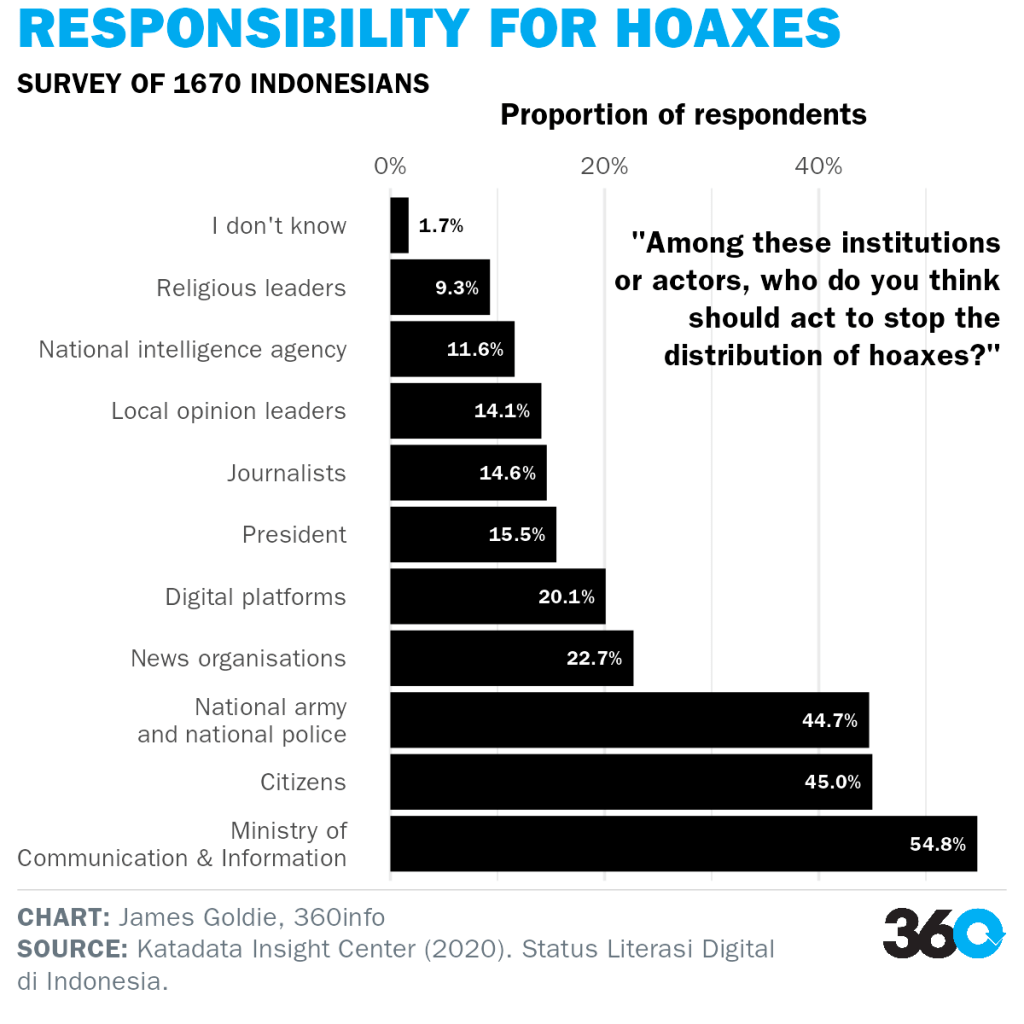
The literacy program has led Indonesians to believe the government will stop misinformation, as opposed to individuals. A 2021 national survey conducted by the Ministry of Information and Communication and Kata Data Insight shows
63% of 10,000 people surveyed believed the ministry was the number one actor responsible for stopping the distribution of hoaxes — an increase from 54.8% of the 1,670 respondents in 2020.
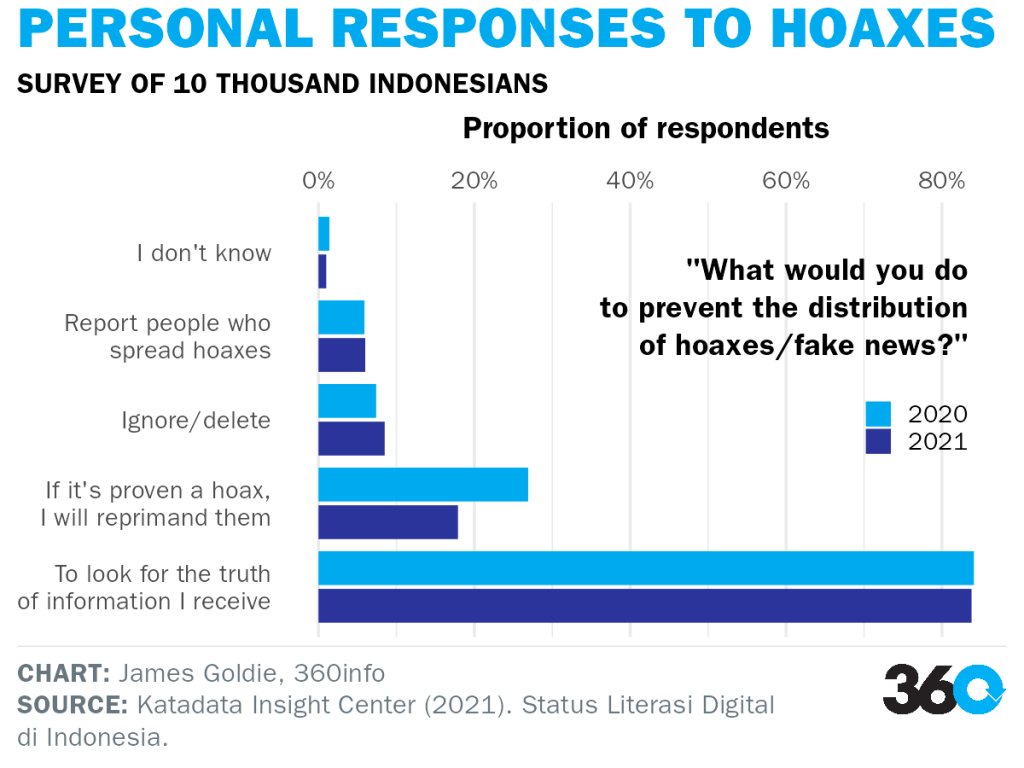
The program can reach millions of people in a year, but the number of people who want to take action to prevent hoaxes is declining. Those who would reprimand others who spread hoaxes declined from 26.9 percent in 2020 to 17.9 in 2021, while those who will ignore or delete fake news increased from 7.4 percent in 2020 to 8.5 the year after.
The literacy program, though reaching millions, may not be as effective as the government hopes, especially at preventing the spread of misinformation.
An old African proverb says it takes a village to raise a child. Although the Indonesian government has an essential role in stopping misinformation, the entire community must actively participate to completely nullify it.
The literacy program is supposed to be an empowering program to stimulate critical thinking skills, but instead it risks strengthening the state’s power over its people.
Dr Ika Idris is an associate professor at Public Policy & Management, Monash University Indonesia. Her works focus on government communication, misinformation, and the internet’s impacts on society. Dr Idris declared no conflicts of interest in relation to this article.
This article was first published on February 14, 2022.
Originally published under Creative Commons by 360info™.
Written by Dr Ika Idris of Monash University on February 14, 2022 for 360Info.org. Dr Ika Idris is an associate professor at Public Policy & Management, Monash University Indonesia. Her works focus on government communication, misinformation, and the internet’s impacts on society. Republished here with a Creative Commons Licence.
ENDS
Dr Setia Budhi: Dayak Ethnographer on media bias and misinformation in Indonesia

“The news about child labour, child slavery and women working on oil palm plantations in horrific conditions gets little attention in media.
“News about customary Dayak lands that are seized for palm oil illegally or by force is online only momentarily and quickly disappears. These violations human rights are rendered invisible by the media in here.

Research studies of SE Asian media reporting on palm oil show a denialist and greenwashing narrative that is similar to climate change denialism i.e. climate change greenwashing.
“We found that media reporting of the denialist narrative is more prevalent than that of the peer-reviewed science consensus-view that palm oil plantations on tropical peat could cause excessive greenhouse gas emissions and enhance the risk of fires.
“Our article alerts to the continuation of unsustainable practices as justified by the media to the public, and that the prevalence of these denialist narratives constitute a significant obstacle in resolving pressing issues such as transboundary haze, biodiversity loss, and land-use change related greenhouse gas emissions in Southeast Asia.”
~ Liu, Felicia & Ganesan, Vignaa & Smith, Thomas. (2020). Contrasting communications of sustainability science in the media coverage of palm oil agriculture on tropical peatlands in Indonesia, Malaysia and Singapore. Environmental Science & Policy. 114. 162-169. 10.1016/j.envsci.2020.07.004.
Read more about palm oil industry greenwashing, manipulation and misinformation

Will palm oil watchdog RSPO rid itself of deforestation or continue to pretend its products are sustainable? – EIA
Palm oil produced through the destruction of forestland is still being sold around the world with the blessing of the Roundtable on Sustainable Palm Oil (RSPO).
On November 30, 2022 EIA and along…
Read more

Research: Palm Oil Deforestation and its connection to RSPO members/supermarket brands
Discover the truth about palm oil from experts’ reports. Research shows RSPO members still cause deforestation and human rights abuses, despite greenwashing!
Read more

Greenwashing Tactic #4: Fake Labels
Claiming a brand or commodity is green based on unreliable, ineffective endorsements or eco-labels such as the RSPO, Forest Stewardship Council (FSC) or FairTrade coffee and cocoa. Greenwashing: Fake Labels and fake certifications…
Read more
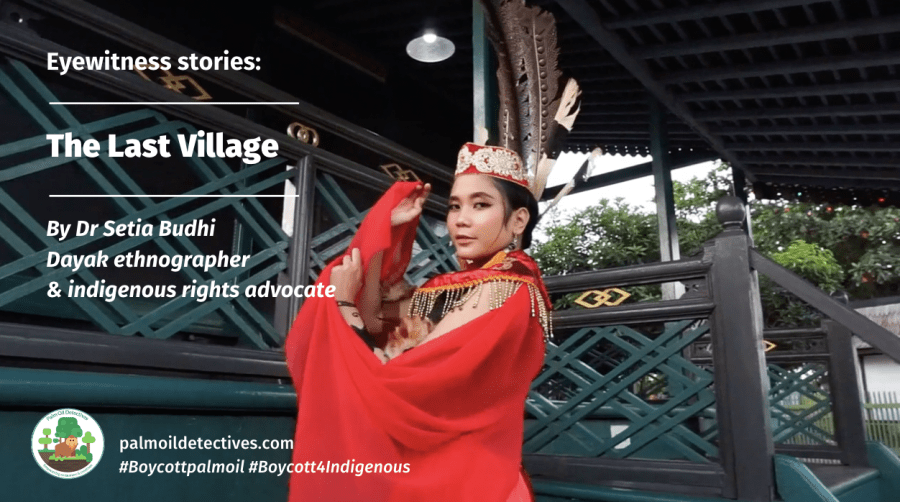
Eyewitness Story: The Last Village by Dr Setia Budhi
A lone Dayak village in Borneo surrounded by palm oil plantations has held out for 14 years and resisted corporate infiltration by global palm oil giants. My name is Dr Setia Budhi, I…
Read more

WHO: Palm Oil Industry Greenwashing Like Big Tobacco
What does the $60 billion USD palm oil industry have in common with Big Tobacco? A lot according to this report by the World Health Organisation. Palm oil industry lobbying tactics are used…
Read more

Roundtable on Sustainable Palm Oil: 19 years is enough
For nearly two decades now, the RSPO has failed in its mission to make the industrial palm oil sector “sustainable”. Instead, it has been used by the palm oil industry to greenwash environmental…
Read more
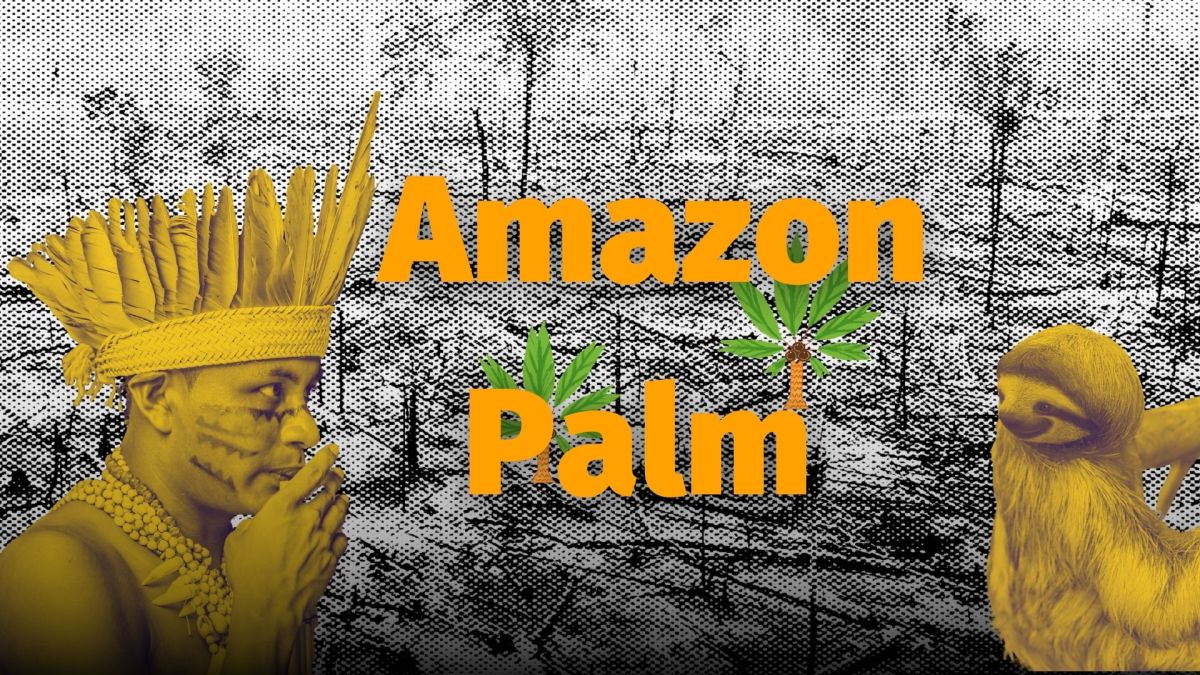
Amazon Palm Oil: Top Brands Source from Amazon Destroyers
Expose the truth about brands like Nestlé, PepsiCo, and Unilever sourcing “sustainable” palm oil from Brazil linked to violence, abuses and fraud. Shame!
Read more

Eyewitness by Craig Jones: A mother and baby orangutan are rescued from an RSPO palm oil plantation in Sumatra
Bio: Craig Jones One of Britain’s finest wildlife photographers, Craig Jones is also one of the most humble and down-to-earth guys you will ever meet. His photography and stories capture the lives of…
Read more

Palm Oil Lobbyists Getting Caught Lying Orangutan Land Trust and Agropalma
For decades, investigative journalists have been exposing that illegal land grabbing from Indigenous peoples as a regular occurrence in West Papua, South and Central America, Africa and Asia. Indigenous people’s land is being…
Read more
10 Tactics of Sustainable Palm Oil Greenwashing
Greenwashing Tactic #1: Hidden Trade Off
When a brand makes token changes while continuing with deforestation, ecocide or human rights abuses in another part of their business – this is ‘Hidden Trade Off’
For example, Nestle talks up satellite monitoring to stop palm oil deforestation. Yet…
Read more
Greenwashing Tactic #2: No Proof
Greenwashing Tactic 5. Palm oil companies make environmental claims without providing proof or evidence of these claims or using spurious evidence.
Read more
Greenwashing Tactic #3: Vagueness
Claiming a brand or commodity is ‘green’ or ‘sustainable’ based on broad generalisations, unclear language or vague statements Jump to section Greenwashing: Vagueness in Language Greenwashing: Vagueness in certification standards Reality: Auditing of RSPO a failure Quote: EIA: Who Watches…
Read moreGreenwashing Tactic #4: Fake Labels
Claiming a brand or commodity is green based on unreliable, ineffective endorsements or eco-labels such as the RSPO, Forest Stewardship Council (FSC) or FairTrade coffee and cocoa. Greenwashing: Fake Labels and fake certifications Ecolabels are designed to reassure consumers that…
Read more
Greenwashing Tactic #5: Irrelevance and Deflection
Learn how lobbyists use irrelevant information and deflection to shift the conversation away from their environmental harms, e.g. “sustainable” palm oil.
Read more
Greenwashing Tactic #6: The Lesser of Two Evils
Claiming that a brand, commodity or industry is greener than others in the same category, in order to excuse ecocide, deforestation, human rights and animal rights abuses. Jump to section Greenwashing: Lesser of Two Evils: Palm Oil Uses Less Land…
Read more
Greenwashing Tactic #7: Lying
Greenwashing lies are falsifying support from authorities to back up claims or using spurious research data to back up the greenwashing, boycott palm oil!
Read more
Greenwashing Tactic 8: Design & Words
Greenwashing Tactic 8. Companies use design principles and subliminal language to signal ‘greenness’ and trigger unconscious emotional responses in consumers
Read more
Greenwashing Tactic 9: Partnerships, Sponsorships and Research Funding
Greenwashing Tactic 9. Corporations use NGOs, Zoo partnerships, sponsorships, and research funding to give an industry or brand a ‘green image.
Read more
Greenwashing Tactic 10: Gaslighting, Harassment, Stalking and Threats
Gaslighting, harassing or stalking vocal critics of a brand, commodity or industry certification in order to silence these critics – this is greenwashing!
Read more
Ten Tactics of ‘Sustainable’ Palm Oil Greenwashing
Learn ten marketing and PR tactics used for “sustainble” palm oil greenwashing to justify endless growth by the palm oil industry. Boycott palm oil now!
Read moreTake Action in Five Ways
1. Join the #Boycott4Wildlife on social media and subscribe to stay in the loop: Share posts from this website to your own network on Twitter, Mastadon, Instagram, Facebook and Youtube using the hashtags #Boycottpalmoil #Boycott4Wildlife.
2. Contribute stories: Academics, conservationists, scientists, indigenous rights advocates and animal rights advocates working to expose the corruption of the palm oil industry or to save animals can contribute stories to the website.


3. Supermarket sleuthing: Next time you’re in the supermarket, take photos of products containing palm oil. Share these to social media along with the hashtags to call out the greenwashing and ecocide of the brands who use palm oil. You can also take photos of palm oil free products and congratulate brands when they go palm oil free.
4. Take to the streets: Get in touch with Palm Oil Detectives to find out more.
5. Donate: Make a one-off or monthly donation to Palm Oil Detectives as a way of saying thank you and to help pay for ongoing running costs of the website and social media campaigns. Donate here
Discover more from Palm Oil Detectives
Subscribe to get the latest posts sent to your email.
 Palm Oil Detectives