
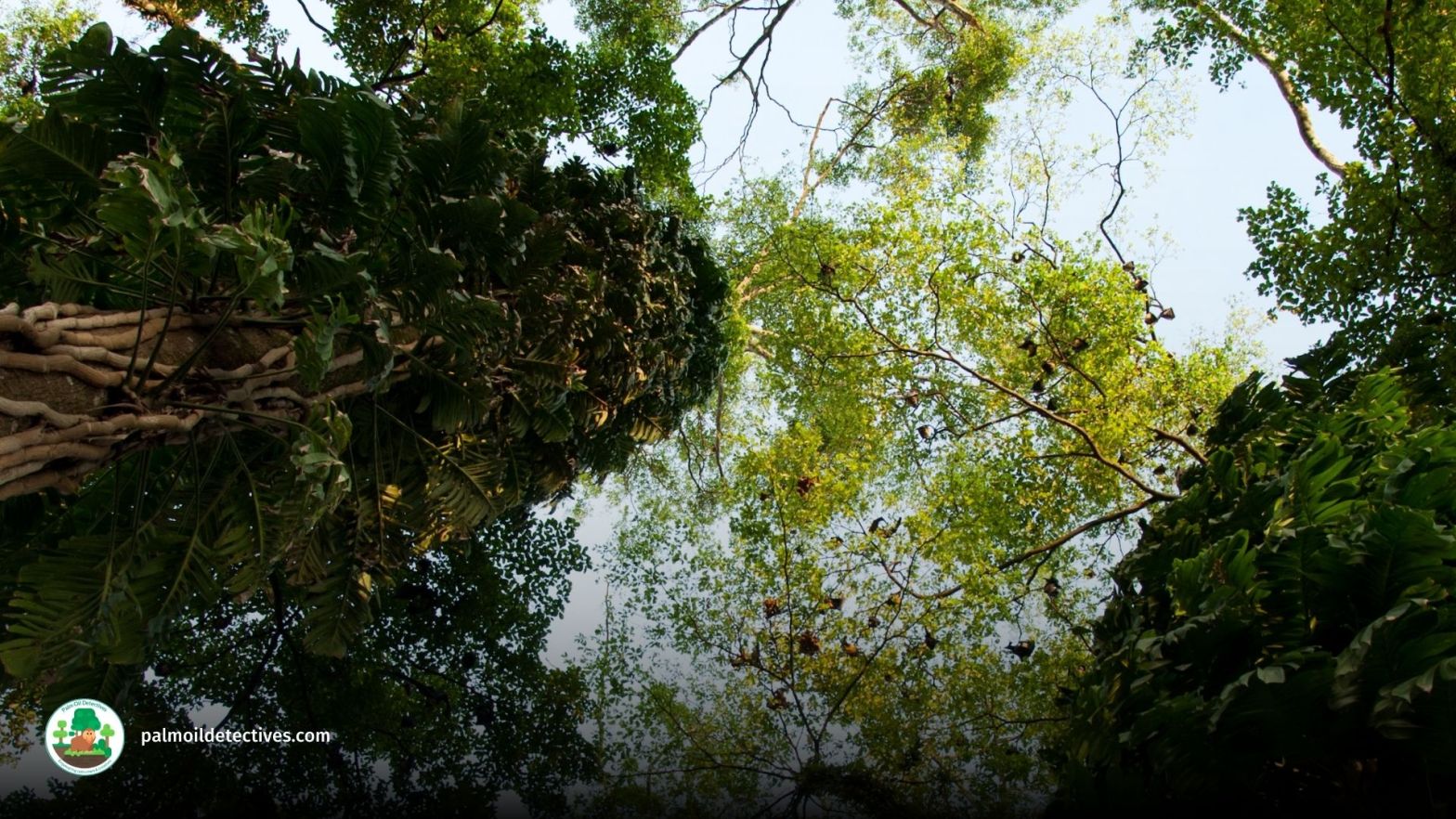
Tropical forests matter to each and every one of us. They suck colossal quantities of carbon out of the atmosphere, providing a crucial brake on the rate of climate change. Yet a statistical model in this study has estimated that by 2030 the African forests’ capacity to remove carbon will decrease by 14%, while Amazonian forests may stop removing carbon dioxide altogether by 2035. What can you do? Demand a system change from greedy capitalism. Use our wallet as a weapon and #Boycottpalmoil #Boycottmeat #Boycott4Wildlife
#Research finds tropical #forests matter to us all! They suck out #carbondioxide and ensure we can breathe, drink and eat. Yet they’re fast disappearing! Resist #extinction every time you shop, be #vegan 🍉🍑 #Boycottpalmoil 🌴🔥🤮⛔️ #Boycott4Wildlife https://palmoildetectives.com/2023/08/16/we-tracked-300000-trees-only-to-find-that-rainforests-are-losing-their-power-to-help-humanity/
Written by Dr Wannes Hubau, Research Scientist, Royal Museum for Central Africa; Aida Cuní Sanchez, Postdoctoral Research Associate, University of York, and Simon Lewis, Professor of Global Change Science at University of Leeds and, UCL. This article is republished from The Conversation under a Creative Commons license. Read the original article.
The speed of change in the world’s forests is staggering. Across the 1990s intact tropical forests – those unaffected by logging or fires – removed roughly 46 billion tonnes of carbon dioxide from the atmosphere. This diminished to an estimated 25 billion tonnes in the 2010s. The lost sink capacity is 21 billion tonnes of carbon dioxide, equivalent to a decade of fossil fuel emissions from the UK, Germany, France and Canada combined.
How did we reach such an alarming conclusion, and how is it that nobody knew this before? The answer is that we – along with 181 other scientists from 36 countries – have spent years tracking individual trees deep in the world’s rainforests.
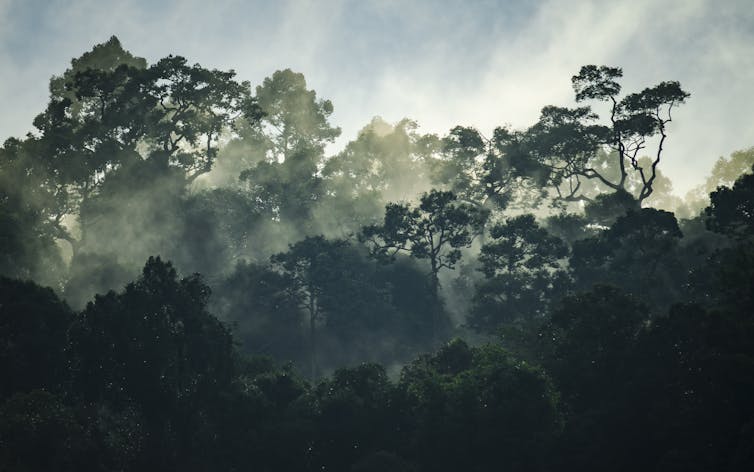
The idea is simple enough: we go and identify the tree species and measure the diameter and height of every individual tree in an area of forest. Then a few years later we return to exactly the same forest and re-measure all the trees again. We can see which grew, which died and if any new trees have grown.
These measurements allow us to calculate how much carbon is stored in a forest, and how it changes over time. By repeating the measurements enough times and in enough places, we can reveal long-term trends in carbon uptake.

This is easier said than done. Tracking trees in tropical forests is challenging, particularly in equatorial Africa, home to the second largest expanse of tropical forest in the world. As we want to monitor forests that are not logged or affected by fire, we need to travel down the last road, to the last village, and last path, before we even start our measurements.
First we need partnerships with local experts who know the trees and often have older measurements that we can build upon. Then we need permits from governments, plus agreements with local villagers to enter their forests, and their help as guides. Measuring trees, even in the most remote location, is a team task.
The work can be arduous. We have spent a week in a dugout canoe to reach the plots in Salonga National Park in central Democratic Republic of the Congo, carried everything for a month-long expedition through swamps to reach plots in Nouabalé Ndoki National Park in the Republic of Congo, and ventured into Liberia’s last forests once the civil war ended. We’ve dodged elephants, gorillas and large snakes, caught scary tropical diseases like Congo red fever and narrowly missed an Ebola outbreak.
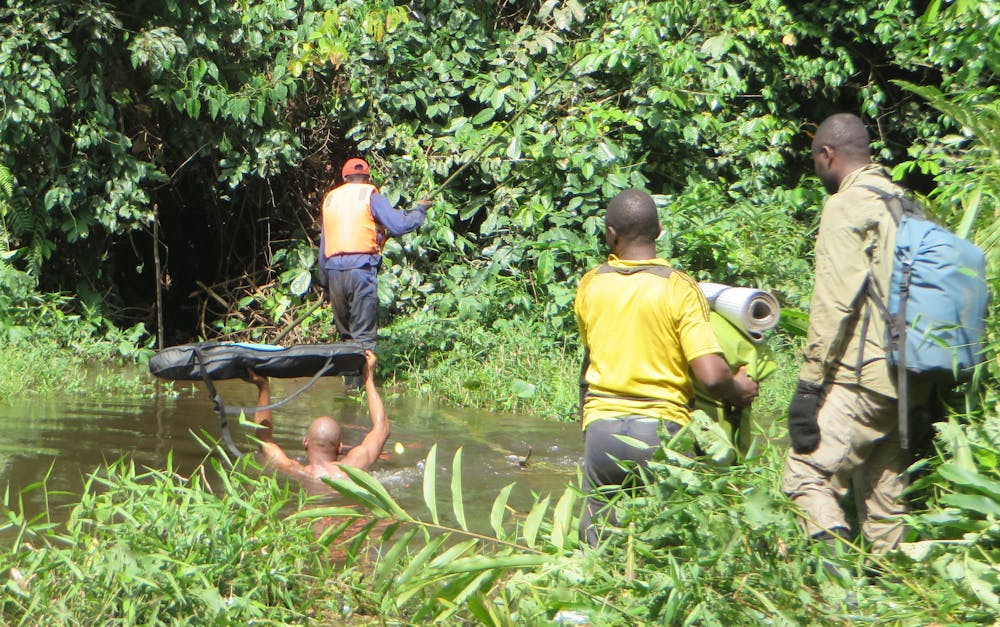
Days start early to make the most of a day in the field. Up at first light, out of your tent, get the coffee on the open fire. Then after a walk to the plot, we use aluminium nails that don’t hurt the trees to label them with unique numbers, paint to mark exactly where we measure a tree so we can find it next time, and a portable ladder to get above the buttresses of the big trees. Plus a tape measure to get the tree diameters and a laser to zap tree heights.
After sometimes a week of travel, it takes four to five days for a team of five people to measure all 400 to 600 trees above 10 cm diameter in the average hectare of forest (100 metres x 100 metres). For our study, this was done for 565 different patches of forest grouped in two large research networks of forest observations, the African Tropical Rainforest Observatory Network and the Amazon Rainforest Inventory Network.
This work means months away. For many years, each of us has spent several months a year in the field writing down diameter measurements on special waterproof water. In total we tracked more than 300,000 trees and made more than 1 million diameter measurements in 17 countries.
Managing the data is a major task. It all goes into a website we designed at the University of Leeds, ForestPlots.net, which allows standardisation, whether the measurements come from Cameroon or Colombia.
Many months of detailed analysis and checking of the data followed, as did time for a careful write-up our findings. We needed to focus on the detail of individual trees and plots, while not losing sight of the big picture. It’s a hard balancing act.

The declining carbon sink results provide pretty grim news and not what we would like to report. But as scientists, we have a job is to follow the data wherever it takes us. That can be far into the rainforests of Congo, or onto the TV to tell people about our work. It’s the least we can do in the climate emergency we are currently living though. We will all need to play a role in solving this crisis.
“The final part of our analysis looked to the future. We used a statistical model and estimates of future environmental change to estimate that by 2030 the African forests’ capacity to remove carbon will decrease by 14%, while Amazonian forests may stop removing carbon dioxide altogether by 2035. Scientists have long feared that one of Earth’s large carbon sinks would switch to become a source. This process has, unfortunately, begun.”
Written by Dr Wannes Hubau, Research Scientist, Royal Museum for Central Africa; Aida Cuní Sanchez, Postdoctoral Research Associate, University of York, and Simon Lewis, Professor of Global Change Science at University of Leeds and, UCL. This article is republished from The Conversation under a Creative Commons license. Read the original article.
ENDS
Take Action in Five Ways
1. Join the #Boycott4Wildlife on social media and subscribe to stay in the loop: Share posts from this website to your own network on Twitter, Mastadon, Instagram, Facebook and Youtube using the hashtags #Boycottpalmoil #Boycott4Wildlife.
2. Contribute stories: Academics, conservationists, scientists, indigenous rights advocates and animal rights advocates working to expose the corruption of the palm oil industry or to save animals can contribute stories to the website.


3. Supermarket sleuthing: Next time you’re in the supermarket, take photos of products containing palm oil. Share these to social media along with the hashtags to call out the greenwashing and ecocide of the brands who use palm oil. You can also take photos of palm oil free products and congratulate brands when they go palm oil free.
4. Take to the streets: Get in touch with Palm Oil Detectives to find out more.
5. Donate: Make a one-off or monthly donation to Palm Oil Detectives as a way of saying thank you and to help pay for ongoing running costs of the website and social media campaigns. Donate here
Discover more from Palm Oil Detectives
Subscribe to get the latest posts sent to your email.
 Palm Oil Detectives
@palmoildetectives.com Préservons et gérons durablement nos forêts tropicales dont celles de Guyane Française !
LikeLike
Remote Reply
Original Comment URL
Your Profile
Why do I need to enter my profile?
This site is part of the ⁂ open social web, a network of interconnected social platforms (like Mastodon, Pixelfed, Friendica, and others). Unlike centralized social media, your account lives on a platform of your choice, and you can interact with people across different platforms.
By entering your profile, we can send you to your account where you can complete this action.