
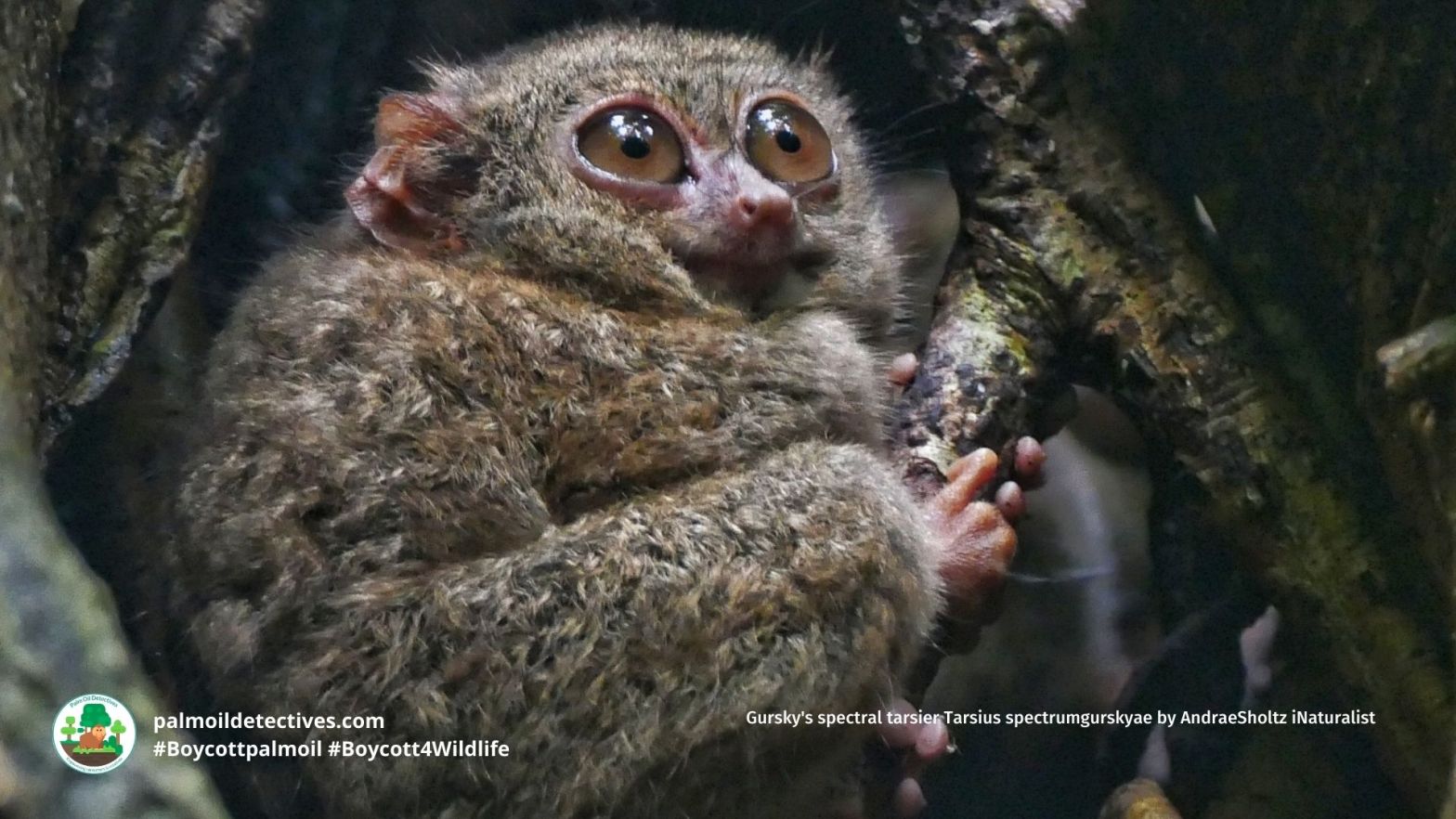
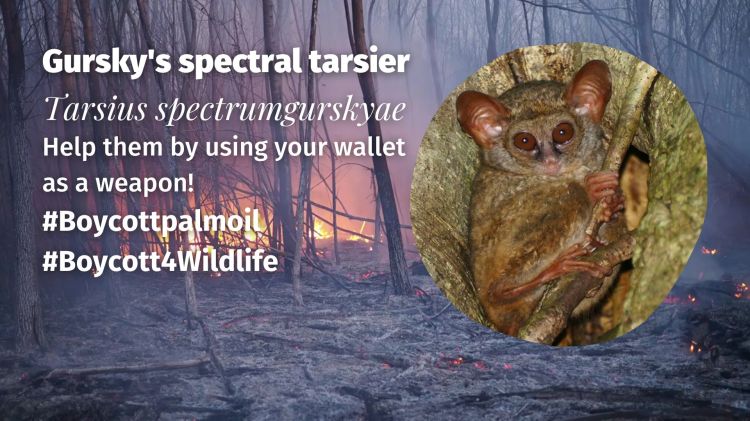
Gursky’s Spectral Tarsier Tarsius spectrumgurskyae
IUCN Red List Status: Vulnerable
Location: Indonesia (Sulawesi)
Found across the northern peninsula of Sulawesi in Indonesia, including from the northern tip to the Isthmus of Gorontalo, in primary forest, mangroves, and disturbed habitats with dense cover.
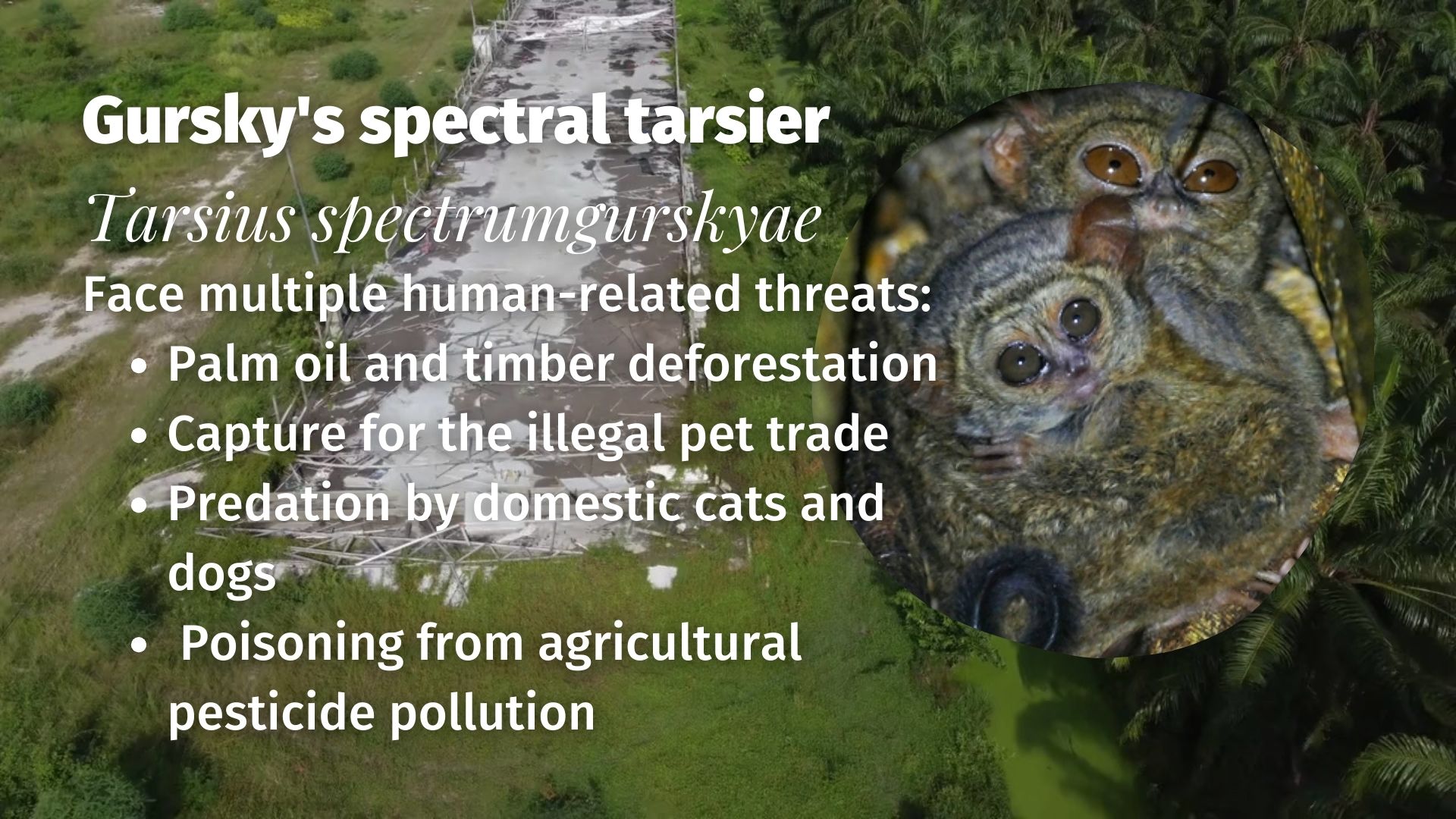
The Gursky’s spectral tarsier Tarsius spectrumgurskyae, also known locally as Wusing, is a recently recognised species of tarsier from northern Sulawesi. Listed as Vulnerable by the IUCN, they have lost more than 30% of their habitat in the past two decades. #Deforestation for #palmoil and #timber, agricultural encroachment, illegal logging, and the #pettrade all threaten their fragile populations. Their survival depends on wild spaces thick with shrubby undergrowth—the very places being rapidly erased. If you love unique #primates like the spectral #tarsier, use your voice and wallet to protect their forest home. #BoycottPalmOil #Boycott4Wildlife
Known locally as ‘Wusing’, Gursky’s Spectral #Tarsiers have enormous moon-like eyes to help them see in dark forests 🌛👀😽 #Palmoil and the #pet trade are serious threats. Help them survive when you #Boycottpalmoil 🌴🚜❌ #Boycott4Wildlife @palmoildetect https://palmoildetectives.com/2026/02/22/gurskys-spectral-tarsier-tarsius-spectrumgurskyae/
Found in tree hollows of #Sulawesi #Indonesia, tiny #primates 🐵🧐 Gursky’s Spectral #Tarsiers are #carnivores with their food, #insects 🪲🦗 being poisoned by #palmoil and #pesticides ☠️ Fight for them! #Boycottpalmoil #Boycott4Wildlife @palmoildetect https://palmoildetectives.com/2026/02/22/gurskys-spectral-tarsier-tarsius-spectrumgurskyae/
Appearance & Behaviour
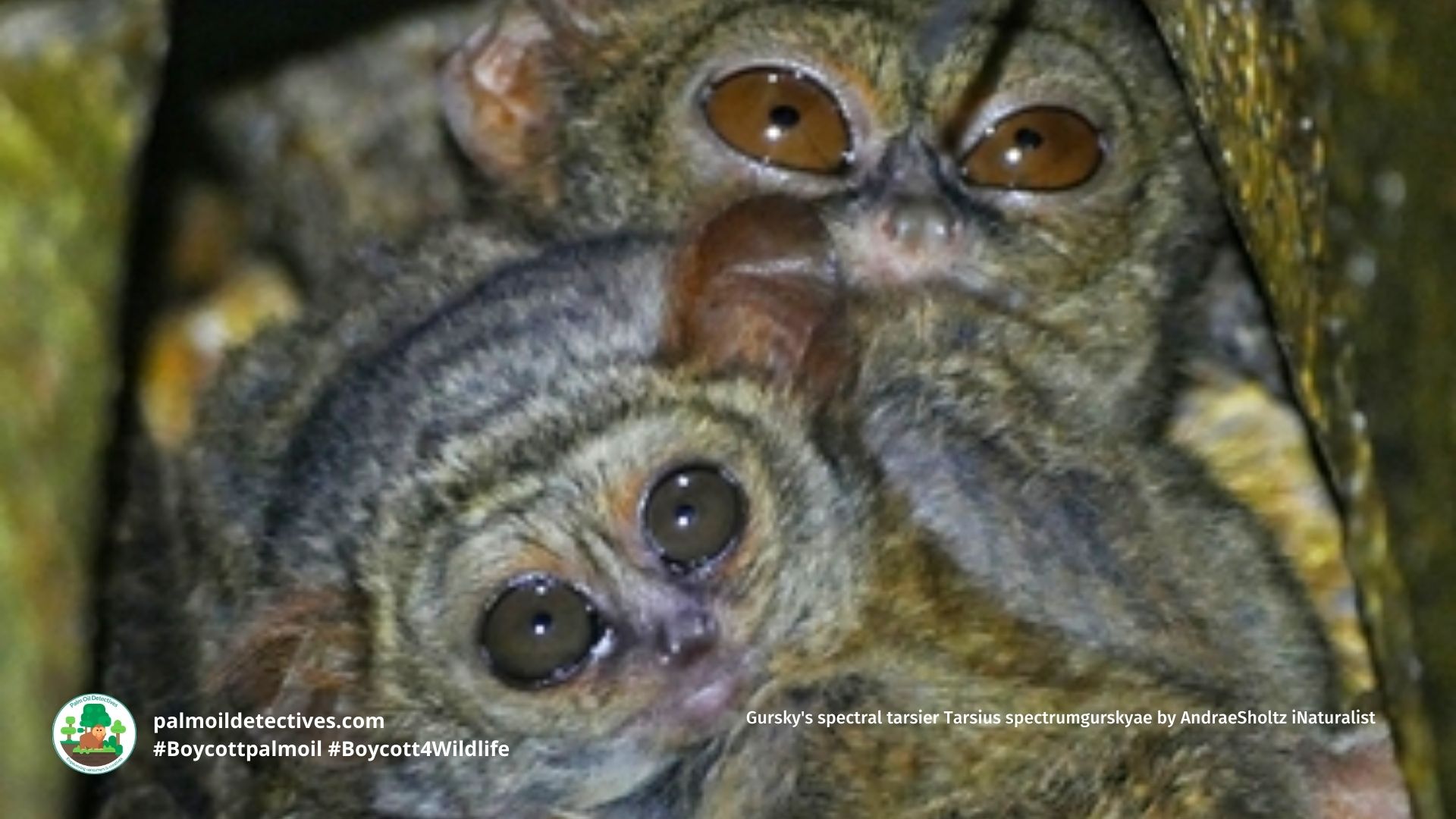
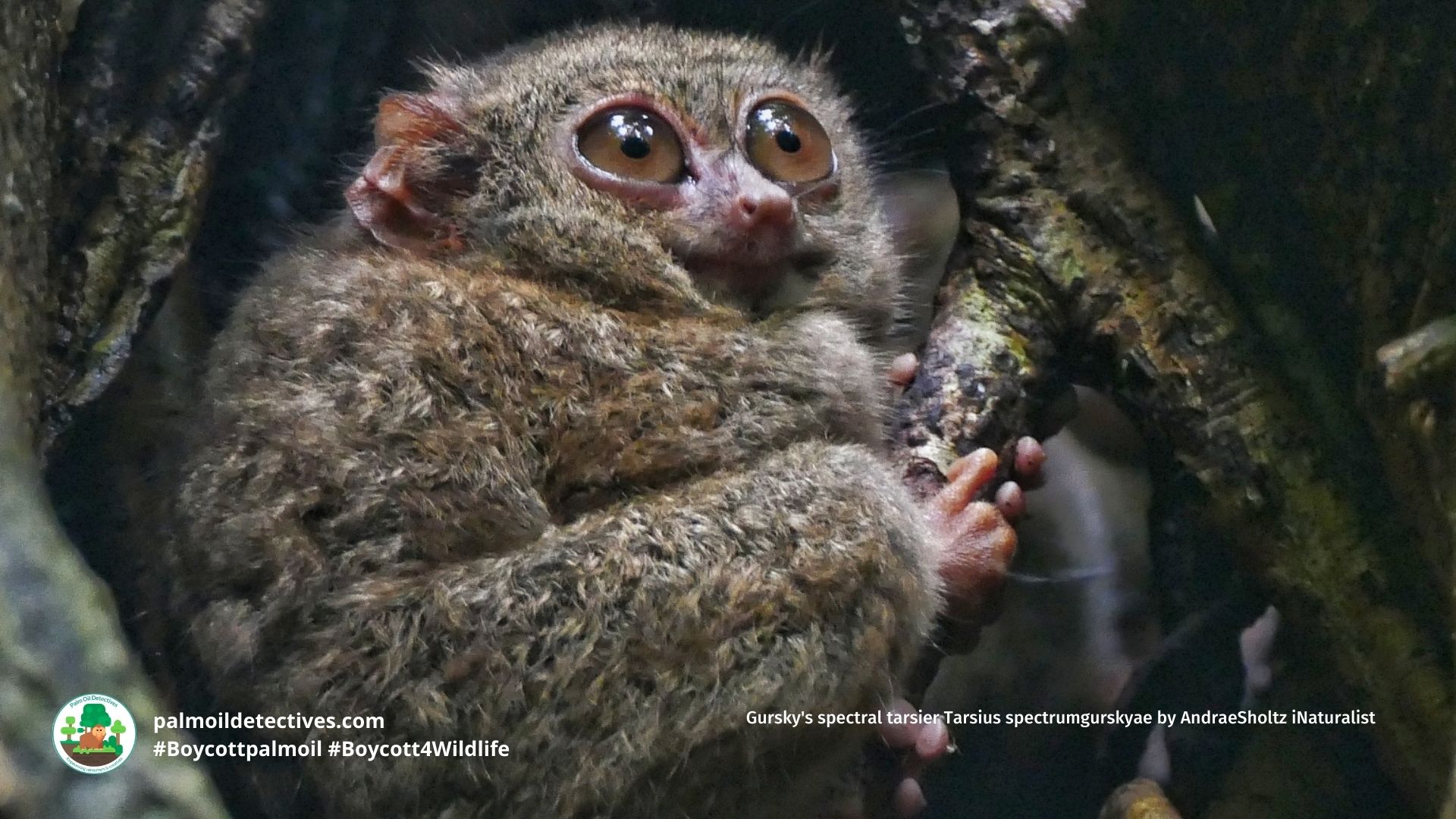
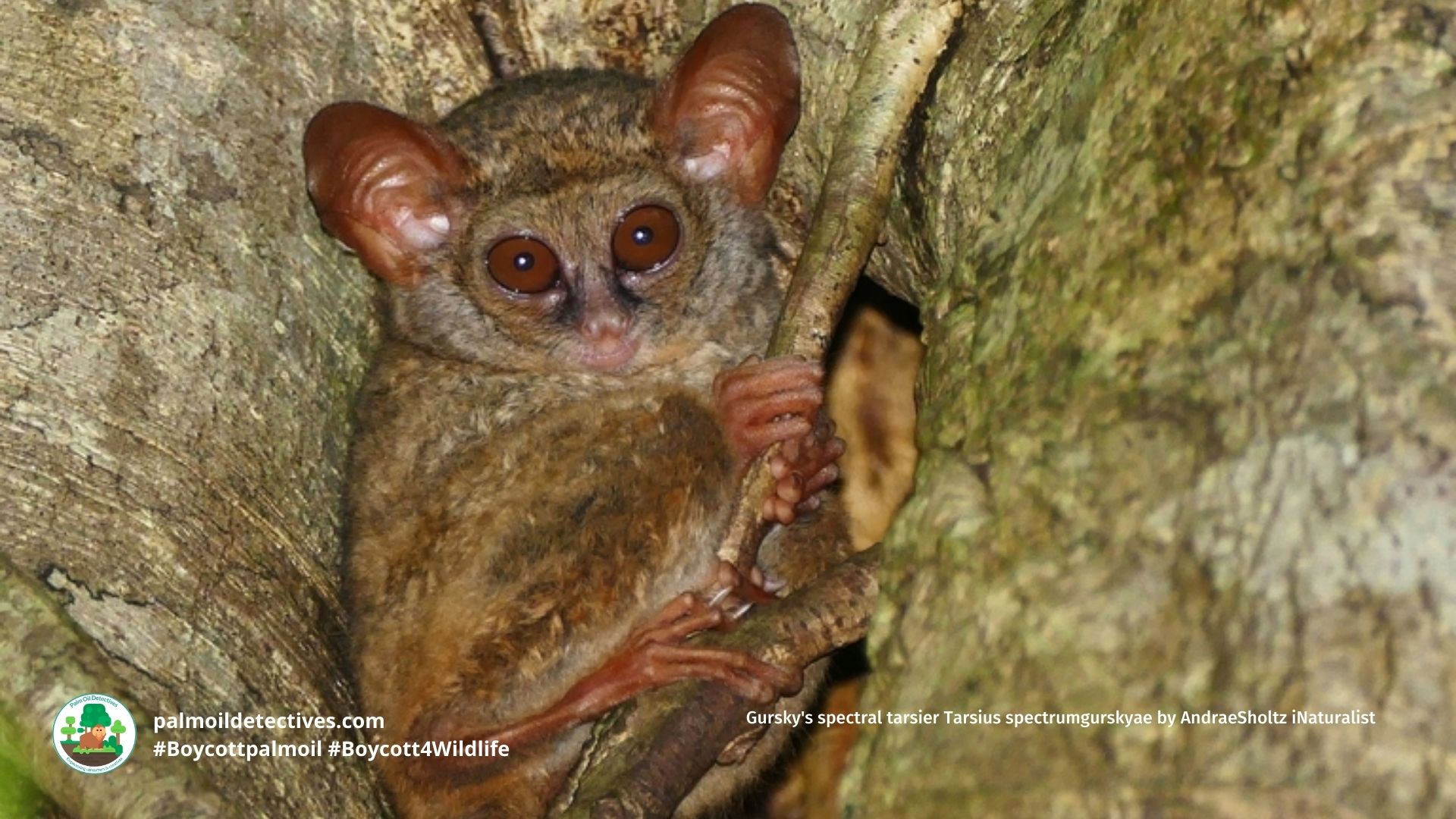
Gursky’s spectral tarsiers also known locally as ‘Wusing’ are hauntingly beautiful tiny #primates with enormous, forward-facing eyes that shine like twin moons in the night. These tiny nocturnal primates have a soft, greyish pelage and elongated fingers adapted for gripping tree branches. They are famed for their extreme leaping ability, known as vertical clinging and leaping (VCL), allowing them to spring through the forest canopy with precision and grace.
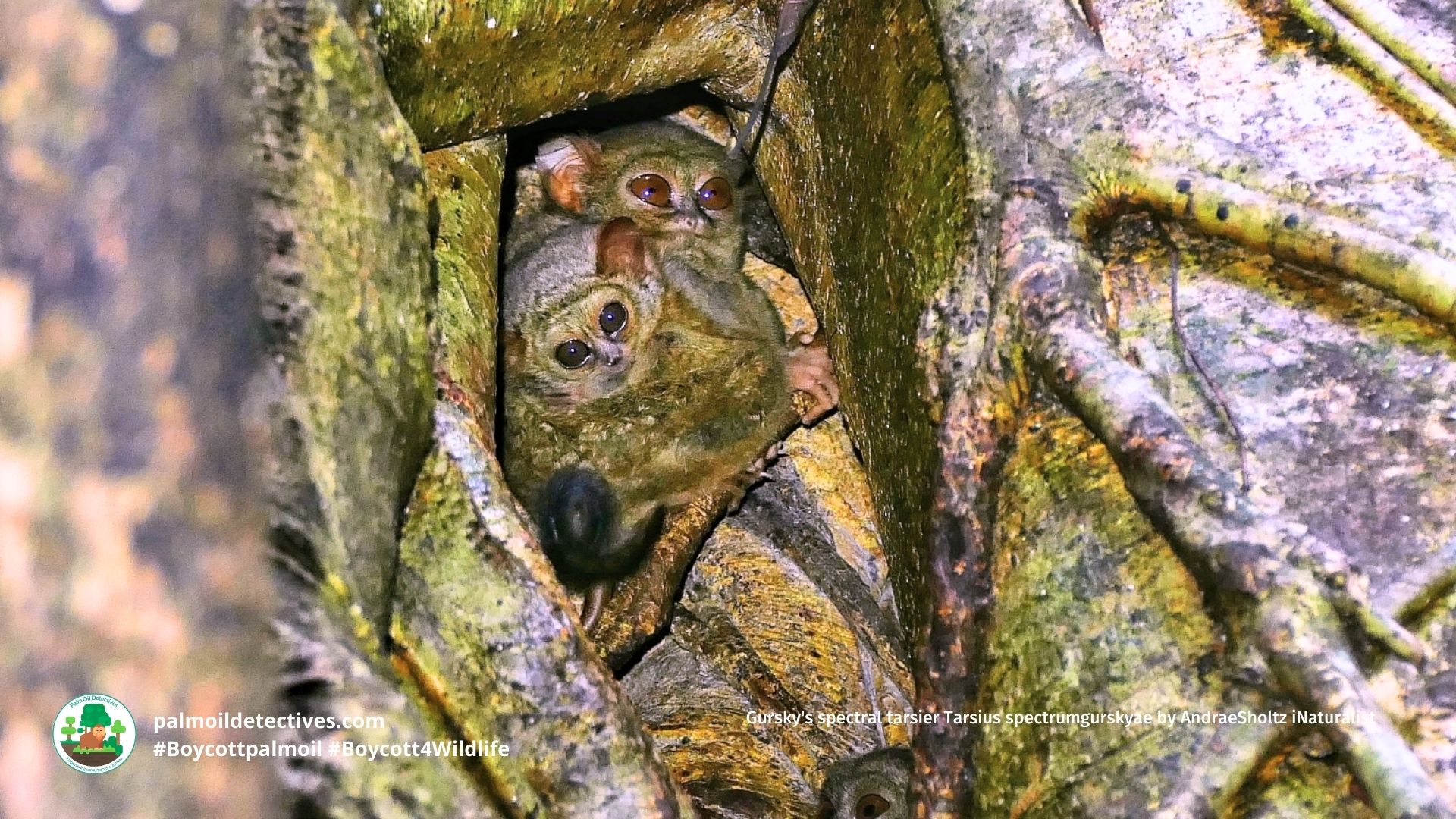
Highly social and vocal, they live in monogamous or polygamous groups of 2–11 individuals. At dawn, their eerie territorial duets echo through the forest just before they return to their sleeping sites in dense foliage or tree cavities. They are shy, elusive, and deeply dependent on forest structure to hide, hunt, and sleep.
Threats
Habitat Loss from Illegal Logging
The primary threat to Gursky’s spectral tarsier is the ongoing destruction of Sulawesi’s forests due to illegal logging. These small nocturnal primates depend on dense understorey vegetation and tree cavities for shelter and foraging. When forests are cleared, their sleeping sites vanish and prey becomes scarce, forcing them into smaller, fragmented patches of habitat. Even moderate disturbance causes a sharp drop in population density—from over 150 individuals/km² to as few as 45 in degraded areas (Merker, 2003).
Agricultural Expansion and Palm Oil Plantations
Much of the Gursky’s Spectral Tarsier’s lowland habitat has already been converted to palm oil and timber agriculture, and expansion continues. Between 1990 and 2000, 15.26% of Sulawesi’s forests were cleared for crops, with at least 10% more lost since then (Salim, pers. comm. in IUCN, 2020). Palm oil plantations are one of the main drivers of this forest conversion. Although the species can survive in agroforestry and disturbed areas, their numbers drastically decline when natural vegetation is replaced with monocultures.
Pesticide Exposure from Nearby Farms
Chemical pesticides used in adjacent agricultural zones contaminate the tarsiers’ insect prey, leading to bioaccumulation and poisoning. Tarsiers consume a diet entirely composed of live animal prey, mostly insects, which makes them highly vulnerable to pesticide residues. Ingestion of contaminated insects can lead to neurological damage, reproductive failure, or death, further weakening populations in edge habitats near farmlands.
Predation by Domestic Animals
Domestic dogs and cats introduced into forested areas pose a significant predation risk to tarsiers. These animals often accompany humans into disturbed or agricultural areas, where they hunt or scavenge. Tarsiers are small-bodied, slow on the ground, and often descend to low levels of the forest, making them easy targets. Predation by pets fragments already-vulnerable populations and disrupts group dynamics.
Illegal Capture for the Pet Trade
Although not widespread, the illegal pet trade is an emerging threat. Gursky’s spectral tarsiers are occasionally taken from the wild to be sold in local markets or online. These sensitive, nocturnal animals suffer tremendously in captivity, often dying due to stress, malnutrition, or improper care. Removing them from the wild also breaks apart family groups and contributes to long-term population decline.
Geographic Range
Gursky’s spectral tarsier is endemic to Indonesia, restricted to northern Sulawesi, from the northern tip of the peninsula to the Isthmus of Gorontalo. Their habitat includes lowland primary forests, secondary growth, mangroves, and areas with some human disturbance, such as agroforestry and selectively logged landscapes. However, their density drops dramatically as habitat degradation increases.
Diet
Their diet is 100% carnivorous, consisting entirely of live animal prey. They primarily consume insects such as moths and crickets but also hunt small vertebrates like frogs and lizards. Their night-time hunting is punctuated by bursts of movement and quiet observation as they stalk their prey through the understorey.
Mating and Reproduction
Although detailed reproductive data are scarce for this species, Gursky’s spectral tarsiers likely follow similar breeding patterns to other tarsiers. They are known to breed throughout the year, producing one offspring at a time after a gestation period of about six months. The young are born furred and open-eyed, clinging to their parent as they learn to navigate the trees.
FAQs
How many Gursky’s spectral tarsiers are left in the wild?
Precise population numbers of these tarsiers are not known, but density estimates suggest that in pristine habitats, up to 156 individuals per km² may exist (Gursky, 1997). However, in heavily degraded areas, this number can plummet to as low as 45 individuals per km² (Merker, 2003). Their fragmented range and habitat loss make accurate counts difficult, but population declines are expected to continue if deforestation is not halted.
What is their lifespan in the wild?
While specific data for Tarsius spectrumgurskyae is not available, other tarsier species can live between 8–12 years in the wild. In captivity, where threats like predation are removed, their lifespan may be slightly longer. However, these animals do not thrive in captivity and should never be kept as pets.
What challenges do they face in conservation?
One major challenge is habitat degradation due to logging, agriculture, and the spread of palm oil plantations. Though they can tolerate some disturbance, their population density drops significantly with increasing habitat destruction. Additionally, their small size and elusive nature make them difficult to monitor, and they are sometimes misidentified as other tarsier species, complicating conservation strategies.
Do Gursky’s spectral tarsiers make good pets?
No. These sensitive and social primates should never be kept as pets. Capturing them from the wild is cruel and contributes directly to population collapse. It destroys their family groups, causes immense suffering, and feeds into illegal wildlife trade networks. If you care about their survival, never buy a wild animal and advocate against exotic pet ownership.
Take Action!
The future of the Gursky’s spectral tarsier hangs by a thread. Forests are falling at an alarming rate, replaced with monocultures and poisoned with pesticides. Speak up. Refuse to fund deforestation-driven industries. Boycott palm oil. Protect what’s left of Sulawesi’s dwindling forests and support indigenous-led conservation efforts. Never buy wildlife as pets. #BoycottPalmOil #Boycott4Wildlife #Vegan #BoycottMeat
Support Gursky’s Tarsiers by going vegan and boycotting palm oil in the supermarket, it’s the #Boycott4Wildlife
Support the conservation of this species
This animal has no protections in place. Read about other forgotten species here. Create art to support this forgotten animal or raise awareness about them by sharing this post and using the #Boycottpalmoil #Boycott4Wildlife hashtags on social media. Also you can boycott palm oil in the supermarket.
Further Information
Shekelle, M., Groves, C. P., Maryanto, I., & Mittermeier, R. A. (2017). Two new tarsier species (Tarsiidae, Primates) and the biogeography of Sulawesi, Indonesia. Primate Conservation, 31, 37–56. https://researchportalplus.anu.edu.au/en/publications/two-new-tarsier-species-tarsiidae-primates-and-the-biogeography-o
Shekelle, M. 2020. Tarsius spectrumgurskyae. The IUCN Red List of Threatened Species 2020: e.T162336422A162336580. https://dx.doi.org/10.2305/IUCN.UK.2020-3.RLTS.T162336422A162336580.en. Accessed on 06 April 2025.
Wikipedia. (n.d.). Gursky’s spectral tarsier. Retrieved April 6, 2025, from https://en.wikipedia.org/wiki/Gursky%27s_spectral_tarsier

How can I help the #Boycott4Wildlife?
Take Action in Five Ways
1. Join the #Boycott4Wildlife on social media and subscribe to stay in the loop: Share posts from this website to your own network on Twitter, Mastadon, Instagram, Facebook and Youtube using the hashtags #Boycottpalmoil #Boycott4Wildlife.
2. Contribute stories: Academics, conservationists, scientists, indigenous rights advocates and animal rights advocates working to expose the corruption of the palm oil industry or to save animals can contribute stories to the website.
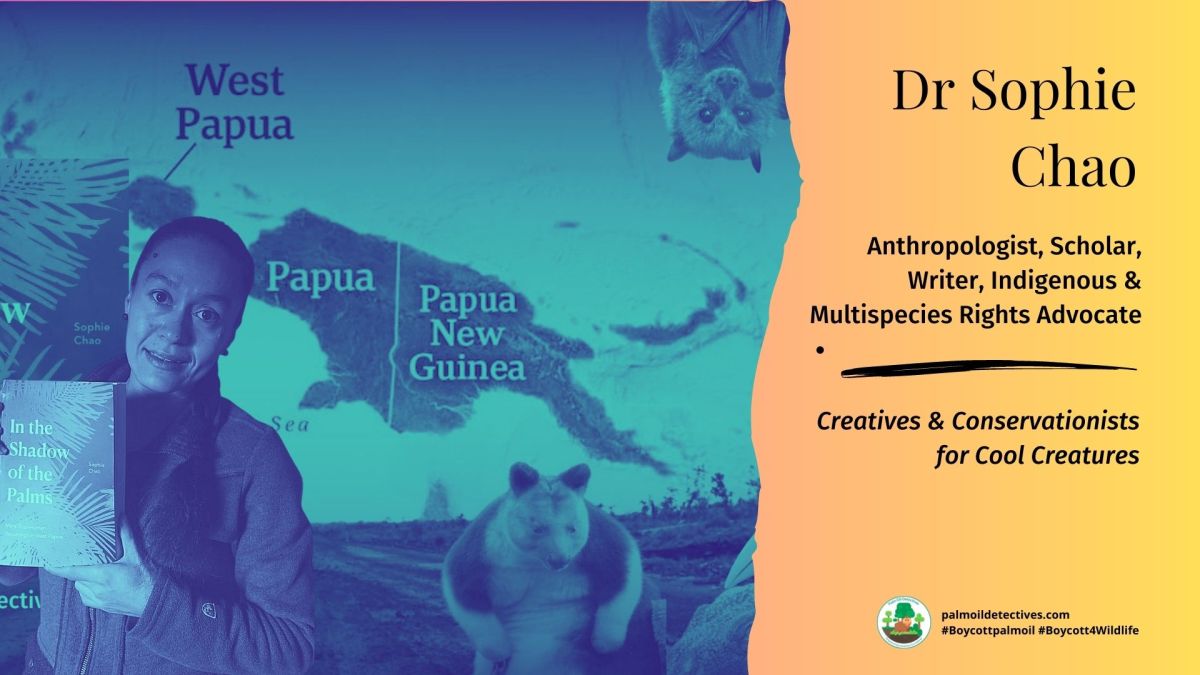



3. Supermarket sleuthing: Next time you’re in the supermarket, take photos of products containing palm oil. Share these to social media along with the hashtags to call out the greenwashing and ecocide of the brands who use palm oil. You can also take photos of palm oil free products and congratulate brands when they go palm oil free.
4. Take to the streets: Get in touch with Palm Oil Detectives to find out more.
5. Donate: Make a one-off or monthly donation to Palm Oil Detectives as a way of saying thank you and to help pay for ongoing running costs of the website and social media campaigns. Donate here
Learn about other animals endangered by palm oil and other agriculture

Learn about “sustainable” palm oil greenwashing
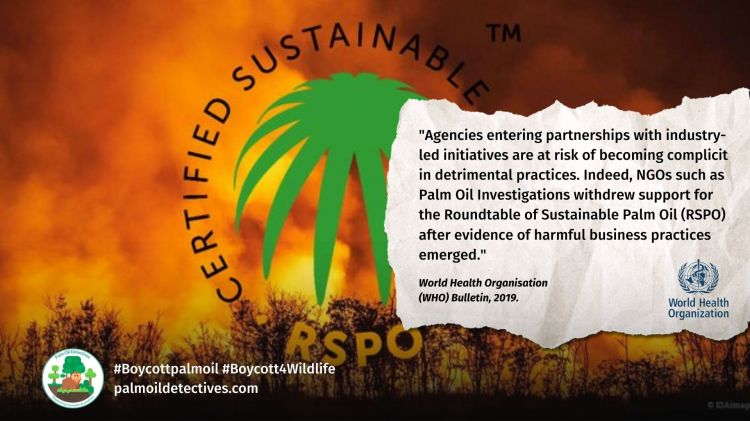
Read more about RSPO greenwashing
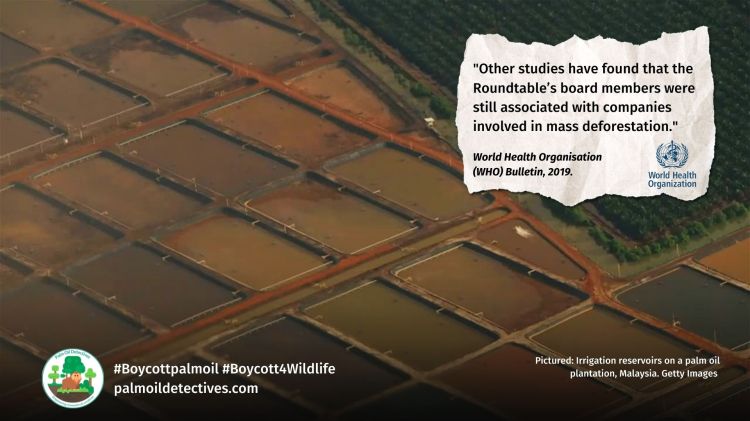
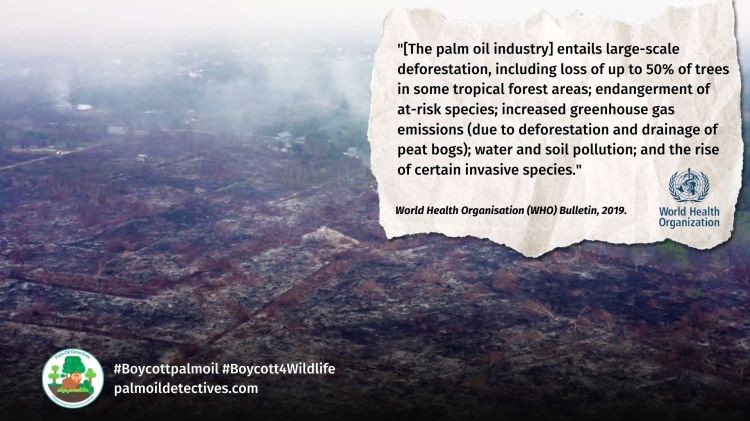
A 2019 World Health Organisation (WHO) report into the palm oil industry and RSPO finds extensive greenwashing of palm oil deforestation and the murder of endangered animals (i.e. biodiversity loss)


Discover more from Palm Oil Detectives
Subscribe to get the latest posts sent to your email.
 Palm Oil Detectives