
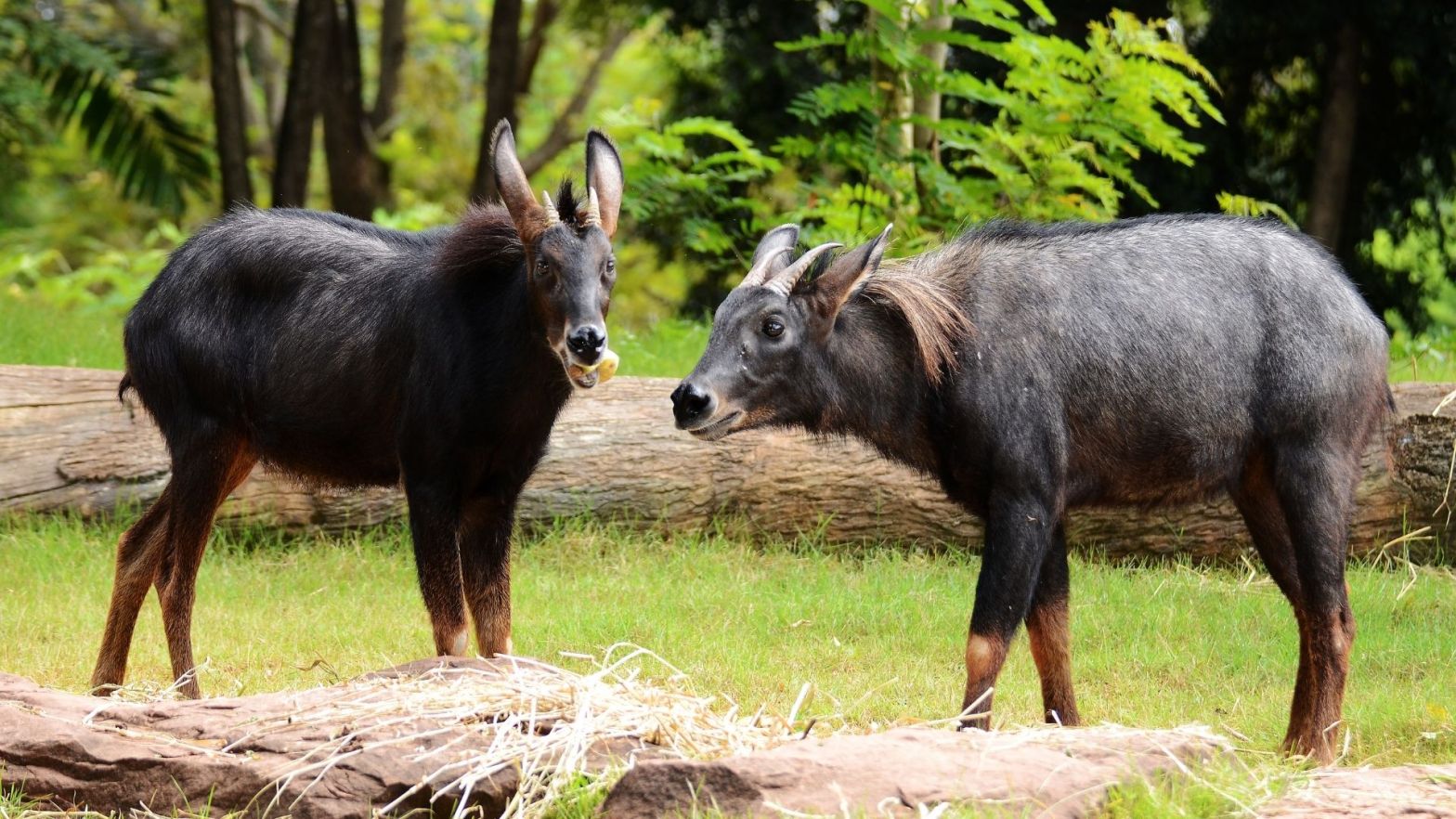
Mainland Serow Capricornis sumatraensis
Status: Vulnerable
Locations: Bangladesh; Bhutan; Cambodia; China; India; Indonesia; Laos; Malaysia; Myanmar; Nepal; Thailand; Vietnam
The Mainland serow, a reclusive wild goat-antelope, is a remarkable yet poorly understood resident of Southeast Asia’s rugged terrains. This enigmatic animal, with their coarse black coat and sharply curving horns, has earned a mythical status in local folklore due to their elusiveness and adaptability to steep, rocky landscapes.
However, the Mainland serow like many other ungulates is facing a precarious future. Habitat destruction from palm oil plantations, logging, and agricultural expansion has drastically reduced their numbers, leaving their population fragmented and declining. Protect these remarkable creatures and their fragile home—boycott palm oil and fight for their survival. #BoycottPalmOil #Boycott4Wildlife
Mainland Serows are gentle forest-dwelling #ungulates 🦌🤎 vulnerable across SE #Asia from #poaching and #rainforest #ecocide for #palmoil and other #agriculture. Take action when you shop and #Boycottpalmoil 🌴🪔☠️🤮⛔️ #Boycott4Wildlife @palmoildetect https://palmoildetectives.com/2021/01/24/mainland-serow-capricornis-sumatraensis/
Mainland #Serows 🦌🩷 are #folklore famous for long black coats and sharply curved horns. They can scrabble up steep rocky cliffs. Yet #palmoil #deforestation is a challenge they can’t beat alone! #Boycottpalmoil 🌴🪔☠️⛔️ #Boycott4Wildlife @palmoildetect https://palmoildetectives.com/2021/01/24/mainland-serow-capricornis-sumatraensis/
The Mainland Serow has declines exceeding 30% over three generations as inferred from local surveys, decline in occupied area and habitat quality as well as actual levels of exploitation and requires urgent conservation actions.
IUCN Red List
Appearance and Behaviour
The Mainland serow is a striking ungulate, standing approximately 85–100 cm tall at the shoulder and weighing between 80–140 kg. Their coarse black or dark grey fur is often flecked with lighter markings, and they sport a characteristic mane of bristly hair along their neck and back. Both males and females possess sharp, backward-curving horns that can grow up to 25 cm in length, providing protection against predators and rivals.
Serows are highly adapted to their rugged habitats, with powerful legs and hooves that allow them to navigate steep cliffs and rocky outcrops with remarkable agility. Primarily crepuscular, they are most active at dawn and dusk, spending their days resting in dense vegetation or hidden crevices. These solitary animals are territorial, marking their range with scent glands to warn off intruders.
Geographic Range
The Mainland serow is found across Southeast Asia, including the mountainous regions of Sumatra, Thailand, Malaysia, Myanmar, and parts of Laos and Vietnam. They inhabit a range of environments, from limestone karst formations and steep cliffs to dense lowland forests. In recent studies, serows have even been recorded at surprisingly low elevations in areas such as Assam, India (Lukmaanias Blog, 2024).
This wide but fragmented distribution is a result of habitat loss, with remaining populations primarily confined to protected areas such as national parks in Sumatra and Thailand.
Diet
Mainland serows are herbivorous and highly opportunistic feeders, consuming a diet of grasses, leaves, shrubs, shoots, and fruits. In rocky habitats, they are known to graze on mosses and lichens. Their foraging habits help regulate vegetation growth in otherwise inaccessible areas, playing an important role in maintaining ecological balance.
Reproduction and Mating
Due to their elusive nature, much about the Mainland serow’s reproductive behaviour remains unknown. Females typically give birth to a single offspring after a gestation period of approximately seven months. Juveniles stay with their mothers for up to a year before becoming independent.
The species’ slow reproductive cycle, combined with habitat destruction and high juvenile mortality rates, makes population recovery a significant challenge.
Threats
The Mainland serow is listed as Vulnerable by the IUCN, with population numbers steadily declining due to palm oil deforestation and poaching. Conservation efforts are underway in several countries, focusing on protecting key habitats and enforcing anti-poaching laws. Protected areas, such as Sumatra’s national parks and wildlife sanctuaries in Thailand, are vital to their survival.
IUCN Status: Vulnerable
Habitat Destruction:
Extensive deforestation for agriculture, including palm oil plantations, has decimated critical habitats in Southeast Asia. Logging and infrastructure projects exacerbate this loss, isolating populations.
Hunting and Poaching:
The serow is hunted for its meat, horns, and body parts, which are used in traditional medicine and local rituals. Poaching pressure continues to threaten even protected populations.
Fragmentation and Isolation:
Human encroachment has fragmented their habitat, leading to isolated populations and reduced genetic diversity.
Climate Change:
Climate change related altered rainfall patterns and rising temperatures threaten the delicate ecosystems these animals rely on for survival.
However, the serow’s secretive nature and remote habitats pose challenges to conservation efforts, making it critical to increase research and engage local communities in protecting their remaining populations.
Take Action!
Help safeguard the Mainland serow by boycotting palm oil and advocating for forest conservation. Share their story and demand stricter wildlife protections. Together, we can fight for their survival. #BoycottPalmOil #Boycott4Wildlife
Further Information

Phan, T.D., Nijhawan, S., Li, S. & Xiao, L. 2020. Capricornis sumatraensis. The IUCN Red List of Threatened Species 2020: e.T162916735A162916910. https://dx.doi.org/10.2305/IUCN.UK.2020-2.RLTS.T162916735A162916910.en. Downloaded on 24 January 2021.
Mongabay. (2021). In Sumatra, a vulnerable mythical wild goat lives an unknown life.
Lukmaanias Blog. (2024). Mainland serow recorded at the lowest elevation in Assam.
Britannica. (2024). Mainland serow.
Phillipps, Q., et al. (2024). Camera trap image of Mainland serow in lowland forest.
Smith, J. et al. (2024). Preliminary assessment of Mainland serow behaviour.


How can I help the #Boycott4Wildlife?
Take Action in Five Ways
1. Join the #Boycott4Wildlife on social media and subscribe to stay in the loop: Share posts from this website to your own network on Twitter, Mastadon, Instagram, Facebook and Youtube using the hashtags #Boycottpalmoil #Boycott4Wildlife.
2. Contribute stories: Academics, conservationists, scientists, indigenous rights advocates and animal rights advocates working to expose the corruption of the palm oil industry or to save animals can contribute stories to the website.



3. Supermarket sleuthing: Next time you’re in the supermarket, take photos of products containing palm oil. Share these to social media along with the hashtags to call out the greenwashing and ecocide of the brands who use palm oil. You can also take photos of palm oil free products and congratulate brands when they go palm oil free.
4. Take to the streets: Get in touch with Palm Oil Detectives to find out more.
5. Donate: Make a one-off or monthly donation to Palm Oil Detectives as a way of saying thank you and to help pay for ongoing running costs of the website and social media campaigns. Donate here
Discover more from Palm Oil Detectives
Subscribe to get the latest posts sent to your email.
 Palm Oil Detectives