
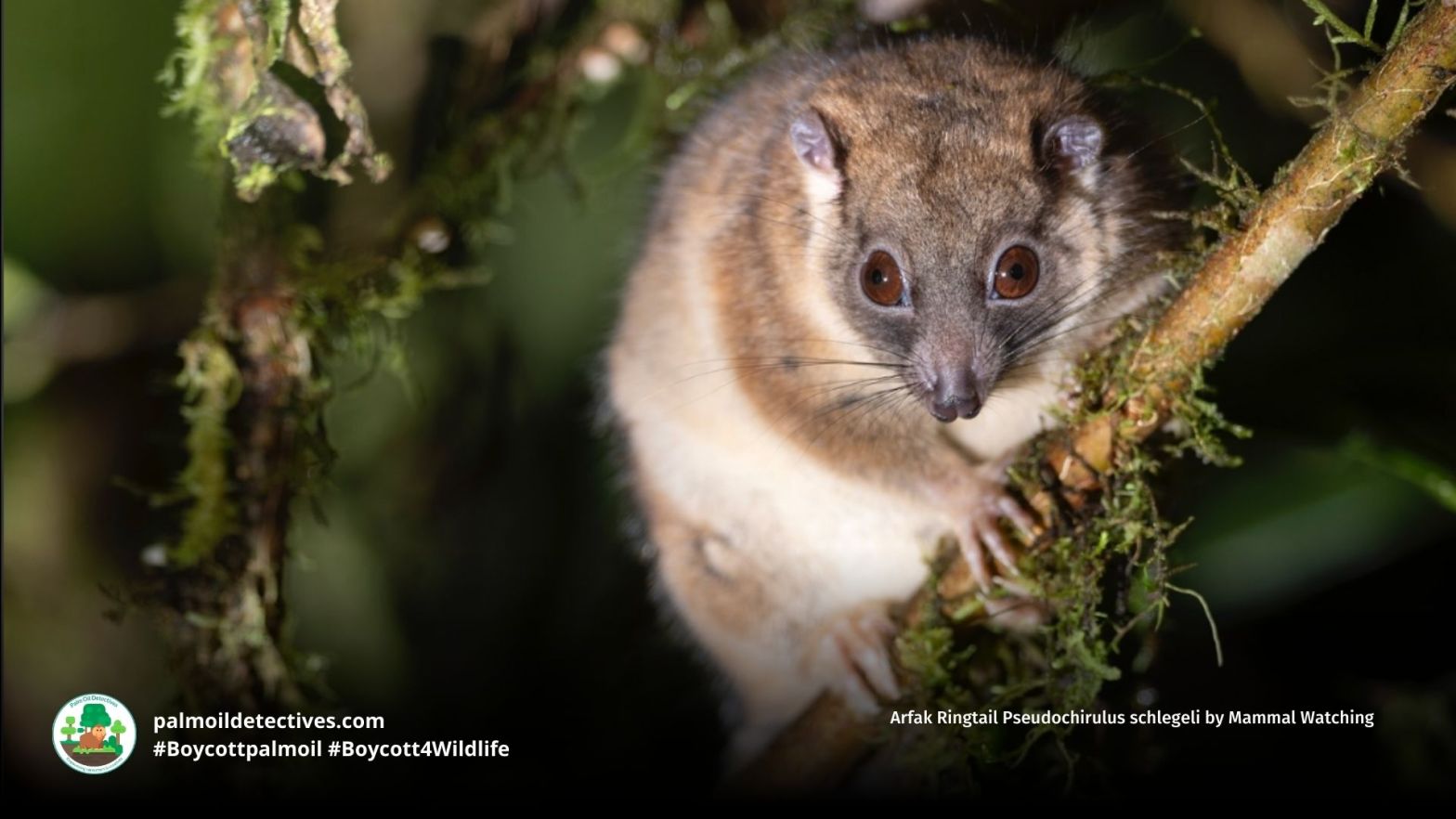
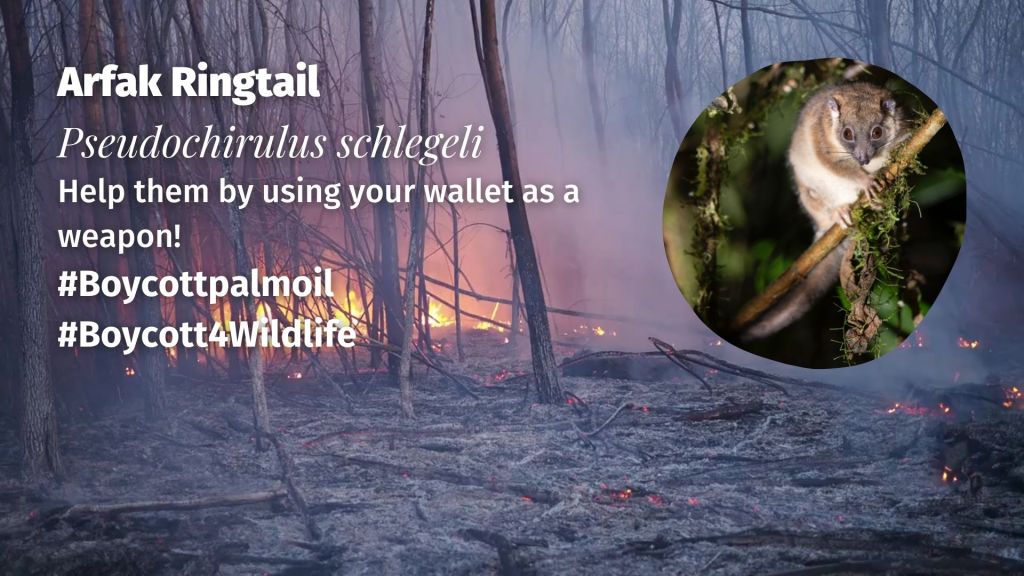
Arfak Ringtail Pseudochirulus schlegeli
Red List Status: Vulnerable
Location: Indonesia (Papua Province – Arfak Mountains, Vogelkop Peninsula)
The Arfak Ringtail is restricted to the cool cloud forests of the Arfak Mountains in West Papua, ranging from 750 to 1,900 metres above sea level.
The Arfak Ringtail Pseudochirulus schlegeli is a wide-eyed and bushy tailed #possum living in the remote Arfak Mountains and cloud forests of #WestPapua. Although little is known of these tree-dwelling #marsupials, much can be gleaned from related #mammals in Australasia. These cryptic and fluffy arboreal beauties are found in the mossy, cloud-wrapped forests of the Vogelkop Peninsula’s Arfak Mountains. Listed as #Vulnerable, the species faces mounting pressure from #deforestation for #palmoil and #timber and #hunting by local communities. With fewer than five known locations and less than 20,000 km² of suitable habitat, this highland #possum could disappear quietly without urgent action. Protect #indigenous forests, say no to palm oil, and stand up against wildlife exploitation #BoycottPalmOil #Boycott4Wildlife #Vegan
Adorable wide-eyed 👀 and bushy tailed 🐀😻🩶 Arfak Ringtails are #marsupials #vulnerable from #mining and #PalmOil #Deforestation in #WestPapua. Protect them when you shop and #BoycottPalmOil 🌴🩸🚜☠️⛔️ #Boycott4Wildlife @palmoildetect #PapuaMerdeka https://palmoildetectives.com/2021/01/26/arfak-ringtail-pseudochirulus-schlegeli/
Cute #marsupials of #WestPapua’s rainforests, Arfak Ringtails are surrounded by #palmoil and dead lands. Papuan land was never ceded or destroyed by #indigenous peoples! Protect animals and people of #Papua! #BoycottPalmOil #FreeWestPapua @palmoildetect https://palmoildetectives.com/2021/01/26/arfak-ringtail-pseudochirulus-schlegeli/
Appearance and Behaviour
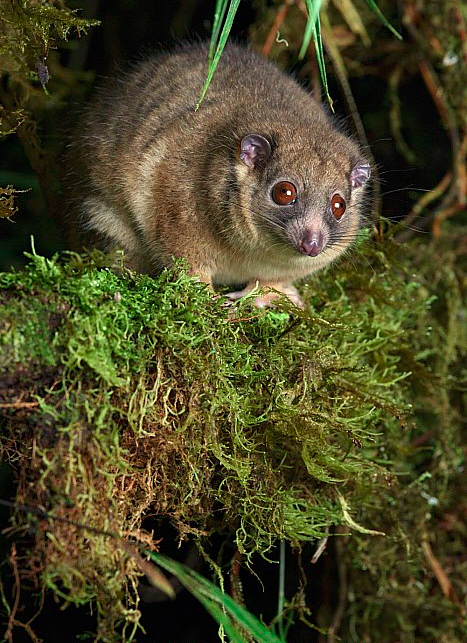
With their wide, watchful eyes and soft fawn coloured fur, the Arfak Ringtail is one of the most endearing mammals of the New Guinean highlands. This species has a round, compact body covered in velvety greyish-brown fur. Their underbellies are pale, with soft pinkish paws finished with sharp claws ideal for clinging to the tree canopy. Their fine and pointed snout and whiskers are sensitive to movement in the forest. Their ears are rounded and translucent and equally as sensitive to sonic disturbances. Like many other possums in Australia and New Guinea, the Arfak Ringtails large and prominent eyes help them to navigate by night and protect themselves against danger.


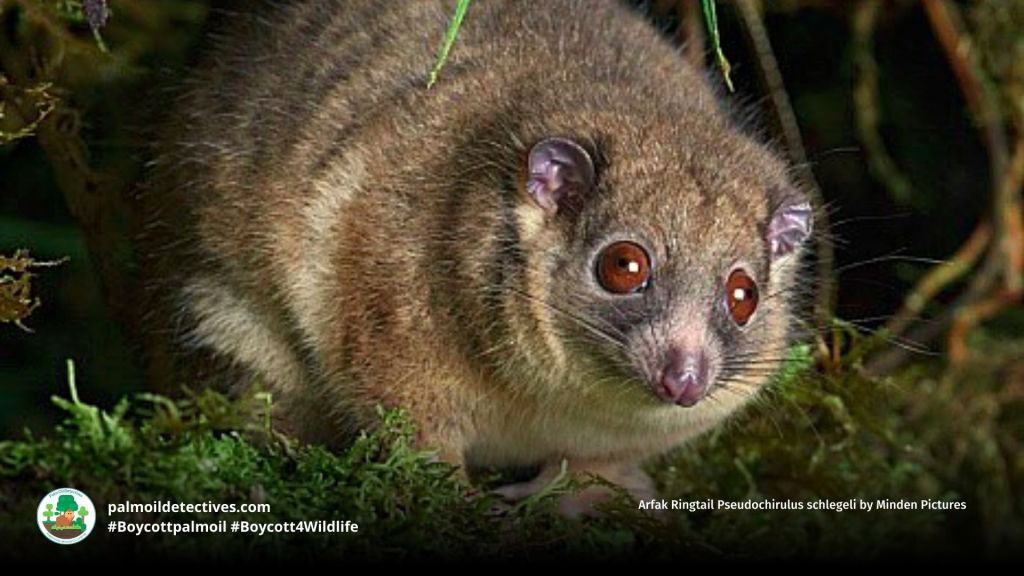
The Arfak Ringtail uses their prehensile tail to deftly navigate moss-draped branches high in the rainforest canopy. Almost nothing is known about the species’ social life, but like other ringtails, the species likely lives a secretive, arboreal existence, emerging at night to forage among the foliage.
Diet
Although never directly observed in the wild, the Arfak Ringtail likely follows a diet similar to other Pseudochirulus possums, feeding primarily on leaves, fruits, flowers, and possibly mosses or fungi. This folivorous diet is supported by a specialised digestive system capable of fermenting tough plant fibres.
Reproduction and Mating
While the breeding biology of the Arfak Ringtail remains a mystery due to their elusive nature and lack of field studies, scientists can infer some details by looking at closely related marsupials such as Australia’s ringtail possums (Pseudocheirus peregrinus) and other members of the Pseudochirulus genus.
Like other marsupials, the Arfak Ringtail likely gives birth to highly underdeveloped young after a short gestation period, possibly around 14 days. These tiny, pink, jellybean-sized joeys crawl unassisted into the mother’s pouch, where they latch onto a teat and continue developing in safety. The pouch phase may last two to three months, after which the young gradually begin to venture outside the pouch and are carried on the mother’s back as they continue to nurse and grow.
Breeding is likely seasonal in response to food availability, as observed in many rainforest marsupials. In Australian ringtail possums, females typically raise one to two young per year, with some species having more frequent breeding cycles depending on habitat conditions. Alloparental care – in which older siblings or group members help care for the young – has been documented in related species and may also occur in the Arfak Ringtail.
The young are weaned several months after pouch emergence and reach independence after about 6–9 months. Juvenile dispersal is thought to reduce inbreeding and help maintain genetic diversity. Like their Australian relatives, the Arfak Ringtail possum likely nests in leafy tree hollows or creates dreys (ball-shaped nests of woven leaves and twigs) high in the canopy to raise their young.
Geographic Range
The Arfak Ringtail is a marsupial possum endemic to the Arfak Mountains on the Vogelkop Peninsula in West Papua. The species occurs between 750 and 1,900 metres above sea level in montane rainforest habitats. Fewer than 10 individuals have ever been recorded, but researchers believe the species may be more widespread within the Arfaks, concealed by the region’s steep, remote terrain.
Threats
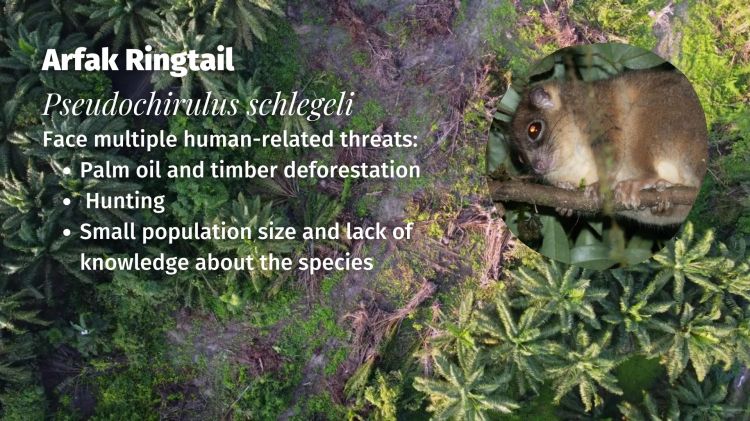
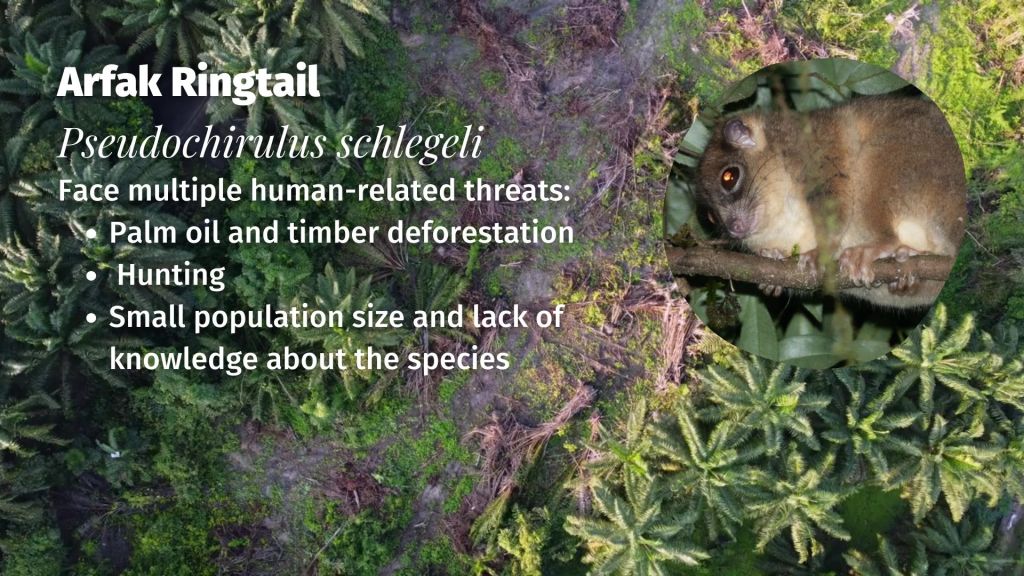
The Arfak Ringtail is a rare and little-known species is restricted to the Arfak mountains in the Vogelkop Peninsula in West Papua Province on the island of New Guinea. This ringtail is known from a handful of localities, but there is reason to believe that this species occurs throughout the Arfaks. This species is listed as Vulnerable because its extent of occurrence is less than 20,000 km2, it occurs at less than five locations, and it is experiencing continuing decline in habitat due to human encroachment, and in the number of mature individuals due to hunting. It is threatened by hunting for food by local people, and also by conversion of suitable forest habitat to cultivated land.
• Habitat destruction for palm oil and timber
Widespread clearing of highland forest for cultivation of palm oil, coffee and other commodities is rapidly eroding the Arfak Ringtail’s habitat. Although the species shows some tolerance for human presence, deforestation disrupts canopy connectivity, limiting access to food and shelter.
• Hunting by local communities
The species is hunted for bushmeat by communities in the Arfak Mountains. Due to the animal’s rarity and small range, even minimal hunting pressure can cause significant population declines, especially when combined with habitat fragmentation.
• Small population size and lack of knowledge
Almost nothing is known about the Arfak Ringtail’s ecology, population size, or behaviour. Without urgent studies, conservation efforts remain speculative, and the species could decline unnoticed. The absence of data delays protection and leaves this secretive marsupial vulnerable to extinction.
Take Action!
Support indigenous-led protection of New Guinea’s montane rainforests. Boycott palm oil and other industries driving deforestation. Never support bushmeat trade or hunting of wild mammals. Demand protection for New Guinea’s endemic species. #BoycottPalmOil #Boycott4Wildlife #Vegan #BoycottMeat
FAQs
How many Arfak Ringtails are left in the wild?
No population estimate currently exists. Fewer than 10 individuals have ever been documented, but researchers believe the species may be more widespread across the Arfak Mountains. Ongoing deforestation and hunting, however, are likely causing a continued decline in numbers (IUCN, 2021).
Where do Arfak Ringtails live?
The species is only found in the Arfak Mountains of the Vogelkop Peninsula in Papua Province, Indonesia. They live in montane cloud forests at elevations between 750 and 1,900 metres above sea level.
What is the main threat to the Arfak Ringtail?
Habitat loss due to industrial palm oil agriculture and logging is the biggest threat, followed closely by hunting. Despite some protection within a national park, ongoing deforestation and lack of data on their ecology hinder effective conservation.
Do Arfak Ringtails make good pets?
Absolutely not. Arfak Ringtails are wild, tree-dwelling marsupials with complex dietary and environmental needs. Capturing them for the illegal pet trade is an incredibly selfish act that contributes to their extinction. If you care about these rare forest dwellers, never support the illegal wildlife trade and advocate against the exploitation of wild animals.
Further Information

Helgen, K., Dickman, C. & Salas, L. 2016. Pseudochirulus schlegeli. The IUCN Red List of Threatened Species 2016: e.T40641A21962129. https://dx.doi.org/10.2305/IUCN.UK.2016-2.RLTS.T40641A21962129.en. Downloaded on 26 January 2021.
Wikipedia contributors. (n.d.). Pseudochirulus schlegeli. Wikipedia. Retrieved March 25, 2025, from https://en.wikipedia.org/wiki/Pseudochirulus_schlegeli
Ziegler, A. C. (n.d.). Evolution of New Guinea’s marsupial fauna in response to a forested environment. In The biology of marsupials (pp. 117–138). Springer. https://doi.org/10.1007/978-1-349-02721-7_7

How can I help the #Boycott4Wildlife?
Take Action in Five Ways
1. Join the #Boycott4Wildlife on social media and subscribe to stay in the loop: Share posts from this website to your own network on Twitter, Mastadon, Instagram, Facebook and Youtube using the hashtags #Boycottpalmoil #Boycott4Wildlife.
2. Contribute stories: Academics, conservationists, scientists, indigenous rights advocates and animal rights advocates working to expose the corruption of the palm oil industry or to save animals can contribute stories to the website.





3. Supermarket sleuthing: Next time you’re in the supermarket, take photos of products containing palm oil. Share these to social media along with the hashtags to call out the greenwashing and ecocide of the brands who use palm oil. You can also take photos of palm oil free products and congratulate brands when they go palm oil free.
4. Take to the streets: Get in touch with Palm Oil Detectives to find out more.
5. Donate: Make a one-off or monthly donation to Palm Oil Detectives as a way of saying thank you and to help pay for ongoing running costs of the website and social media campaigns. Donate here
Discover more from Palm Oil Detectives
Subscribe to get the latest posts sent to your email.
 Palm Oil Detectives