

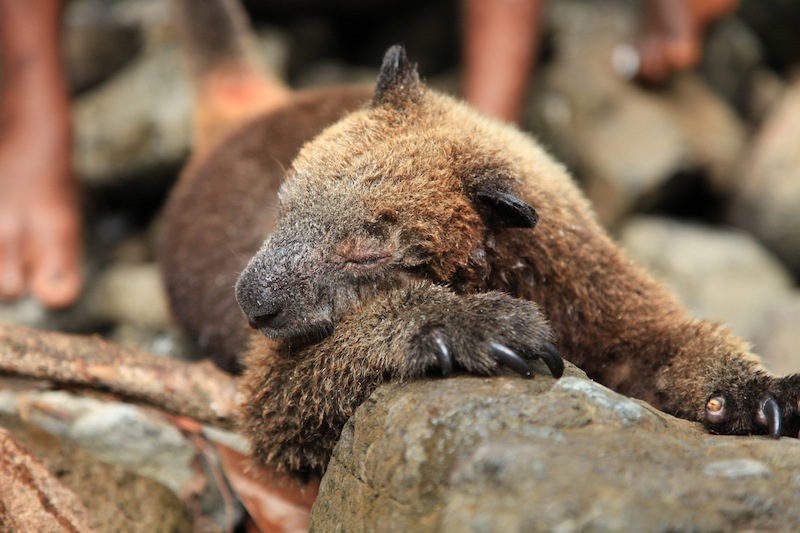
Ifola Dendrolagus notatus
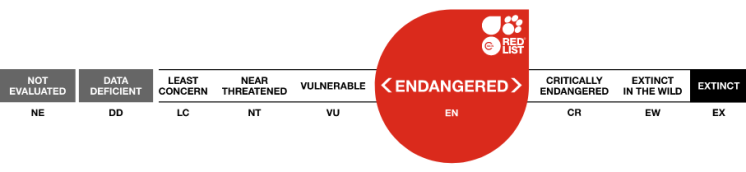
IUCN Red List Status: Endangered
Locations: Papua New Guinea, Indonesian-occupied West Papua
Ifolas are gentle forest-dwelling #marsupials of the tree #kangaroo genus #Dendrolagus in #PapuaNewGuinea 🦘🦘🤎. Endangered due to #palmoil #deforestation. Say no to palm oil and #BoycottPalmOil 🌴🪔☠️🤮⛔️ #Boycott4Wildlife @palmoildetect https://palmoildetectives.com/2021/01/31/ifola-dendrolagus-notatus/
Ifolas are gentle tree #kangaroos on the edge of #extinction in #WestPapua and #PapuaNewGuinea 🇵🇬🦘🦘🤎 due to hunting and #PalmOil #deforestation. Say no to palm oil when you shop! #BoycottPalmOil 🌴🪔🙈🚫🤮#Boycott4Wildlife @palmoildetect https://palmoildetectives.com/2021/01/31/ifola-dendrolagus-notatus/
The Ifola, a rare and little-known #marsupial tree kangaroo, inhabits the tropical montane forests of the Fakfak Mountains in Papua New Guinea and Indonesian-occupied West Papua. First identified as a distinct species in 1993, this remarkable marsupial is part of the genus Dendrolagus, known for their arboreal lifestyle. With their restricted range and vulnerability to habitat loss, Ifola are at significant risk due to palm oil deforestation, gold mining, and other human activities encroaching on their high-altitude homes. Their survival is tied to the preservation of the rich, biodiverse forests they call home. #BoycottPalmOil #Boycott4Wildlife
Appearance and Behaviour
The Ifola are strikingly agile and robust tree kangaroos, characterised by their reddish-brown coat, paler underparts, and a long, bushy tail. Their strong claws and muscular limbs are perfectly adapted for climbing the dense rainforest branches of , allowing them to thrive in the dense canopies of tropical forests (IUCN, 2015).
These shy and solitary animals are known for their elusive nature, often avoiding human contact. Primarily nocturnal, Ifola are adept at navigating the upper canopy, where they forage and rest, blending seamlessly into their environment (Tenkile Conservation Alliance, n.d.).
Diet
The Ifola’s diet consists primarily of leaves, which they supplement with fruits, flowers, and other vegetation. Their folivorous habits allow them to exploit a specialised niche in their montane forest habitat. However, their reliance on forest resources makes them particularly vulnerable to habitat destruction (IUCN, 2015).
Reproduction and Mating
As with many marsupial tree kangaroo species, there is limited information about the reproductive behaviours of Ifola. They are likely to have a low reproductive rate, with females giving birth to a single joey that remains in the pouch for several months. After giving birth, they are suspected to have an 18 month dependency period before the female is ready to breed again. This slow reproduction makes population recovery challenging, especially under current threats (IUCN, 2015; Tenkile Conservation Alliance, n.d.).
Geographic Range
The Ifola are endemic to the Fakfak Mountains in the Bird’s Head Peninsula of Indonesian-occupied West Papua. They are found in a narrow range of tropical montane forests, typically between 1,000 and 2,000 metres above sea level (IUCN, 2015). This limited distribution places them at heightened risk from habitat destruction and environmental changes.
Their habitat has been heavily impacted by logging, mining, and the expansion of palm oil plantations, further reducing their already restricted range (Palm Oil Detectives, 2021).
Threats
This incredibly rare tree kangaroo is listed as Endangered because they are suspected to have undergone at least a 50% population reduction in the last three generations (i.e., 30 years) that has not ceased, due mainly to hunting pressures and loss of habitat.
Palm Oil and Timber Deforestation: Logging and agricultural expansion, including out-of-control palm oil plantations, are destroying their habitat at an alarming rate (IUCN, 2015).
Gold Mining: Extractive industries pose a significant threat to the montane forests they depend on.
Climate Change: Rising temperatures threaten to shrink the high-altitude forests where they thrive, pushing them into even smaller ranges.
Take Action!
Protecting the Ifola requires urgent action to preserve their montane forest habitat. Support indigenous-led conservation initiatives in West Papua and choose products free from palm oil and deforestation. Adopting a vegan lifestyle and using your voice to advocate for the protection of biodiverse ecosystems are vital steps to ensure their survival. #BoycottPalmOil #Boycott4Wildlife #Vegan
The Ifola is threatened by heavy hunting for food with dogs by local people (it has disappeared from the Schrader Range). They are also threatened by loss of habitat due to agriculture (shifting cultivation) and deforestation due to logging.
IUCN Red List
Further Information
Leary, T., Seri, L., Flannery, T., Wright, D., Hamilton, S., Helgen, K., Singadan, R., Menzies, J., Allison, A. & James, R. 2016. Dendrolagus notatus. The IUCN Red List of Threatened Species 2016: e.T136732A21957010. https://dx.doi.org/10.2305/IUCN.UK.2016-2.RLTS.T136732A21957010.en. Downloaded on 31 January 2021.
Palm Oil Detectives. (2021). Ifola Tree Kangaroo. Retrieved from https://palmoildetectives.com/2021/01/31/ifola-dendrolagus-notatus/
Tenkile Conservation Alliance. (n.d.). Ifola Tree Kangaroo. Retrieved from https://tenkile.com/ifola-tree-kangaroo
Support the conservation of this species

How can I help the #Boycott4Wildlife?
Take Action in Five Ways
1. Join the #Boycott4Wildlife on social media and subscribe to stay in the loop: Share posts from this website to your own network on Twitter, Mastadon, Instagram, Facebook and Youtube using the hashtags #Boycottpalmoil #Boycott4Wildlife.
2. Contribute stories: Academics, conservationists, scientists, indigenous rights advocates and animal rights advocates working to expose the corruption of the palm oil industry or to save animals can contribute stories to the website.






3. Supermarket sleuthing: Next time you’re in the supermarket, take photos of products containing palm oil. Share these to social media along with the hashtags to call out the greenwashing and ecocide of the brands who use palm oil. You can also take photos of palm oil free products and congratulate brands when they go palm oil free.
4. Take to the streets: Get in touch with Palm Oil Detectives to find out more.
5. Donate: Make a one-off or monthly donation to Palm Oil Detectives as a way of saying thank you and to help pay for ongoing running costs of the website and social media campaigns. Donate here
Discover more from Palm Oil Detectives
Subscribe to get the latest posts sent to your email.
 Palm Oil Detectives
One thought on “Ifola Dendrolagus notatus”