
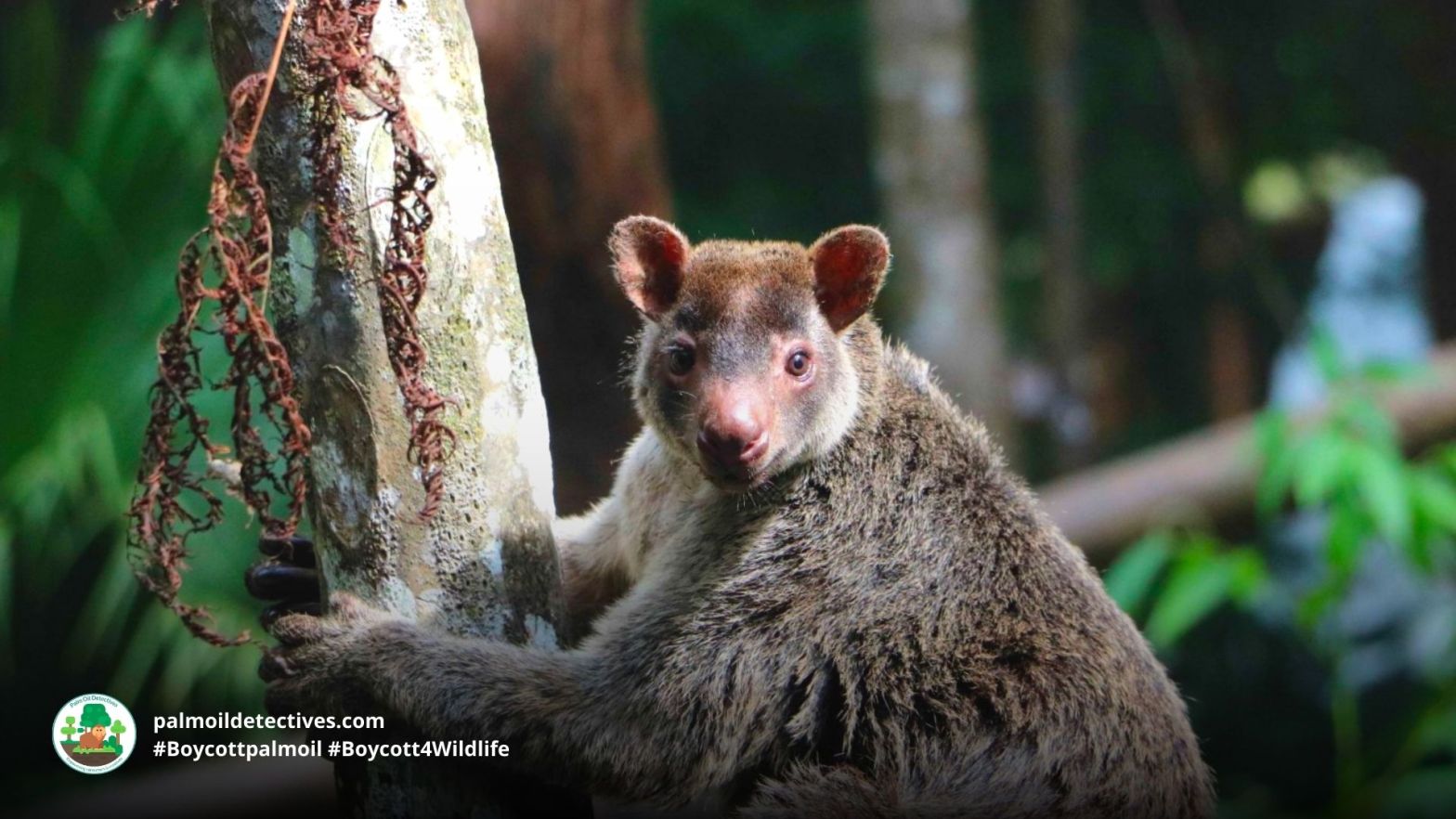
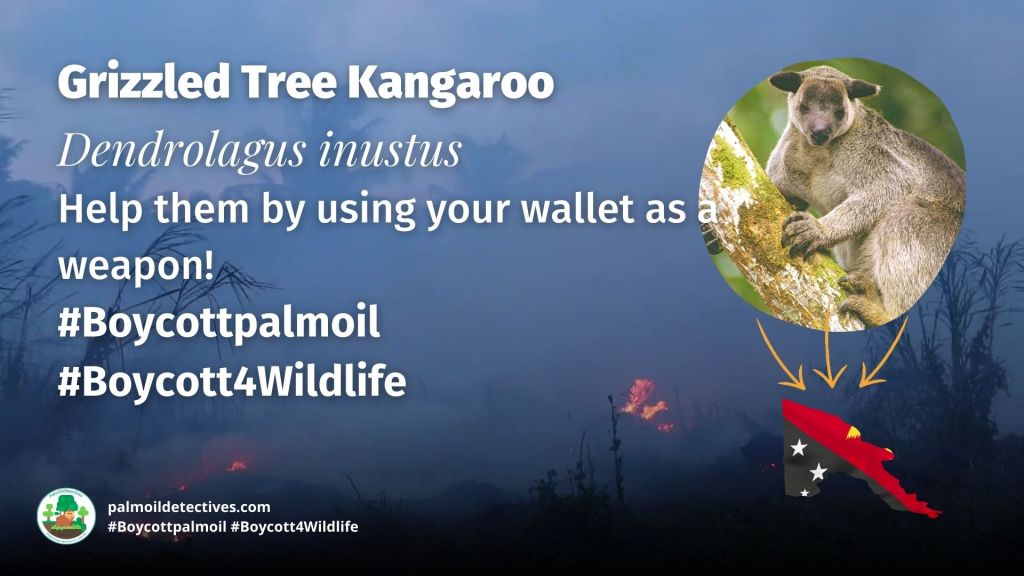
Grizzled Tree Kangaroo Dendrolagus inustus
IUCN Status: Vulnerable (VU)
Location: Indonesia (West Papua, islands of Japen, Waigeo, Misool, Salawati), Papua New Guinea
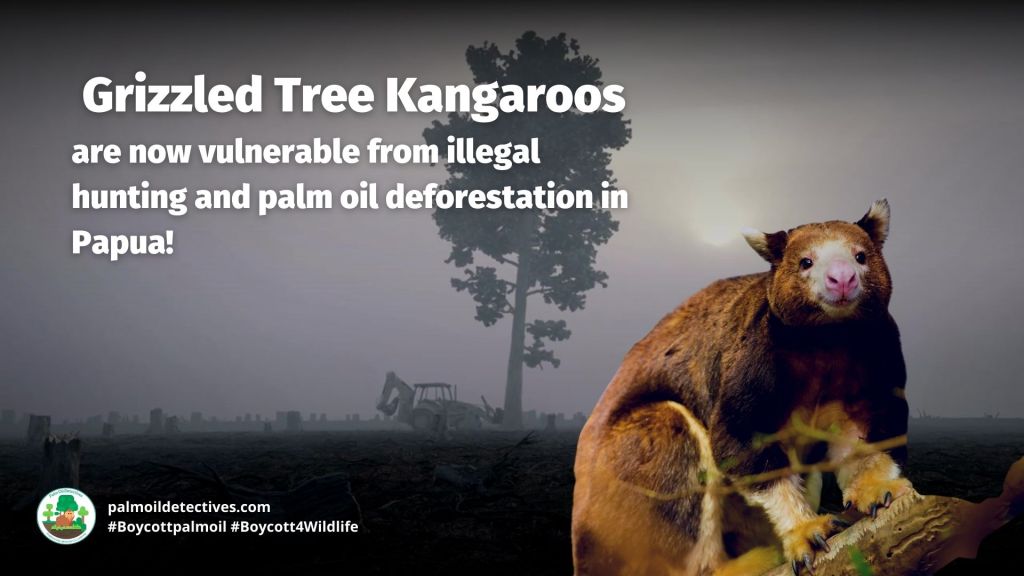
Where the forest rises steeply from the rivers and the mist hangs low over the green spires of the Foja Mountains and the Torricelli Range, the Grizzled Tree Kangaroo moves like a living memory. The Grizzled Tree Kangaroo Dendrolagus inustus and their ash-grey coats and quiet agile movements, are the ghostly figures of New Guinea’s dwindling rainforests. Listed as Vulnerable on the Red List, these rare tree kangaroos now stand at the edge of survival. Hunting dogs track their scent; chainsaws fell their towering homes. Palm oil is rapidly obliterating their forest home. Without urgent action, these shy, elusive creatures will vanish into the mist forever. Boycott palm oil and go #vegan for them. Protect their ancient world. #BoycottPalmOil #Boycott4Wildlife
Grizzled Tree Kangaroos 🦘 are looked after by @Tenkile they are vulnerable from #palmoil #deforestation in #WestPapua and #PapuaNewGuinea. Help their survival! When you shop #Boycottpalmoil 🌴🪔☠️🤮🧐🙊⛔️#Boycott4Wildlife @palmoildetect https://palmoildetectives.com/2021/02/03/grizzled-tree-kangaroo-dendrolagus-inustus/
Listed as Vulnerable because of an ongoing population decline, suspected to be more than 30% over the last generation (i.e, 10 years), and projected exceed 30% over the next two generations (i.e., 20 years), due to hunting and habitat loss and degradation from expanding agricultural activities.
IUCN Red List
Appearance and Behaviour
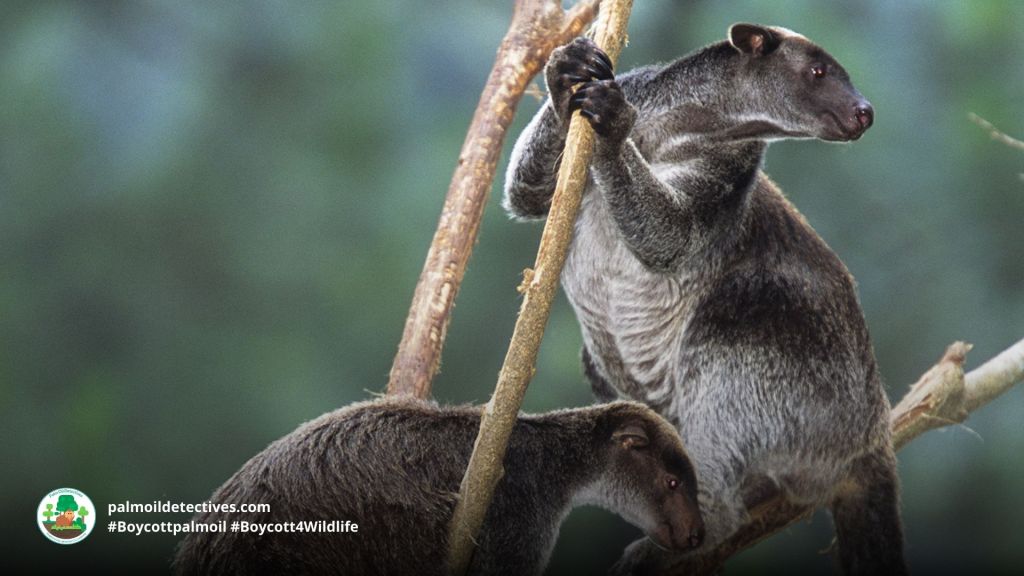
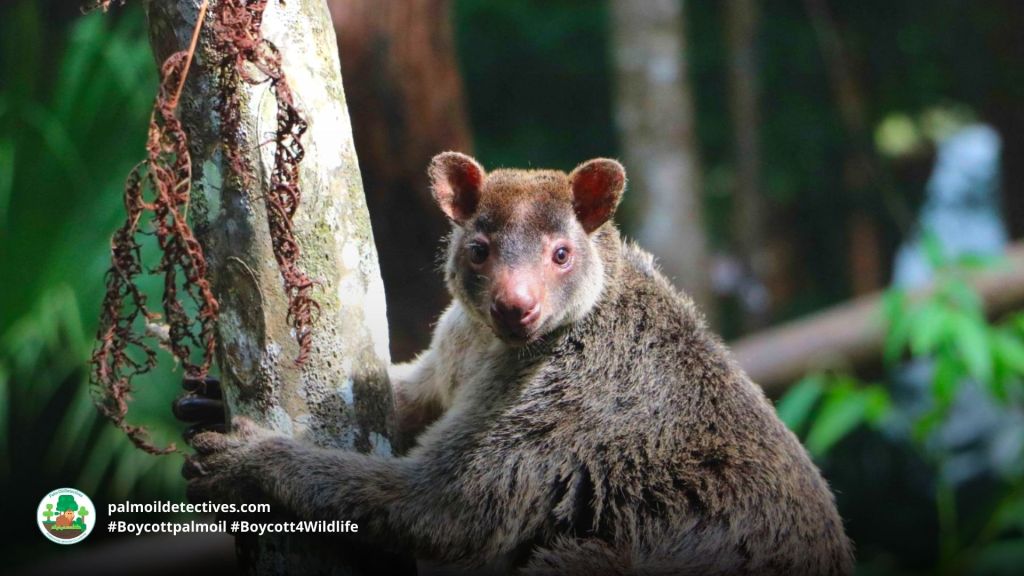
The Grizzled Tree Kangaroo are curious and gentle marsupials who blend in with the shadowplay of the forest canopy. Their charcoal-grey fur is streaked with rusty undertones. Strong forearms grasp thick branches with ease, while broad hind legs so familiar in their terrestrial cousins — are used in Papua for climbing, not bounding on the ground. A long, bushy tail acts as a balast and balances their weight in the treetops.
Distinct among tree kangaroos, males grow larger than females, reaching up to 15 kilograms, their bodies powerful, almost bear-like. Their faces are striking: some carry a grey forehead, others have darker facial marks.
They move at first light and in the purple hush before dusk, cautious and careful, threading the canopy as generations have done before them. Little is known of their social lives — the forest keeps their secrets well.
Diet
Grizzled Tree Kangaroos are folivores, primarily feeding on a variety of leaves, fruits, and bark. Their diet includes the foliage of plants such as Schuurmansiella angustifolia, Gnetum, Tetracera, Elatostema, arums, and several species of fig trees (Ficus spp.). They select a range of edible leaves and fruits available in the rainforest canopy and occasionally descend to the ground in search of additional food sources. Their feeding habits play a role in maintaining the ecological balance of their forest habitat.
Reproduction and Mating
The Grizzled Tree Kangaroo gives birth to a single, tiny joey, barely larger than a peanut, who clambers unaided into the mother’s pouch. Here, sheltered and nurtured, the joey will remain for nine months, unseen by human eyes.
Yet much remains to be discovered about the reproduction of Grizzled Tree Kangaroos in the wild. Reports suggest that reproduction occurs once a year, with observations of females carrying young in March, June, and December. Rare instances of twins have been recorded in the wild.

Geographic Range
The Grizzled Tree Kangaroo once moved freely across the northern forests of New Guinea, from the Torricelli Range to the Vogelkop Peninsula. Today, their range is fragmented but still broad:
- Indonesia: Vogelkop and Fakfak Peninsulas, Foja Mountains, islands of Japen, Waigeo, Misool, Salawati, possibly Batanta.
- Papua New Guinea: Northern coast ranges as far east as Wewak.
They are found from sea level up to 1,500 metres above sea level, climbing the spine of mountains wrapped in mist. They live in both primary and degraded forests — but it is the untouched forests, dense and dripping with life, where they truly belong.
Threats
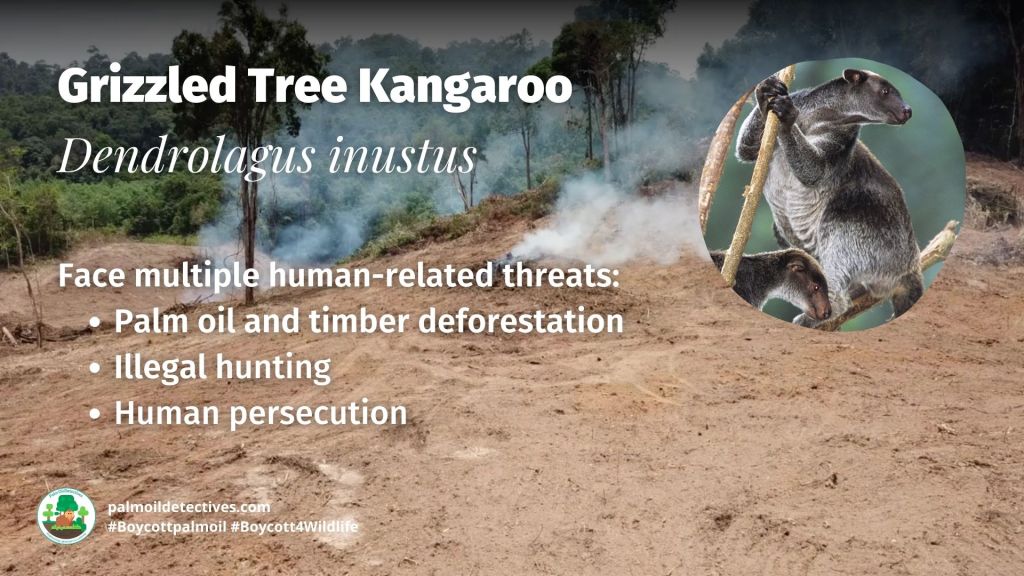
Palm oil deforestation
Large-scale clearing of forests for palm oil plantations is a major driver of habitat loss for the Grizzled Tree Kangaroo. Primary and secondary forests are converted to monocultures, removing the dense, diverse vegetation they require for food and shelter.
Gold mining
Mercury and other pollutants from illegal and small-scale gold mining operations contaminate the rivers and soil within their habitat, indirectly affecting the forest ecosystem, animals and indigenous peoples and reducing available resources.
Commercial and illegal logging activities create fragmented landscapes, isolating populations of Grizzled Tree Kangaroos and restricting their movement. Fragmentation increases their vulnerability to hunting and reduces genetic diversity.
Hunting
Hunting for bushmeat remains a significant threat throughout the species’ range. Tree kangaroos are slow-moving and often targeted by hunters, leading to population declines, especially in areas without hunting restrictions.
Illegal pet trade
Young Grizzled Tree Kangaroos are sometimes captured and sold into the illegal pet trade. Captivity causes stress and high mortality rates, and the removal of individuals further destabilises wild populations.
Climate change
Changes in rainfall patterns and temperature regimes affect the flowering and fruiting cycles of forest plants. Altered environmental conditions may impact food availability and the overall health of the habitat.
Take Action!
The Grizzled Tree Kangaroo is a survivor of a world most will never see. Protecting them means rejecting palm oil. Boycott soy-fed meat. Stand with indigenous-led conservation and agroecology. Fight the illegal pet trade. Let the canopy stay whole. Let the forest breathe. #BoycottPalmOil #Boycott4Wildlife #Vegan #BoycottMeat
FAQs
What is the current population of Grizzled Tree Kangaroos?
The exact population is unknown, but their numbers are believed to be declining across their fragmented range. Reports suggest that where hunting moratoriums are in place, sightings have increased after decades of absence (Tenkile Conservation Alliance, 2024).
How long do Grizzled Tree Kangaroos live?
While no comprehensive studies exist, similar species can live 15–20 years in the wild. In captivity, where breeding success has been achieved, lifespans can be longer.
Why are Grizzled Tree Kangaroos threatened?
Palm oil plantations, hunting, illegal logging, and habitat fragmentation are stripping away their homes and severing their populations. Combined with climate change, these forces push the Grizzled Tree Kangaroo closer to extinction.
Do Grizzled Tree Kangaroos make good pets?
No. They are solitary, tree-dwelling creatures who suffer deeply in captivity. Torn from their families, trapped in cages, deprived of the forest’s vast canopy, they quickly decline. The pet trade robs them of everything they are.
Further Information

Flannery, T. (1995). Mammals of New Guinea. Cornell University Press.
Flannery, T., Martin, R., & Szalay, A. (1996). Tree Kangaroos: A Curious Natural History. Reed Books.
Leary, T., Seri, L., Wright, D., Hamilton, S., Helgen, K., Singadan, R., Menzies, J., Allison, A., James, R., Dickman, C., Aplin, K., Flannery, T., Martin, R. & Salas, L. 2016. Dendrolagus inustus. The IUCN Red List of Threatened Species 2016: e.T6431A21957669. https://dx.doi.org/10.2305/IUCN.UK.2016-2.RLTS.T6431A21957669.en. Downloaded on 03 February 2021.
Tenkile Conservation Alliance. (2024). Grizzled Tree Kangaroo. Retrieved from https://tenkile.com/grizzled-tree-kangaroo/
Wikipedia. (n.d.). Grizzled tree-kangaroo. Retrieved June 3, 2025, from https://en.wikipedia.org/wiki/Grizzled_tree-kangaroo

How can I help the #Boycott4Wildlife?
Take Action in Five Ways
1. Join the #Boycott4Wildlife on social media and subscribe to stay in the loop: Share posts from this website to your own network on Twitter, Mastadon, Instagram, Facebook and Youtube using the hashtags #Boycottpalmoil #Boycott4Wildlife.
2. Contribute stories: Academics, conservationists, scientists, indigenous rights advocates and animal rights advocates working to expose the corruption of the palm oil industry or to save animals can contribute stories to the website.





3. Supermarket sleuthing: Next time you’re in the supermarket, take photos of products containing palm oil. Share these to social media along with the hashtags to call out the greenwashing and ecocide of the brands who use palm oil. You can also take photos of palm oil free products and congratulate brands when they go palm oil free.
4. Take to the streets: Get in touch with Palm Oil Detectives to find out more.
5. Donate: Make a one-off or monthly donation to Palm Oil Detectives as a way of saying thank you and to help pay for ongoing running costs of the website and social media campaigns. Donate here
Discover more from Palm Oil Detectives
Subscribe to get the latest posts sent to your email.
 Palm Oil Detectives
One thought on “Grizzled Tree Kangaroo Dendrolagus inustus”