
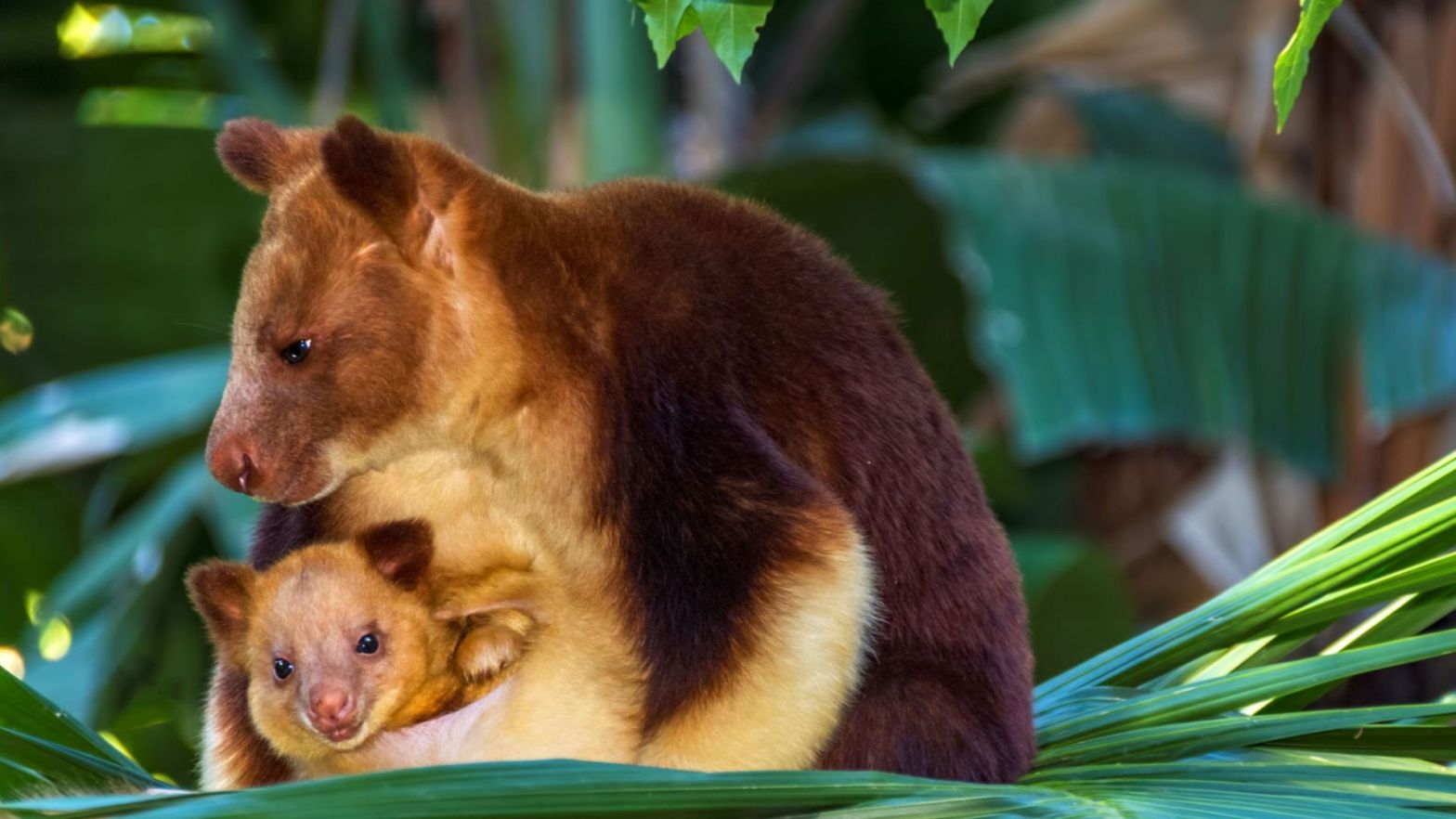
Lowlands Tree Kangaroo Dendrolagus spadix
IUCN Status: Vulnerable
Location: The Lowlands Tree Kangaroo is native to Papua New Guinea, found in the limestone karst forests of the Gulf and Western provinces. These dense, humid jungles are difficult to traverse, providing a natural refuge for this elusive species. However, increased human access due to roads and logging threatens their survival.
The Lowlands Tree #Kangaroo Dendrolagus spadix is a #Vulnerable species endemic to the forests of #PapuaNewGuinea. Unlike their ground-dwelling relatives, they are agile climbers, leaping through lush rainforest canopies with ease despite their bulky size. However, their survival is in peril due to widespread #deforestation driven by #palmoil plantations, #timber logging, and expansion of #roads, which has led to habitat destruction and increased #hunting pressures. If urgent action is not taken, this unique species faces further decline. Take action and resist for this species every time you shop and go #BoycottPalmOil #Boycott4Wildlife in the supermarket.
The Lowlands #TreeKangaroo 🦘🤎 is a #vulnerable #marsupial of #PapuaNewGuinea’s rainforests 🌳🇵🇬 threatened by #PalmOil, #mining #deforestation and #hunting. Help them to survive when you shop #BoycottPalmOil 🌴☠️🔥🧐🙊⛔️ #Boycott4Wildlife @palmoildetect https://palmoildetectives.com/2021/02/03/lowlands-tree-kangaroo-dendrolagus-spadix/
Despite their chunky size, Lowlands Tree #Kangaroos 🦘 are able to leap many metres. They’re #vulnerable due to #palmoil and #hunting in #PapuaNewGuinea. Fight for them when you shop, go #PalmOilFree and #BoycottPalmOil 🌴🚫#Boycott4Wildlife @palmoildetect https://palmoildetectives.com/2021/02/03/lowlands-tree-kangaroo-dendrolagus-spadix/
Appearance & Behaviour
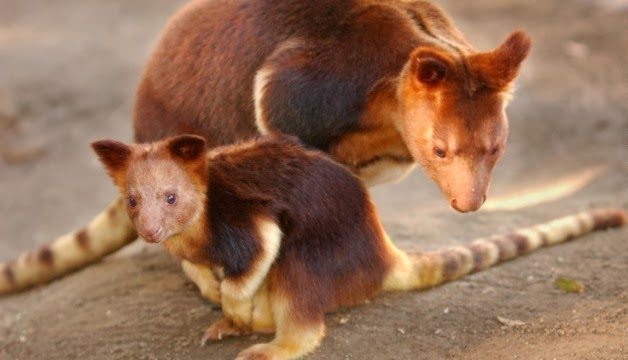
The Lowlands Tree Kangaroo is a striking, muscular marsupial with a dense coat of rich auburn, fading to golden hues on their belly and limbs. Unlike their ground-dwelling kangaroo relatives, they are built for life in the treetops, with stocky limbs, powerful claws, and an impressively long tail used for balance.
Watching a Lowlands Tree Kangaroo move is a surreal experience. On the ground, they amble in an almost bear-like gait, placing one foot in front of the other in a slow, deliberate waddle. Yet, when they climb, they transform into graceful acrobats, using their strong forelimbs to hoist themselves into the canopy with surprising ease. Despite their bulky build, they can leap remarkable distances between branches, navigating the dense jungle with grace.

Appearance & Behaviour
Largely solitary, these secretive tree-dwellers emerge at dusk to forage, preferring the cool, shadowy undergrowth or the safety of high branches. Their excellent camouflage and quiet nature make them incredibly difficult to spot in the wild.
Diet
The Lowlands Tree Kangaroo is a dedicated folivore, primarily feasting on a variety of leaves, fruits, flowers, and occasionally fungi. Their slow metabolism allows them to extract maximum nutrition from their fibrous diet. However, their reliance on specific plants means that large-scale deforestation can have devastating consequences, cutting off vital food sources.
Logging and land clearing for palm oil plantations pose a severe threat by destroying primary forests and forcing these marsupials into fragmented, less suitable habitats.
Reproduction & Mating
The Lowlands Tree Kangaroo has a slow reproductive rate, with females typically giving birth to a single tiny, jellybean-sized joey. This vulnerable newborn crawls into their mother’s pouch, where they remain hidden for several months. Even after emerging, the joey clings to their mother’s back for up to a year, learning essential survival skills before venturing out on their own.
This slow, careful nurturing process makes the species highly vulnerable to population declines. When individuals are lost due to hunting or habitat destruction, it takes a long time for their numbers to recover.
Threats
Deforestation & Habitat Loss
The Lowlands Tree Kangaroo’s biggest threat is habitat destruction caused by industrial logging and land clearing. A staggering 75% of their range is now covered by logging concessions, leading to habitat fragmentation and food shortages (IUCN, 2016).
Palm Oil & Infrastructure Development
The expansion of palm oil plantations is devastating for the species, as vast stretches of forest are cleared for monoculture crops. New roads built for logging and petroleum extraction have also opened up previously inaccessible regions, leading to increased human encroachment.
Hunting & Increased Human Access
Traditionally, hunting of the Lowlands Tree Kangaroo was limited due to the rugged and remote nature of their habitat. However, as roads now cut into once-inaccessible forests, hunting pressure has escalated. While local communities have long relied on the species as a food source, increased access has made hunting more widespread and unsustainable.
FAQs
Where do Lowlands Tree Kangaroos live?
The Lowlands Tree Kangaroo is native to Papua New Guinea, specifically found in the limestone karst forests of the Gulf and Western provinces. These forests are rugged and remote, providing some protection from human encroachment, though logging and road expansion are rapidly changing their habitat.
Why are Lowlands Tree Kangaroos endangered?
They are classified as Vulnerable due to habitat destruction, hunting, and increased human access to their previously isolated range. Over 75% of their habitat is now covered by logging and palm oil concessions, and road construction has led to an increase in hunting pressure. Palm oil plantations also contribute to large-scale deforestation, further reducing their numbers (IUCN, 2016).
What do Lowlands Tree Kangaroos eat?
Their diet consists mainly of leaves, fruits, flowers, and occasionally fungi. They rely on a slow metabolism to extract nutrients from fibrous plants, meaning they are particularly vulnerable to habitat destruction that removes key food sources.
Are Lowlands Tree Kangaroos social animals?
No, they are primarily solitary. Unlike ground-dwelling kangaroos, they do not form large groups. They prefer to navigate the dense rainforest canopy alone, only coming together briefly for mating.
Do they move like regular kangaroos?
In some ways they do, but in other ways they don’t. While ground-dwelling kangaroos hop over long distances on the ground, Lowlands Tree Kangaroos move in a slow, deliberate manner, placing one foot in front of the other, much like a bear. In trees, however, they are surprisingly agile, using their strong limbs to grip to tree branches and their long tails and strong legs to leap between branches. They are able to leap several metres at a time between tree canopies and can descend from trees up to 20 metres without injury.
Are Lowlands Tree Kangaroos hunted?
Yes, they are traditionally hunted by local communities for food. However, this was historically sustainable due to the remote nature of their habitat. Now, with new roads making hunting easier, populations are at risk of decline.
How does palm oil deforestation affect them?
Palm oil plantations are a major driver of deforestation in Papua New Guinea, destroying vast areas of rainforest. As the trees are cleared, Lowlands Tree Kangaroos lose their food sources and shelter, forcing them into smaller, fragmented habitats where they are more vulnerable to hunting and other threats.
How long do baby Lowlands Tree Kangaroos stay with their mothers?
Joeys stay in their mother’s pouch for several months before emerging. Even after leaving the pouch, they cling to their mother’s back and remain dependent on her for nearly a year. This slow reproductive cycle makes population recovery difficult if too many individuals are lost.
What can be done to protect them?
- Boycott products containing palm oil, which is a major threat to their continued existence.
- Support indigenous land rights, as traditional landowners help protect these forests.
- • Donate to conservation groups working to protect Papua New Guinea’s forests such as Tenkile.
- • Raise awareness by sharing information about the threats they face.
Are tree kangaroos protected by law?
While tree kangaroos are recognised as vulnerable species, weak enforcement of conservation laws in Papua New Guinea and the expansion of industrial projects continue to put them at risk. Conservation efforts must focus on habitat protection and stronger regulations against deforestation and hunting.
How can I help tree kangaroos from home?
- Always choose products that are 100% palm oil-free to avoid contributing to deforestation and biodiversity loss.
- Spread awareness on social media using hashtags like #BoycottPalmOil and #Boycott4Wildlife.
- Support conservation projects that work to protect Papua New Guinea’s forests and wildlife.
Take Action!
The survival of the Lowlands Tree Kangaroo depends on urgent conservation action. You can help by:
- Boycotting palm oil products and choosing brands that do not contribute to deforestation.
- Advocating for indigenous land rights, as traditional landowners play a key role in protecting these forests.
- Supporting conservation organisations that fight against logging and land conversion in Papua New Guinea.
- Raising awareness about the threats facing the Lowlands Tree Kangaroo by sharing information on social media using the hashtags #BoycottPalmOil #Boycott4Wildlife
You can support the conservation of this animal:
There are now logging concessions over almost 75% of the species inferred range. There has presumably been significant habitat disturbance and reduction in habitat quality as a result of logging
IUCN Red List
Further Information

Leary, T., Seri, L., Wright, D., Hamilton, S., Helgen, K., Singadan, R., Menzies, J., Allison, A., James, R., Dickman, C., Aplin, K., Salas, L., Flannery, T. & Bonaccorso, F. 2016. Dendrolagus spadix. The IUCN Red List of Threatened Species 2016: e.T6436A21956250. https://dx.doi.org/10.2305/IUCN.UK.2016-2.RLTS.T6436A21956250.en. Downloaded on 03 February 2021.
McGreevy, T. J., Dabek, L., & Husband, T. P. (2011). Tree kangaroo molecular systematics based on partial cytochrome b sequences: are Matschie’s tree kangaroo (Dendrolagus matschiei) and Goodfellow’s tree kangaroo (D. goodfellowi buergersi) sister taxa? Australian Mammalogy, 34(1), 18-28. https://doi.org/10.1071/AM10017
You can support the conservation of this animal:

How can I help the #Boycott4Wildlife?
Take Action in Five Ways
1. Join the #Boycott4Wildlife on social media and subscribe to stay in the loop: Share posts from this website to your own network on Twitter, Mastadon, Instagram, Facebook and Youtube using the hashtags #Boycottpalmoil #Boycott4Wildlife.
2. Contribute stories: Academics, conservationists, scientists, indigenous rights advocates and animal rights advocates working to expose the corruption of the palm oil industry or to save animals can contribute stories to the website.





3. Supermarket sleuthing: Next time you’re in the supermarket, take photos of products containing palm oil. Share these to social media along with the hashtags to call out the greenwashing and ecocide of the brands who use palm oil. You can also take photos of palm oil free products and congratulate brands when they go palm oil free.
4. Take to the streets: Get in touch with Palm Oil Detectives to find out more.
5. Donate: Make a one-off or monthly donation to Palm Oil Detectives as a way of saying thank you and to help pay for ongoing running costs of the website and social media campaigns. Donate here
Discover more from Palm Oil Detectives
Subscribe to get the latest posts sent to your email.
 Palm Oil Detectives
One thought on “Lowlands Tree Kangaroo Dendrolagus spadix”