
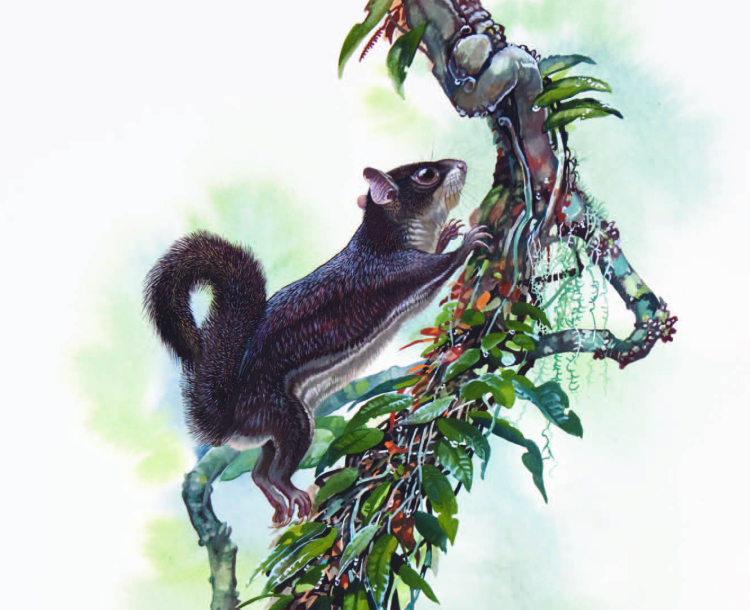
Mentawi Flying Squirrel Iomys sipora
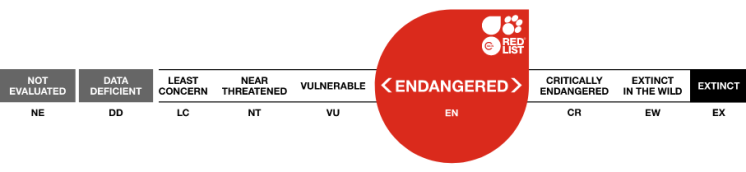
IUCN Status: Endangered
Location: Indonesia (Mentawai Islands: Sipura and North Pagai)
The #Mentawi Flying #Squirrel (Iomys sipora), endemic to the remote Mentawai Islands of Indonesia, is a rare and elusive species that glides effortlessly through the dense tropical canopy. Unlike their more widespread relatives, these unique flying squirrels are confined to just two islands, #Sipura and North Pagai, where they depend entirely on the survival of lowland primary forests. With velvety fur, large nocturnal eyes, and a patagium—an outstretched skin membrane allowing them to glide between trees—these squirrels are adapted to a life above the ground. However, relentless deforestation for palm oil plantations, logging, and agriculture has devastated their habitat, putting them at serious risk of extinction. Despite repeated surveys, including a 1991 study by the National Museum of #Indonesia, sightings of Iomys sipora are alarmingly rare, raising fears that their population may be critically low—or even lost. With no conservation measures in place, urgent action is needed to prevent their disappearance. Boycott #deforestation-linked products and support indigenous-led conservation. #BoycottPalmOil #Boycott4Wildlife.
Gliding between trees in #Indonesia 🇮🇩with effortless grace, the Mentawi Flying #Squirrel 🦦is a sight to behold. They need #rainforest to survive. #PalmOil is a threat, make sure you #BoycottPalmOil 🌴🪔💀🤮🧐🙊⛔️ #Boycott4Wildlife @palmoildetect https://palmoildetectives.com/2021/02/05/mentawi-flying-squirrel-iomys-sipora/
This squirrel is threatened by forest loss due to logging and agricultural conversion.
IUCN Red list
Appearance and Behaviour
The world’s gliding mammals are an extraordinary group of animals that have the ability to glide from tree to tree with seemingly effortless grace. There are more than 60 species of gliding mammals including the flying squirrels from Europe and North America, the scaly-tailed flying squirrels from central Africa and the gliding possums of Australia and New Guinea.
The Mentawi Flying Squirrel is a striking and little-documented species with dense, velvety fur ranging from reddish-brown to deep grey. Their large, round eyes are adapted for night vision, enabling them to forage under the cover of darkness. A defining feature of this species is its patagium— a thin membrane of skin stretching between its limbs—that allows them to glide through the air with remarkable agility. This natural adaptation enables them to travel between trees without descending to the forest floor, avoiding predators while seeking food. Despite their impressive gliding ability, their dependence on intact rainforest means they struggle to survive in fragmented landscapes, making habitat loss a critical threat.
Threats
The Mentawi Flying Squirrel lives in primary forests up to 500 m. Habitat loss on the two islands represents a major threat to this lowland species.
Palm Oil Deforestation and Habitat Destruction
The Mentawai Islands are experiencing rapid deforestation, with lowland primary forests being cleared for palm oil plantations, logging, and agriculture. Iomys sipora relies entirely on undisturbed rainforest, and the loss of old-growth trees has significantly reduced available nesting sites and food sources. Once widespread, they are now found in just two fragmented locations, and their numbers are declining.
Illegal Wildlife Trade Extirpation
A 1991 survey failed to locate any individuals, raising concerns that populations may already be critically low or locally extinct. Habitat degradation and fragmentation mean that surviving populations are likely small and isolated, making recovery efforts increasingly difficult.
Agricultural Expansion and Infrastructure
Beyond palm oil, the Mentawai Islands face destruction from logging, rubber plantations, and road development, which further degrade the remaining habitat. Unlike more adaptable rodents, these flying squirrels cannot survive in secondary forests, making primary forest loss particularly devastating.
Climate Change and Extreme Weather Patterns
Climate change is altering rainfall patterns and increasing temperatures, which could further threaten this species’ delicate forest ecosystem. Rising temperatures may also affect fruiting seasons, reducing their food supply and further impacting their already struggling population.
Diet
Like other flying squirrels, Iomys sipora is primarily herbivorous, feeding on a mix of fruits, seeds, leaves, and flowers. Their diet plays a vital role in seed dispersal, helping regenerate their native rainforest. They rely on old-growth trees, which provide an abundance of food sources, but as these trees are felled, their dietary options become severely limited.
Reproduction and Mating
Due to the extreme rarity of Iomys sipora, very little is known about their reproductive habits. However, they are presumed to be solitary nesters, using tree hollows to raise their young. Like other flying squirrels, females likely give birth to one or two pups per litter, which remain dependent on their mothers until they develop the ability to glide and forage independently. The loss of old-growth trees also removes critical nesting sites, impacting their reproductive success and ability to recover from population losses.
Geographic Range
The Mentawi Flying Squirrel is restricted to two islands in Indonesia:
• Sipura Island
• North Pagai Island
Both islands are part of the Mentawai Archipelago, located off the coast of Sumatra. Their habitat is limited to lowland tropical primary forests below 500 metres above sea level, an ecosystem rapidly disappearing due to human activity.
FAQs
Why is the Mentawi Flying Squirrel endangered?
This species is classified as endangered due to its highly restricted range and ongoing deforestation. Logging, palm oil plantations, and habitat destruction have driven it to the brink, with no known conservation measures in place to protect its remaining populations.
Do Mentawi Flying Squirrels make good pets?
No. The illegal pet trade has devastating effects on wildlife, and keeping a Mentawi Flying Squirrel as a pet would contribute to their decline. These animals are highly specialised and cannot survive in captivity, often dying due to stress or inadequate care. Removing individuals from the wild further destabilises already fragile populations. If you care about their survival, support habitat protection and never purchase exotic pets.
How does palm oil impact the Mentawi Flying Squirrel?
Palm oil plantations are a primary driver of deforestation in Indonesia, replacing biodiverse rainforests with monoculture wastelands that provide no habitat for native species. These plantations have destroyed much of the Mentawai Islands’ primary forest, leaving little space for this already endangered species. Boycotting palm oil products is a direct way to protect their habitat.
How can we protect the Mentawi Flying Squirrel?
The most important conservation efforts include:
• Protecting remaining old-growth forests on the Mentawai Islands.
• Supporting indigenous-led conservation efforts, which are crucial for preserving biodiversity.
• Boycotting palm oil and timber products linked to deforestation.
• Encouraging reforestation projects in degraded areas to restore lost habitat.
Support the conservation of this species
This animal has no protections in place. Read about other forgotten species here. Create art to support this forgotten animal or raise awareness about them by sharing this post and using the #Boycottpalmoil #Boycott4Wildlife hashtags on social media. Also you can boycott palm oil in the supermarket.
Further Information
Lee, B. 2016. Iomys sipora (errata version published in 2017). The IUCN Red List of Threatened Species 2016: e.T10846A115099877. https://dx.doi.org/10.2305/IUCN.UK.2016-3.RLTS.T10846A22249119.en. Downloaded on 04 February 2021.
Ruedas, L., Duckworth, J. W., Lee, B., & Tizard, R. J. (2008). Iomys sipora. The IUCN Red List of Threatened Species. Retrieved from https://pmc.ncbi.nlm.nih.gov/articles/PMC8317177/.
Wikipedia. (2024). Mentawi Flying Squirrel. Retrieved from https://en.wikipedia.org/wiki/Mentawi_flying_squirrel.
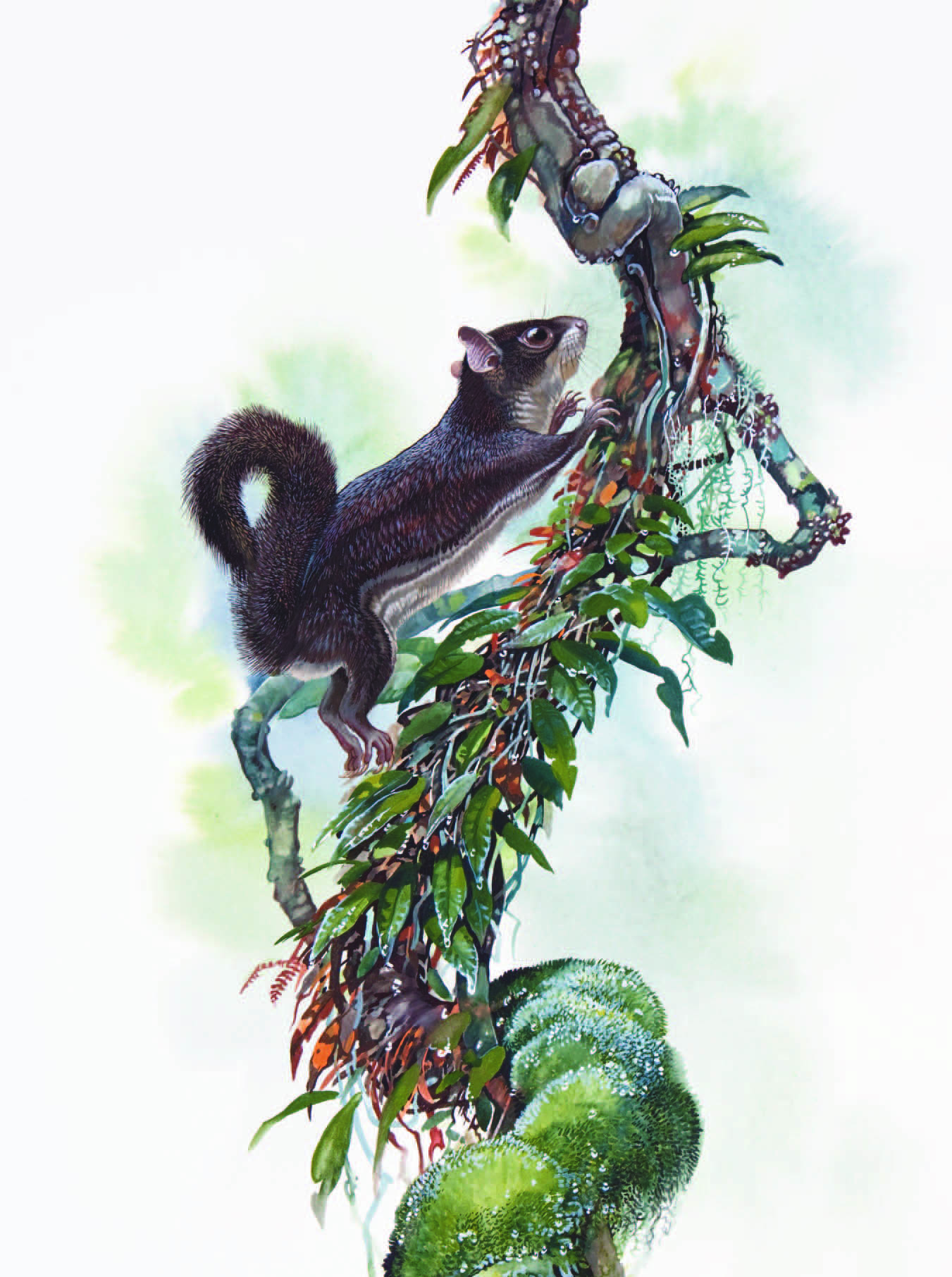
Caption: This beautiful painting is by My YM

How can I help the #Boycott4Wildlife?
Take Action in Five Ways
1. Join the #Boycott4Wildlife on social media and subscribe to stay in the loop: Share posts from this website to your own network on Twitter, Mastadon, Instagram, Facebook and Youtube using the hashtags #Boycottpalmoil #Boycott4Wildlife.
2. Contribute stories: Academics, conservationists, scientists, indigenous rights advocates and animal rights advocates working to expose the corruption of the palm oil industry or to save animals can contribute stories to the website.



3. Supermarket sleuthing: Next time you’re in the supermarket, take photos of products containing palm oil. Share these to social media along with the hashtags to call out the greenwashing and ecocide of the brands who use palm oil. You can also take photos of palm oil free products and congratulate brands when they go palm oil free.
4. Take to the streets: Get in touch with Palm Oil Detectives to find out more.
5. Donate: Make a one-off or monthly donation to Palm Oil Detectives as a way of saying thank you and to help pay for ongoing running costs of the website and social media campaigns. Donate here
Discover more from Palm Oil Detectives
Subscribe to get the latest posts sent to your email.
 Palm Oil Detectives