
Woolly Flying Squirrel Eupetaurus cinereus
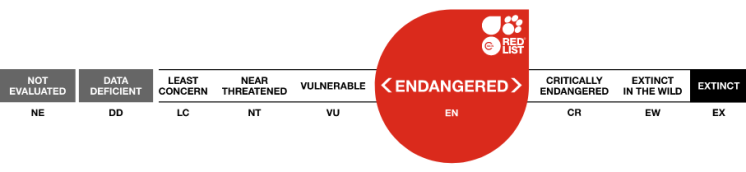
IUCN Status: Endangered
Location: Pakistan, India, Bhutan
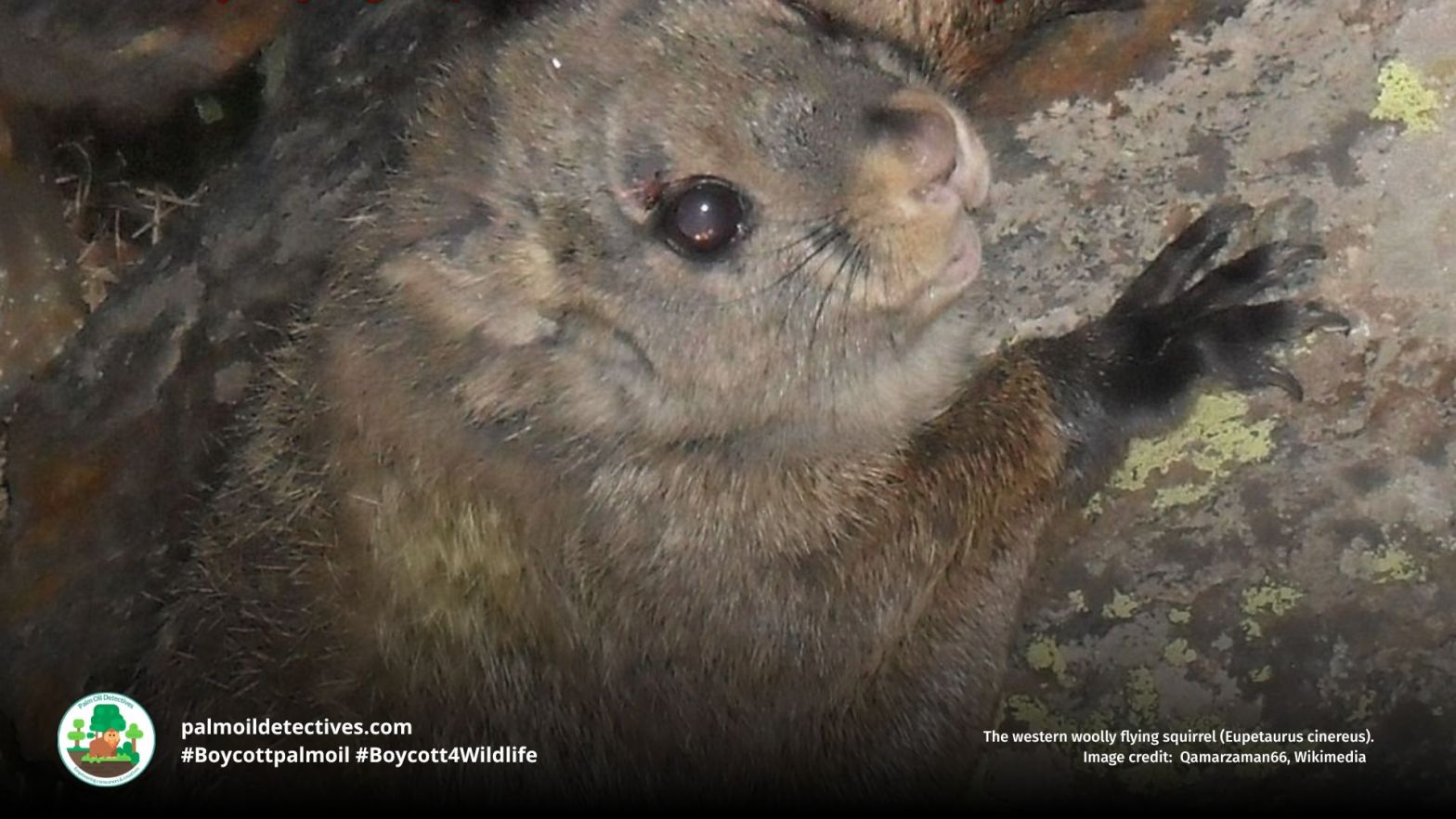
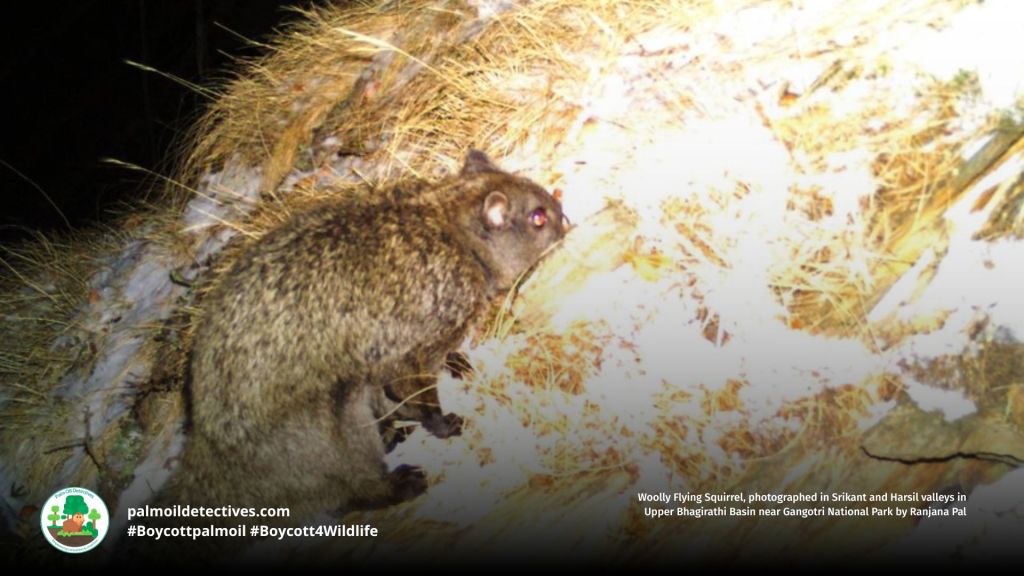
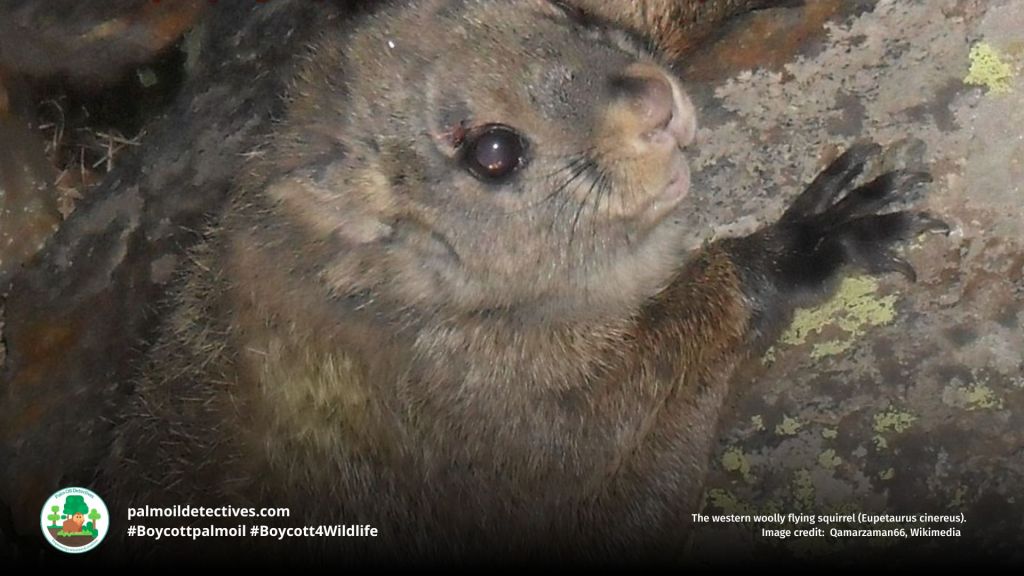
The Western Woolly Flying #Squirrel Eupetaurus cinereus is one of the world’s largest and least understood gliding mammals. Once thought extinct for nearly 70 years, they were rediscovered in the remote mountainous forests of northern #Pakistan and #India in 1994. This remarkable species inhabits high-altitude cliffs and coniferous forests, where they glide with effortless grace between trees despite their large size. However, their survival is under severe threat from habitat destruction, #deforestation, and human persecution. Help them by sharing out this campaign and calling out exploitative industries, it’s the #Boycott4Wildlife
The fluffy and rare Woolly Flying #Squirrel 🦦🌳 glides 100s of metres in forests of #Pakistan 🇵🇰 and #India 🇮🇳They’re #endangered by #deforestation and human persecution 😿 Help them to survive and #Boycott4Wildlife industries destroying their home https://palmoildetectives.com/2021/02/05/woolly-flying-squirrel-eupetaurus-cinereus/
This squirrel is threatened by forest loss due to logging and agricultural conversion.This species is threatened by habitat loss due to large-scale clear-cutting of forests (Zahler and Woods 1997). It is also threatened to a lesser extent by expansion of agriculture, small-scale logging, infrastructure development, and human settlements (Molur et al. 2005).
IUCN Red list
A Phantom of the High Himalayas
For decades, the Western Woolly Flying Squirrel was little more than a legend—known only from a handful of 19th-century specimens. Weighing up to 2.5 kg and measuring over a metre in total length, they are among the largest gliding mammals. Their long, thick fur gives them a distinctively woolly appearance, helping them withstand the harsh conditions of their mountain habitat.
Their ability to glide is no less impressive than smaller flying squirrels, despite their size. These elusive creatures live in some of the world’s most inaccessible terrain, high in the Himalayas, where they navigate steep cliffs and deep valleys. But despite their extraordinary adaptations, human activity is pushing them towards extinction.
#BoycottPalmOil #Boycott4Wildlife every time you shop.
Appearance and Behaviour
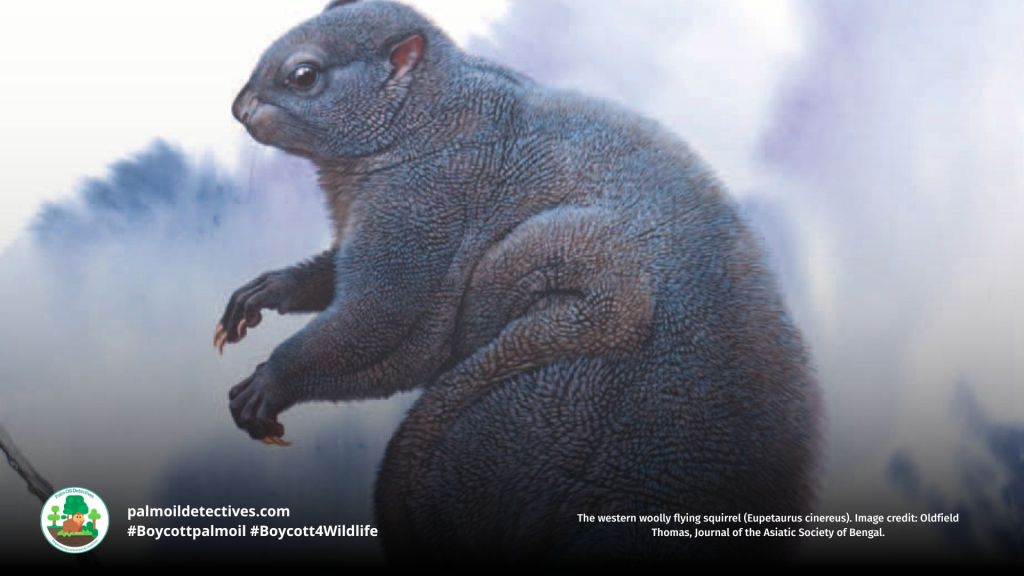
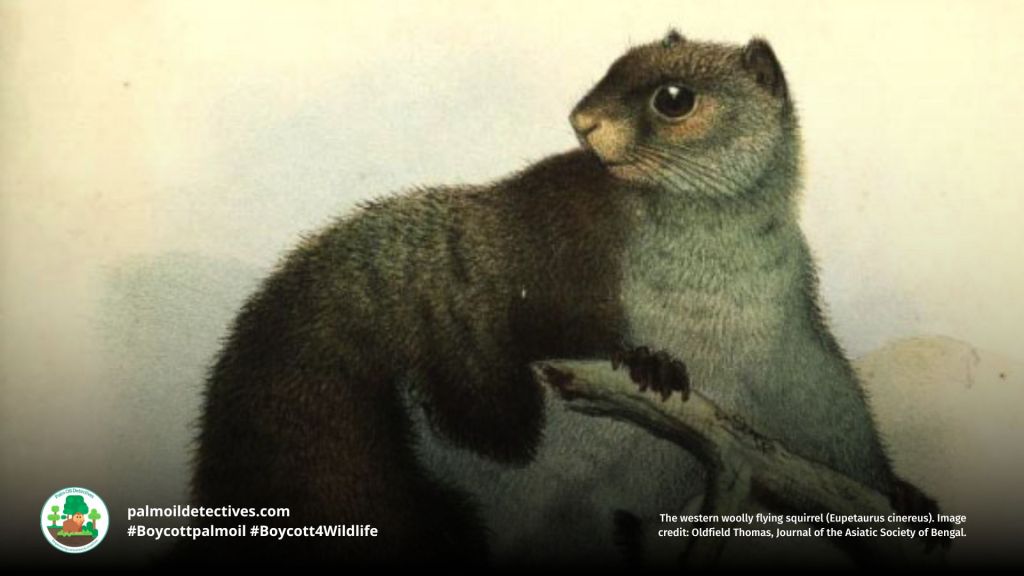
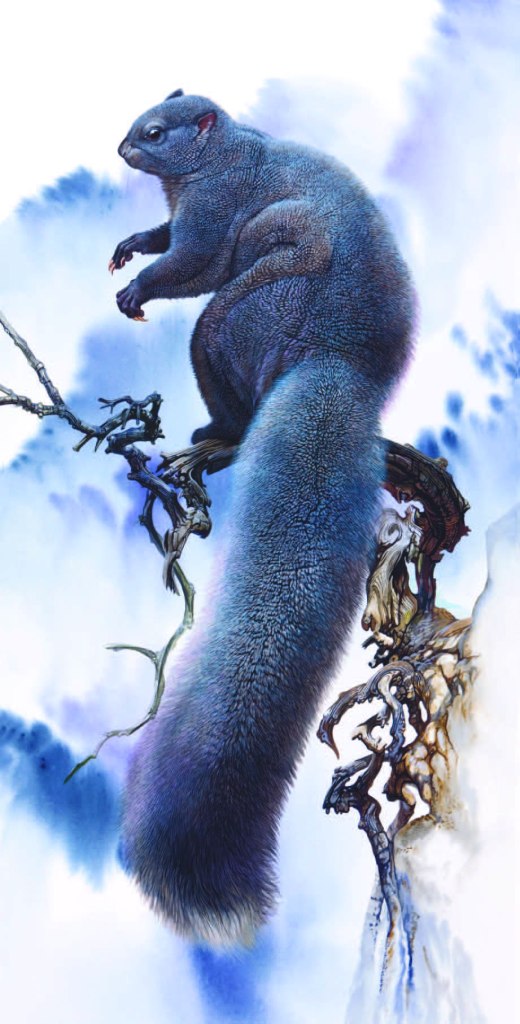
Western Woolly Flying Squirrels are covered in dense, greyish fur that gives them a shaggy, woolly look—unlike their recently discovered relatives, which have a more reddish-brown coat. Their long, bushy tails provide stability in flight, while their large, gliding membranes stretch between their limbs, allowing them to soar effortlessly through their rugged forest home.
They are highly specialised for life at extreme altitudes, found in conifer forests and rocky outcrops above 3,500 metres. Unlike many other flying squirrels, they have powerful jaw muscles and high-crowned teeth, adaptations that allow them to feed on tough conifer needles.
Diet
Unlike other flying squirrels that rely on nuts and fruits, the Western Woolly Flying Squirrel primarily feeds on pine needles. Their unique dental structure enables them to consume this fibrous diet, which is otherwise difficult to digest. They also contribute to the formation of shilajit—a resin-like substance prized in traditional medicine—through the accumulation of their faeces, urine, and shed hair in rocky crevices over centuries.
Reproduction and Mating
Little is known about the breeding habits of the Western Woolly Flying Squirrel. Their remote and inaccessible habitat makes long-term observation nearly impossible. However, like other flying squirrels, they likely give birth to small litters of offspring, raising their young in cliffside nests or tree hollows. Further research is needed to understand their reproductive behaviour and population dynamics.
Geographic Range
Once thought to be extinct, the Western Woolly Flying Squirrel was rediscovered in the 1990s in northern Pakistan, specifically in the Gilgit-Baltistan region, including Chitral, Astor, and Skardu. They have since been recorded in the Upper Neelum Valley of Azad Jammu and Kashmir, as well as in Uttarakhand, India, and Jigme Dorji National Park in Bhutan. The species’ preference for steep, forested cliffs makes their range extremely fragmented and vulnerable to disturbance.
Threats
• Deforestation – Large-scale logging operations are rapidly destroying their coniferous forest habitat.
• Human expansion – Agricultural expansion, infrastructure projects, and human settlements are encroaching on their high-altitude forests.
• Habitat fragmentation – Roads and development projects disrupt their ability to glide between trees and find suitable nesting sites.
• Hunting and poaching – Although not commonly targeted, they may be hunted for their fur or as a perceived pest.
Take Action!
Protecting the Western Woolly Flying Squirrel requires urgent action to preserve their high-altitude forest habitat. You can help by:
• Avoiding products linked to deforestation, including palm oil and unsustainable timber.
• Supporting conservation efforts focused on protecting the Himalayan ecosystem.
• Raising awareness about the importance of preserving one of the world’s rarest flying squirrels. #BoycottPalmOil #Boycott4Wildlife #Vegan
FAQs
How many Western Woolly Flying Squirrels are left in the wild?
Their exact population size is unknown due to their remote habitat and elusive nature, but their numbers are believed to be declining due to habitat loss.
How long do Western Woolly Flying Squirrels live?
There is no confirmed data on their lifespan in the wild, but other large flying squirrels live around 10–15 years.
Are Western Woolly Flying Squirrels good pets?
No. These animals are highly specialised for life in extreme mountain environments and would not survive in captivity. Additionally, removing them from the wild would further endanger their fragile populations.
How far can they glide?
Though not well documented, similar-sized flying squirrels can glide over 100 metres. Their adaptations suggest they are capable of covering long distances between trees and cliffs.
Why are they so rare?
They live in one of the most remote and inaccessible regions in the world. Their preference for steep cliffs and high-altitude forests makes them extremely difficult to find and study.
Support the conservation of this species
This animal has no protections in place. Read about other forgotten species here. Create art to support this forgotten animal or raise awareness about them by sharing this post and using the #Boycottpalmoil #Boycott4Wildlife hashtags on social media. Also you can boycott palm oil in the supermarket.
Further Information
Jackson, S. M., et al. (2021). Across the great divide: revision of the genus Eupetaurus (Sciuridae: Pteromyini), the woolly flying squirrels of the Himalayan region, with the description of two new species. Zoological Journal of the Linnean Society. https://doi.org/10.1093/zoolinnean/zlab018
Zahler, P. 2010. Eupetaurus cinereus. The IUCN Red List of Threatened Species 2010: e.T8269A12904144. https://dx.doi.org/10.2305/IUCN.UK.2010-2.RLTS.T8269A12904144.en. Downloaded on 04 February 2021.
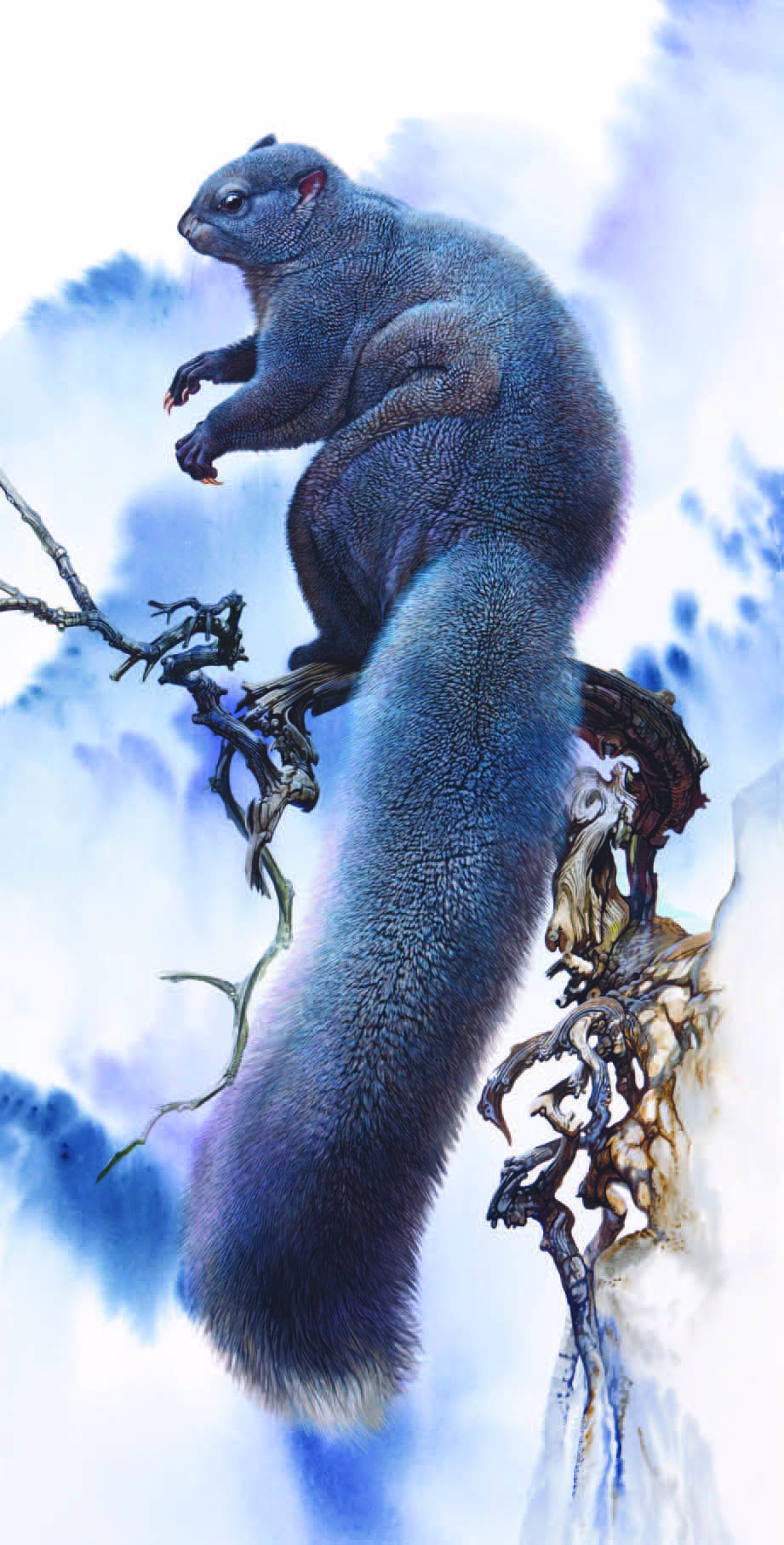
Caption: This beautiful painting is by My YM

How can I help the #Boycott4Wildlife?
Take Action in Five Ways
1. Join the #Boycott4Wildlife on social media and subscribe to stay in the loop: Share posts from this website to your own network on Twitter, Mastadon, Instagram, Facebook and Youtube using the hashtags #Boycottpalmoil #Boycott4Wildlife.
2. Contribute stories: Academics, conservationists, scientists, indigenous rights advocates and animal rights advocates working to expose the corruption of the palm oil industry or to save animals can contribute stories to the website.






3. Supermarket sleuthing: Next time you’re in the supermarket, take photos of products containing palm oil. Share these to social media along with the hashtags to call out the greenwashing and ecocide of the brands who use palm oil. You can also take photos of palm oil free products and congratulate brands when they go palm oil free.
4. Take to the streets: Get in touch with Palm Oil Detectives to find out more.
5. Donate: Make a one-off or monthly donation to Palm Oil Detectives as a way of saying thank you and to help pay for ongoing running costs of the website and social media campaigns. Donate here
Discover more from Palm Oil Detectives
Subscribe to get the latest posts sent to your email.
 Palm Oil Detectives