
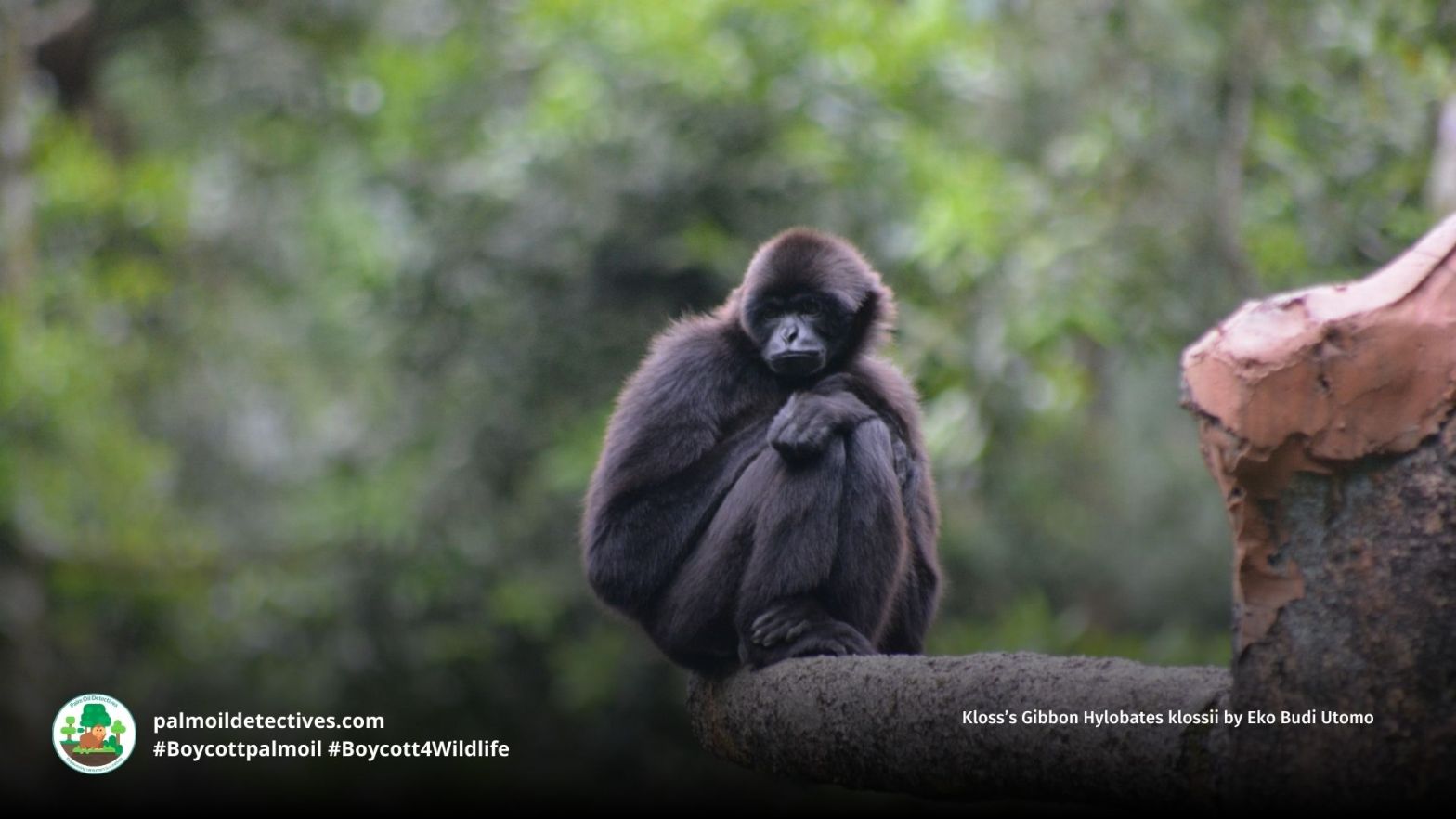
Kloss’s Gibbon Hylobates klossii
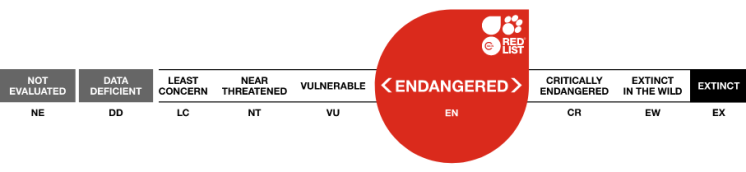
Endangered
Locations: Endemic to the Mentawai Islands off the west coast of Sumatra, Indonesia
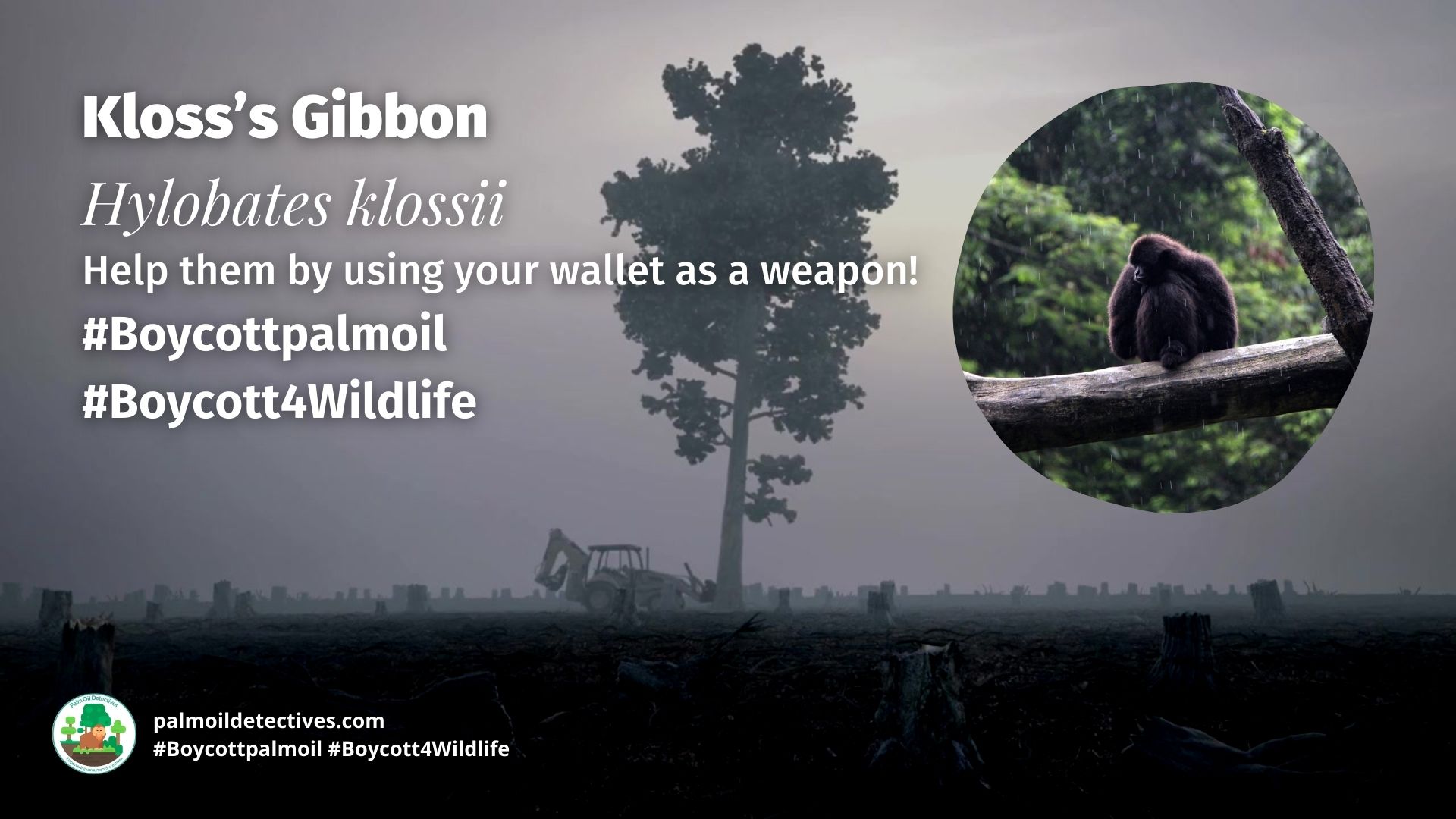
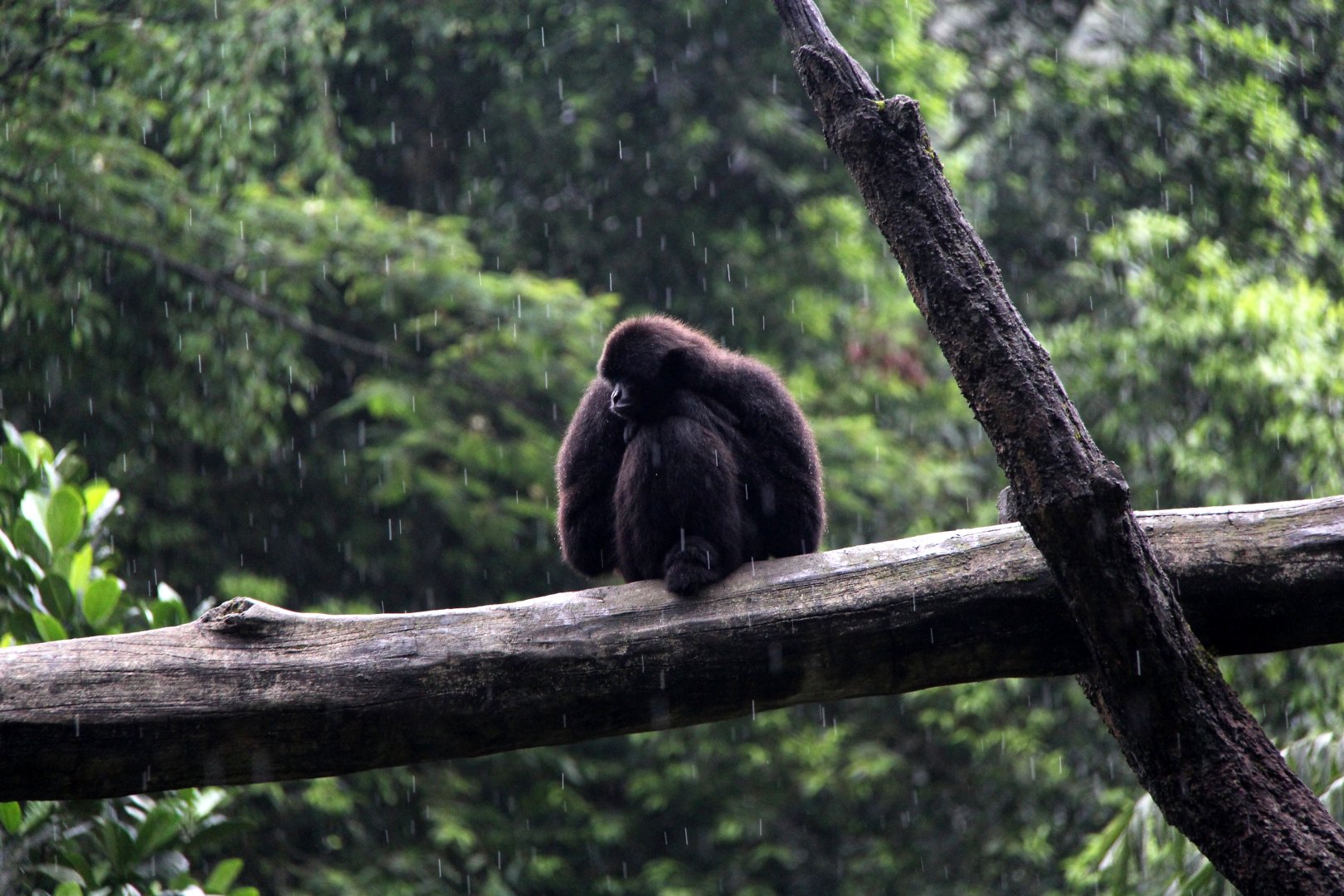
The Kloss’s gibbon Hylobates klossii, also known as the dwarf siamang, Mentawai gibbon or bilou by locals, is a small, agile primate with dark smoky grey fur and an ethereal song that resonates and echoes throughout the forests of the Mentawai Islands. These gibbons are known for their intricate vocalisations, with both males and females producing unique solo songs. Their haunting melodies play an essential role in marking territory and strengthening social bonds.
Classified as Endangered by the IUCN, Kloss’s gibbons face a relentless barrage of threats, including habitat destruction for logging and palm oil plantations, poaching for the illegal pet trade, and human encroachment. With populations declining by 50% in the past 45 years, immediate action is needed to save this unique species. Fight for their survival with indigenous-led conservation efforts and use your wallet as a weapon—boycott palm oil and support agroecology. #BoycottPalmOil #Boycott4Wildlife
Smoky coloured Kloss’s #Gibbons 🐵🐒🤎 are the forgotten species of #gibbon nobody has heard of. #Endangered on #Mentawai islands of #Indonesia 🇮🇩 they barely hang on due to #palmoil #deforestation #BoycottPalmOil 🌴🪔☠️⛔️#Boycott4Wildlife @palmoildetect https://palmoildetectives.com/2021/02/06/klosss-gibbon-hylobates-klossii/
One of the smallest gibbons has the most spectacular song. Kloss’s #Gibbon male and females perform solos for each other 🐒🎶🎵 Sadly #endangered on #Mentawai #Indonesia 🇮🇩 due to #palmoil. Help them to survive! #BoycottPalmOil 🌴🤮⛔️ #Boycott4Wildlife https://palmoildetectives.com/2021/02/06/klosss-gibbon-hylobates-klossii/
This species is threatened mainly by hunting and commercial logging (Whittaker 2006). It is also threatened by conversion to oil palm plantations, in addition to forest clearing and product extraction by local people (Whittaker 2006).
IUCN Red List
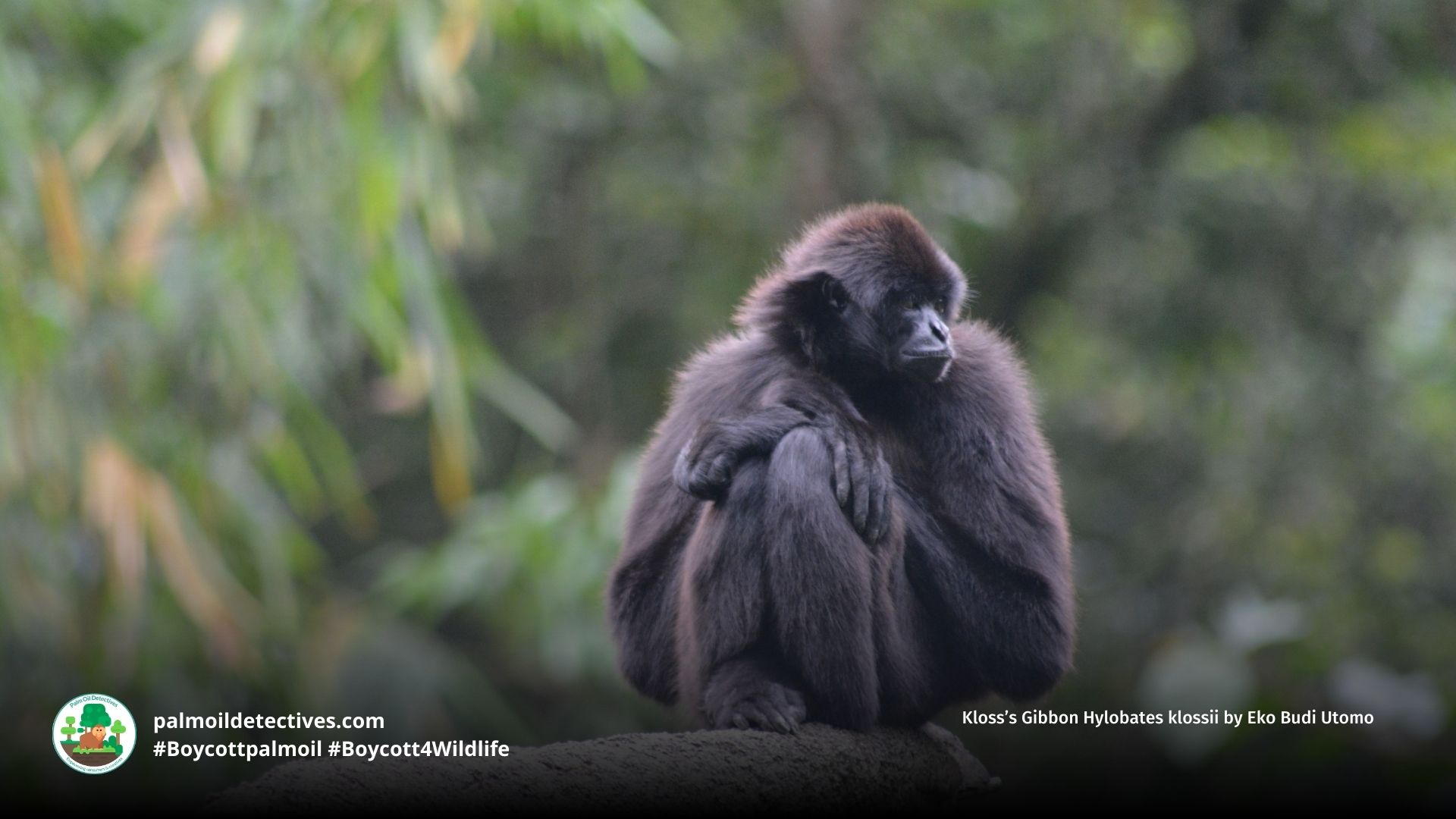

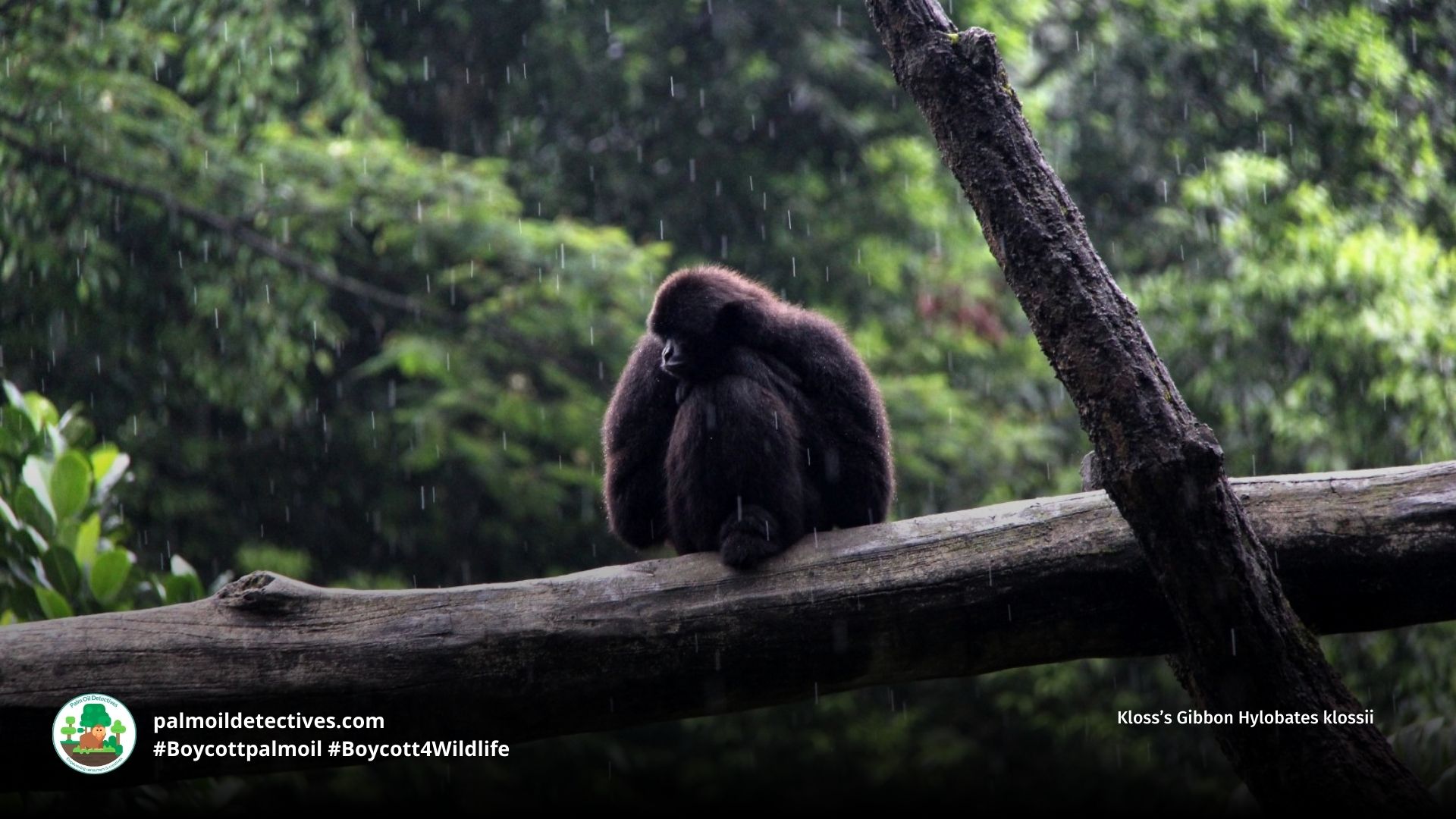
Appearance and Behaviour
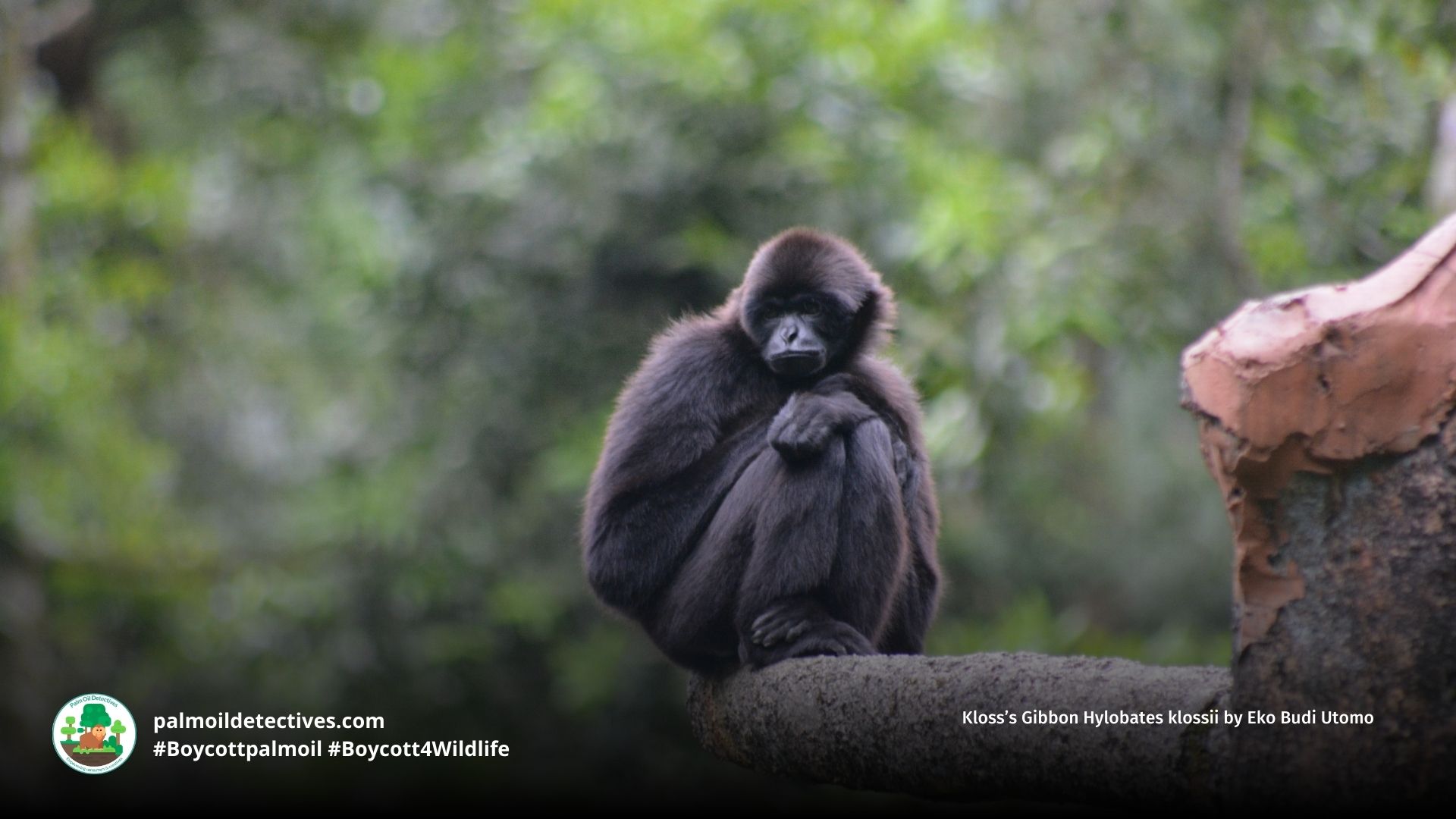
Kloss’s gibbons are small, agile primates with slender bodies covered in dense smoky grey or black fur, which provides camouflage in the shadows of the tropical forests. They weigh between 4–7 kg and measure 44–63 cm in length, making them one of the smallest gibbons. Unlike other gibbon species, they lack facial markings, adding to their striking appearance.
The Kloss’s Gibbon belongs to the genus Hylobates meaning ‘Forest Walker’ in Greek. They are known to communicate in species-specific song when defining territory or attracting mates. They sing in regional accents to each other, have long swinging arms, inquisitive natures and superior acrobatic skills, they spend most of their lives high up in the tree-tops.
Known for their arboreal lifestyle, Kloss’s gibbons use their long arms to effortlessly swing between trees, a movement called brachiation. They are diurnal, spending their days foraging for fruit, young leaves, flowers, and occasionally insects. Their territorial vocalisations are among the most complex in the animal kingdom, with males and females performing distinct solo songs featuring trills, rising notes, and intricate phrasing.
Threats
IUCN Status: Endangered
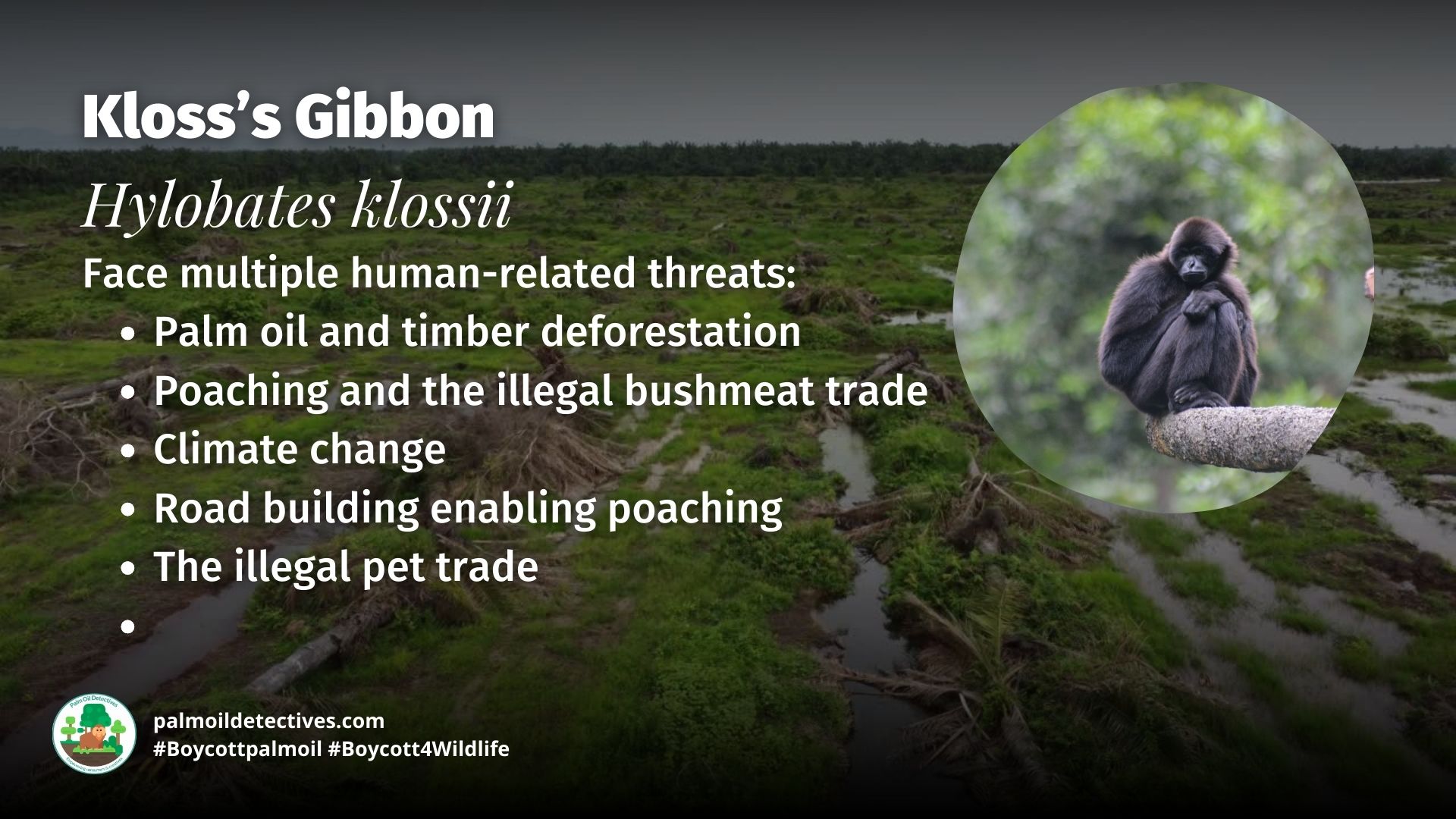
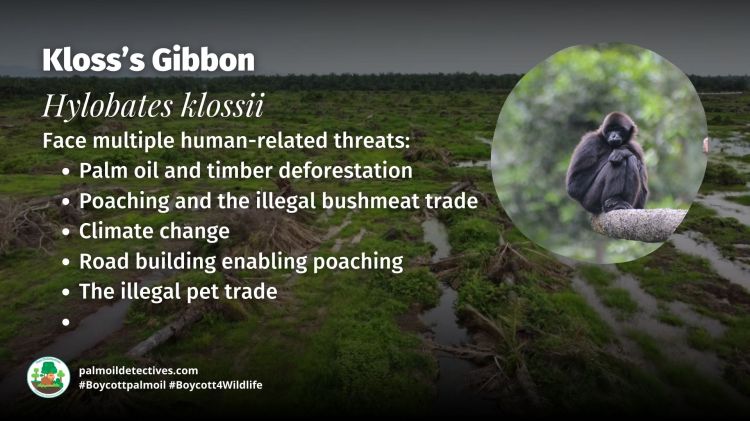
Palm oil and timber deforestation: Habitat loss for commercial logging, palm oil plantations, and agriculture has devastated the Mentawai Islands. Forest clearing not only removes their primary habitat but also fragments populations, isolating groups and increasing vulnerability.
Road building: Logging roads further disrupt habitats, allowing access for poachers and illegal traders.
Hunting and the Illegal Pet Trade: Kloss’s gibbons are frequently targeted for bushmeat and the pet trade. Poachers often kill adult gibbons to capture their infants, which are sold as exotic pets.
Climate Change: Rising temperatures and changing rainfall patterns due to climate change threaten the delicate ecosystems of the Mentawai Islands, further endangering the gibbons’ already restricted range.
Population Decline: The population of Kloss’s gibbons has decreased by 50% over the past 45 years, and fewer than 25,000 individuals remain. Without urgent conservation efforts, their numbers will continue to plummet.
Geographic Range
Kloss’s gibbons are endemic to the Mentawai Islands, including Siberut, Sipora, North Pagai, and South Pagai, off the west coast of Sumatra, Indonesia. They inhabit lowland and montane rainforests, preferring dense canopy cover to protect against predators and provide ample food sources. However, logging and agricultural expansion for palm oil have severely reduced and fragmented their habitat, confining them to smaller, isolated patches.
Diet
These gibbons are primarily frugivorous, with fruits making up the majority of their diet. They also consume young leaves, flowers, and insects to supplement their nutritional needs. Their foraging behaviour plays a critical ecological role, as they disperse seeds throughout the forest, aiding in regeneration and maintaining biodiversity.
Reproduction and Mating
Kloss’s gibbons are monogamous, forming long-term pair bonds that last for life. Breeding pairs raise a single offspring every 2–3 years, with a gestation period of approximately seven months. The infant remains dependent on the mother for up to two years before becoming more independent. The low reproductive rate makes population recovery challenging, particularly in the face of ongoing threats.
Take Action!
Protecting Kloss’s gibbons requires urgent action. Support indigenous sovereignty and agroecology initiatives that safeguard their habitats. Boycott palm oil and advocate for stricter anti-poaching laws. Together, we can secure a future for these remarkable primates. #BoycottPalmOil #Boycott4Wildlife
FAQ
How many Kloss’s gibbons are left in the world?
The population of Kloss’s gibbons has declined by more than 50% over the past 45 years, with fewer than 25,000 individuals remaining in the wild. Their numbers continue to dwindle due to habitat destruction, hunting, and the illegal pet trade.
What is unique about the Kloss’s gibbon?
Kloss’s gibbons are celebrated for their ethereal, complex vocalisations. Males and females perform distinct solo songs featuring trills and rising notes, often described as hauntingly beautiful. These songs serve as territorial markers and help strengthen social bonds.
Where would you find Kloss’s gibbons?
Kloss’s gibbons are found exclusively on the Mentawai Islands, including Siberut, Sipora, North Pagai, and South Pagai. They inhabit dense lowland and montane rainforests, where they forage in the canopy and use their long arms for brachiation.
What are the main threats to Kloss’s gibbons?
The main threats include habitat loss from logging and palm oil plantations, hunting for bushmeat, and capture for the illegal pet trade. Climate change also poses a significant risk to their already fragile ecosystems.
The Kloss’s Gibbon is Endangered due to a past and continued population reduction, estimated at more than 50% over a period of 45 years, including two past generations (1986-2015) and the current generation (2016-2030). The population reduction is due to widespread local hunting for cultural reasons and loss of habitat, particularly in North Pagai, South Pagai and Sipora Islands.
A recent study shows that habitat loss in the Mentawai islands was mainly due to forest conversion for agriculture expansion by local communities. A total of 73,500 ha of forest in Siberut, North Pagai, South Pagai and Sipora Islands have been allocated for oil palm plantation by the local government and about 34,000 ha (46%) was granted to only two companies (FFI, unpublished report)
Further Information
Liswanto, D., Whittaker, D., Geissmann, T. & Whitten, T. 2020. Hylobates klossii. The IUCN Red List of Threatened Species 2020: e.T10547A17967475. https://dx.doi.org/10.2305/IUCN.UK.2020-2.RLTS.T10547A17967475.en. Downloaded on 06 February 2021.
Neprimate Conservancy. (2022). Kloss’s Gibbon. Neprimate Conservancy.
Setiawan, A., et al. (2020). Distribution Survey of Kloss’s Gibbons in Mentawai Islands. ResearchGate.
Whittaker, D. J. (2012). Kloss Gibbon (Hylobates klossii) Behaviour Facilitates the Avoidance of Human Predation in the Peleonan Forest, Siberut Island, Indonesia. ResearchGate.
Wikipedia contributors. (2023). Kloss’s gibbon. Wikipedia.

How can I help the #Boycott4Wildlife?
Take Action in Five Ways
1. Join the #Boycott4Wildlife on social media and subscribe to stay in the loop: Share posts from this website to your own network on Twitter, Mastadon, Instagram, Facebook and Youtube using the hashtags #Boycottpalmoil #Boycott4Wildlife.
2. Contribute stories: Academics, conservationists, scientists, indigenous rights advocates and animal rights advocates working to expose the corruption of the palm oil industry or to save animals can contribute stories to the website.



3. Supermarket sleuthing: Next time you’re in the supermarket, take photos of products containing palm oil. Share these to social media along with the hashtags to call out the greenwashing and ecocide of the brands who use palm oil. You can also take photos of palm oil free products and congratulate brands when they go palm oil free.
4. Take to the streets: Get in touch with Palm Oil Detectives to find out more.
5. Donate: Make a one-off or monthly donation to Palm Oil Detectives as a way of saying thank you and to help pay for ongoing running costs of the website and social media campaigns. Donate here
Discover more from Palm Oil Detectives
Subscribe to get the latest posts sent to your email.
 Palm Oil Detectives