
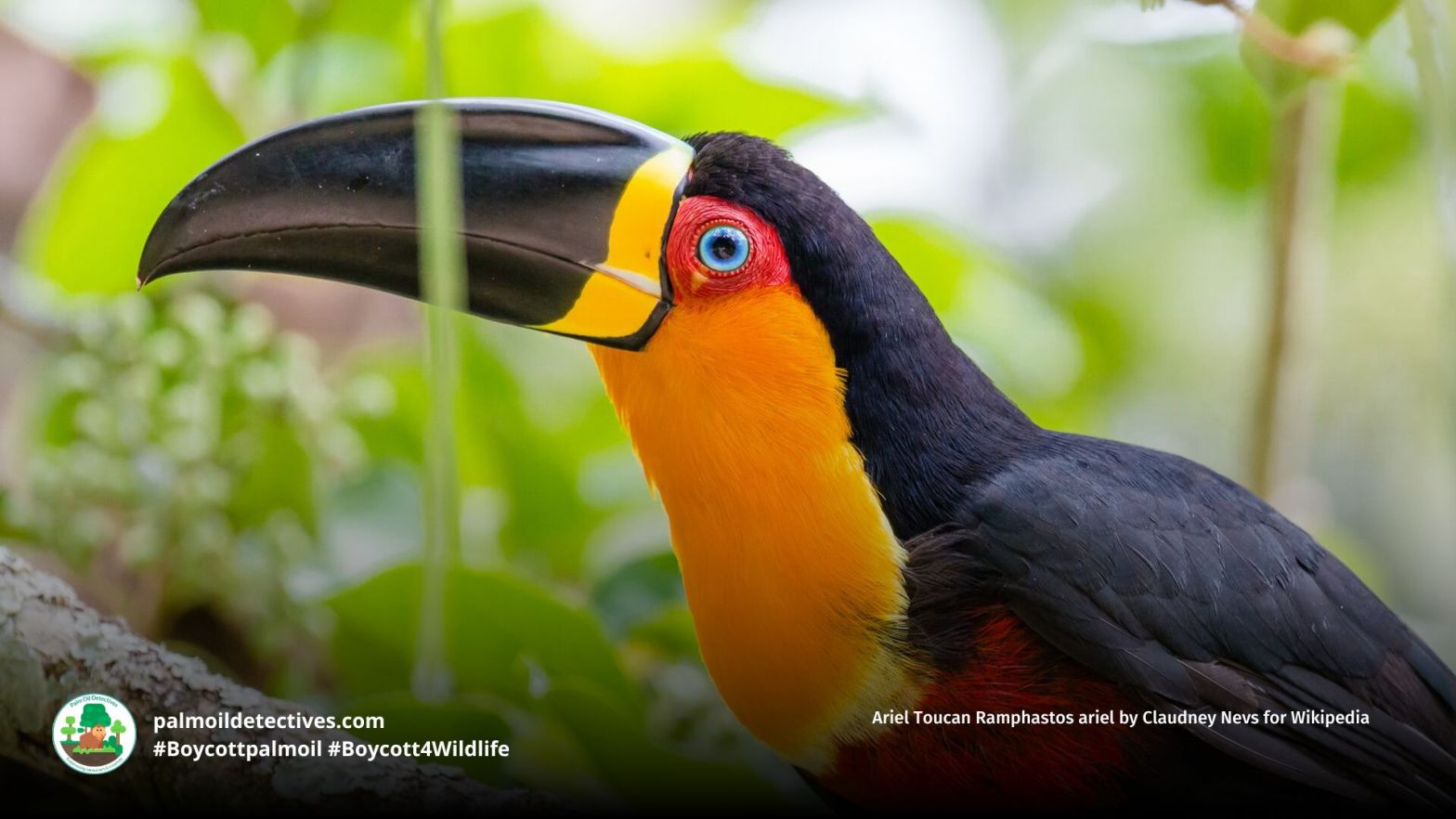
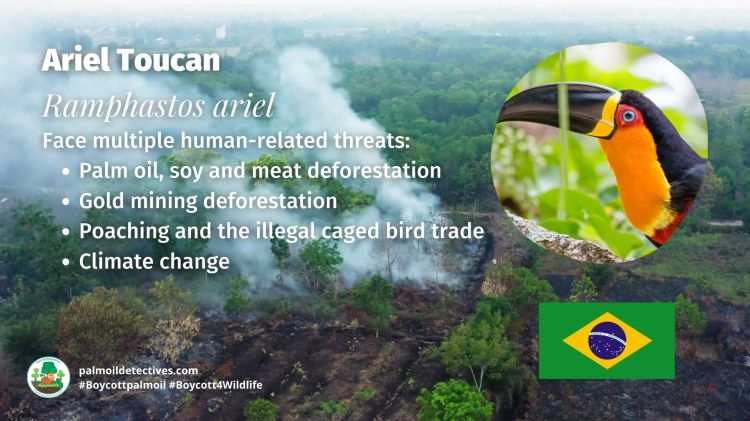
Ariel Toucan Ramphastos ariel
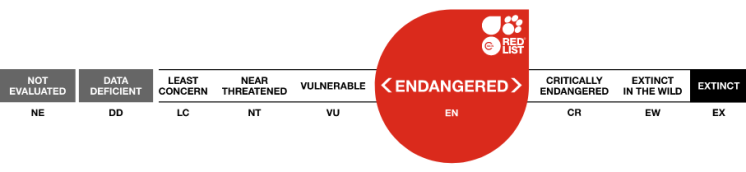
Near Threatened
Location: South America, primarily in Brazil, with occurrences in Venezuela, Guyana, and northern Argentina
No conservation
The Ariel Toucan (Ramphastos ariel) is a vibrant and charismatic bird native to South America, celebrated for their multi-coloured bill and ecological importance as seed dispersers. Found in tropical and subtropical forests, these toucans contribute significantly to forest regeneration, ensuring the survival of diverse plant species.
However, habitat loss due to deforestation for gold mining, soy and meat agriculture, and palm oil plantations has led to population declines, resulting in their classification as Near Threatened. Protect these iconic rainforest birds by boycotting palm oil, go vegan for them and support indigenous-led agroecology. #BoycottPalmOil #Boycott4Wildlife #BoycottGold4Yanomami and be #vegan
The magnificent Ariel Toucan’s glossy black plumage 🌈🦜✨ contrasts with a fiery orange 🧡 throat. #Palmoil #soy and #meat #deforestation in #Brazil are threats. Help them to survive! Be #vegan #BoycottPalmOil 🌴🪔🚫#Boycott4Wildlife @palmoildetect https://palmoildetectives.com/2021/04/01/ariel-toucan-ramphastos-ariel/
An iconic #bird 🦜💚of the #Amazon #rainforest #SouthAmerica the Ariel #Toucan is endangered from #hunting #beef and #soy #palmoil #deforestation. Support this icon and be #vegan 🌱🍉 #BoycottPalmOil 🌴🪔☠️🤮⛔️ #Boycott4Wildlife @palmoildetect https://palmoildetectives.com/2021/04/01/ariel-toucan-ramphastos-ariel/
Appearance and Behaviour
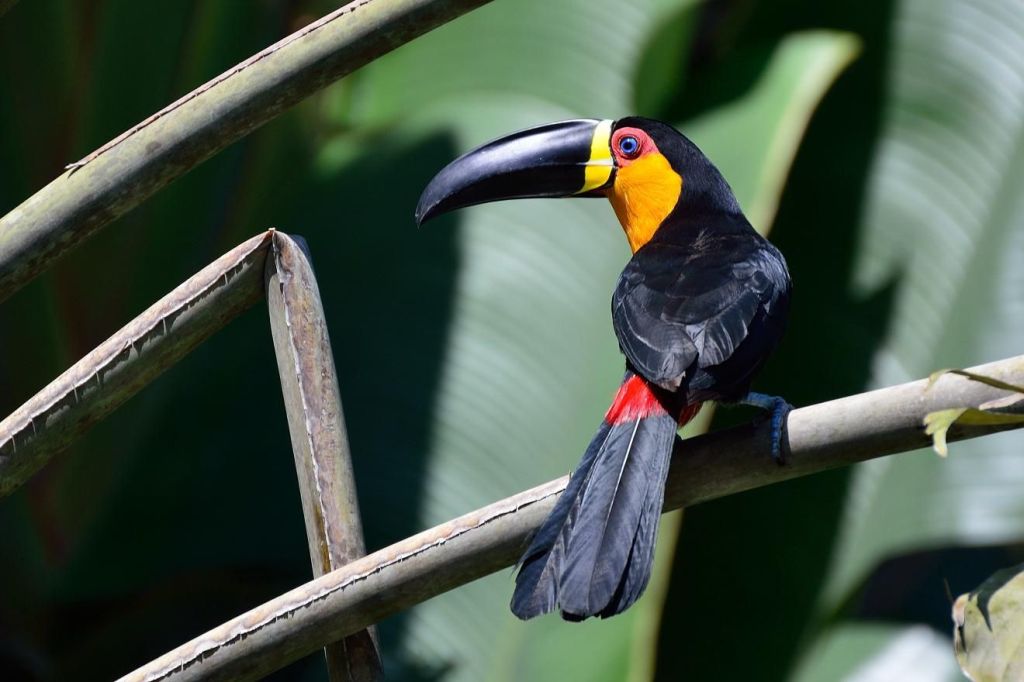
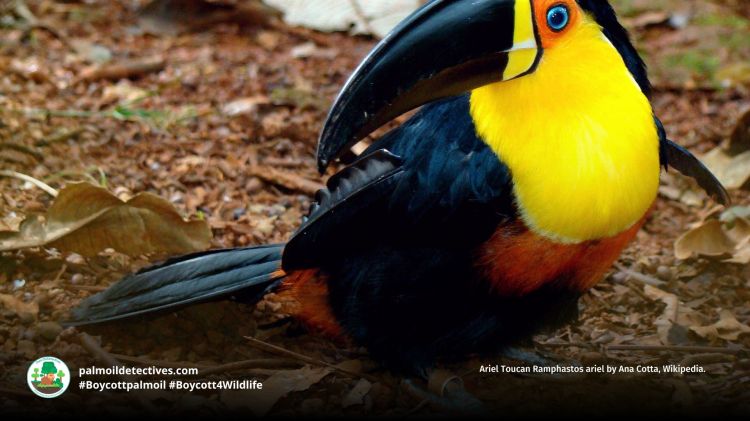
Ariel Toucans are medium-sized birds, measuring 40–50 cm in length, with a strikingly large bill accounting for up to one-third of their body length. Their glossy black plumage contrasts with a fiery orange to red throat and chest. This vibrant coloration makes the Ariel Toucan visually stunning.
These toucans are highly social and live in pairs or small flocks. They communicate using a variety of croaks and yelps and are often seen hopping between branches in the forest canopy. Their large, lightweight bills are perfectly adapted for plucking fruits from hard-to-reach branches, showcasing their evolutionary specialisation for frugivory.





Geographic Range
The Ariel Toucan inhabits tropical rainforests, lowland forests, and fragmented secondary forests across South America. Their range includes regions south of the Amazon in Brazil, extending to parts of Venezuela, Guyana, and northern Argentina.
While their range remains relatively broad, habitat destruction and fragmentation, particularly in the Atlantic Forest and Amazon Basin, have isolated populations and reduced their available habitat.
Diet
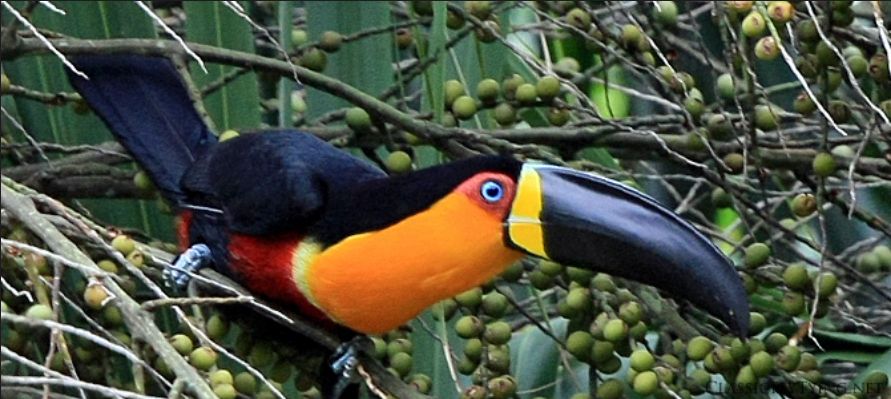
Ariel Toucans are predominantly frugivorous, relying on fruits such as figs, guavas, and berries. They also consume small invertebrates, eggs, and nestlings when fruit is scarce.
Their role as seed dispersers is critical for forest regeneration. By consuming fruits and dispersing seeds over large areas, they support biodiversity and the growth of numerous tree species. However, deforestation disrupts their access to diverse food sources, threatening their ecological function.
Reproduction and Mating
During the breeding season, Ariel Toucans nest in tree cavities, often repurposing old woodpecker holes. Females lay 2–4 eggs, which are incubated by both parents over a period of 16–18 days.
The chicks remain in the nest for several weeks after hatching, with both parents actively feeding and protecting them. Juveniles develop their vibrant plumage and distinctive bills as they mature, gaining full independence after several months.
Threats
Although the Ariel Toucan is currently classified as Near Threatened, population declines are ongoing. Conservation priorities include protecting and restoring rainforest habitats, particularly in regions like the Amazon and Atlantic Forest. Strengthening anti-deforestation measures are critical for their survival.
Efforts to combat the illegal pet trade and raise awareness of their ecological importance are also vital. Continued monitoring and research are necessary to track population trends and threats effectively.
IUCN Status: Near Threatened
Habitat Destruction:
Large-scale deforestation in the Amazon Basin and Atlantic Forest for soy and palm oil agriculture, logging, and cattle ranching significantly reduces their habitat.
Palm Oil Plantations:
The conversion of forested areas into palm oil plantations further accelerates habitat loss.
Illegal Pet Trade:
Ariel Toucans are captured for the pet trade, which disrupts local populations.
Habitat fragmentation and isolation:
Fragmented habitats restrict movement and genetic exchange, increasing the risk of local extinctions.
Climate Change:
Altered rainfall patterns and rising temperatures affect fruiting cycles and habitat suitability, adding further pressure on populations.
Take Action!
Help protect the Ariel Toucan by boycotting palm oil and supporting reforestation projects. Advocate for stricter wildlife protections and raise awareness about their plight. Together, we can ensure a future for this iconic species. #BoycottPalmOil #Boycott4Wildlife

The primary threat to this species is accelerating deforestation in the Amazon basin as land is cleared for cattle ranching and soy production, facilitated by expansion of the road network (Soares-Filho et al. 2006, Bird et al. 2011).
IUCN red list
Support the conservation of this species
This animal has no protections in place. Read about other forgotten species here. Create art to support this forgotten animal or raise awareness about them by sharing this post and using the #Boycottpalmoil #Boycott4Wildlife hashtags on social media. Also you can boycott palm oil in the supermarket.
Further Information
BirdLife International. 2023. Ramphastos ariel. The IUCN Red List of Threatened Species 2023: e.T22726233A221624536. https://dx.doi.org/10.2305/IUCN.UK.2023-1.RLTS.T22726233A221624536.en. Accessed on 28 December 2024.
BirdLife International. (2024). Ariel Toucan (Ramphastos ariel).
Birds of the World. (2024). Ariel Toucan introduction.
Merazonia wildlife rescue and sanctuary rehabilitate parrots and toucans, some of the most trafficked animals in the world. Donate to them here

How can I help the #Boycott4Wildlife?
Take Action in Five Ways
1. Join the #Boycott4Wildlife on social media and subscribe to stay in the loop: Share posts from this website to your own network on Twitter, Mastadon, Instagram, Facebook and Youtube using the hashtags #Boycottpalmoil #Boycott4Wildlife.
2. Contribute stories: Academics, conservationists, scientists, indigenous rights advocates and animal rights advocates working to expose the corruption of the palm oil industry or to save animals can contribute stories to the website.




3. Supermarket sleuthing: Next time you’re in the supermarket, take photos of products containing palm oil. Share these to social media along with the hashtags to call out the greenwashing and ecocide of the brands who use palm oil. You can also take photos of palm oil free products and congratulate brands when they go palm oil free.
4. Take to the streets: Get in touch with Palm Oil Detectives to find out more.
5. Donate: Make a one-off or monthly donation to Palm Oil Detectives as a way of saying thank you and to help pay for ongoing running costs of the website and social media campaigns. Donate here
Discover more from Palm Oil Detectives
Subscribe to get the latest posts sent to your email.
 Palm Oil Detectives
One thought on “Ariel Toucan Ramphastos ariel”