
We know that ecosystems under stress can reach a point where they rapidly collapse into something very different. Research published in the journal Nature Communications, shows that the size of the ecosystem is important. Once a “tipping point” is triggered, large ecosystems could collapse much faster than we had thought possible. It’s a finding that has worrying implications for the functioning of our planet. Fight back and resist for nature when you shop be #vegan and #BoycottPalmOil #Boycott4Wildlife
#Research finds once a #tippingpoint is reached, an #ecosystem will collapse much faster than first thought. A coral reef ecosystem could take 15 years, the Amazon rainforest 49 years to collapse. Be #vegan 🥦🍅#Boycott4Wildlife 🌴🩸❌ @palmoildetect https://palmoildetectives.com/2021/05/26/huge-ecosystems-could-collapse-in-less-than-50-years-new-study/
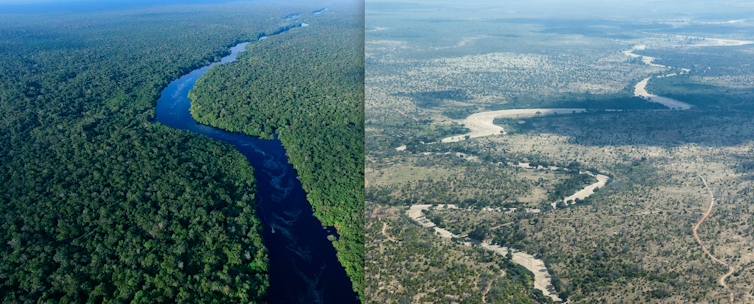
The clear water of a pristine lake can turn algae-green in a matter of months. In hot summers, a colourful coral reef can soon become bleached and virtually barren. And if a tropical forest has its canopy significantly reduced by deforestation, the loss of humidity can cause a shift to savanna grassland with few trees. We know this can happen because such changes have already been widely observed.
We started off by wondering how the size of the ecosystem might affect the time taken for these changes (ecologists call them “regime shifts”) to happen. It seems intuitive to expect large ecosystems to shift more slowly than small ones. If so, would the relationship between shift time and size be the same for lakes, corals, fisheries and forests?
We began by analysing data for about 40 regime shifts that had already been observed by scientists. These ranged in size from very small ponds in North America, through to savanna grassland in Botswana, the Newfoundland fishery and the Black Sea aquatic ecosystem.
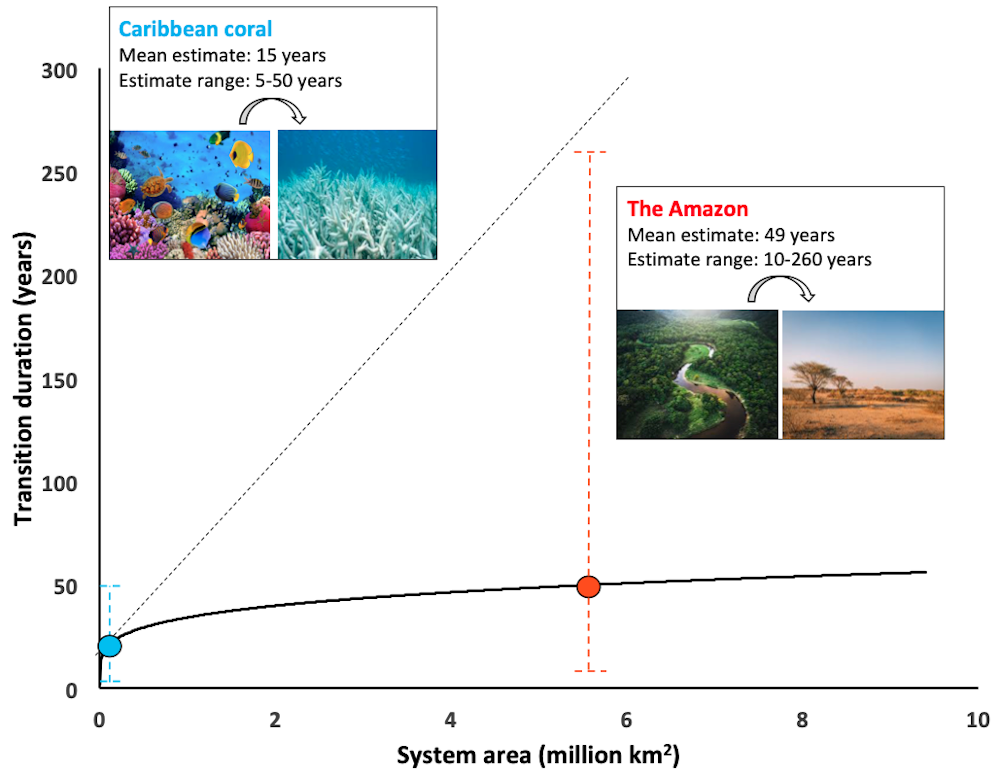
We found that larger ecosystems do indeed take longer to collapse than small systems, due to the diffusion of stresses across large distances and time-lags. The relationship does seem to hold across different types of ecosystem: lakes take longer than ponds, forests take longer to collapse than a copse, and so on.
But what really stood out was that larger systems shift relatively faster. A forest that is 100 times bigger than another forest will not take 100 times longer to collapse – it actually collapses much more quickly than that. This is quite a profound finding because it means that large ecosystems that have been around for thousands of years could collapse in less than 50 years. Our mean estimates suggest the Caribbean coral reefs could collapse in only 15 years and the whole Amazon rainforest in just 49 years.
What explains this phenomenon? To find out, we ran five computer models that simulated things like predation and herbivory (think: wolves, sheep and grasslands) or social networks (how accents spread through society). The models support the data in that large systems collapse relatively faster than small ones.
However, the models also provide further insight. For example, large ecosystems often have relatively more species and habitats existing as connected compartments, or sub-systems. This enhanced “modularity” actually makes the system more resilient to stress and collapse, rather like the water-tight compartments in a ship prevent it from sinking if the hull is breached.
But paradoxically, the same modularity seems to allow a highly stressed system to unravel more quickly once a collapse starts. And because large systems are relatively more modular, their collapse is relatively faster.
These unravelling effects should add to concerns about the effects of fires on the long-term resilience of the Amazon to climate change, or the rapid spread of recent bush fires in Australia caused by existing fires igniting further fires. The only upside to our finding concerns ecosystems that have already been managed into alternate regimes, such as human-made agricultural landscapes. These now have much less modularity, and thus may experience relatively slow transitions in the face of climate change or other stresses.
The messages are stark. Humanity now needs to prepare for changes in ecosystems that are faster than we previously envisaged through our traditional linear view of the world. Large iconic ecosystems like the Amazon rainforest or the Caribbean coral reefs are likely to collapse over relatively short “human timescales” of years and decades once a tipping point is triggered. Our findings are yet another reason to halt the environmental damage that is pushing ecosystems to their limits.
John Dearing, Professor of Physical Geography, University of Southampton; Greg Cooper, Postdoctoral Research Fellow, Centre for Development, Environment and Policy, SOAS, University of London, and Simon Willcock, Senior Lecturer in Environmental Geography, Bangor University
This article is republished from The Conversation under a Creative Commons license. Read the original article.
Take Action in Five Ways
1. Join the #Boycott4Wildlife on social media and subscribe to stay in the loop: Share posts from this website to your own network on Twitter, Mastadon, Instagram, Facebook and Youtube using the hashtags #Boycottpalmoil #Boycott4Wildlife.
2. Contribute stories: Academics, conservationists, scientists, indigenous rights advocates and animal rights advocates working to expose the corruption of the palm oil industry or to save animals can contribute stories to the website.


3. Supermarket sleuthing: Next time you’re in the supermarket, take photos of products containing palm oil. Share these to social media along with the hashtags to call out the greenwashing and ecocide of the brands who use palm oil. You can also take photos of palm oil free products and congratulate brands when they go palm oil free.
4. Take to the streets: Get in touch with Palm Oil Detectives to find out more.
5. Donate: Make a one-off or monthly donation to Palm Oil Detectives as a way of saying thank you and to help pay for ongoing running costs of the website and social media campaigns. Donate here
Discover more from Palm Oil Detectives
Subscribe to get the latest posts sent to your email.
 Palm Oil Detectives