
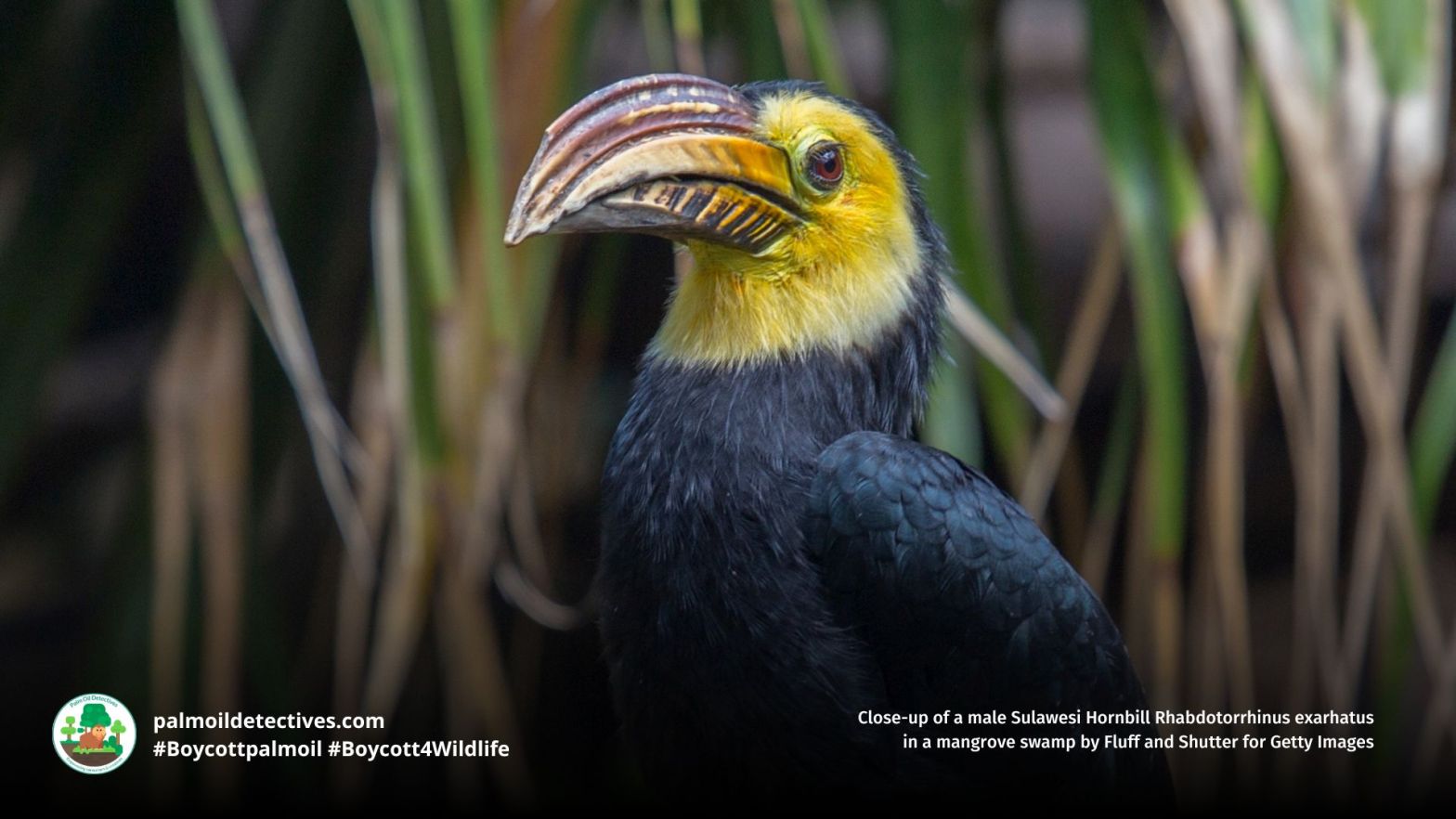
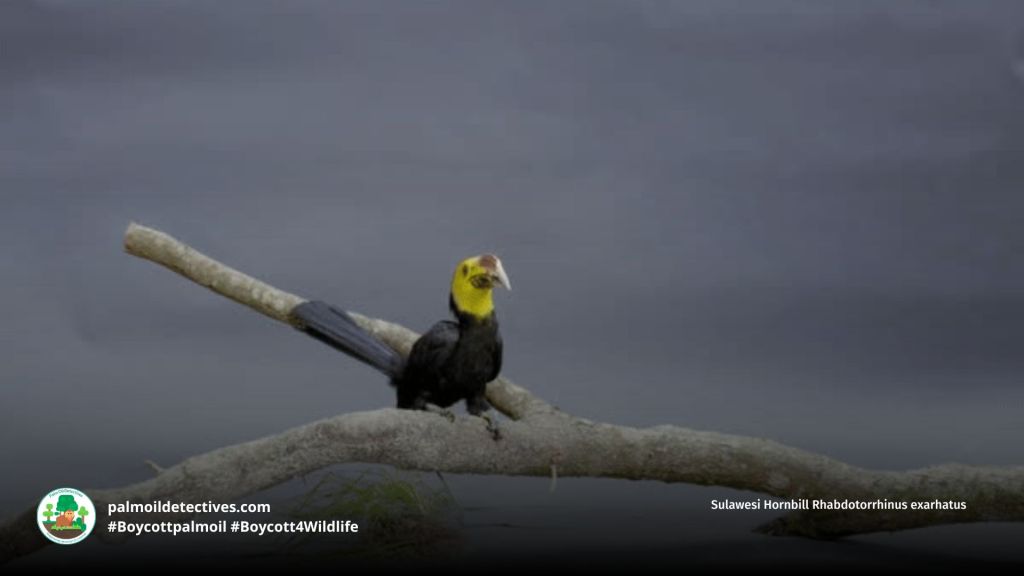
Sulawesi Hornbill Rhabdotorrhinus exarhatus
Vulnerable
Locations: Endemic to Sulawesi and nearby islands, Indonesia
The Sulawesi hornbill (Rhabdotorrhinus exarhatus) is a striking and large yellow and black bird endemic to Sulawesi, Indonesia. Known for their unique vocalisations and social nature, including communal shared breeding practices, these medium-sized hornbills are integral to the rainforest ecosystem, acting as crucial seed dispersers for many important tree species.
Sadly, the Sulawesi hornbill is classified as Vulnerable due to habitat destruction from logging, agriculture, and palm oil plantations, as well as poaching for the illegal pet trade. Protecting their remaining rainforest habitats is essential to ensuring their survival. Fight for their survival every time you shop. #BoycottPalmOil #Boycott4Wildlife
Striking yellow and black #Sulawesi #hornbills 🦜💌💚 are extremely social and nest in tree hollows with helper birds feeding them. They’re vulnerable from #palmoil #deforestation. Help them survive! #BoycottPalmOil 🌴🙊⛔️ #Boycott4Wildlife @palmoildetect https://palmoildetectives.com/2021/10/02/sulawesi-hornbill-rhabdotorrhinus-exarhatus/
Sulawesi #Hornbills are spectacular birds 🦜🫶💚 endemic to #Sulawesi #Indonesia, #vulnerable from #palmoil #deforestation #hunting and the #pettrade. Help them survive every time you shop #BoycottPalmOil 🌴🔥💀⛔️ #Boycott4Wildlife @palmoildetect https://palmoildetectives.com/2021/10/02/sulawesi-hornbill-rhabdotorrhinus-exarhatus/
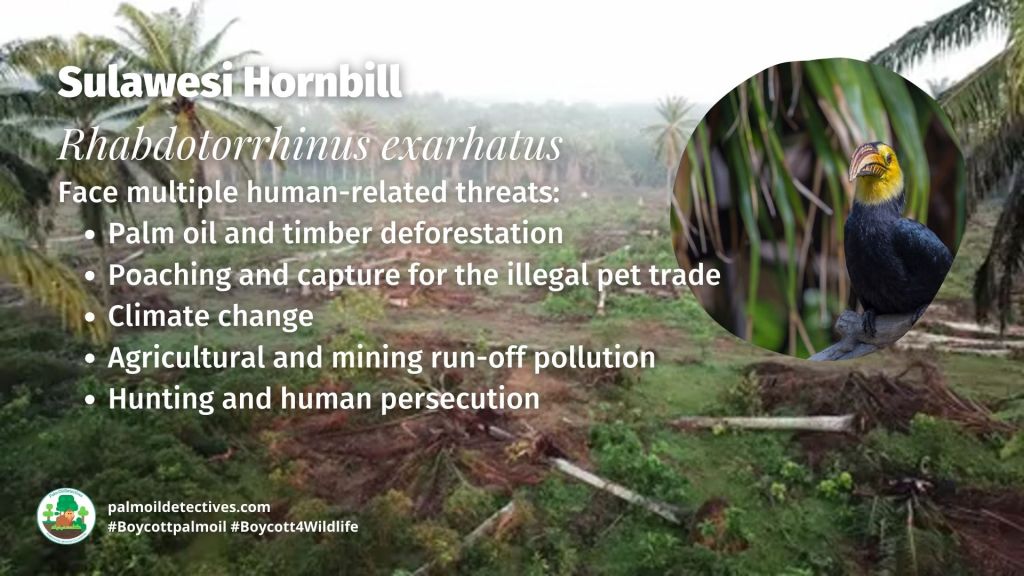
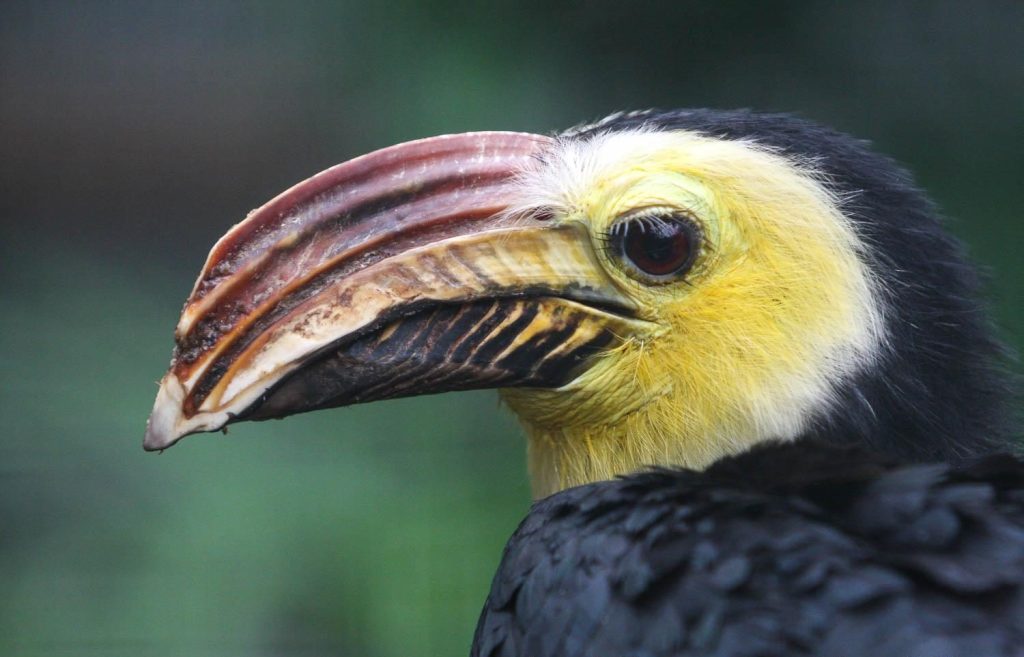
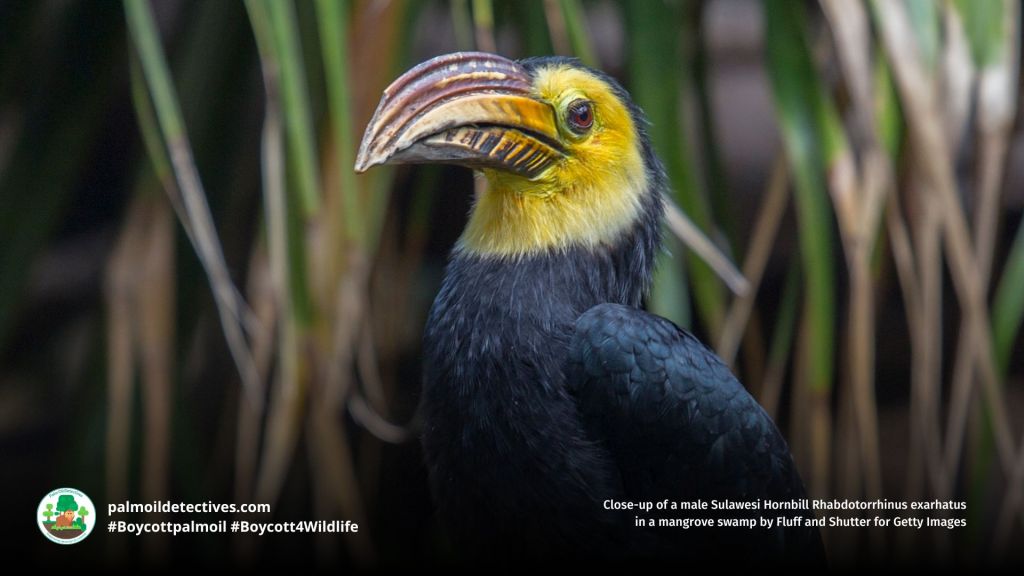
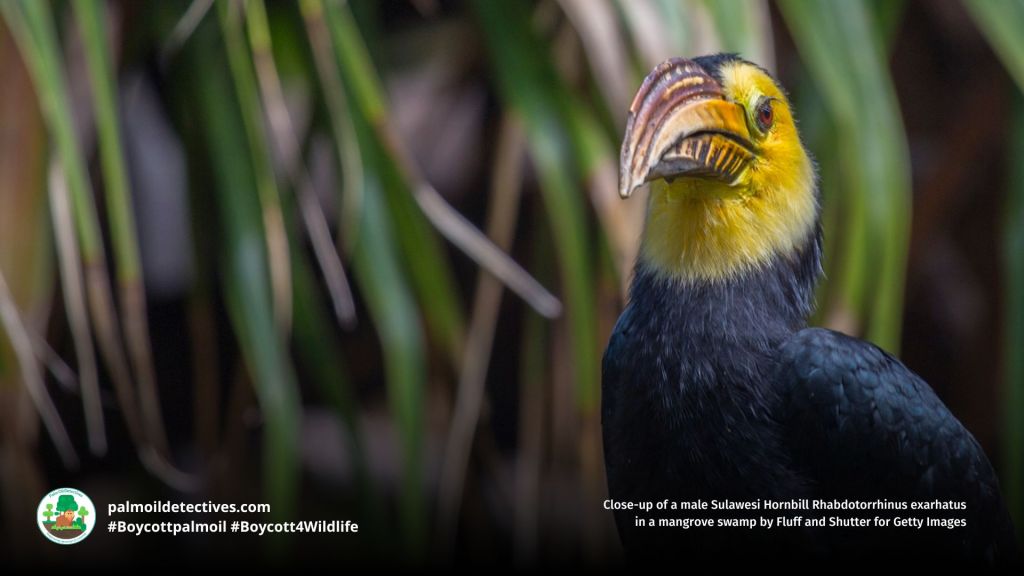
Appearance and Behaviour
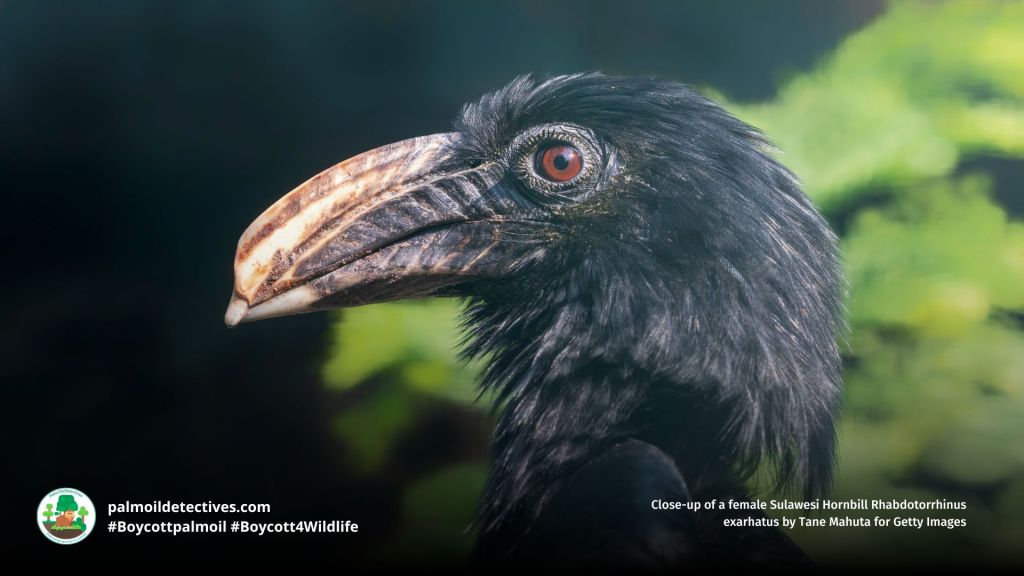
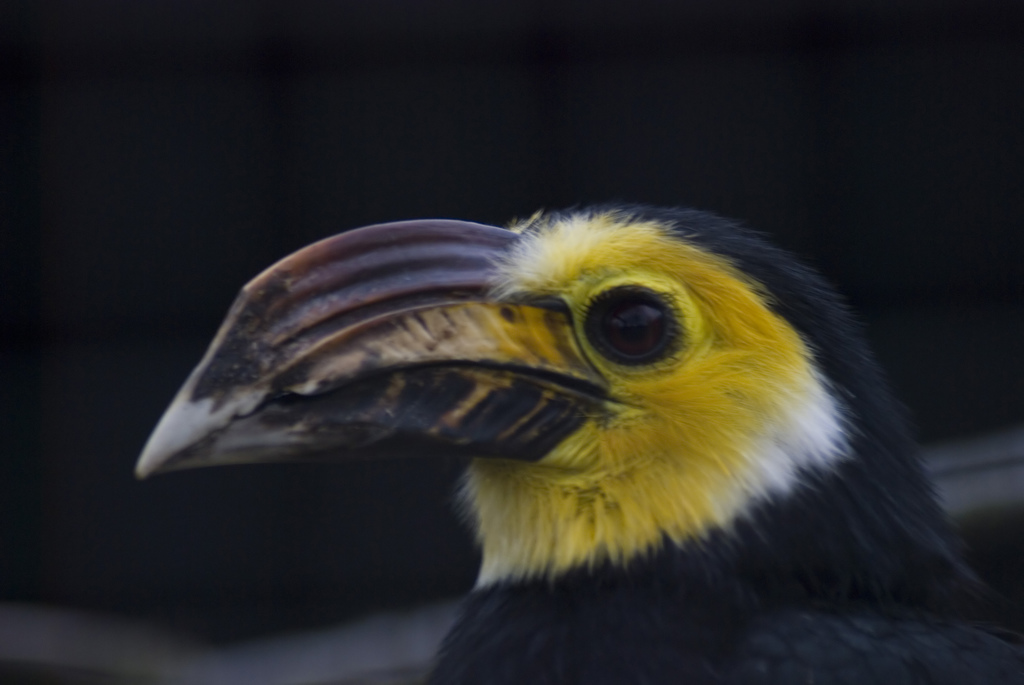
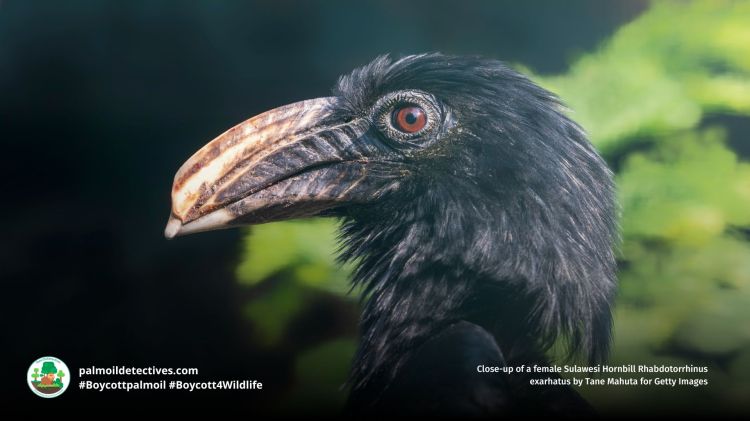
The Sulawesi hornbill Rhabdotorrhinus exarhatus is a medium-sized hornbill, measuring about 45 cm in length. Male hornbills are easily recognised by their predominantly black plumage accented by vibrant yellow feathers around their face and throat, giving them a striking appearance in the lush greenery of Sulawesi’s forests. This contrasts to female birds with all black feathers on their faces. Their sturdy, slightly curved bills are pale brown and red with prominent grooves, and their modest casque—a protuberance on the upper bill—adds to their distinctive profile.
Known for their lively and social nature, Sulawesi hornbills often produce a variety of vocalisations, including loud, bracing calls that carry through the dense forest. Their behaviour is equally captivating; these birds are playful and resourceful, using their powerful bills to grasp fruit, engage in social interactions, and navigate their arboreal habitat. Usually observed in pairs or small family groups, they are a charismatic presence in their native ecosystems.
These hornbills are known for their energetic behaviour, often moving through the canopy in search of fruit or insects. They are social birds, typically seen in pairs or small groups. Vocal and communicative, they produce loud and distinctive calls that echo through the forest.
The Sulawesi Hornbill is threatened with habitat destruction, with forest on Sulawesi being lost at a rate of 16.9% per ten years during 1985-1997; and 36.1% per ten years during 1997-2001 (based on D. A. Holmes in litt. 1999 and Kinnaird and O’Brien 2007). The species’s specialised breeding requirements (including a dependence on large trees) makes them particularly vulnerable to forest loss and degradation (e.g. Winarni and Jones 2012). Hunting, both for food and for keeping as pets, is also a serious threat (del Hoyo et al. 2001).
IUCN red list
Threats
IUCN Status: Vulnerable
Habitat Loss for timber and palm oil plantations:
- Sulawesi hornbills have lost significant portions of their natural habitat to deforestation for logging, agriculture, and palm oil plantations. These activities not only destroy critical nesting sites but also reduce food availability.
- Protected areas like Bogani Nani Wartabone National Park have faced encroachment, further limiting their habitat.
Hunting and Pet Trade:
- Hornbills are hunted for their striking appearance and taken from the wild for the illegal pet trade. Poaching poses a significant threat, particularly to isolated populations.
Fragmented Populations:
- Habitat fragmentation isolates populations, reducing genetic diversity and increasing vulnerability to environmental changes and human disturbances.
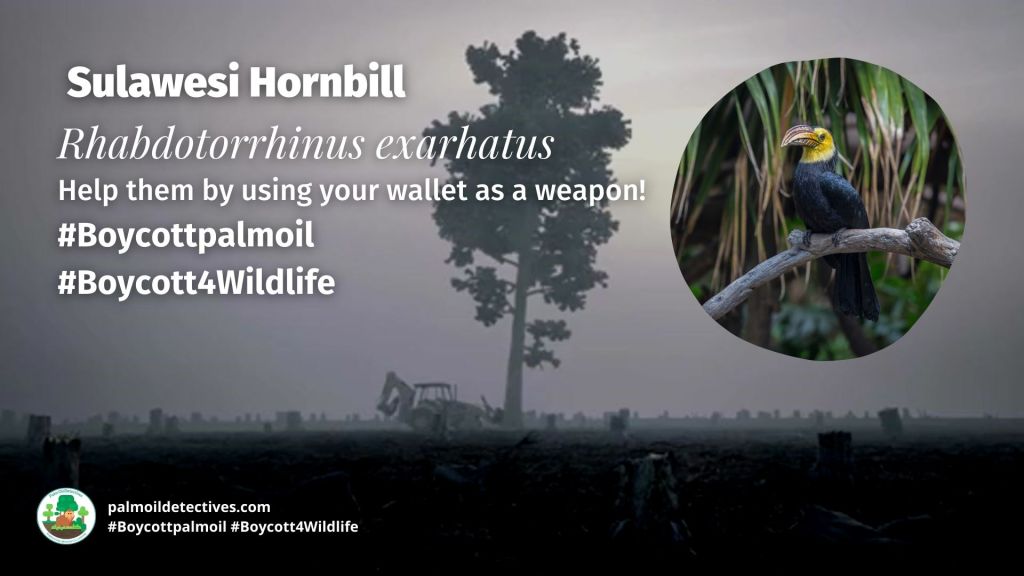
Take action against habitat destruction and illegal wildlife trade. Use your wallet as a weapon and #BoycottPalmOil #Boycott4Wildlife.
Geographic Range
An Indonesian endemic, the Sulawesi Hornbill is distributed in the tropical lowland, swamps and primary forests of Sulawesi and nearby islands, including Lembeh and Buton from sea level to altitude up to 1,100 metres. There are two subspecies of the Sulawesi Hornbill. The nominate subspecies, P. e. exarhatus, occurs in north Sulawesi, and P. e. sanfordi are found in central, east and south Sulawesi, Buton and Muna Island. However, habitat destruction has pushed them into increasingly fragmented and degraded forest patches.
Diet
Sulawesi hornbills are primarily frugivorous, with their diet consisting largely of figs and other fruits. They also consume insects and small vertebrates to supplement their nutrition. Their role as seed dispersers is vital for maintaining forest biodiversity. By feeding on fruit and dispersing seeds across vast distances, they facilitate forest regeneration and ensure the survival of numerous plant species.
Reproduction and Mating
The Sulawesi Hornbill is a social species who live in groups of up to 20 individuals. Only the dominant pair breeds, while the remaining members of the group act as helpers.
During the breeding season, Sulawesi hornbills exhibit unique nesting behaviour. Females seal themselves into tree cavities, leaving only a small slit for the male partner and other helper birds to pass food through. This process helps protect the eggs and chicks from predators. After an incubation period of 40–50 days, the chicks hatch and remain dependent on their parents for several months before fledging.
Their diet consists mainly of fruits, figs and insects. The female seals herself inside a tree hole to lay her eggs. During this time, the male and helpers provide food for the female and the young.
Take Action!
Help protect Sulawesi hornbills by supporting indigenous-led conservation efforts and boycotting products linked to deforestation, such as palm oil. Fight for their survival every time you shop. #BoycottPalmOil #Boycott4Wildlife
FAQ
What does the Sulawesi hornbill eat?
Sulawesi hornbills are predominantly frugivores, feeding mainly on figs and other forest fruits. They occasionally consume insects, small reptiles, or amphibians to supplement their diet. Their role as seed dispersers is crucial to forest health. By eating fruit and spreading seeds across their range, they contribute significantly to the regeneration of their rainforest habitat.
Which species of hornbill is most regularly sighted in Pulau Ubin and the main Singapore island?
While Sulawesi hornbills are endemic to Indonesia, other hornbill species, such as the Oriental pied hornbill (Anthracoceros albirostris), are commonly seen in Pulau Ubin and Singapore. Conservation efforts in these regions have led to the successful reintroduction of Oriental pied hornbills, making them a frequent sight in urban and semi-urban areas.
How to identify this species?
The Sulawesi Hornbill also known as the Sulawesi Tarictic Hornbill, Temminck’s hornbill or Sulawesi Dwarf Hornbill, is a relatively small, approximately 45 cm (18 in) long, black hornbill. The male has a yellow face and throat, and yellowish horn bill with black markings. The female has all-black plumage and a darker bill.
What sounds does the Sulawesi hornbill make?
Sulawesi hornbills are known for their loud and distinctive vocalisations, often described as an excited, bracing series of notes: “kerok-tee-kerok-tee-kerok-tee-tee…” These calls can last several seconds and are often heard as part of their territorial or mating displays. Their vocalisations echo through the forest, making them one of the more easily detectable species despite their elusive nature.
You can support this beautiful animal
There are no known conservation activities for this animal. Share out this post to social media and join the #BoycottPalmOil #Boycott4Wildlife on social media to raise awareness
Further Information

BirdLife International. 2017. Rhabdotorrhinus exarhatus (amended version of 2016 assessment). The IUCN Red List of Threatened Species 2017: e.T22682504A117181682. https://dx.doi.org/10.2305/IUCN.UK.2017-3.RLTS.T22682504A117181682.en. Downloaded on 08 June 2021.
Birds of the World. (n.d.). Sulawesi hornbill. Birds of the World.
eBird. (n.d.). Sulawesi hornbill. eBird.
Hornbill Specialist Group. (n.d.). Sulawesi hornbill. IUCN Hornbill Specialist Group.
O’Brien, T. G. (2008). Behavioural ecology of the North Sulawesi Tarictic Hornbill (Penelopides exarhatus exarhatus) during the breeding season. Ibis, 139(1), 97–101. https://www.researchgate.net/publication/230482379_Behavioural_ecology_of_the_North_Sulawesi_Tarictic_Hornbill_Penelopides_exarhatus_exarhatus_during_the_breeding_season

How can I help the #Boycott4Wildlife?
Take Action in Five Ways
1. Join the #Boycott4Wildlife on social media and subscribe to stay in the loop: Share posts from this website to your own network on Twitter, Mastadon, Instagram, Facebook and Youtube using the hashtags #Boycottpalmoil #Boycott4Wildlife.
2. Contribute stories: Academics, conservationists, scientists, indigenous rights advocates and animal rights advocates working to expose the corruption of the palm oil industry or to save animals can contribute stories to the website.





3. Supermarket sleuthing: Next time you’re in the supermarket, take photos of products containing palm oil. Share these to social media along with the hashtags to call out the greenwashing and ecocide of the brands who use palm oil. You can also take photos of palm oil free products and congratulate brands when they go palm oil free.
4. Take to the streets: Get in touch with Palm Oil Detectives to find out more.
5. Donate: Make a one-off or monthly donation to Palm Oil Detectives as a way of saying thank you and to help pay for ongoing running costs of the website and social media campaigns. Donate here
Discover more from Palm Oil Detectives
Subscribe to get the latest posts sent to your email.
 Palm Oil Detectives