
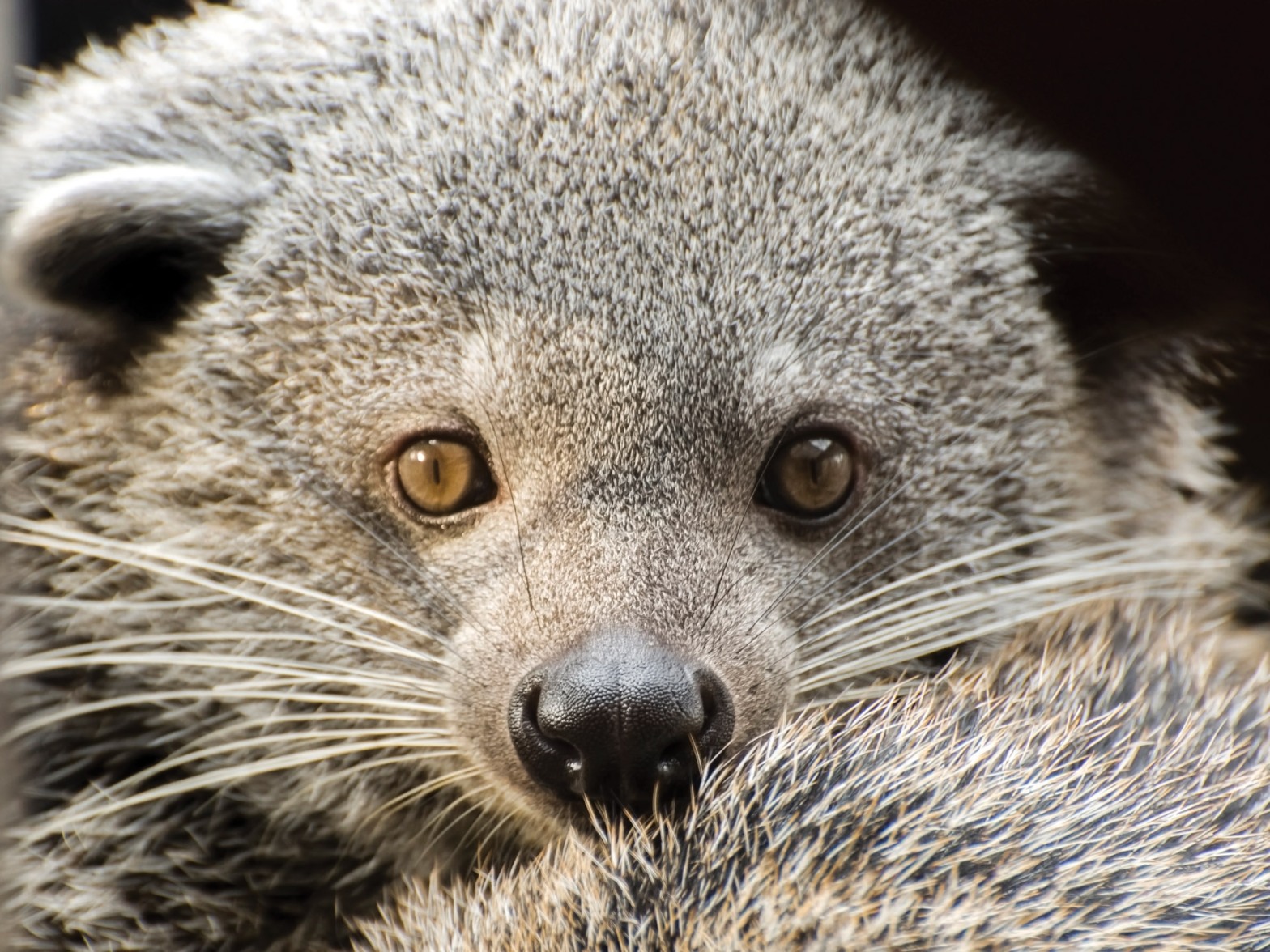
Binturong Arctictis binturong
Extant: Bangladesh; Bhutan; Cambodia; China; India; Indonesia (Kalimantan, Jawa, Sumatera); Lao People’s Democratic Republic; Malaysia (Sarawak, Sabah, Peninsular Malaysia); Myanmar; Nepal; Philippines; Thailand; Vietnam
Presence Uncertain: Brunei Darussalam
Status: Vulnerable
You may smell a Binturong in an Asian forest before you see them. They give off the aroma of buttered popcorn or cheesy crisps due to a compound in their urine that they use to attract mates. The binturong, Arctictis binturong, is a fascinating and rare mammal who roam the dense rainforests of Southeast Asia. Often called the “bearcat” due to their looks, binturongs are neither bears nor cats, but are more closely related to civets. With their monkey-like prehensile tail, thick wiry fur, and a popcorn-like scent, these unique and irreplaceable creatures play vital roles as seed dispersers in S.E Asian forests, particularly for strangler figs (Ficus spp.), making them keystone species in their ecosystem.
Despite their ecological significance, the binturongs are now classed as Vulnerable. Populations have plummeted due to habitat destruction, particularly for palm oil deforestation; along with illegal hunting, exploitation for the coffee market and the illegal bushmeat and pet trade. Protecting the majestic binturong requires urgent action to safeguard their rainforest home. Fight for them every time you use your wallet! #BoycottPalmOil #Boycott4Wildlife
Habitat loss has been the predominant driver of decline of the Binturong’s southern (Sundaic) portion of the range, where a significant proportion of lowland habitats have been converted to other land-uses that do not support the species e.g. oil palm plantations.
IUCN red list
#Binturongs AKA Bearcats are not actually related to cats or bears. They smell of buttered popcorn and #vulnerable due to #palmoil #deforestation in SE #Asia 🇮🇩🇻🇳🇲🇾🇵🇭 Help them every time you #BoycottPalmOil 🌴🪔⛔️#Boycott4Wildlife @palmoildetect https://palmoildetectives.com/2021/10/16/binturong-arctictis-binturong/
#Binturongs and other #civets in SE #Asia are kept in cages for cruel #KopiLuwak #coffee 🤮☕️ Another threat is #palmoil #deforestation. Help end #AnimalCruelty for vulnerable Binturongs! #BoycottPalmOil 🌴🪔⛔️#Boycott4Wildlife @palmoildetect https://palmoildetectives.com/2021/10/16/binturong-arctictis-binturong/

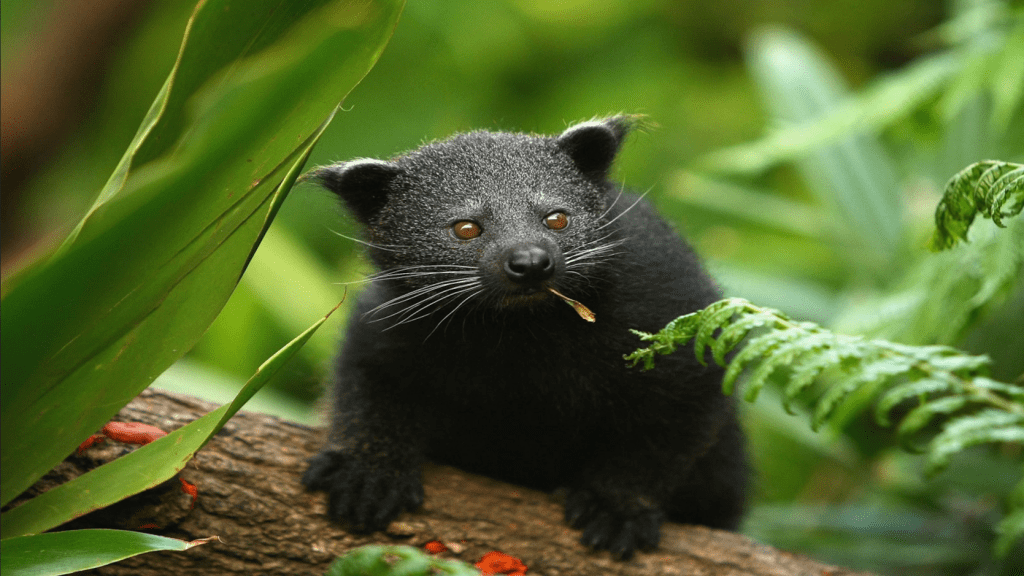
Appearance and behaviour
Their expressive eyes, tufted ears, and long whiskers enhance their unique look, while their prehensile tail acts as a fifth limb, allowing them to deftly navigate treetops (Cambridge University Press, 2024)
Although the binturong is known colloquially as the ‘Bearcat’, the species isn’t related to cats or bears. They are small carnivorans belonging to the family Viverridae and they are related to palm civets.
The scent glands of the Binturong secrete a musk which some have likened to the aroma of cheesy crisps or buttered popcorn. This is due to a scent in their urine of 2-acetyl-1-pyrroline, a compound which they use to mark territory and signal their presence to other binturongs (National Geographic, 2024).
They possess a prehensile tail and are mainly tree-dwelling. Binturongs use their powerful limbs and tail to climb trees. They move slowly and deliberately but are capable climbers. Their diet consists mainly of fruit, particularly figs, but they also consume small mammals, birds, and insects, showcasing their omnivorous tendencies (Mongabay, 2016).
The species is heavy and stocky and can weigh up to 20 kilos. While more agile and smaller arboreal animal species can leap between trees, due to the Binturong’s heavy frame, they must descend to the ground to go from one tree to another.
There are no records of this species from within blocks of monoculture plantations such as palm oil or rubber. Habitat loss and degradation are major threats to the Binturong (Schreiber et al. 1989) as is fragmentation, particularly in those parts of the range where hunting is heavy.
Threats
IUCN Status: Vulnerable
The binturong (Arctictis binturong) faces multiple overlapping threats, including habitat destruction for palm oil and timber, hunting, illegal trade, and exploitation for commercial products. These threats, exacerbated by weak enforcement of conservation laws, are causing dramatic population declines across its range.
Illegal Wildlife and Pet Trade
Tragically, the binturong is heavily exploited across their range in Asia for their meat, skin, use in civet coffee production, and the pet trade. Recent research highlights alarming statistics on the trade of binturongs, revealing the following:
- Online Trade: A study identified 594 advertisements offering over 720 live binturongs during the study period, with the majority (97.6%) appearing on Facebook (Springer, 2024). The trade primarily caters to the pet market, with most animals likely sourced illegally from the wild.
- Seizures: Data from wildlife seizures revealed 103 live binturongs confiscated, further underscoring the prevalence of illegal hunting for this species despite existing wildlife protection laws (Springer, 2024).
- Regulatory Challenges: Traders and buyers openly operate without fear of detection, highlighting weak enforcement and legislative gaps. Addressing these gaps, enhancing law enforcement, and prosecuting offenders are critical to halting the illegal trade of binturongs.
- Online Platforms: The role of platforms like Facebook in facilitating illegal wildlife trade demands immediate attention. Establishing stringent regulations and accountability for online wildlife traders is vital to curbing this issue.
Palm Oil and Timber Deforestation:
- Unsustainable logging and agricultural land conversion are rapidly depleting binturong habitats, particularly in Peninsular Malaysia and Sumatra (Cambridge University Press, 2024).
- Palm oil plantations have destroyed vast tracts of rainforest in Indonesia, Malaysia, and Thailand, leading to habitat fragmentation and population isolation. Lowland rainforests, where binturongs thrive, are particularly vulnerable to clearance (IUCN, 2016).
- Habitat destruction due to logging, palm oil plantations, and agricultural expansion is a leading threat to the binturong.
- In Indonesia, 40% of forest loss between 2000–2012 occurred in protected areas, including national parks (Rode-Margano et al., 2014).
- In mainland Southeast Asia, extensive deforestation has fragmented and degraded binturong habitats. In Thailand, large-scale deforestation has significantly reduced the species’ range (Chutipong et al., 2014).
Climate Change
A study by Abedin et al. (2025) warns that climate change could drastically reduce suitable habitats for the binturong. Currently, 26% of its habitat is suitable for survival, but projections show a 90% decline in suitability in the near future.
Current habitat patches are already highly fragmented, and future changes will exacerbate this isolation, leaving isolated populations even more vulnerable to extinction. The study highlights the urgent need for transboundary wildlife corridors across South and Southeast Asia to connect fragmented populations (Abedin et al., 2025).
Illegal Pet and Wildlife Trade
Binturongs are heavily exploited in the illegal wildlife trade for their meat, skins, and use in traditional medicine, as well as for the exotic pet trade:
- Pet Trade: Binturongs are among the most frequently caged live carnivores displayed in markets in Laos. Over 97% of online pet trade advertisements for binturongs were found on Facebook during one study (Springer, 2024). Many animals sold in this trade are young, illegally captured from the wild.
Snaring and Opportunistic Hunting
Recent camera-trap surveys reveal that binturongs frequently descend to the ground, making them vulnerable to snares and traps. The increased use of snares has a devastating impact on ground-foraging species like the binturong, who are often caught unintentionally (Naniwadekar et al., 2013).
Isolated Populations
Historically considered relatively common, binturongs are now rare across most of their range. Camera-trap surveys indicate severe declines in Laos, Cambodia, and Vietnam due to habitat loss and hunting pressures (Willcox et al., 2014). The species is approaching national extinction in China due to rampant deforestation and opportunistic logging.
Exploitation for Products
Binturongs are exploited commercially for a variety of products:
Skin Trade: Their pelts are frequently found in markets in Laos and other parts of Southeast Asia.
Meat and Traditional Medicine: The species is hunted for food in countries like Laos and Vietnam, where its meat is considered a delicacy. Civet meat, including binturongs, is in high demand across China and Vietnam and the Philippines. In Northeast India, binturong meat is consumed in states like Nagaland and Assam as part of subsistence hunting practices.
Civet Coffee Exploitation: In Indonesia, binturongs and common palm civets are captured and kept in captivity to produce ‘kopi luwak’ or civet coffee, which is a popular but ethically repugnant practice and product involving extreme animal cruelty.
Take Action!
The dire combination of habitat loss, illegal trade, and hunting makes immediate conservation action essential to protect the binturong. Advocating for indigenous-led conservation and stricter enforcement of wildlife laws is crucial to secure its future. Use your wallet as a weapon and support #BoycottPalmOil and #Boycott4Wildlife.
Diet
Binturongs are frugivores, with a diet heavily reliant on figs (Ficus spp.). They also consume other fruits, leaves, eggs, small mammals, and carrion. Their role as seed dispersers is crucial for maintaining rainforest biodiversity, as they propagate seeds over large distances, ensuring the survival of many tree species (Britannica, 2024).
Reproduction and Mating
Binturongs exhibit delayed implantation, allowing females to time births with optimal environmental conditions. After a gestation period of approximately 92 days, females give birth to 1–3 cubs. Juveniles are dependent on their mothers for several months, during which they develop climbing and foraging skills (Mongabay, 2016).
Geographic Range
Binturongs inhabit tropical rainforests across Southeast Asia, including:
- India: Northeastern states such as Assam and Arunachal Pradesh.
- Indonesia: Lowland forests in Sumatra and Borneo.
- Malaysia: Forest reserves in Peninsular Malaysia.
- Philippines: Palawan Island.
- Vietnam and Laos: Annamite Mountains and other forested regions.
FAQs
What are some facts about binturongs?
Binturongs are unique mammals that can smell like buttered popcorn or cheesy crispps, thanks to a chemical compound in their urine. They are crucial seed dispersers, particularly for strangler figs. Binturongs are also one of the few carnivores with a fully prehensile tail, aiding their arboreal lifestyle (Britannica, 2024).
What is the IUCN status of binturong?
The binturong is listed as Vulnerable on the IUCN Red List, with its population declining by over 30% in the last 30 years due to habitat destruction, poaching, and the illegal pet trade (IUCN, 2016).
How do binturongs help the environment?
Binturongs are keystone species in their ecosystems. By consuming and dispersing the seeds of many fruiting trees, particularly figs, they help regenerate rainforests and maintain biodiversity (Cambridge University Press, 2024).
How many binturongs are left in the world?
Exact population numbers are unknown, but surveys suggest densities as low as 10 individuals per 100 square kilometres in some regions, indicating a sharp population decline (IUCN, 2016).
You can support this beautiful animal
Support indigenous-led conservation and agroecology to protect binturongs and their rainforest habitats. Use your wallet as a weapon. #BoycottPalmOil #Boycott4Wildlife.
ABConservation is an organisation dedicately solely to the protection of Binturongs and they work to stop the illegal pet trade and ads on social media and much more. Find out more: ABConservation
Further Information

Abedin, I., Mukherjee, T., Kim, A. R., Kim, H. W., Lee, S. R., & Kundu, S. (2025). Shifting shadows: Assessing the habitat and climate change response of binturong (Arctictis binturong) in the conservation landscape of the Asian continent. Ecological Informatics, 85, Article 102941. https://doi.org/10.1016/j.ecoinf.2024.102941
Britannica. (n.d.). Binturong. Retrieved from https://www.britannica.com/animal/binturong
Department of Natural Resources and Environment Tasmania. (n.d.). Binturong (Arctictis binturong): Species risk assessment. Retrieved from
Gomez, L., Shepherd, C.R. The illegal trade of binturongs in Indonesia (arctictis binturong). Discov Anim 1, 27 (2024). https://doi.org/10.1007/s44338-024-00029-8
Irawati Dwi Arini, D., Fitriari, U., & Fahmi Firdaus, M. (2024). Observation on Binturong (Arctictis binturong) behaviour and its conservation management practices at Semarang Zoo, Central Java. BIO Web of Conferences, 123, Article 01045. https://doi.org/10.1051/bioconf/202412301045
Honda, A., Amir, Z., Mendes, C. P., Moore, J. H., & Luskin, M. S. (2024). Binturong ecology and conservation in pristine, fragmented and degraded tropical forests. Oryx, 58(2), 218–227. doi:10.1017/S0030605322001491
Nairn, C. (2016, October 13). What is a binturong? Almost Famous Animals. Asia. Retrieved from https://news.mongabay.com/2016/10/its-a-bear-its-a-cat-no-its-a-binturong-and-its-threatened/
ScienceDirect. (2024). Binturong habitat preferences and behavioural ecology. Retrieved from https://www.sciencedirect.com/science/article/pii/S1574954124004837
Wikipedia contributors. (n.d.). Binturong. Wikipedia. Retrieved from https://en.wikipedia.org/wiki/Binturong
Willcox, D.H.A., Chutipong, W., Gray, T.N.E., Cheyne, S., Semiadi, G., Rahman, H., Coudrat, C.N.Z., Jennings, A., Ghimirey, Y., Ross, J., Fredriksson, G. & Tilker, A. 2016. Arctictis binturong. The IUCN Red List of Threatened Species 2016: e.T41690A45217088. https://dx.doi.org/10.2305/IUCN.UK.2016-1.RLTS.T41690A45217088.en. Downloaded on 08 June 2021.


How can I help the #Boycott4Wildlife?
Take Action in Five Ways
1. Join the #Boycott4Wildlife on social media and subscribe to stay in the loop: Share posts from this website to your own network on Twitter, Mastadon, Instagram, Facebook and Youtube using the hashtags #Boycottpalmoil #Boycott4Wildlife.
2. Contribute stories: Academics, conservationists, scientists, indigenous rights advocates and animal rights advocates working to expose the corruption of the palm oil industry or to save animals can contribute stories to the website.






3. Supermarket sleuthing: Next time you’re in the supermarket, take photos of products containing palm oil. Share these to social media along with the hashtags to call out the greenwashing and ecocide of the brands who use palm oil. You can also take photos of palm oil free products and congratulate brands when they go palm oil free.
4. Take to the streets: Get in touch with Palm Oil Detectives to find out more.
5. Donate: Make a one-off or monthly donation to Palm Oil Detectives as a way of saying thank you and to help pay for ongoing running costs of the website and social media campaigns. Donate here
Discover more from Palm Oil Detectives
Subscribe to get the latest posts sent to your email.
 Palm Oil Detectives
Hi, hope it’s ok, had to shorten your tweet so it would send. The message is still the same though. #BoycottPalmOil
LikeLiked by 1 person
Hello my dear friend thanks so much for sharing this page 🙂 hugs
LikeLike