

Many people know that chimpanzees and orangutans have personalities, feel emotions and are “almost human”. However a recent paper has found that great apes also have a mid-life slump or a “midlife crisis”. Great apes (chimpanzees, bonobos, gorillas and orangutans) are just as socially, politically and cognitively complex as we are. Our “hairy” great ape relatives are like us in every respect. Help them to survive when you shop and be #Vegan #BoycottPalmOil #Boycott4Wildlife
#Chimpanzees 🦍 #orangutans 🦧 and other #GreatApes have strong personalities and astonishingly may have midlife crises! Yet another reason to protect these wonderful beings. #Primatology #Boycottpalmoil 🌴🪔🤢☠️🔥🧐🚫 #Boycott4Wildlife @palmoildetect https://palmoildetectives.com/2022/03/13/do-chimpanzees-and-orangutans-really-have-midlife-crises/
Great apes feel and demonstrate fear, affection, laughter and compassion. They are also capable of gang-like killing and “warfare” between neighbouring communities, rape, “battering” females, infanticide and cannibalism.
Genome sequence projects have established the close genetic relationship between “naked” and “hairy” great apes. Cognitive studies show that chimpanzees are capable of deception and have the ability to remember past events and imagine or plan for future events (mental time travel).
But popular culture suggests that there is at least one developmental or lifestyle phenomenon unique to humans; namely, the “midlife crisis”.
What is a midlife crisis?
In affluent societies, there is a popular belief that as soon as men reach their mid-forties, they suddenly take up high-risk activities or buy a showy red sports car or powerful motorbike.
This time of apparent stress, confusion, dissatisfaction with life and display of “crazy” behaviour is popularly known as the “midlife crisis”.
In reality, around the world, irrespective of culture or wealth, both men and women seem to experience a midlife “slump” in happiness or well-being. This may be reflected in poor mental or physical health.
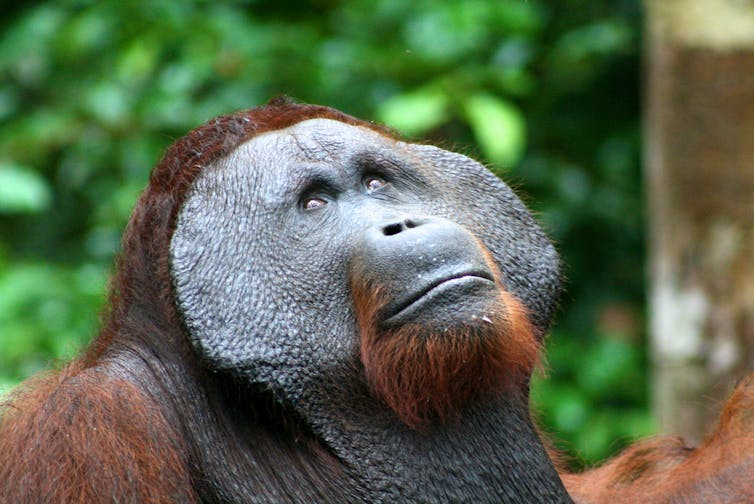
Typically, studies of this phenomenon are conducted by economists or psychologists, but the approaches they take and questions they address may be different. Economic research may compare happiness of younger, middle aged and older adults, who fall into similar socio-economic categories (such as income, marital status, health). This provides a “snapshot” in time. Their findings tend to support the existence of a “U-curve” when age is plotted against happiness, with younger and older people feeling more positive or happy.
Psychologists, on the other hand, prefer longitudinal studies of people over their lifetime to look for changes in “subjective wellbeing”.
How do you measure an ape’s happiness?
Measuring happiness or wellbeing is typically done by asking participants to fill out a questionnaire or self-report inventory, which rates their feelings or experiences.
Over the last two decades, researchers have been adapting the human questionnaires and rating scales for use with our closest “hairy” relatives: chimpanzees, bonobos, gorillas and orangutans. They want to see whether personality and subjective wellbeing can be reliably measured in other species.
Not surprisingly, “hairy” apes also show individual differences in personality and subjective wellbeing or happiness. These can be reliably measured if a person who has known the “hairy” ape for a long time (generally more than two years) and very well (say, if they’re a zoo keeper or caregiver) rates the individual.
Why are we surprised that our ape relatives have midlife “issues”?
To ensure coverage in the popular press, good science communicators pick catchy titles. These authors did exactly this by including the words “midlife crisis”, “great apes” and “human well-being”. However, “midlife crisis” is an emotive phrase that may not accurately reflect the findings.
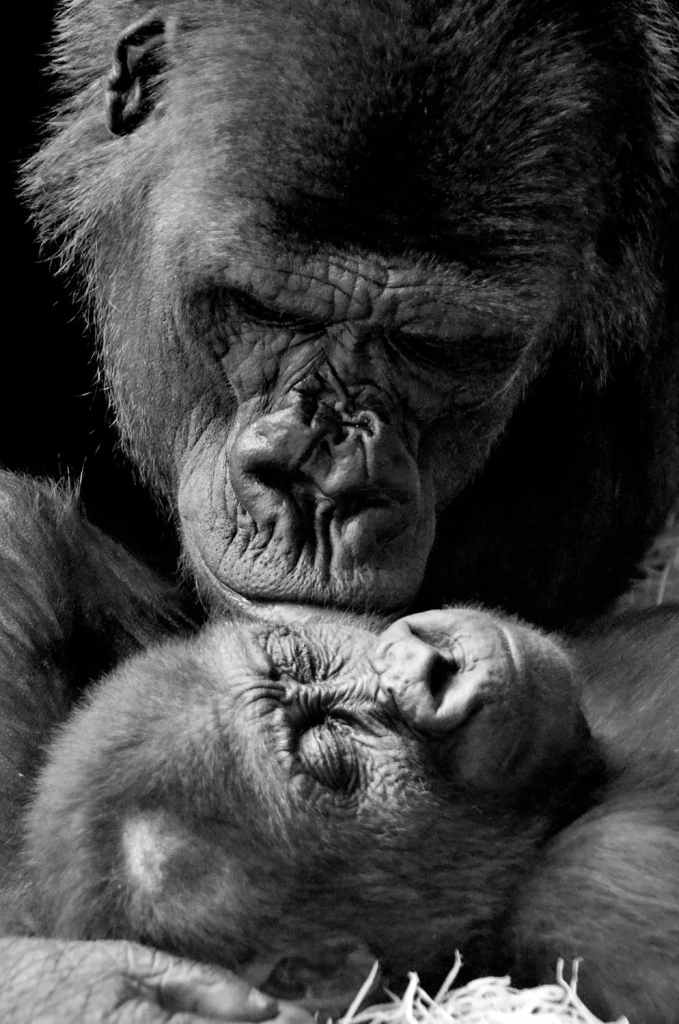
The research team included renowned psychologists/primatologists/geneticists and an economist. Following the data analysis used by economists for this type of research, the “U-curve” with its slump in well-being was evident for the 500+ chimpanzees and orangutans included in the analysis. The “hairy” apes were all housed in captive institutions (zoos, research centres and a sanctuary) in Japan, the United States, Canada, Singapore and Australia. The chimpanzees and orangutans ranged in age from less than 1 year old to 56 years old.
Humans tend to show a slump in well-being at about 45-50 years of age. For chimpanzees it was at 27-28 years of age and for orangutans about 35 years of age. Since this slump exists in chimpanzees and orangutans and isn’t unique to humans, the authors suggest evolutionary or biological explanations must be considered. The slump does not appear to be due to socio-economic or lifestyle factors.
Sadly, the authors missed the opportunity to mention that chimpanzees and orangutans are endangered in the wild and may not reach middle age, yet alone old age. In captivity, they may indeed live beyond the age of 50 with veterinarians and caregivers to attend to their needs and no threats from their only predators – humans.

However, these findings suggest that zoos and other captive institutions must be proactive in seeking ways to improve welfare for great apes showing a slump in well-being. They need to be vigilant as individuals approach their 30s. These practical welfare implications were also not mentioned by the authors.
In the wild, by middle age many chimpanzees and orangutans have witnessed the destruction of their forests and death of family members to poachers for food or illegal animal trade. Every day is a struggle for survival, and by middle age wild great apes may be physically exhausted or maimed. They do not have the benefit of relaxing and reflecting on their happiness. They certainly do not have the option of buying a sports car or seeking their lost youth.
Carla Litchfield, Lecturer, School of Psychology, Social Work and Social Policy, University of South Australia
This article is republished from The Conversation under a Creative Commons license. Read the original article.
Take Action in Five Ways
1. Join the #Boycott4Wildlife on social media and subscribe to stay in the loop: Share posts from this website to your own network on Twitter, Mastadon, Instagram, Facebook and Youtube using the hashtags #Boycottpalmoil #Boycott4Wildlife.
2. Contribute stories: Academics, conservationists, scientists, indigenous rights advocates and animal rights advocates working to expose the corruption of the palm oil industry or to save animals can contribute stories to the website.




3. Supermarket sleuthing: Next time you’re in the supermarket, take photos of products containing palm oil. Share these to social media along with the hashtags to call out the greenwashing and ecocide of the brands who use palm oil. You can also take photos of palm oil free products and congratulate brands when they go palm oil free.
4. Take to the streets: Get in touch with Palm Oil Detectives to find out more.
5. Donate: Make a one-off or monthly donation to Palm Oil Detectives as a way of saying thank you and to help pay for ongoing running costs of the website and social media campaigns. Donate here
Discover more from Palm Oil Detectives
Subscribe to get the latest posts sent to your email.
 Palm Oil Detectives