
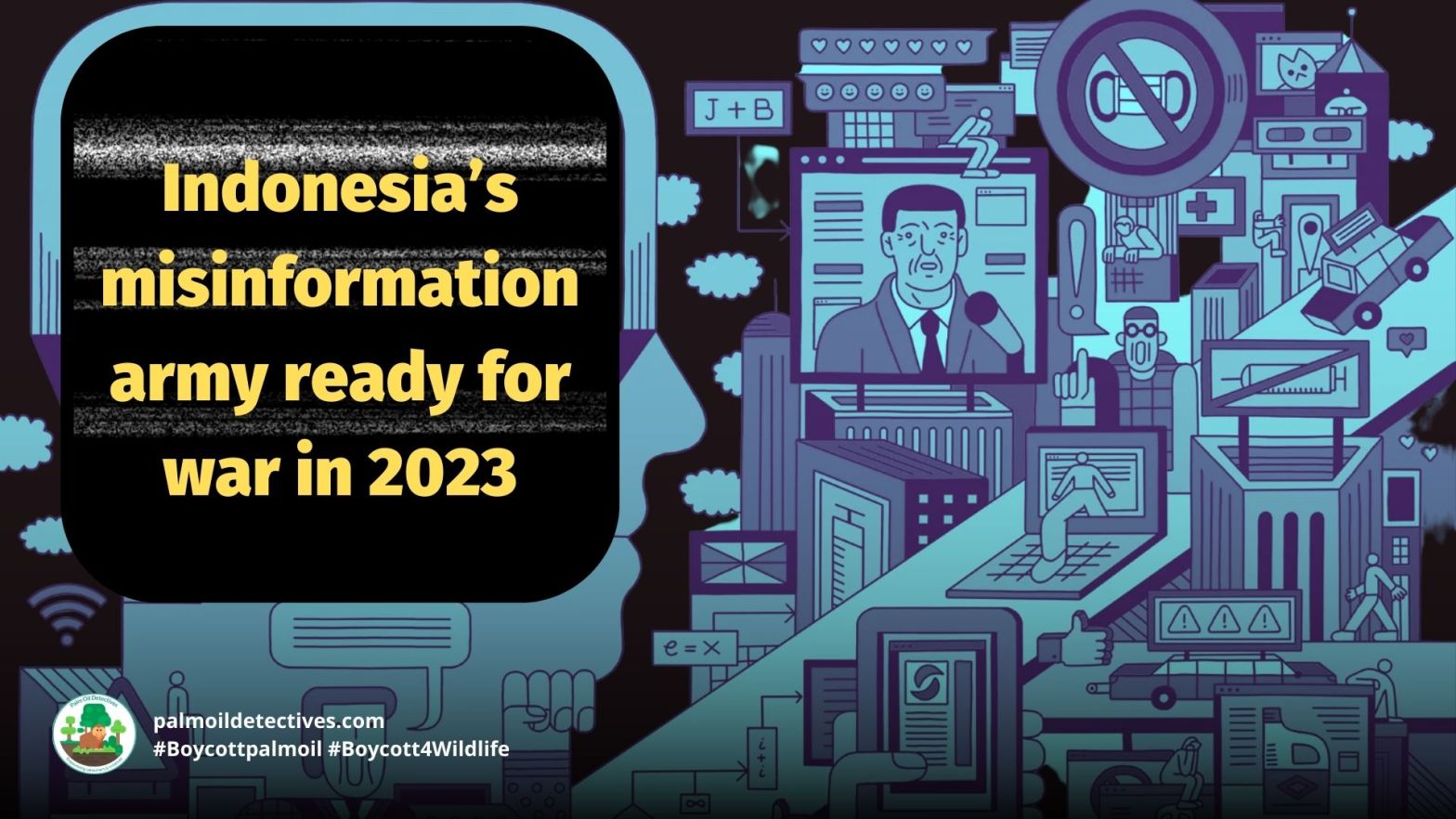
With an election looming and controversial law reform on its way, Indonesia’s government is set to ratchet up its well-oiled propaganda machine.
But the biggest propagator of disinformation seems not to be political renegades, but the Widodo administration. Fuelled by a well-resourced propaganda machine, the government is ready to fight dirty to win over public opinion.

Written by By Ika Idris, Monash University Indonesia, Laeeq Khan, Ohio University, and Nuurrianti Jalli, Northern State University in Tangerang. January 16 2023 for 360Info.org. Dr Ika Idris is an associate professor at Public Policy & Management, Monash University Indonesia. Her works focus on government communication, misinformation, and the internet’s impacts on society. Republished here with a Creative Commons Licence. Read original article.
With an election looming and controversial law reform on its way, Indonesia’s government is set to ratchet up its well-oiled propaganda machine.
Indonesia’s heavy-handed laws outlawing criticism of the government have been ushered in under the pretence of an epidemic of hoaxes and conspiracies. President Joko Widodo insists his government has been the victim of disinformation campaigns, causing unrest over employment reforms, Indonesia’s new capital city, and the sweeping penal code reforms set to be codified this year.
But the biggest propagator of disinformation seems not to be political renegades, but the Widodo administration. Fuelled by a well-resourced propaganda machine, the government is ready to fight dirty to win over public opinion.
With 12 months before the election, Widodo has two priority policies that are mired in controversy — building a new capital city and penal code reform. The government is pressing ahead.
It is usually not wise for a democratically elected government to be so dismissive of public concerns, but Widodo’s government has developed a winning playbook since coming to power in 2014: delegitimise critics and flood online chatter with counter-messaging from state officials.
Most recently, Indonesia’s Director-General of Information and Public Communication Usman Kansong told hundreds of government public relations officials their work to promote the new penal code in 2023 would be vital.
Scholars and civil society groups worry the code is a setback to Indonesia’s democracy, outlawing insults aimed at the government and restricting what can be taught in schools. They fear the provisions will be wielded to muzzle criticism of the government.
But former TV journalist Kansong told the room of officials there was nothing wrong with the code, the government just needed to more strategically communicate its content to the public. When Widodo’s administration commits to ‘strategic communication’, it tends to mean amplifying its agenda and silencing criticism.
The Indonesian Government’s 2019 #SawitBaik campaign championed the palm oil industry
The government’s 2019 #SawitBaik campaign championed the palm oil industry during negotiations to export the product to the European Union, drowning out criticism of a forest fire at a large Indonesian palm oil plantation.
During the pandemic, the government hired ‘buzzers’: people who will push a cause online for hire, to push back against criticism of Widodo’s COVID-19 reopening plan.
This ‘single narrative’ focus from the government has been seen over and over. Widodo dismissed a series of 2020 protests over employment law reforms, saying complaints were based on “disinformation and hoaxes spread through social media”.
There were genuine gripes with the bills: the law was unconstitutional and tabled without proper public consultation. After Widodo’s statement, sentiment on social media shifted away from rejecting the bill towards supporting the government.

The following August, minister Johnny Plate was more explicit, telling all government officials that no government messaging could contradict Widodo’s policies.
After being elected in 2014, Widodo established a special public relations team (Tenaga Humas Pemerintah) to spread government narratives, disorient the public and silence criticism. This team supported the government’s orchestration in countering public criticism and assuring that every government agency publishes social media posts to amplify the government policy.

In 2017, Widodo dialled up the PR machine, overseeing the creation of a government social media team that reached across agencies and institutions.
Sinergi Media Sosial Aparatur Sipil Negara (SIMAN): The government’s social media ‘special force’
Sinergi Media Sosial Aparatur Sipil Negara (SIMAN) was the government’s social media “special force” — a team whose duty was to combat online radicals and pranksters, and help the government’s messages go viral.
In reality, they sought to drown out any criticism of the state on social media. Any government employee could put themselves forward to join. Going viral (“viralisasi”) was the message every government official heard over and over at workshops between 2017 and 2019, which were part of the recruitment process. In 2019, around 5,946 government officers were recruited as SIMAN troops through 42 workshops.
SIMAN is no longer as active as it was during the 2019 election and Tenaga Humas Pemerintah has folded. Indonesia’s Ministry of Communication prefers to call upon the government PR association, drawing members from around 900 state apparatuses spread across agencies and institutions.
The government offers extra performance credits to those who push the government’s narrative online, which can be cashed in when applying for a promotion.
PR officers who promoted Indonesia’s G20 presidency on their personal social media accounts were rewarded with a credit point — leading to an avalanche of pro-Widodo messages.
Widodo desires a single narrative (“narasi tunggal”) and a population that supports his policies unconditionally
The government’s information laws have already been used to target online activists, but the revised penal code could take the crackdown even further.
Public relations can serve a purpose in democracies — it can act as a bridge between the government and the people, helping open up lines of communication between the government and marginalised groups they serve. But when governments use their PR muscle to shut down opposing voices and add to the swirl of disinformation, it can drive democracies backwards.

Based on the Widodo administration’s messaging around the G20 and employment reforms, the risk of severe state-sponsored disinformation this year is high as the government presses state officials to ‘promote’ the controversial penal code. During Widodo’s reign, the government has orchestrated a state narrative on every policy and — with more on the line than ever in an election year — there’s no sign of it slowing down.
ENDS
Written by By Ika Idris, Monash University Indonesia, Laeeq Khan, Ohio University, and Nuurrianti Jalli, Northern State University in Tangerang. January 16 2023 for 360Info.org. Dr Ika Idris is an associate professor at Public Policy & Management, Monash University Indonesia. Her works focus on government communication, misinformation, and the internet’s impacts on society. Republished here with a Creative Commons Licence. Read original article.
On Twitter, a South East Asian couple wears Papuan indigenous traditional clothing in an obvious effort to erase Melanesian ethnicity and to normalise Indonesian rule – Spoiler: Papuans never ceded their sovereignty
Dr Setia Budhi: Dayak Ethnographer on media bias and misinformation in Indonesia

“The news about child labour, child slavery and women working on oil palm plantations in horrific conditions gets little attention in media.
“News about customary Dayak lands that are seized for palm oil illegally or by force is online only momentarily and quickly disappears. These violations human rights are rendered invisible by the media in here.
“In our news hungry and busy world, most people don’t read beyond the headlines. The messy, corrupt and invisible world of massive land-clearing for palm oil goes on without the world knowing about it through the media. In the meantime, tropical rainforests of Indonesia and Malaysia are silently disappearing.” ~ Dr Setia Budhi.

Research studies of SE Asian media reporting on palm oil show a denialist and greenwashing narrative that is similar to climate change denialism i.e. climate change greenwashing.
“We found that media reporting of the denialist narrative is more prevalent than that of the peer-reviewed science consensus-view that palm oil plantations on tropical peat could cause excessive greenhouse gas emissions and enhance the risk of fires.
“Our article alerts to the continuation of unsustainable practices as justified by the media to the public, and that the prevalence of these denialist narratives constitute a significant obstacle in resolving pressing issues such as transboundary haze, biodiversity loss, and land-use change related greenhouse gas emissions in Southeast Asia.”
~ Liu, Felicia & Ganesan, Vignaa & Smith, Thomas. (2020). Contrasting communications of sustainability science in the media coverage of palm oil agriculture on tropical peatlands in Indonesia, Malaysia and Singapore. Environmental Science & Policy. 114. 162-169. 10.1016/j.envsci.2020.07.004.
Read more about palm oil industry greenwashing, manipulation and misinformation

Will palm oil watchdog RSPO rid itself of deforestation or continue to pretend its products are sustainable? – EIA
Palm oil produced through the destruction of forestland is still being sold around the world with the blessing of the Roundtable on Sustainable Palm Oil (RSPO).
On November 30, 2022 EIA and along…
Read more

Research: Palm Oil Deforestation and its connection to RSPO members/supermarket brands
Discover the truth about palm oil from experts’ reports. Research shows RSPO members still cause deforestation and human rights abuses, despite greenwashing!
Read more

Greenwashing Tactic #4: Fake Labels
Claiming a brand or commodity is green based on unreliable, ineffective endorsements or eco-labels such as the RSPO, Forest Stewardship Council (FSC) or FairTrade coffee and cocoa. Greenwashing: Fake Labels and fake certifications…
Read more
Eyewitness Story: The Last Village by Dr Setia Budhi
A lone Dayak village in Borneo surrounded by palm oil plantations has held out for 14 years and resisted corporate infiltration by global palm oil giants. My name is Dr Setia Budhi, I…
Read more

WHO: Palm Oil Industry Greenwashing Like Big Tobacco
What does the $60 billion USD palm oil industry have in common with Big Tobacco? A lot according to this report by the World Health Organisation. Palm oil industry lobbying tactics are used…
Read more

Roundtable on Sustainable Palm Oil: 19 years is enough
For nearly two decades now, the RSPO has failed in its mission to make the industrial palm oil sector “sustainable”. Instead, it has been used by the palm oil industry to greenwash environmental…
Read more
Amazon Palm Oil: Top Brands Source from Amazon Destroyers
Expose the truth about brands like Nestlé, PepsiCo, and Unilever sourcing “sustainable” palm oil from Brazil linked to violence, abuses and fraud. Shame!
Read more

Eyewitness by Craig Jones: A mother and baby orangutan are rescued from an RSPO palm oil plantation in Sumatra
Bio: Craig Jones One of Britain’s finest wildlife photographers, Craig Jones is also one of the most humble and down-to-earth guys you will ever meet. His photography and stories capture the lives of…
Read more

Palm Oil Lobbyists Getting Caught Lying Orangutan Land Trust and Agropalma
For decades, investigative journalists have been exposing that illegal land grabbing from Indigenous peoples as a regular occurrence in West Papua, South and Central America, Africa and Asia. Indigenous people’s land is being…
Read more
10 Tactics of Sustainable Palm Oil Greenwashing
Greenwashing Tactic #1: Hidden Trade Off
When a brand makes token changes while continuing with deforestation, ecocide or human rights abuses in another part of their business – this is ‘Hidden Trade Off’
For example, Nestle talks up satellite monitoring to stop palm oil deforestation. Yet…
Read more
Greenwashing Tactic #2: No Proof
Greenwashing Tactic 5. Palm oil companies make environmental claims without providing proof or evidence of these claims or using spurious evidence.
Read more
Greenwashing Tactic #3: Vagueness
Claiming a brand or commodity is ‘green’ or ‘sustainable’ based on broad generalisations, unclear language or vague statements Jump to section Greenwashing: Vagueness in Language Greenwashing: Vagueness in certification standards Reality: Auditing of RSPO a failure Quote: EIA: Who Watches…
Read moreGreenwashing Tactic #4: Fake Labels
Claiming a brand or commodity is green based on unreliable, ineffective endorsements or eco-labels such as the RSPO, Forest Stewardship Council (FSC) or FairTrade coffee and cocoa. Greenwashing: Fake Labels and fake certifications Ecolabels are designed to reassure consumers that…
Read more
Greenwashing Tactic #5: Irrelevance and Deflection
Learn how lobbyists use irrelevant information and deflection to shift the conversation away from their environmental harms, e.g. “sustainable” palm oil.
Read more
Greenwashing Tactic #6: The Lesser of Two Evils
Claiming that a brand, commodity or industry is greener than others in the same category, in order to excuse ecocide, deforestation, human rights and animal rights abuses. Jump to section Greenwashing: Lesser of Two Evils: Palm Oil Uses Less Land…
Read more
Greenwashing Tactic #7: Lying
Greenwashing lies are falsifying support from authorities to back up claims or using spurious research data to back up the greenwashing, boycott palm oil!
Read more
Greenwashing Tactic 8: Design & Words
Greenwashing Tactic 8. Companies use design principles and subliminal language to signal ‘greenness’ and trigger unconscious emotional responses in consumers
Read more
Greenwashing Tactic 9: Partnerships, Sponsorships and Research Funding
Greenwashing Tactic 9. Corporations use NGOs, Zoo partnerships, sponsorships, and research funding to give an industry or brand a ‘green image.
Read more
Greenwashing Tactic 10: Gaslighting, Harassment, Stalking and Threats
Gaslighting, harassing or stalking vocal critics of a brand, commodity or industry certification in order to silence these critics – this is greenwashing!
Read more
Ten Tactics of ‘Sustainable’ Palm Oil Greenwashing
Learn ten marketing and PR tactics used for “sustainble” palm oil greenwashing to justify endless growth by the palm oil industry. Boycott palm oil now!
Read moreTake Action in Five Ways
1. Join the #Boycott4Wildlife on social media and subscribe to stay in the loop: Share posts from this website to your own network on Twitter, Mastadon, Instagram, Facebook and Youtube using the hashtags #Boycottpalmoil #Boycott4Wildlife.
2. Contribute stories: Academics, conservationists, scientists, indigenous rights advocates and animal rights advocates working to expose the corruption of the palm oil industry or to save animals can contribute stories to the website.





3. Supermarket sleuthing: Next time you’re in the supermarket, take photos of products containing palm oil. Share these to social media along with the hashtags to call out the greenwashing and ecocide of the brands who use palm oil. You can also take photos of palm oil free products and congratulate brands when they go palm oil free.
4. Take to the streets: Get in touch with Palm Oil Detectives to find out more.
5. Donate: Make a one-off or monthly donation to Palm Oil Detectives as a way of saying thank you and to help pay for ongoing running costs of the website and social media campaigns. Donate here
Discover more from Palm Oil Detectives
Subscribe to get the latest posts sent to your email.
 Palm Oil Detectives
Reblogged this on MARY CALVO .
LikeLiked by 1 person
Thank you Mary
LikeLiked by 1 person
thanks you. 🙂
LikeLiked by 1 person
thank you. excellent work.! my friends. 🙂
LikeLiked by 1 person
Thank you dear friend for your endless support and sharing of these posts, happy weekend and big hugs
LikeLiked by 1 person
so kind. best wishes return to you. big hugs. 🙂
LikeLike