
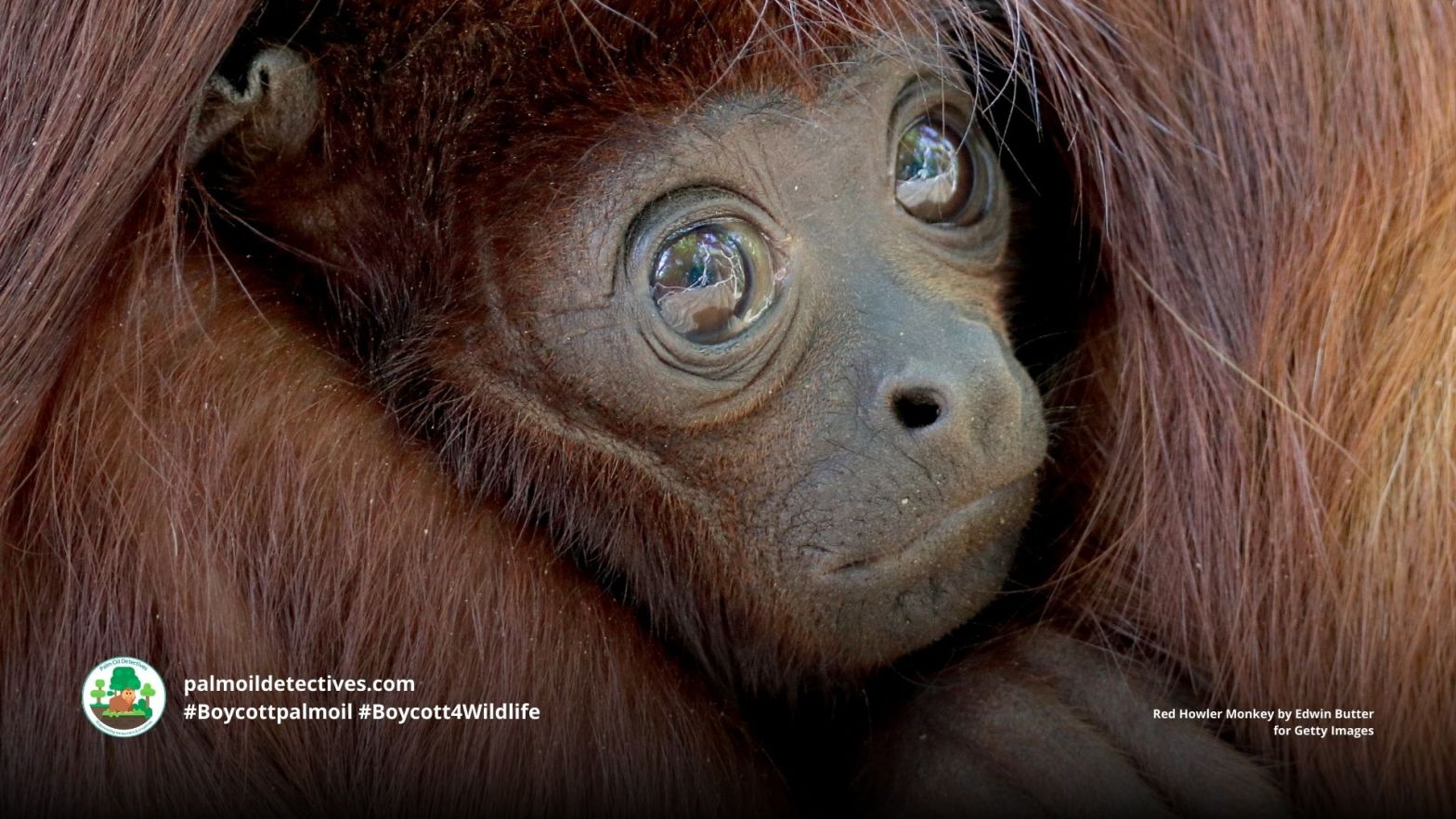
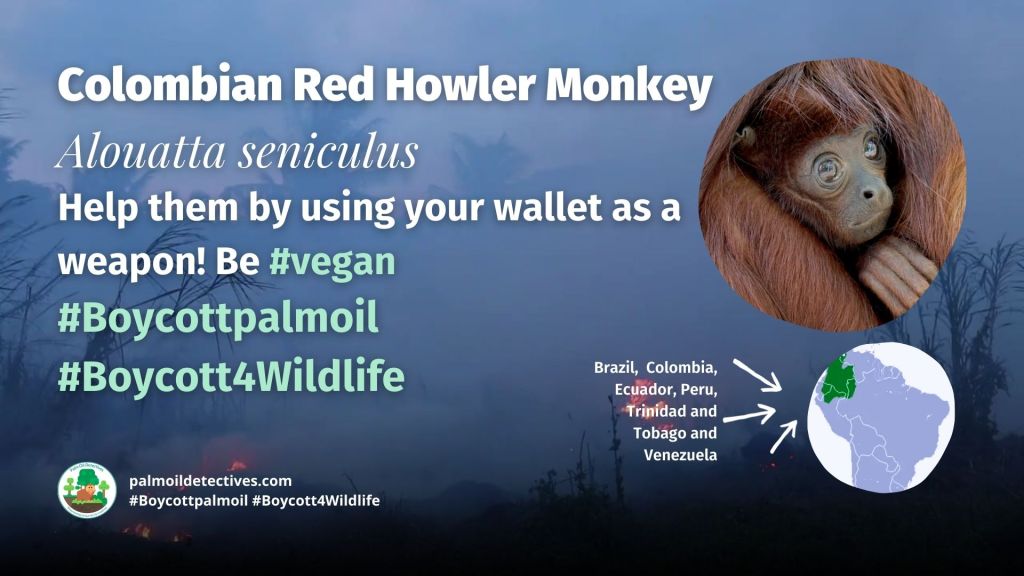
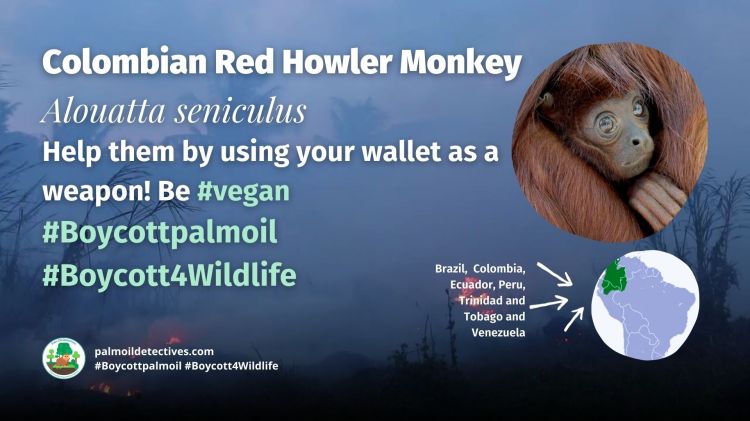
Colombian Red Howler Monkey Alouatta seniculus
(Likely now) Vulnerable
Extant (resident)
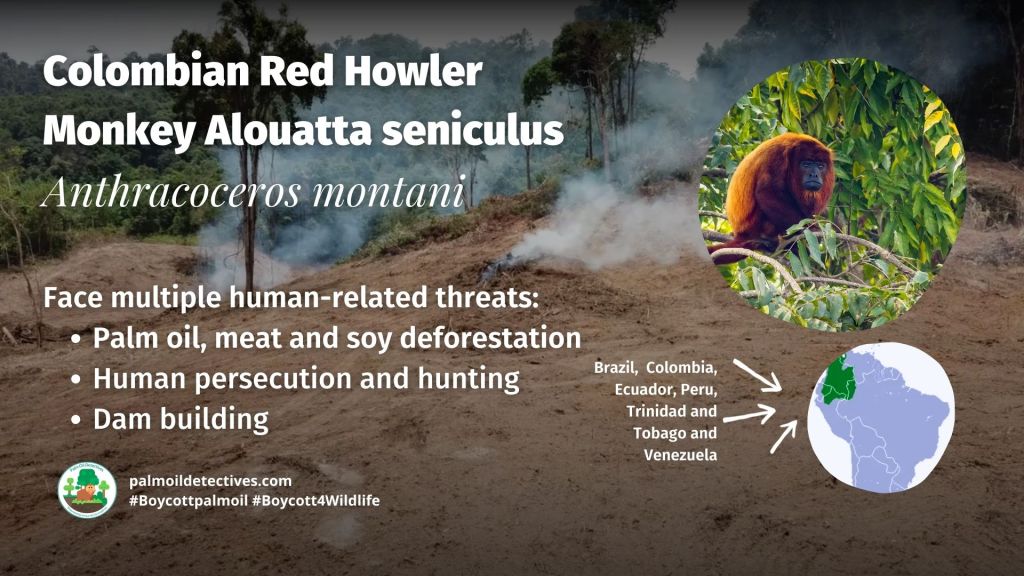
Brazil (Amazonas); Colombia; Ecuador; Peru; Trinidad and Tobago; Venezuela.
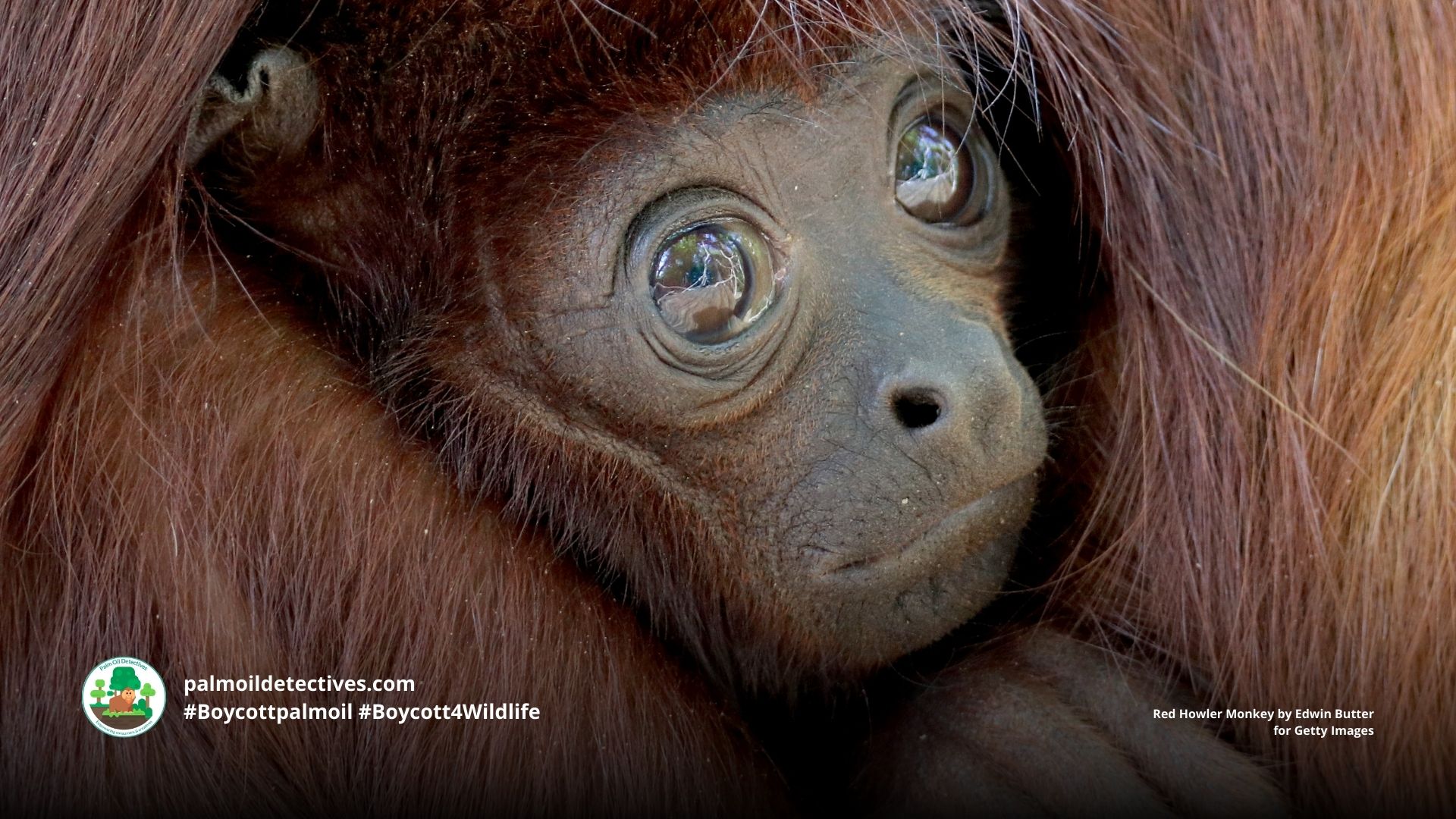
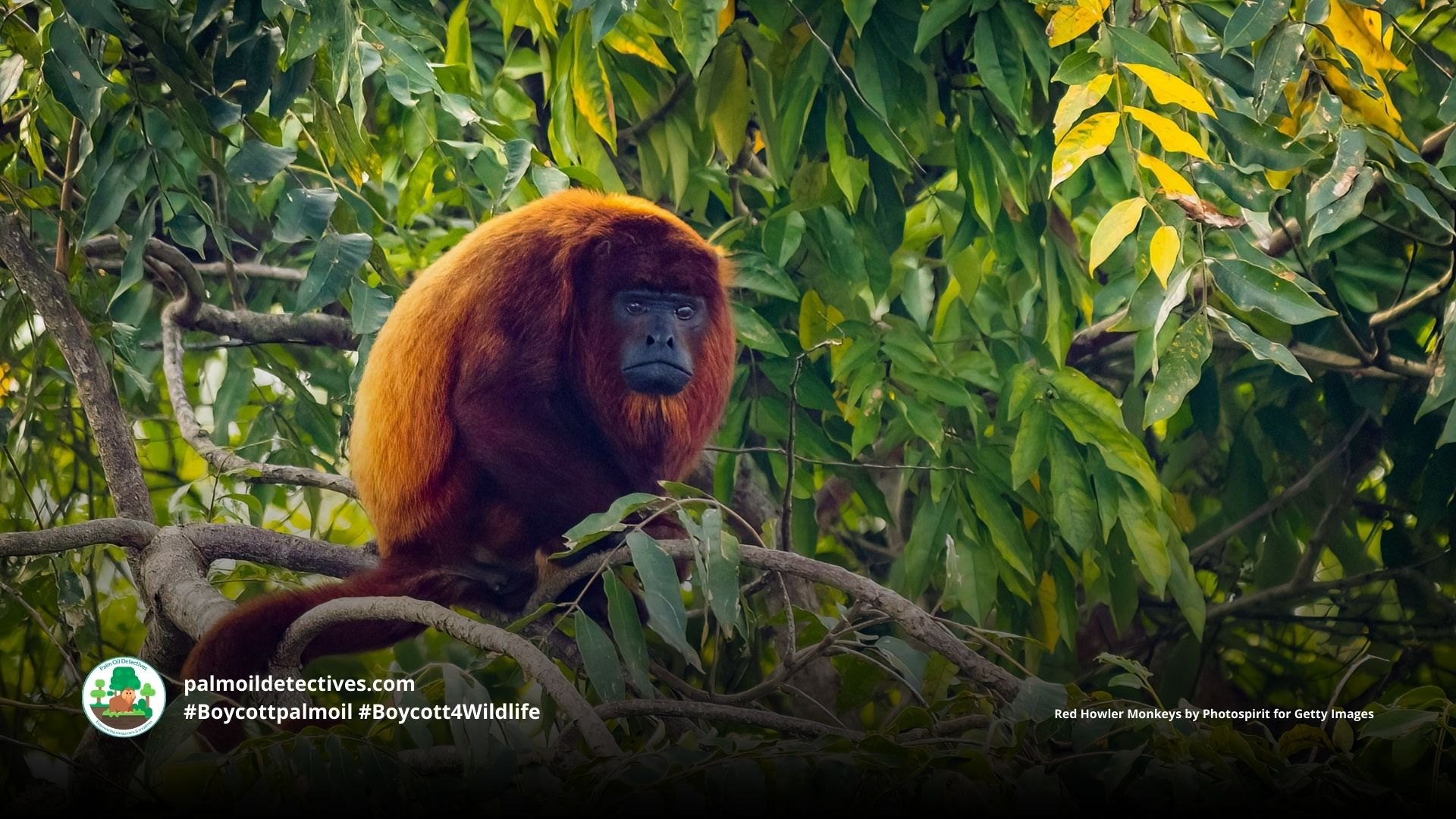
Red howlers are the largest of the howler monkey species. They have dense and vividly coloured fur that ranges from brown to dark red, with gold or bright orange undersides – the colour can vary based on their age and habitat. Their bare, dark faces contrast with the surrounding fur. They have stunning and characterful faces with stubby noses, wide jaws, and thick beards. These beautiful #monkeys face multiple threats including palm oil, soy and meat deforestation, the construction of #hydroelectric dams, #hunting and human persecution. Help them to survive each time you shop, #BoycottGold #Boycottpalmoil #Boycott4Wildlife
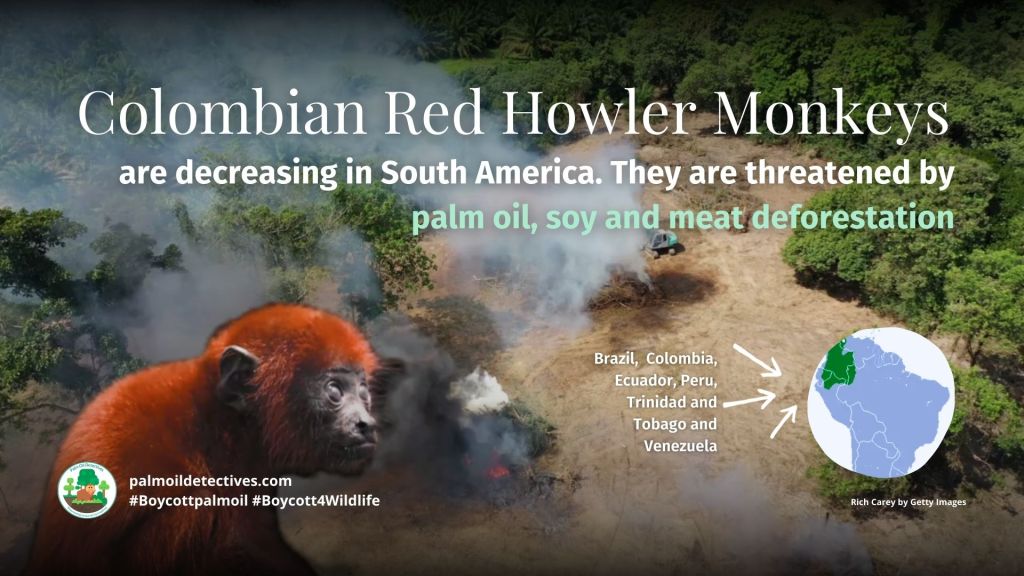
The largest of the howler #monkeys, Colombian Red #Howler 🐵🐒❤️ are decreasing due to #palmoil #soy #meat and #mining #deforestation. Help them to survive and #Boycottpalmoil 🌴🪔🔥🧐⛔️ #Boycott4Wildlife #BoycottGold @palmoildetect https://palmoildetectives.com/2024/02/25/colombian-red-howler-monkey-alouatta-seniculus/
Red Howlers, characterful, cheeky red furry #monkeys of #Colombia 🐵🐒🙈🙉 they are under threat from #palmoil and #gold #deforestation 😿 fight for them and #Boycottpalmoil 🌴🔥⛔️ #BoycottGold 🥇🔥⛔️ #Boycott4Wildlife @palmoildetect https://palmoildetectives.com/2024/02/25/colombian-red-howler-monkey-alouatta-seniculus/
The Colombian or Venezuelan red howler is a type of howler monkey that lives in the western Amazon Basin of South America, across countries like Venezuela, Colombia, Ecuador, Peru, and Brazil. In 1986, the monkeys in Bolivia’s Santa Cruz were identified as a different species called the Bolivian red howler. More recently, monkeys in northeastern South America and Trinidad have been named as the Guyanan red howler. All these howler monkeys are part of a larger family called Atelidae, which is a group of New World monkeys.
Several threats are known to this species across their distribution range, including hunting, deforestation and other pressures due to human activities. Although howler monkeys are believed to easily adapt to disturbed forest, extensive deforestation has occurred throughout their range in Colombia. Recent reports from northern Peru show that A. seniculus populations are highly affected by hunting for local consumption, deforestation for agriculture, cattle ranching, logging, and hydrocarbon exploration (Aquino et al. 2016).
IUCN red list
Appearance & Behaviour
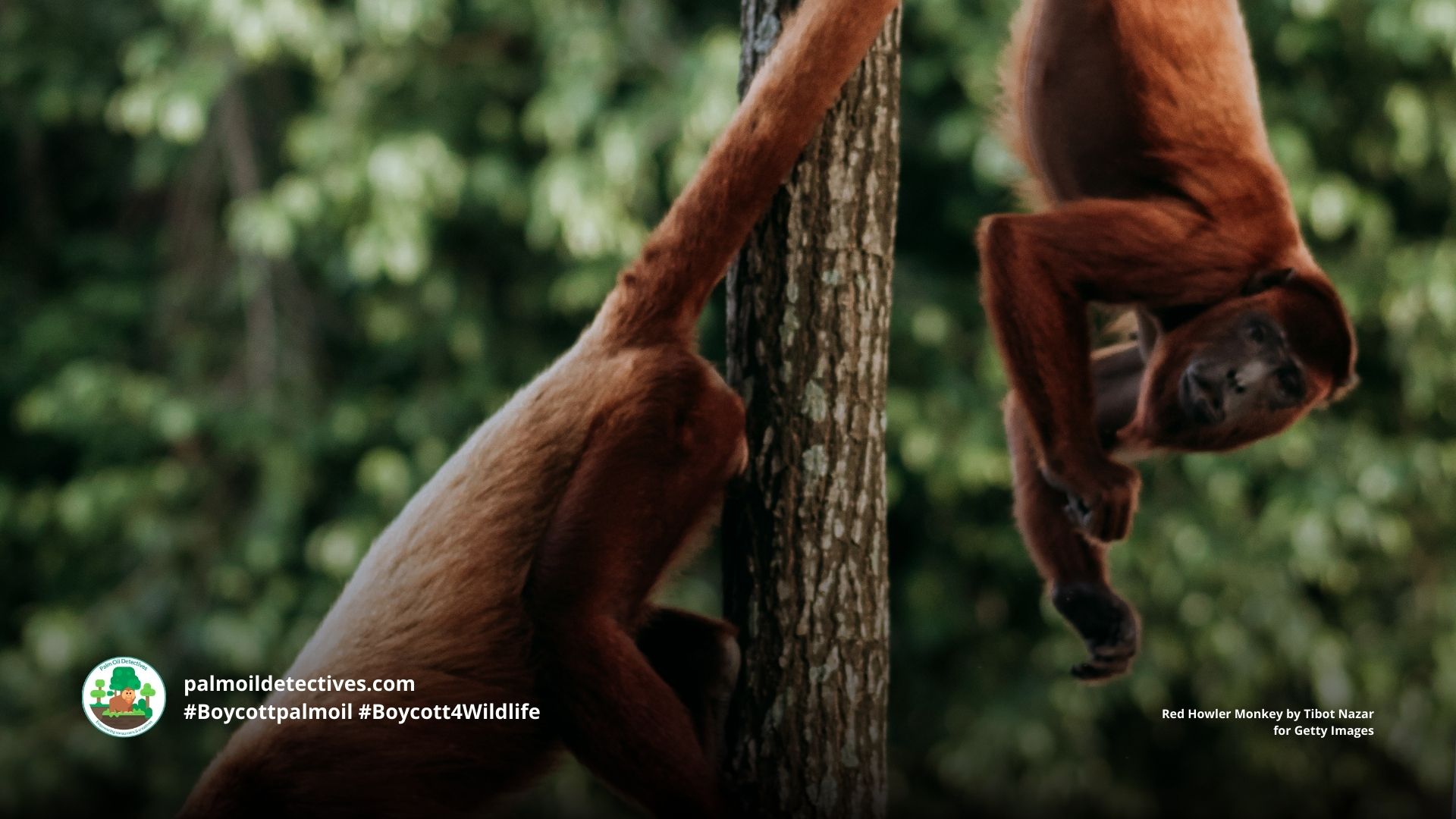
Curious and social, Red howlers live in groups with 1 to 3 males, 2 to 7 females, and varying numbers of young monkeys. Their throats appear swollen due to an enlarged hyoid bone at the base of the tongue. Males are larger than females with darker and denser beards.
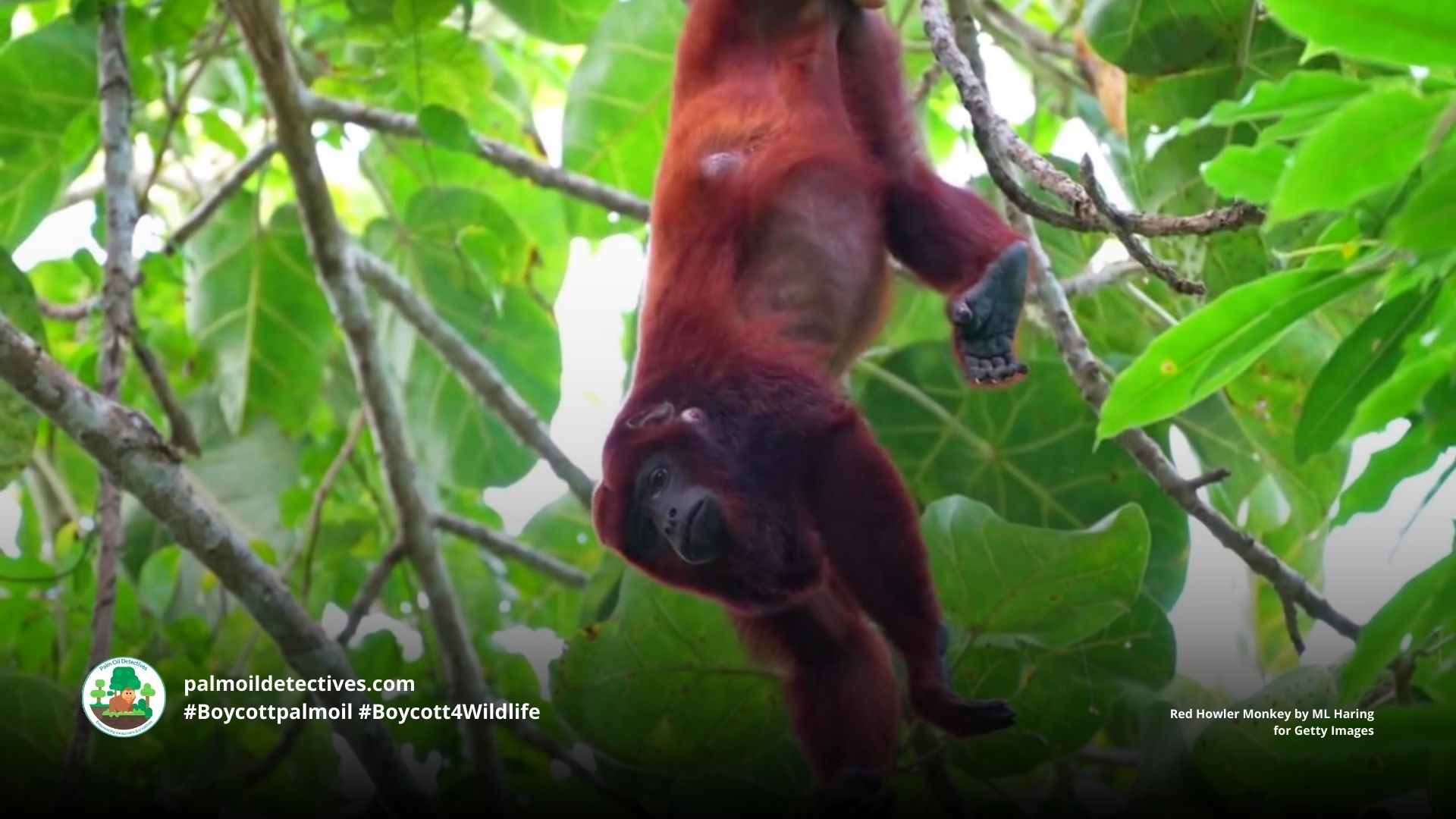
Their tails are exceptionally long, with the last third being hairless underneath, which helps them grip branches better. The males in all-male groups sometimes fight in order to gain the status and take control – in order to become the alpha male.
These monkeys are known for their loud howls, which can be heard up to 5 km away, usually at dawn and before they sleep at night. This communication helps avoid territory overlap with our neighbouring troops. Red howlers are most active in the morning and prefer staying high up in trees where they can find the most leaves. They aren’t fans of rain and often make plaintive howls when it’s raining, while sitting hunched over in trees.

Threats
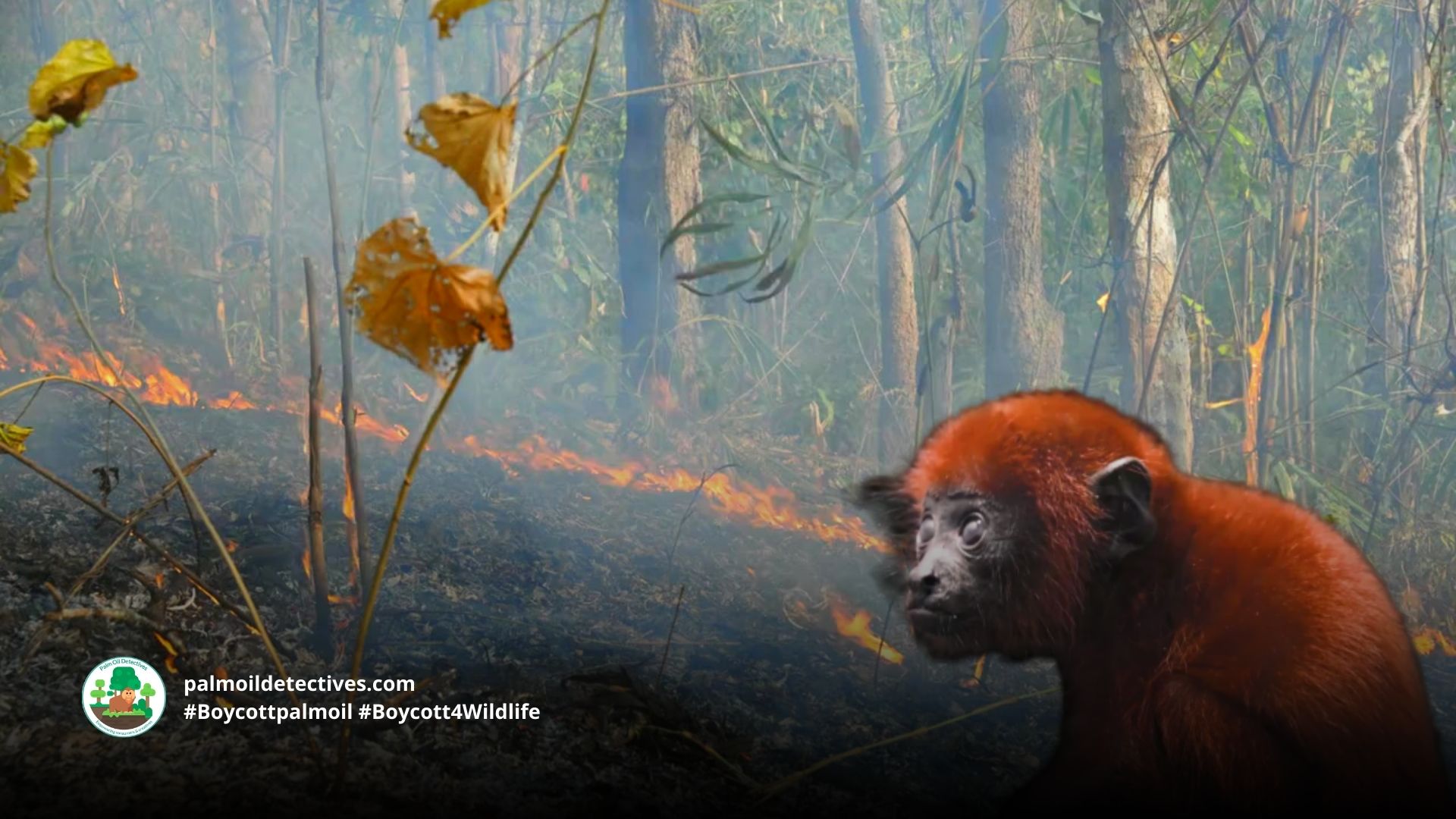
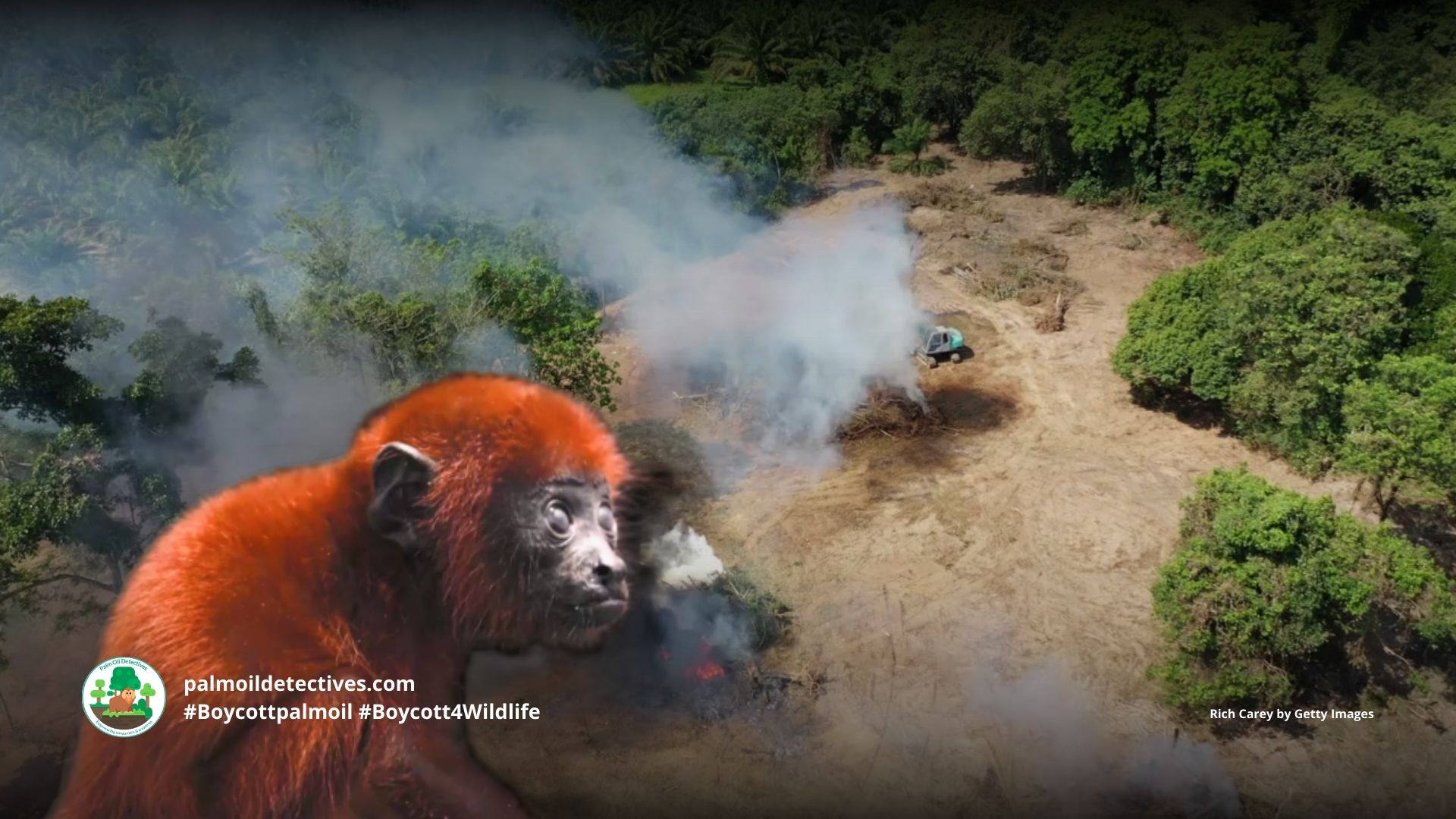
The main danger to red howlers is the loss of their home to deforesation. Also the forests that flood seasonally.
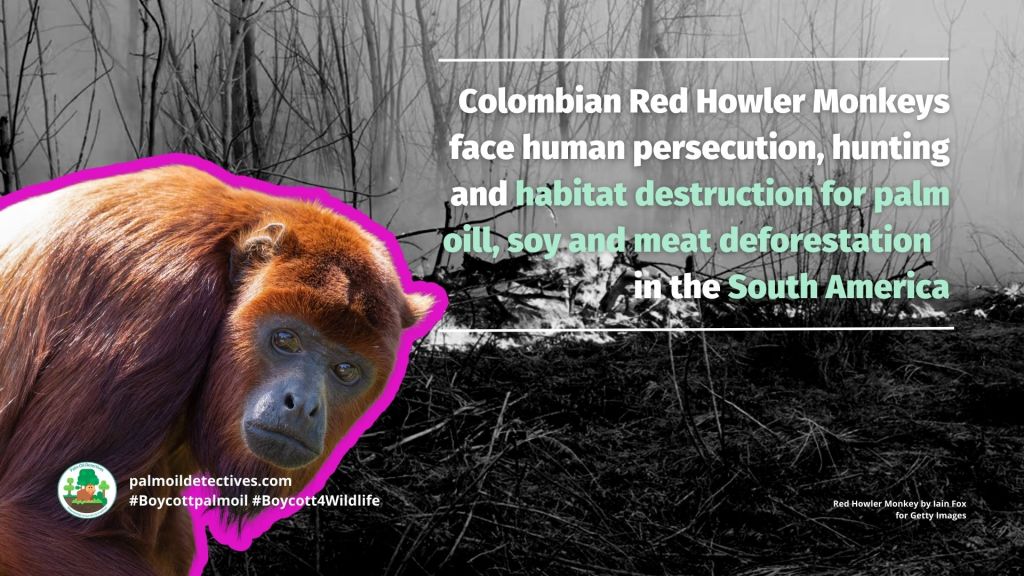
Changes like building dams and cutting down trees along rivers have dramatically reduced their habitat range. Sadly, many red howlers are killed for their unique enlarged hyoid bone, which is used as a cup in treating certain health conditions, or simply for food. They can also be captured and sold commercially.
- Deforestation for palm oil, meat and soy: Habitat destruction is the primary threat to red howlers.
- Deforestation for hydroelectric dams: They are affected by dam construction and logging, as they live in seasonally flooded forests.
- Human persecution: Red howlers are sometimes killed for their enlarged hyoid bone, which is used as a drinking vessel for treating health conditions by local people.
- Hunting: They are hunted for food.
- Illegal pet trade: Commercial exportation is also a threat, as they can be captured and sold.
- Disease: Dengue and Yellow Fever viruses
Although this animal was previously recorded on IUCN Red List as being ‘Least Concern’ 100,000’s of hectares of rainforest have since disappeared for palm oil, soy and meat across their range. It is likely that this rating will be updated to be either ‘Near Threatened’ or ‘Vulnerable’ by IUCN Red List.
Habitat
Red howler monkeys inhabit a broad range of northwestern South American countries, including Bolivia, Brazil, Colombia, Ecuador, Guyana, French Guiana, Venezuela, Peru, Suriname, and the island of Trinidad, among others. They predominantly dwell in the canopies of tropical deciduous forests and rainforests, with a special preference for Cecropia and teak trees.
Diet
Red howler monkeys’ diet consists of flowers, leaves, and fruit, with leaves making up to 60% of their food intake. They are picky eaters, carefully avoiding leaves that are toxic or harmful. They particularly prefer young, tender leaves which are not only easier to digest but also contain more protein and sugar.
Mating and breeding
Male Red howler monkeys follow a polygynous mating system (where one male mates with multiple females). A female typically initiates courtship by sticking out her tongue at a male and if there’s no response, she moves on to another male. Mating happens all year round and after a 6 month pregnancy, a single baby is usually born. By one month old, infants can use their tail to cling to their mother and ride on her back until they are one year old.
Weaning happens when the young monkeys are between 18 to 24 months old. Males often show affection to their direct offspring. Male red howlers reach sexual maturity at five years old, whereas females mature at four years old.
Violent dominance is prevalent among males
There’s intense competition among male red howler monkeys due to an unequal sex ratio. When male monkeys grow up, they’re kicked out of their birth group. These males then try to take over another group by killing their existing leader and his offspring, to eliminate any future competition. This violent takeover means that sadly – less than 25% of young monkeys survive such invasions.
Support Red Howler Monkeys by going vegan and boycotting palm oil and boycotting gold, it’s the #Boycott4Wildlife
Support the conservation of this species
This animal has no protections in place. Read about other forgotten species here. Create art to support this forgotten animal or raise awareness about them by sharing this post and using the #Boycottpalmoil #Boycott4Wildlife hashtags on social media. Also you can boycott palm oil in the supermarket.
Further Information
Link, A., Palacios, E., Cortés-Ortiz, L., Stevenson, P.R., Cornejo, F.M., Mittermeier, R.A., Shanee, S., de la Torre, S., Boubli, J.P., Guzmán-Caro, D.C., Moscoso, P., Urbani, B. & Seyjagat, J. 2021. Alouatta seniculus. The IUCN Red List of Threatened Species 2021: e.T198676562A198687134. https://dx.doi.org/10.2305/IUCN.UK.2021-2.RLTS.T198676562A198687134.en. Accessed on 23 February 2023.
Cornejo, F.M., Boubli, J.P., Alves, S.L., Bicca-Marques, J.C., Cortés-Ortiz, L., Calouro, A.M. & de Melo, F.R. 2021. Alouatta puruensis (amended version of 2020 assessment). The IUCN Red List of Threatened Species 2021: e.T136787A190430767. https://dx.doi.org/10.2305/IUCN.UK.2021-1.RLTS.T136787A190430767.en. Accessed on 26 May 2023.
Red Howler Monkey Wikipedia article – https://en.wikipedia.org/wiki/Venezuelan_red_howler
Red Howler Monkey on The IUCN Red List site – http://www.iucnredlist.org/details/70547436/0

How can I help the #Boycott4Wildlife?
Take Action in Five Ways
1. Join the #Boycott4Wildlife on social media and subscribe to stay in the loop: Share posts from this website to your own network on Twitter, Mastadon, Instagram, Facebook and Youtube using the hashtags #Boycottpalmoil #Boycott4Wildlife.
2. Contribute stories: Academics, conservationists, scientists, indigenous rights advocates and animal rights advocates working to expose the corruption of the palm oil industry or to save animals can contribute stories to the website.






3. Supermarket sleuthing: Next time you’re in the supermarket, take photos of products containing palm oil. Share these to social media along with the hashtags to call out the greenwashing and ecocide of the brands who use palm oil. You can also take photos of palm oil free products and congratulate brands when they go palm oil free.
4. Take to the streets: Get in touch with Palm Oil Detectives to find out more.
5. Donate: Make a one-off or monthly donation to Palm Oil Detectives as a way of saying thank you and to help pay for ongoing running costs of the website and social media campaigns. Donate here
Discover more from Palm Oil Detectives
Subscribe to get the latest posts sent to your email.
 Palm Oil Detectives