

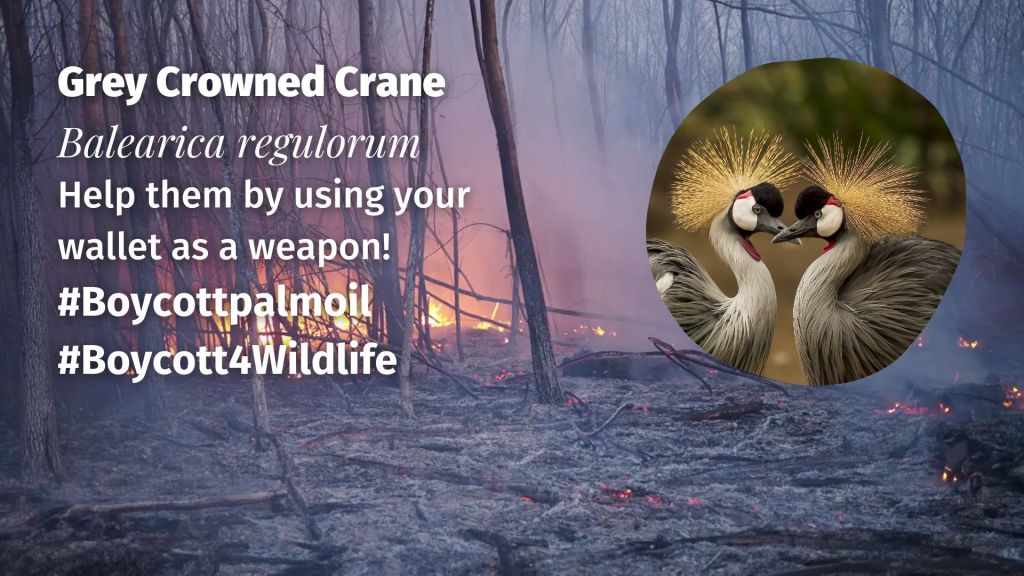
Grey Crowned Crane Balearica regulorum
IUCN Status: Endangered
Location: Uganda, Kenya, Tanzania, Rwanda, Burundi, South Sudan, Democratic Republic of the Congo, Angola, Zambia, Malawi, Mozambique, Zimbabwe, Namibia, Botswana, South Africa, Eswatini, Lesotho
Found across wetlands, grasslands, and cultivated lands of eastern and southern Africa, this elegant bird is particularly emblematic in Uganda, where they feature on the national flag and coat of arms.
The Endangered Grey Crowned #Crane is one of #Africa’s most graceful, regal and recognisable #birds, adorned with a halo of golden feathers and traversing the skies and forests of #Uganda, #Tanzania, #DRC #Congo, #Namibia and more. Behind their dazzling beauty is a grim reality. Since 1985, their global population has crashed by over 59%, driven by relentless wetland destruction, tobacco, timber and cocoa agriculture, palm oil expansion, illegal egg collection, and wildlife trafficking. Once numbering over 100,000, now fewer than 25,000 mature individual birds remain alive. Urgent action is needed to save these majestic and irreplaceable birds before their calls fall silent across Africa’s skies. Help them every time you shop and #BoycottPalmOil #Boycott4Wildlife
The crowning jewel of #Uganda 🇺🇬 is their national #bird, the Grey-Crowned Crane, a majestic #songbird 🎶🐦👑 of the #peatlands 🌊 Sadly, this title hasn’t protected them from #PalmOil and hunting. #BoycottPalmOil 🌴⛔️ #Boycott4Wildlife @palmoildetect https://wp.me/pcFhgU-b7K
Once numbering over 100K, the most regal #bird 👑🐦 in #Tanzania #Congo #SouthAfrica and #Namibia hangs on for survival against Big #PalmOil 🌴 Big #Tobacco 🚬 and #Hydroelectric dams 🚜 Help them survive! #BoycottPalmOil #Boycott4Wildlife @palmoildetect https://wp.me/pcFhgU-b7K
Appearance & Behaviour
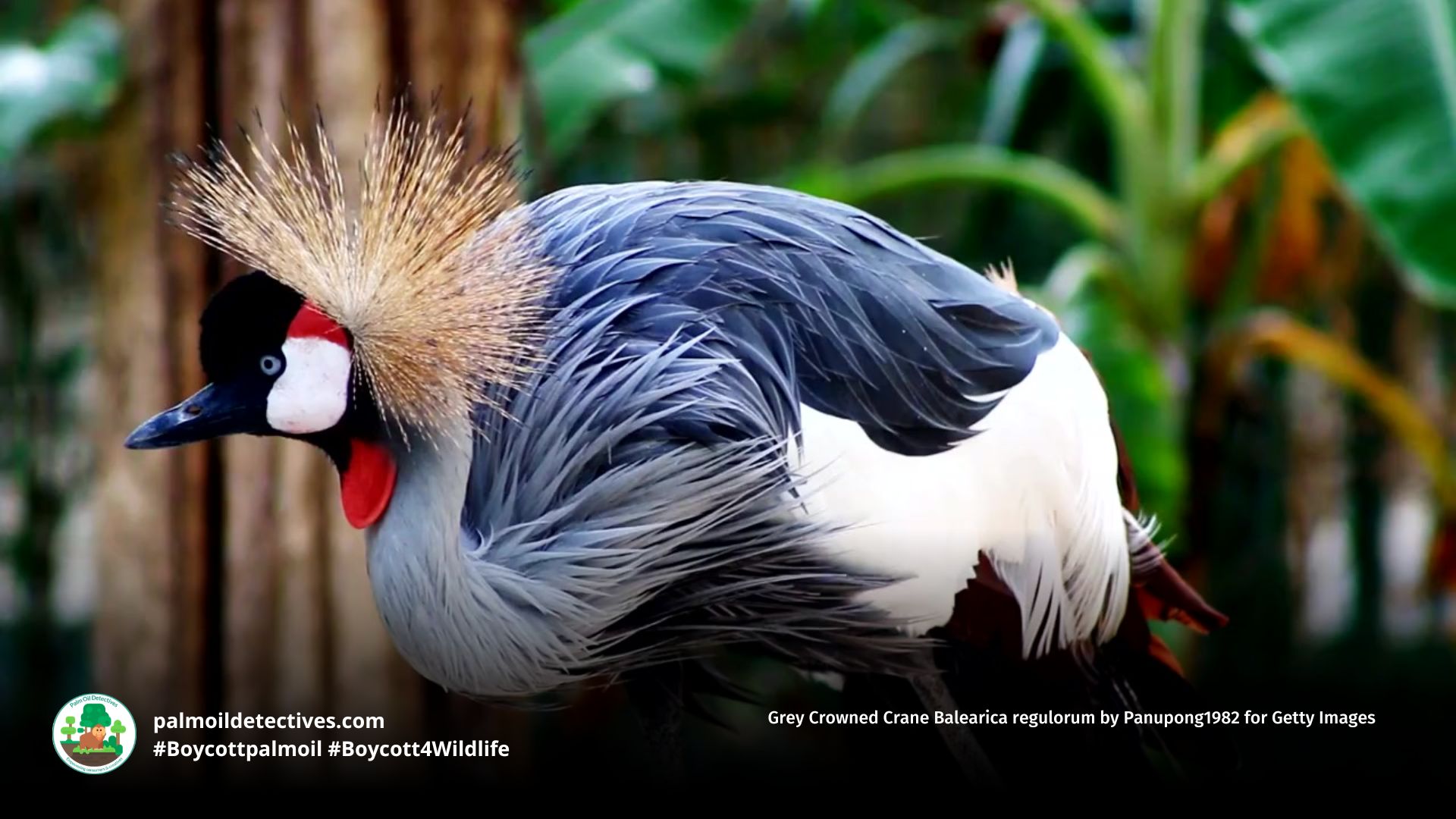
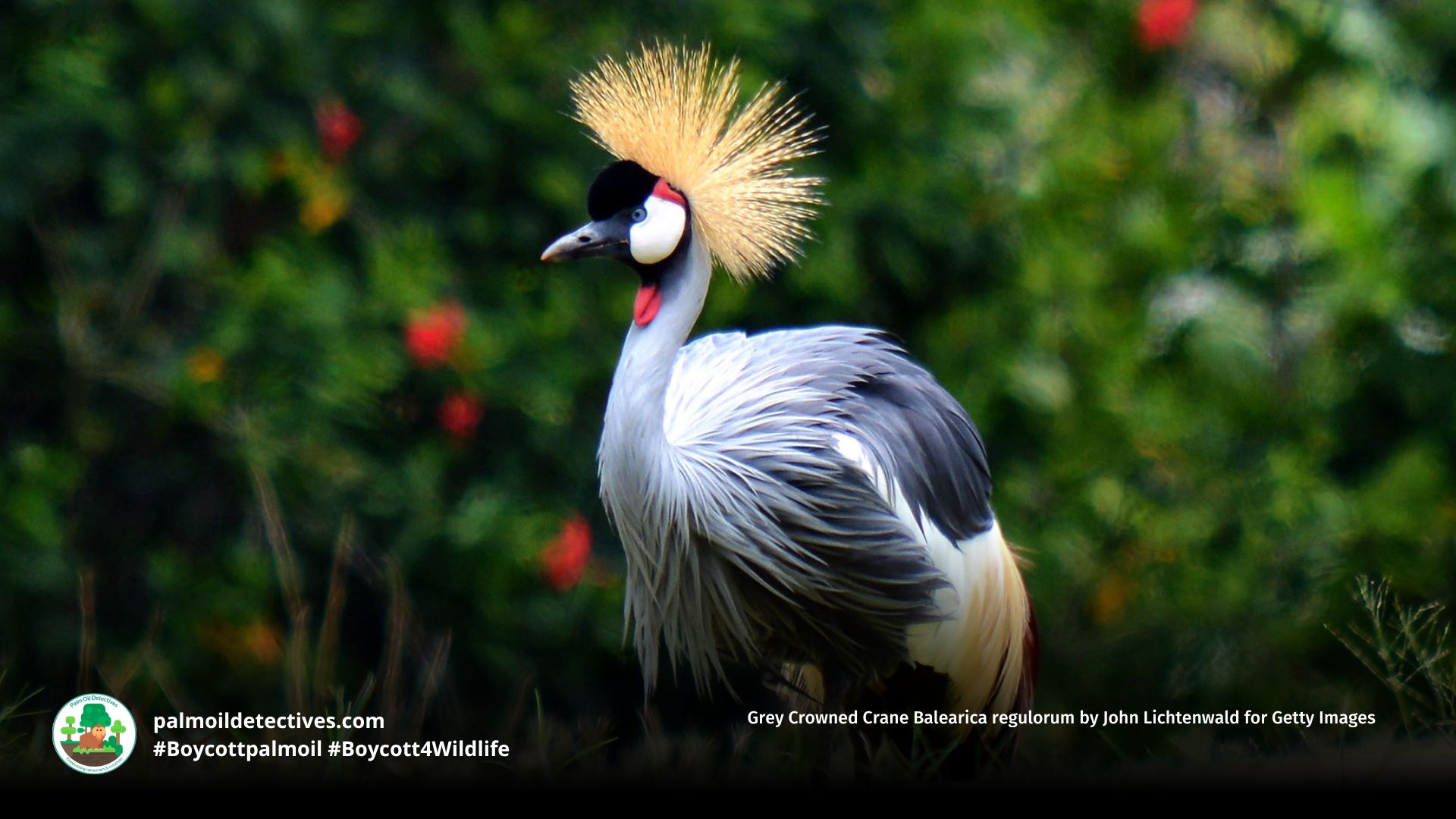
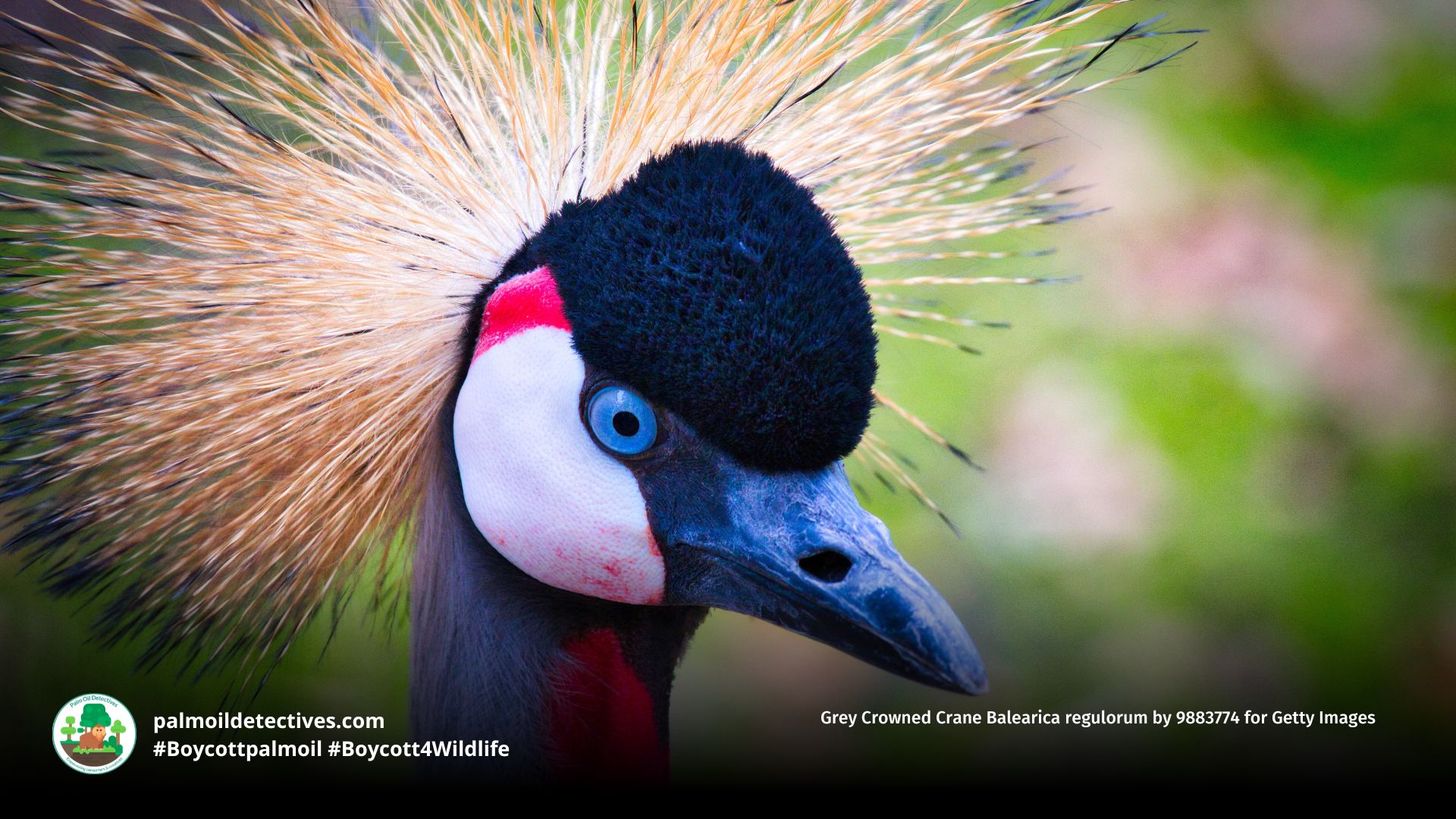
Standing a metre tall, the Grey Crowned Crane captivates with their stately grey plumage, snowy cheeks, bright red wattle and a dazzling aurora of stiff golden feathers. Their courtship rituals are equally enchanting, with pairs leaping, bowing, and calling in dazzling synchronised dances that can attract the attention of entire flocks. Their red gular sac inflates with a deep booming call, echoing through the savannah.
Unlike other crane species, Grey Crowned Cranes possess a long hind toe allowing them to roost in trees – a trait thought to be ancient among cranes. They often gather in large flocks outside of the breeding season and are known to adapt their behaviour to live increasingly close to human communities.






Threats
• Wetland destruction and degradation
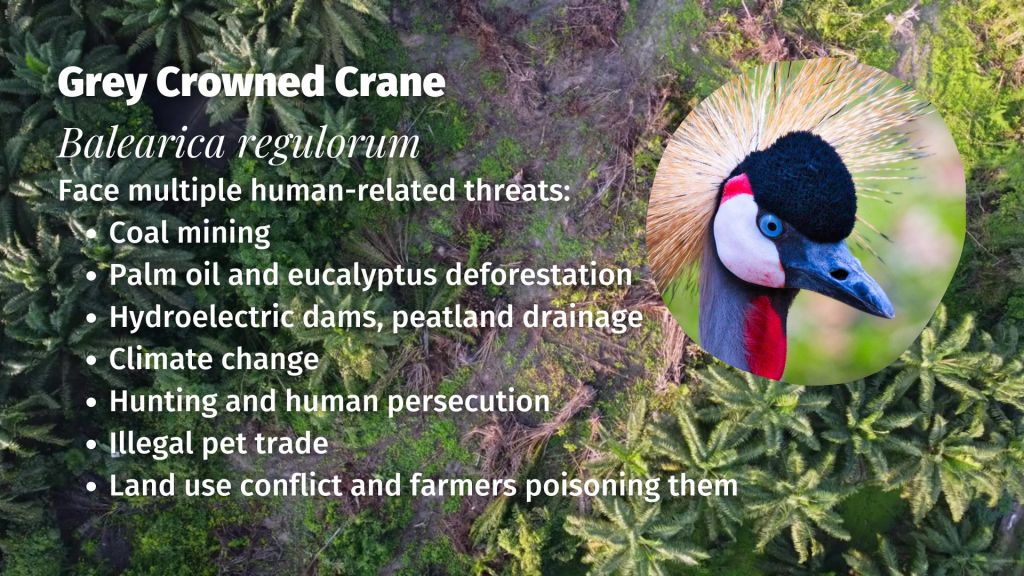
Wetlands are vital breeding and foraging grounds for Grey Crowned Cranes. These habitats are being drained or converted for agriculture, tree plantations (particularly Eucalyptus), and dam construction. Overgrazing by livestock and increased sedimentation from deforestation also contribute to their degradation, leaving cranes with fewer safe places to breed and raise their chicks.
• Industrial palm oil and agricultural expansion
Agricultural land-use change, including the expansion of palm oil and food crop cultivation, is rapidly encroaching on Grey Crowned Crane habitat. In places like Kenya and Uganda, this leads to the fragmentation of once-continuous wetland and savannah ecosystems. The conversion of native grasslands into farmland eliminates critical feeding and nesting areas, directly impacting crane survival.
• Illegal capture for trade and egg collection
Chicks and eggs are frequently stolen from nests to be sold into the illegal pet trade or to captive facilities. This is especially common in Uganda, Tanzania, and Rwanda, where birds are trafficked domestically and exported to informal zoos or exotic collectors, particularly in the Middle East and Asia. The removal of young birds from the wild not only reduces the population but causes immense suffering and family disruption among cranes.
• Poisoning and persecution by farmers
In some areas, cranes are seen as agricultural pests due to their foraging on newly planted crops such as maize. As a result, they are deliberately poisoned or killed in retaliation. Poisoning incidents are widespread and often indiscriminate, also affecting other wildlife and entire crane flocks, with devastating consequences for local populations.
• Electrocution and collisions with power lines
As human infrastructure expands, cranes are increasingly flying into overhead power lines or being electrocuted while roosting on utility poles. This is particularly prevalent in Uganda, South Africa, and Tanzania. These deaths are preventable, but without mitigation measures like line markers or insulation, the threat will likely increase as rural electrification spreads.
• Climate change and extreme weather events
Rising temperatures and changes in rainfall patterns due to climate change across southern Africa are expected to reshape crane habitat. Droughts reduce water levels in breeding wetlands, while extreme weather events like hail or flooding can destroy nests and kill chicks. Long-term climate shifts may also affect the availability of the crops and invertebrates cranes rely on for food.
• Disturbance from human activity and land use conflicts
As human populations grow, cranes are forced to live closer to agricultural areas and settlements. This increases the likelihood of disturbance during the breeding season, leading to nest abandonment and lower chick survival. Intense land-use pressures mean that even protected areas are often not safe havens, with noise, hunting, and encroachment disrupting the cranes’ life cycle.
• Coal mining, peat extraction, hydroelectric dams
In South Africa and Rwanda, coal mining and proposed peat extraction projects threaten to destroy large areas of wetland and grassland habitat. These industries alter hydrological regimes, pollute waterways, and destroy nesting grounds. The cumulative impact of such extractive industries could irreversibly damage the remaining strongholds of the species.
• Avian influenza and disease outbreaks
A highly virulent strain of avian influenza (H5N1) has already killed dozens of Grey Crowned Cranes in South Africa. With increased human-wildlife contact and climatic stress, the risk of future outbreaks is likely to grow. Disease outbreaks can wipe out entire flocks and undermine conservation gains in areas where populations have recently stabilised.
Geographic Range
The Grey Crowned Crane is found in Angola, Botswana, Burundi, the Democratic Republic of the Congo, Eswatini, Kenya, Lesotho, Malawi, Mozambique, Namibia, Rwanda, South Africa, South Sudan, Tanzania, Uganda, Zambia, and Zimbabwe. Though widespread, the species is highly localised in wetland-dependent habitats, and their historical range is shrinking rapidly due to land-use changes and human encroachment.
Diet
Omnivorous and opportunistic, Grey Crowned Cranes forage in wetlands, fields, and grasslands. Their diet includes seeds, grass tips, grain, insects, frogs, lizards, crabs, and even snakes. They cleverly stamp their feet to flush out hidden insects and often forage alongside grazing animals, seizing disturbed prey with swift precision.
Mating and Reproduction
Breeding is timed with rainfall – during dry seasons in East Africa and wet seasons in southern regions. Pairs construct large, floating nests in tall wetland vegetation. Clutches contain 2–5 eggs, incubated by both sexes for about 30 days. Chicks are precocial, running soon after hatching and fledging between 56–100 days. In rare communal events resembling ‘weddings’, flocks may witness two young cranes pairing off to begin a new life together.
FAQs
How many Grey Crowned Cranes are left in the wild?
As of 2024, the global population is estimated between 30,200 and 36,900 individuals, equivalent to about 20,100–24,600 mature birds. This marks a catastrophic decline from over 100,000 in 1985 (Morrison, 2015; Wamiti et al., 2023). While some countries like Uganda, Rwanda, and Zambia are seeing modest population increases due to reintroductions, overall trends remain concerning.
How long do Grey Crowned Cranes live?
In the wild, Grey Crowned Cranes can live up to 22–25 years, while in captivity, they may reach 30 years or more with proper care (Archibald et al., 2020).
Why are Grey Crowned Cranes endangered?
The main drivers are habitat loss due to agriculture, deforestation, and infrastructure development, alongside illegal wildlife trade, poisoning, and disturbance from human activity. Out-of-control palm oil plantations and eucalyptus monocultures have also devastated wetland habitats across their range (Morrison & Dodman, 2019).
Do Grey Crowned Cranes make good pets?
Absolutely not. Keeping Grey Crowned Cranes as pets is cruel and contributes to their extinction. Many chicks and eggs are taken illegally from the wild, leading to population collapse and breaking up family groups. If you care about these birds, never support the exotic pet trade.
Take Action!
Boycott palm oil and products contributing to deforestation. Advocate for the protection and restoration of African wetlands. Support indigenous-led conservation and agroecology efforts that protect native grasslands and wildlife. Report illegal wildlife trade and pressure governments to enforce protective laws. #BoycottPalmOil #Boycott4Wildlife
Support the Grey Crowned Crane by going vegan and boycotting palm oil in the supermarket, it’s the #Boycott4Wildlife
Support the conservation of this species
This animal has no protections in place. Read about other forgotten species here. Create art to support this forgotten animal or raise awareness about them by sharing this post and using the #Boycottpalmoil #Boycott4Wildlife hashtags on social media. Also you can boycott palm oil in the supermarket.
Further Information
Amulike, B. B., Griffin, C. R., & Fuller, T. K. (2023). Conservation-related knowledge, interactions, and attitudes of local people toward Grey Crowned-Cranes in Tanzania. Ecology and Society, 18(2). https://doi.org/10.5751/ACE-02467-180203
BirdLife International. 2024. Balearica regulorum. The IUCN Red List of Threatened Species 2024: e.T22692046A240198049. https://dx.doi.org/10.2305/IUCN.UK.2024-2.RLTS.T22692046A240198049.en. Accessed on 02 April 2025.
Wamiti, W., & Kimani, D. K. (2020). Kenya’s first countrywide census of Grey Crowned Crane Balearica regulorum, February–March 2019. Bulletin of the African Bird Club, 27(2), 210–218. https://www.researchgate.net/publication/344680836_Kenya’s_first_countrywide_census_of_Grey_Crowned_Crane_Balearica_regulorum_February-March_2019
Wamiti, S. W. (2022). Factors Affecting Population, Nesting Habits, and Conservation of Grey Crowned Crane in Lake Ol’ Bolossat Basin, Kenya. University of Nairobi. Retrieved from https://erepository.uonbi.ac.ke/handle/11295/163228


How can I help the #Boycott4Wildlife?
Take Action in Five Ways
1. Join the #Boycott4Wildlife on social media and subscribe to stay in the loop: Share posts from this website to your own network on Twitter, Mastadon, Instagram, Facebook and Youtube using the hashtags #Boycottpalmoil #Boycott4Wildlife.
2. Contribute stories: Academics, conservationists, scientists, indigenous rights advocates and animal rights advocates working to expose the corruption of the palm oil industry or to save animals can contribute stories to the website.





3. Supermarket sleuthing: Next time you’re in the supermarket, take photos of products containing palm oil. Share these to social media along with the hashtags to call out the greenwashing and ecocide of the brands who use palm oil. You can also take photos of palm oil free products and congratulate brands when they go palm oil free.
4. Take to the streets: Get in touch with Palm Oil Detectives to find out more.
5. Donate: Make a one-off or monthly donation to Palm Oil Detectives as a way of saying thank you and to help pay for ongoing running costs of the website and social media campaigns. Donate here
Learn about other animals endangered by palm oil and other agriculture
Learn about “sustainable” palm oil greenwashing
Read more about RSPO greenwashing
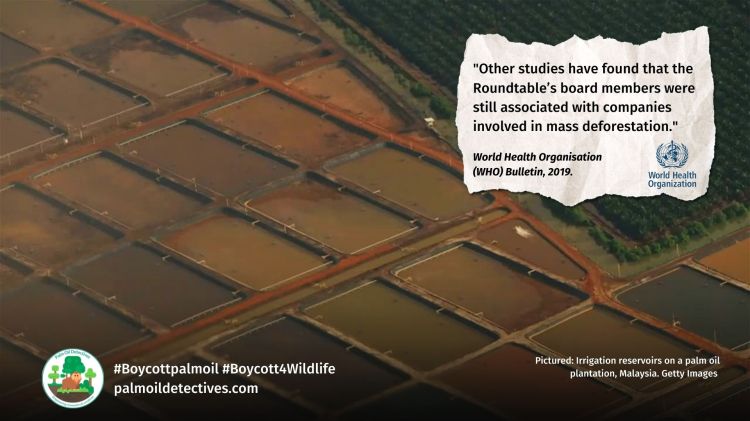
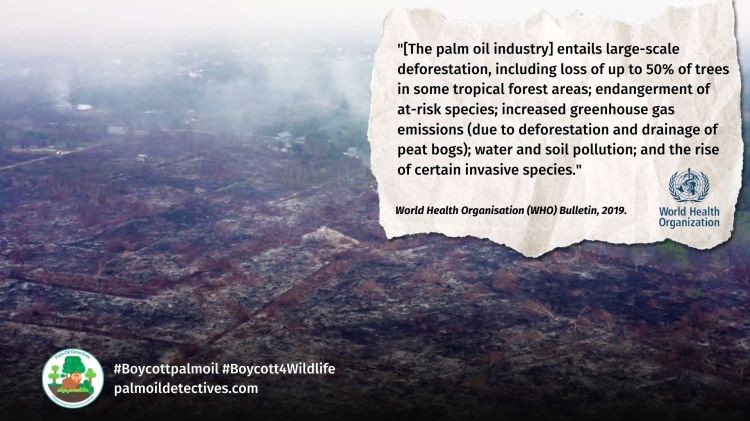
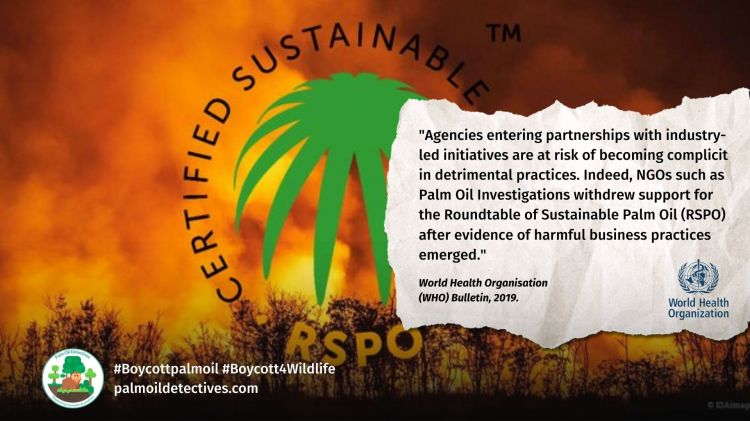
A 2019 World Health Organisation (WHO) report into the palm oil industry and RSPO finds extensive greenwashing of palm oil deforestation and the murder of endangered animals (i.e. biodiversity loss)


Discover more from Palm Oil Detectives
Subscribe to get the latest posts sent to your email.
 Palm Oil Detectives