
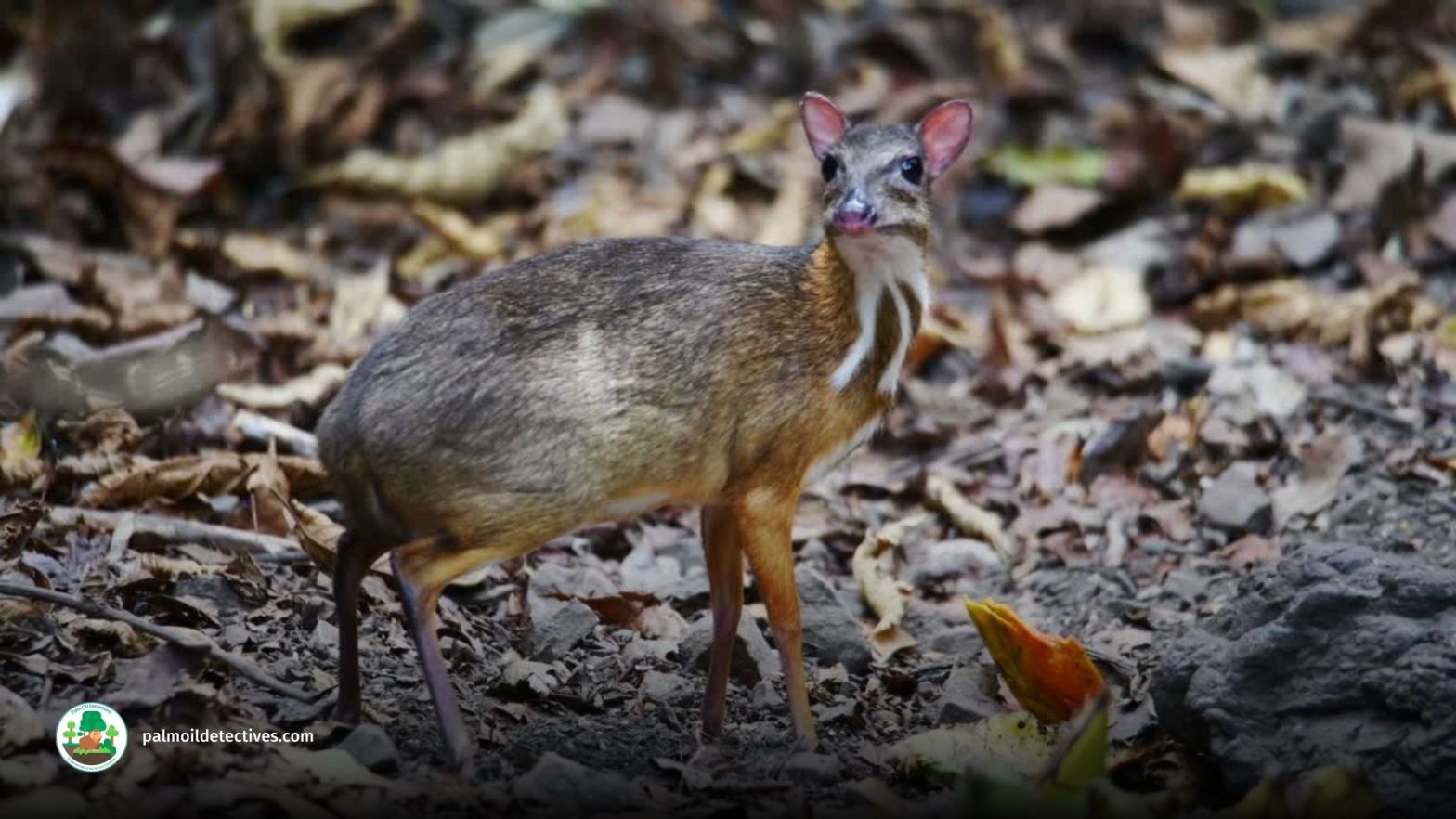
Balabac Mouse Deer Tragulus nigricans
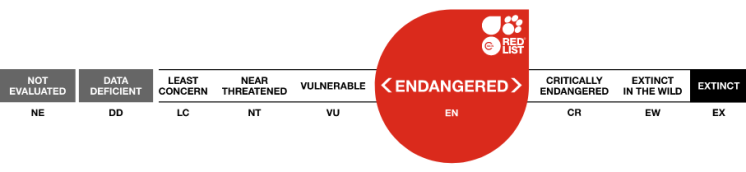
Endangered
Extant (resident) Philippines; Presence Uncertain: Malaysia
The Balabac Mouse-deer, also known as the Philippine Mouse-deer or locally as Pilandok, is a tiny, fragile deer most active at night. They are ruminants endemic to the Balabac Islands in the Philippines. Despite their diminutive size, the deers play a significant role in their ecosystem, aiding in seed dispersal and maintaining forest undergrowth. Unfortunately, habitat loss and hunting have led to a decline in their populations. To protect the Balabac Mouse-deer you can take action every time you shop! Use your wallet as a weapon to fight for their survival and #BoycottPalmOil #Boycott4Wildlife
The Balabac Mouse Deer is a timid and tiny deer 🦌 one of the smallest in the 🌍. They are endangered and may be extinct in #Malaysia 🇲🇾 due to #palmoil #deforestation, the pet trade and #poaching. Support them! #Boycottpalmoil 🌴🙊🔥⛔️ #Boycott4Wildlife https://palmoildetectives.com/2021/01/25/balabac-mouse-deer-tragulus-nigricans/
The species is also affected by habitat loss due to conversion of former habitat to coconut plantations and other agriculture.
IUCN Red List
Appearance and Behaviour
Balabac Mouse-deer are among the world’s smallest hoofed mammals, standing about 40 cm tall at the shoulder and weighing approximately 2.5 kg. They have a sleek, dark brown coat with white markings on the throat and chest, and slender legs adapted for swift movement through dense underbrush. Primarily nocturnal, they are shy and elusive, relying on their keen senses to avoid predators. Their diet consists mainly of fruits, leaves, and other plant materials, making them important seed dispersers in their habitat.
Geographic Range
Endemic to the Philippines, the Balabac Mouse-deer is found primarily on Balabac Island and nearby smaller islands such as Bugsuk and Ramos, located southwest of Palawan. Their preferred habitats are lowland forests and mangrove areas, where they can find ample cover and food resources.
Diet
As herbivores, Balabac Mouse-deer feed on a variety of plant materials, including fruits, leaves, flowers, and buds. Their foraging habits contribute to seed dispersal, aiding in forest regeneration and maintaining ecological balance within their environment.
Reproduction and Mating
Information on the reproductive behaviour of Balabac Mouse-deer is limited. However, like other species in the Tragulus genus, they are believed to have a polygynous mating system, with breeding occurring year-round. Females typically give birth to a single offspring after a gestation period of approximately 140–177 days. The young are precocial, meaning they are relatively mature and mobile shortly after birth, which is advantageous for avoiding predators.
Threats
The Balabac Mouse-deer is listed as Endangered on the IUCN Red List, with populations continuing to decline due to ongoing threats. Conservation efforts include habitat protection, anti-poaching measures, and environmental education to raise awareness about the species’ plight. Recent studies have highlighted the need for more comprehensive data on their distribution and population status to inform effective conservation strategies.
IUCN Status: Endangered
- Palm oil and timber deforestation: Deforestation due to logging, palm oil agricultural expansion, and development has led to significant reductions in their natural habitat.
- Hunting and the illegal wildlife trade: Despite legal protections, hunting for local consumption and the illegal wildlife trade continues to threaten their populations.
- Limited Range: Being confined to a small geographic area makes them particularly vulnerable to environmental changes and human activities.
Take Action!
Protect the Balabac Mouse-deer by boycotting products linked to deforestation, such as palm oil. Use your wallet as a weapon to support ethical and eco-friendly choices. Share their story and fight for their survival with #BoycottPalmOil and #Boycott4Wildlife.
Further Information
CSIRO Publishing. (2021). Geographic distribution, population and conservation status of Tragulus nigricans. Retrieved from CSIRO Publishing
Supsup, C. E., Asis, A. A., Carestia Jr., U. V., Puna, N. M., & Avanceña, J. B. (2021). Geographic distribution, population and conservation status of Tragulus nigricans, an endangered mouse deer endemic to western Philippines. Pacific Conservation Biology. Retrieved from ResearchGate
Widmann, P. 2015. Tragulus nigricans. The IUCN Red List of Threatened Species 2015: e.T22065A61977991. https://dx.doi.org/10.2305/IUCN.UK.2015-2.RLTS.T22065A61977991.en. Downloaded on 25 January 2021.
Wikipedia contributors. (n.d.). Philippine Mouse-deer. Retrieved from Wikipedia


How can I help the #Boycott4Wildlife?
Take Action in Five Ways
1. Join the #Boycott4Wildlife on social media and subscribe to stay in the loop: Share posts from this website to your own network on Twitter, Mastadon, Instagram, Facebook and Youtube using the hashtags #Boycottpalmoil #Boycott4Wildlife.
2. Contribute stories: Academics, conservationists, scientists, indigenous rights advocates and animal rights advocates working to expose the corruption of the palm oil industry or to save animals can contribute stories to the website.






3. Supermarket sleuthing: Next time you’re in the supermarket, take photos of products containing palm oil. Share these to social media along with the hashtags to call out the greenwashing and ecocide of the brands who use palm oil. You can also take photos of palm oil free products and congratulate brands when they go palm oil free.
4. Take to the streets: Get in touch with Palm Oil Detectives to find out more.
5. Donate: Make a one-off or monthly donation to Palm Oil Detectives as a way of saying thank you and to help pay for ongoing running costs of the website and social media campaigns. Donate here
Discover more from Palm Oil Detectives
Subscribe to get the latest posts sent to your email.
 Palm Oil Detectives
You failed to mention that a large amount of palm oil goes to “biodiesel” so that governments and oil companies can claim to be reducing carbon emissions.
LikeLiked by 1 person
It’s true Hugh and it’s a massive issue for sure. It would be great to investigate into this and give consumers the option to boycott biodiesel, I have not had time to work out where this biodiesel goes and to offer consumers ways to practically boycott brands using this palm oil biodiesel yet, but I would definitely welcome other people’s ideas on how to do that or what companies that people can boycott. Thank you for your comment 🙂
LikeLike