
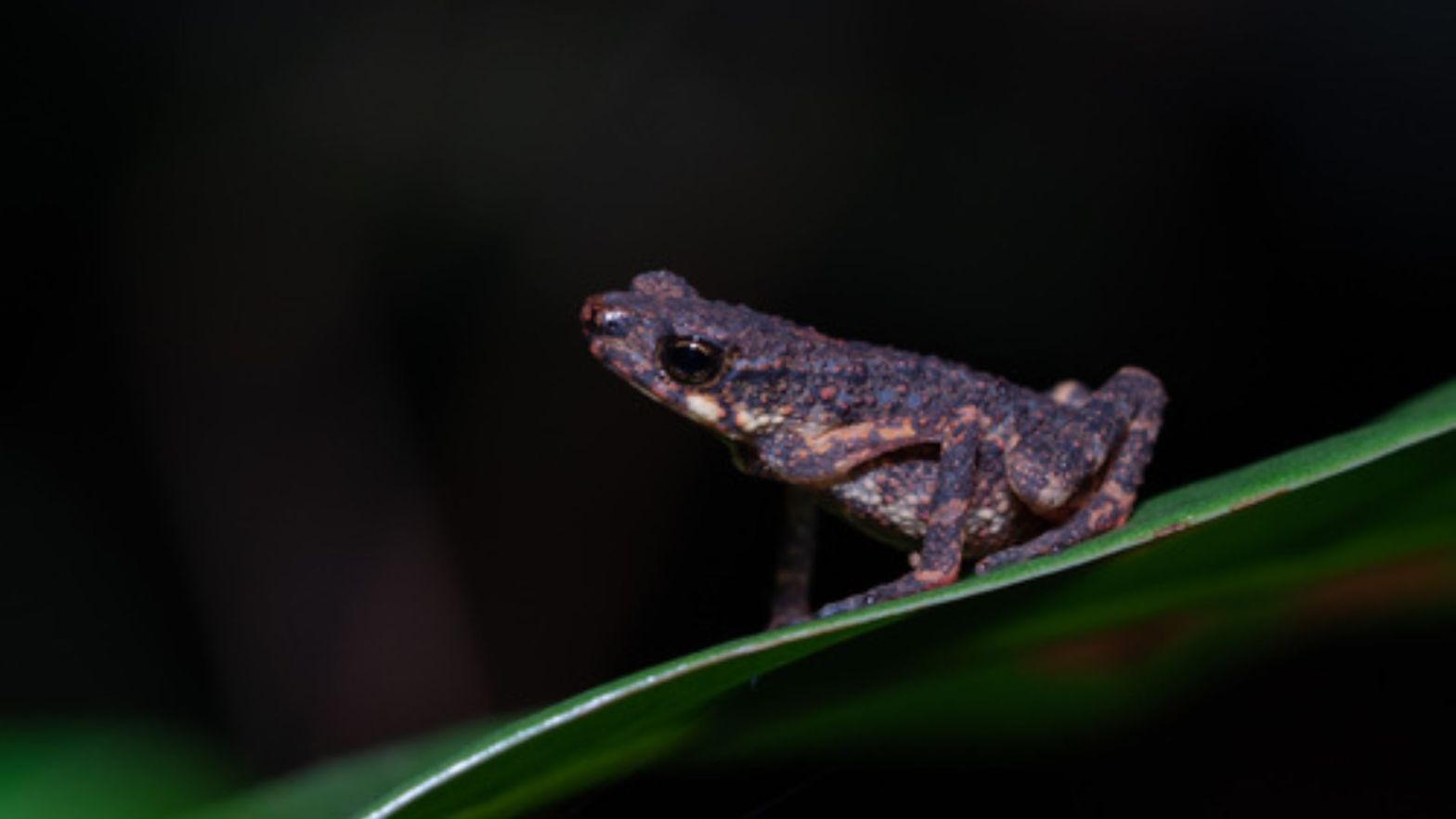
Murud Black Slender Toad Ansonia vidua
Murud Black Slender Toad Ansonia vidua
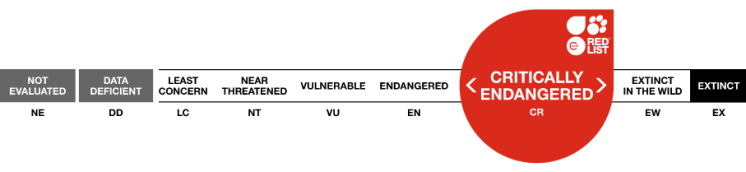
IUCN Red List Status: Critically Endangered
Location: The Murud Black Slender Toad is endemic to the montane forests of Mount Murud in Sarawak, Malaysian Borneo. Their range is restricted to this high-altitude area, where they depend on pristine forests and fast-flowing streams for survival.
The Murud Black Slender Toad is an enigmatic amphibian, perfectly camouflaged among the rocks and vegetation of Borneo’s high-altitude forests. Known only from the remote Mount Murud region, their sleek black body and delicate frame make them one of the most unique species of their kind. These toads are specialists, thriving near fast-flowing streams where they feed and reproduce.
Despite their ecological significance, they face mounting pressures from habitat destruction. Logging, agricultural expansion for palm oil, and rising temperatures are pushing them closer to extinction. Fight to save them by boycotting palm oil and supporting indigenous-led conservation. #BoycottPalmOil #Boycott4Wildlife.
Murud Black Slender #Toads 🐸💚🫶 have nowhere to hide. Critically #endangered by #palmoil #ecocide in #Sarawak Malaysian #Borneo 🇲🇾they are cornered by lifeless monoculture. Fight back for them! #BoycottPalmOil 🌴🪔☠️⛔️ #Boycott4Wildlife @palmoildetect https://palmoildetectives.com/2021/01/25/murud-black-slender-toad-ansonia-vidua/
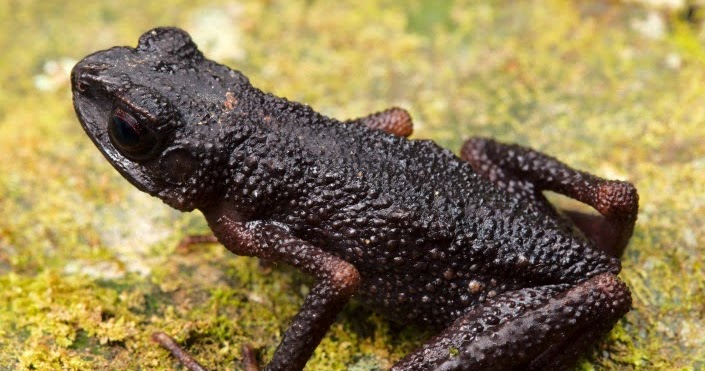
Appearance and Behaviour
The Murud Black Slender Toad is a small, streamlined amphibian with jet-black skin that blends seamlessly into the shadowy forest floor. Their slender limbs and long toes allow them to move with agility across rocks and vegetation, especially near their fast-flowing stream habitats. Large, rounded eyes add an expressive quality to their otherwise understated appearance.
These shy, nocturnal toads are most active during the rainy season, when breeding peaks and males can be heard emitting soft, melodic calls to attract mates. By day, they hide under rocks and leaf litter, evading predators and remaining hidden from view.
Threats
The Murud Black Slender Toad is a rare and striking amphibian, uniquely adapted to the cool, humid environment of Mount Murud. However, their existence is under constant threat from habitat destruction caused by out-of-control palm oil plantations, logging, and climate change. Protecting their fragile ecosystem is critical to their survival.
The Murud Black Slender Toad lives in a single threat-defined location, and there is a continuing decline in the extent and quality of their habitat in the vicinity of Gunung Murud due to logging activities for oil palm.
IUCN Red list
- Palm Oil and Timber Deforestation: Rampant logging and the expansion of out-of-control palm oil plantations are destroying the montane forests of Mount Murud. These activities fragment and degrade their habitat, leaving them fewer safe spaces to live and breed.
- Climate Change: As temperatures rise and rainfall patterns shift, the delicate ecosystem of Mount Murud is becoming less hospitable. High-altitude species like the Murud Black Slender Toad have no higher elevations to retreat to, making them especially vulnerable.
- Restricted Range: With their tiny range confined to Mount Murud, any disturbance to their habitat has a disproportionately severe impact. They are highly susceptible to events like droughts, landslides, or disease outbreaks.
Diet
The Murud Black Slender Toad feeds on small invertebrates, such as insects and arthropods. By consuming these forest-floor creatures, they play a crucial role in controlling insect populations and maintaining the ecological balance of their environment.
Reproduction and Mating
Reproduction is closely tied to the fast-flowing streams of Mount Murud. Females lay eggs in submerged vegetation or rocks, where the eggs develop into aquatic larvae (tadpoles) that thrive in oxygen-rich waters. During the rainy season, males produce calls to attract mates. Their reliance on clean, undisturbed water makes them particularly vulnerable to habitat degradation.
Geographic Range
The Murud Black Slender Toad is found exclusively on Mount Murud, the highest peak in Sarawak, Malaysian Borneo. They inhabit montane forests and rely on the network of fast-flowing streams within this pristine ecosystem. This tiny, isolated range makes them one of the most endangered amphibians in the region.
The Murud Black Slender Toad is known from undisturbed montane mossy forest on leaves of plants a few metres away from a small stream (Hertwig et al. 2014). Listed as Critically Endangered, as a precautionary approach, because even though they may occur slightly more widely, their current estimated extent of occurrence (EOO) is 10 km2.
FAQ
What is the Murud Black Slender Toad?
The Murud Black Slender Toad (Ansonia vidua) is a critically endangered amphibian found only in the montane forests of Mount Murud in Sarawak, Malaysian Borneo. Their slender, jet-black bodies and dependence on fast-flowing streams make them uniquely adapted to this high-altitude rainforest environment.
Why is the Murud Black Slender Toad endangered?
This species is critically endangered due to deforestation caused by logging, agricultural expansion for palm oil, and climate change. Their restricted range on Mount Murud further exacerbates their vulnerability to habitat loss and environmental changes.
Why are they called slender toads?
Slender toads are named for their streamlined bodies and long, delicate limbs, which are perfectly suited for navigating rocky, fast-flowing streams. These physical adaptations allow them to move efficiently in their challenging montane habitat.
What do Murud Black Slender Toads eat?
They primarily feed on small invertebrates such as insects and arthropods, which they hunt on the forest floor. Their diet helps maintain the ecological balance of their montane ecosystem.
Take Action!
The Murud Black Slender Toad is on the brink of extinction. Protect this unique species by boycotting palm oil products, supporting indigenous-led conservation initiatives, and advocating for stronger protections for Borneo’s forests. Every choice you make can help preserve their fragile montane habitat. #BoycottPalmOil #Boycott4Wildlife
Further Information
AmphibiaWeb. (n.d.). Ansonia vidua. Retrieved from https://amphibiaweb.org/species/8194
Fehlandt, L. (2023, March 24). Murud Black Slender Toad. Retrieved from https://www.lars-fehlandt.de/2023/03/24/murud-black-slender-toad-ansonia-vidua/
IUCN SSC Amphibian Specialist Group. 2020. Ansonia vidua (amended version of 2018 assessment). The IUCN Red List of Threatened Species 2020: e.T78901981A176033895. https://dx.doi.org/10.2305/IUCN.UK.2020-3.RLTS.T78901981A176033895.en. Downloaded on 24 January 2021.
Species on the Brink. (n.d.). Murud Black Slender Toad. Retrieved from https://www.speciesonthebrink.org/species-blog/https/murud-black-slender-toad
Xeno-Canto. (n.d.). Ansonia vidua. Retrieved from https://xeno-canto.org/admin.php/species/Ansonia-vidua

How can I help the #Boycott4Wildlife?
Take Action in Five Ways
1. Join the #Boycott4Wildlife on social media and subscribe to stay in the loop: Share posts from this website to your own network on Twitter, Mastadon, Instagram, Facebook and Youtube using the hashtags #Boycottpalmoil #Boycott4Wildlife.
2. Contribute stories: Academics, conservationists, scientists, indigenous rights advocates and animal rights advocates working to expose the corruption of the palm oil industry or to save animals can contribute stories to the website.



3. Supermarket sleuthing: Next time you’re in the supermarket, take photos of products containing palm oil. Share these to social media along with the hashtags to call out the greenwashing and ecocide of the brands who use palm oil. You can also take photos of palm oil free products and congratulate brands when they go palm oil free.
4. Take to the streets: Get in touch with Palm Oil Detectives to find out more.
5. Donate: Make a one-off or monthly donation to Palm Oil Detectives as a way of saying thank you and to help pay for ongoing running costs of the website and social media campaigns. Donate here
Discover more from Palm Oil Detectives
Subscribe to get the latest posts sent to your email.
 Palm Oil Detectives