
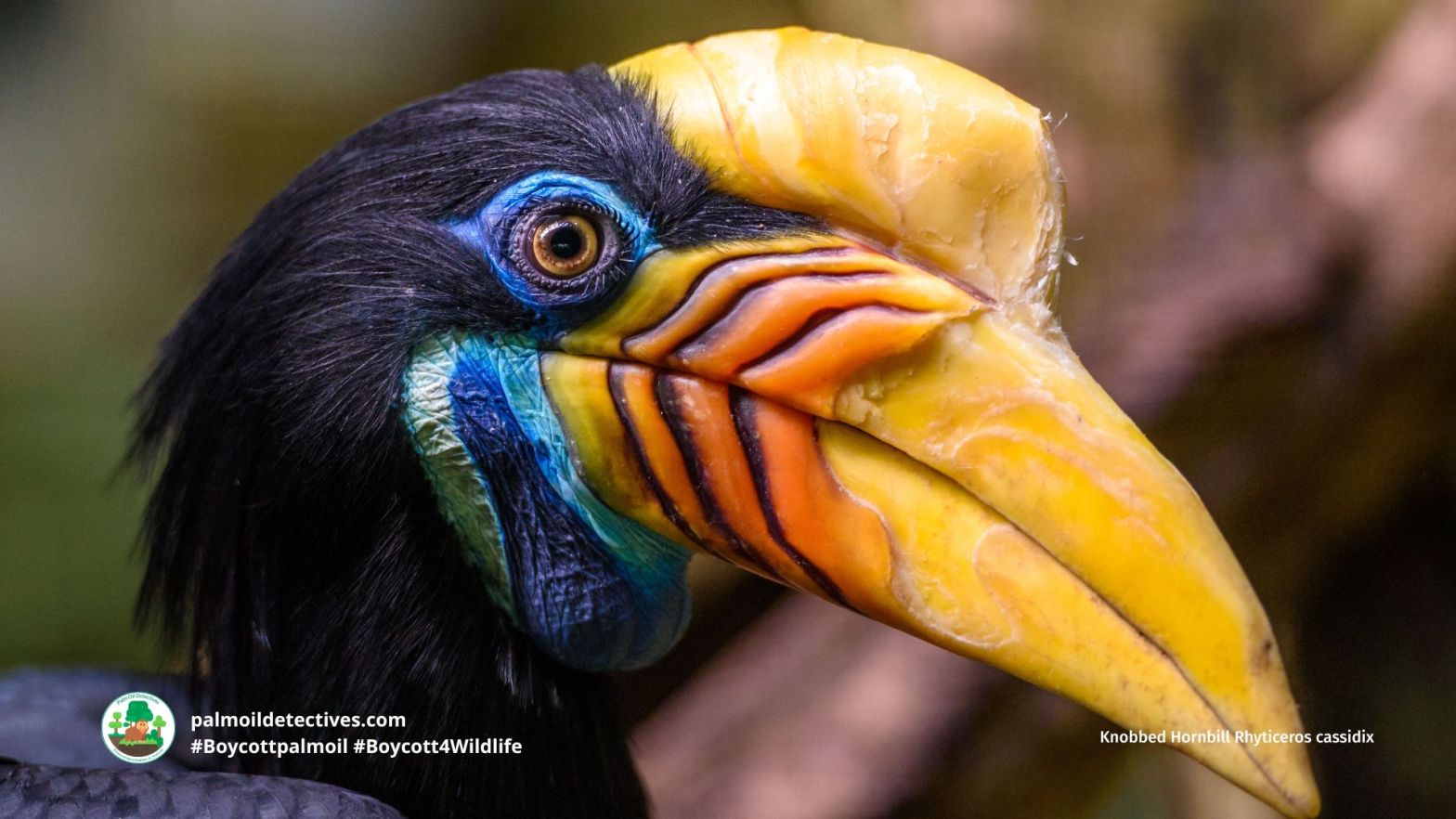
Knobbed Hornbill Rhyticeros cassidix
IUCN Red List Status: Vulnerable
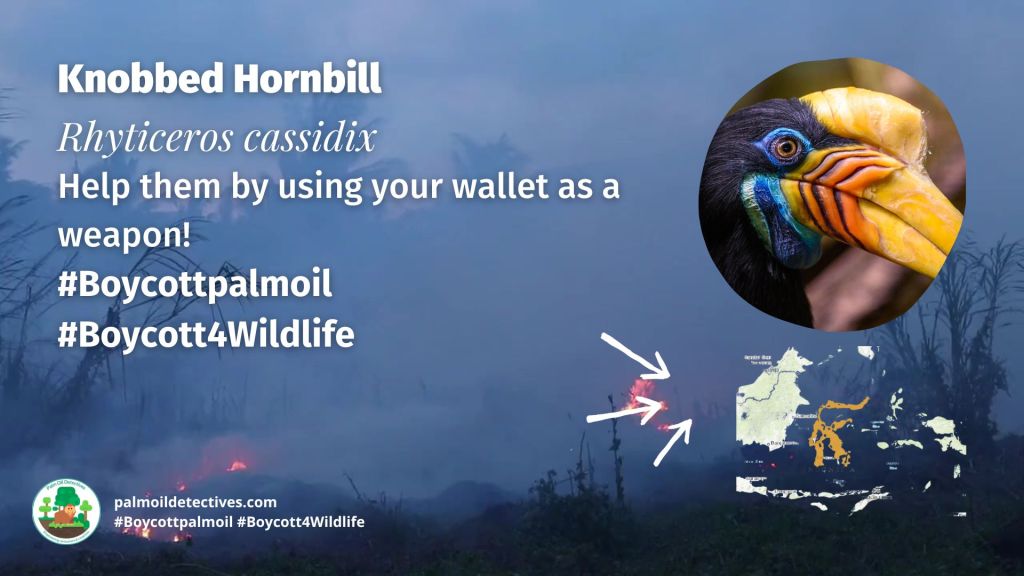
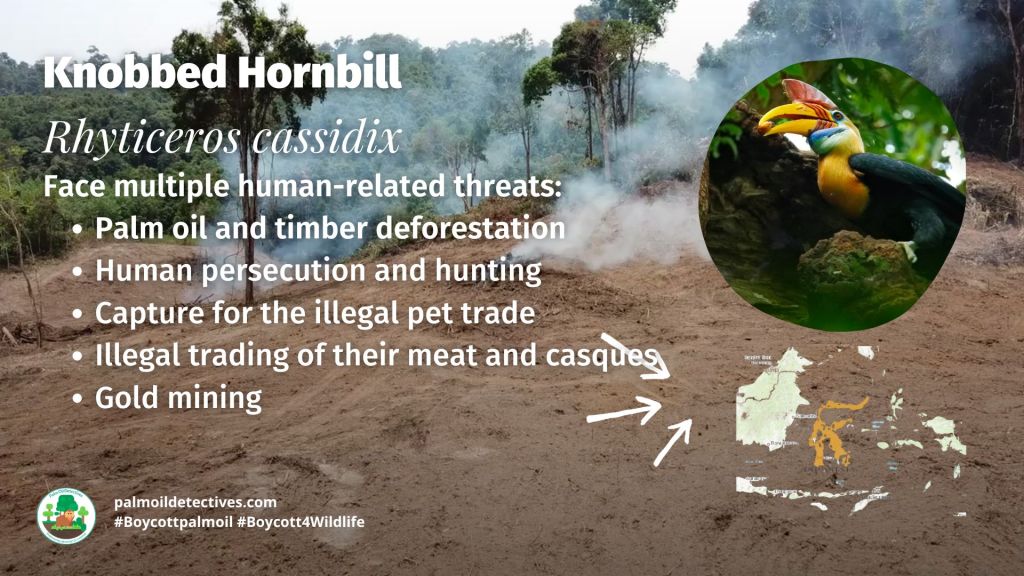
Location: Indonesia (Sulawesi, Lembeh, Togian Islands, Muna, Butung) This vibrant, charismatic species is found only on the island of Sulawesi and its offshore islands in Indonesia. It inhabits lowland and montane rainforest ecosystems up to 1,800 metres above sea level, especially thriving in evergreen and tall primary forests.
Introduction
The Knobbed #Hornbills Rhyticeros cassidix announce themselves in gorgeous swirls of colourful feathers and beaks. They are currently listed as Vulnerable on the IUCN Red List in #Sulawesi #Indonesia due to rapidly accelerating #palmoil and #timber #deforestation, #hunting, and habitat degradation across Sulawesi. Despite being relatively common in some areas, this iconic #hornbill is suffering from extensive loss of lowland forest, fires, gold #mining concessions, and encroachment from palm oil plantations. As a seed-dispersing frugivore with unique breeding requirements, their survival is intrinsically linked to the preservation of large, undisturbed forest tracts. Their dramatic decline underscores the urgent need to halt industrial land use in Sulawesi’s remaining rainforest. Use your power as a consumer to #BoycottPalmOil #Boycott4Wildlife every time you shop.
Knobbed Hornbills 🦜🌈 are stunning rainbow coloured #birds endemic to #Sulawesi #Indonesia. They are #vulnerable from #palmoil #deforestation and #hunting. Help them survive when you shop #BoycottPalmOil 🌴🪔🩸☠️🧐🚫#Boycott4Wildlife https://palmoildetectives.com/2021/10/30/knobbed-hornbill-rhyticeros-cassidix/
Knobbed #Hornbills 🦜🌈 need tree hollows to nest These intelligent #birds living in #Sulawesi #Indonesia are #vulnerable from #palmoil #ecocide and #poaching. Fight for them when you shop #BoycottPalmOil 🌴🪔🩸☠️🧐🚫#Boycott4Wildlife https://palmoildetectives.com/2021/10/30/knobbed-hornbill-rhyticeros-cassidix/
Appearance and Behaviour
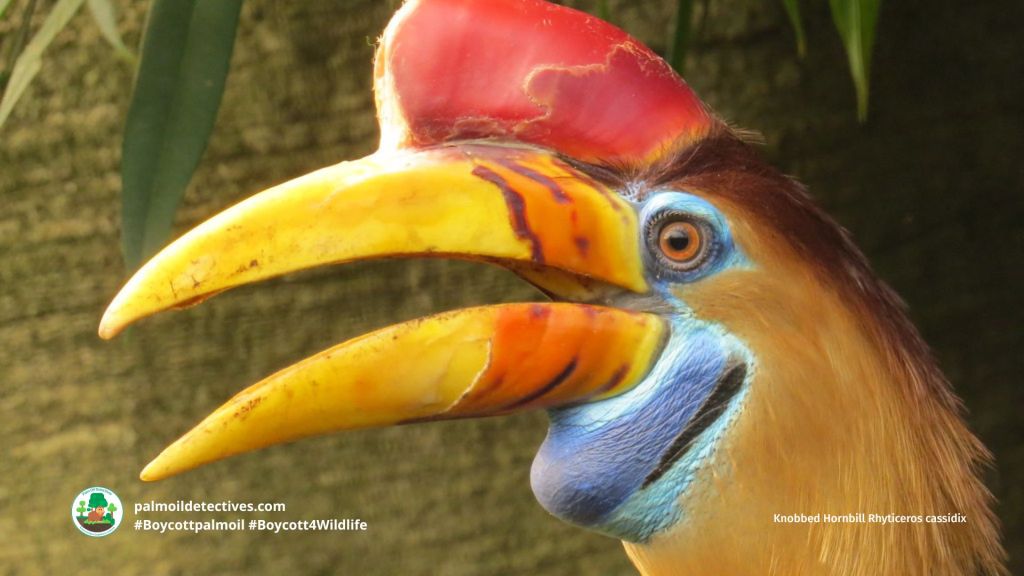
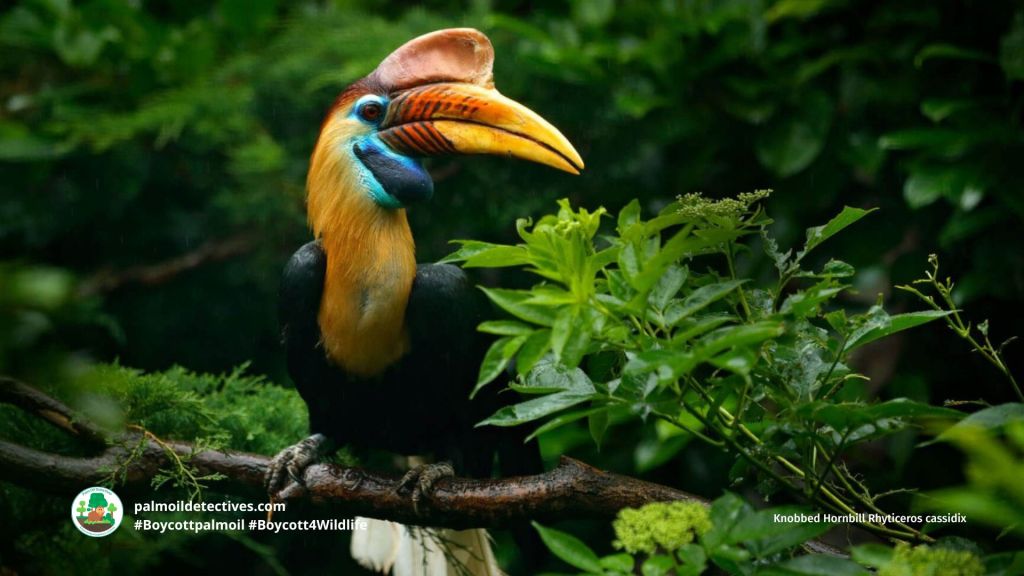
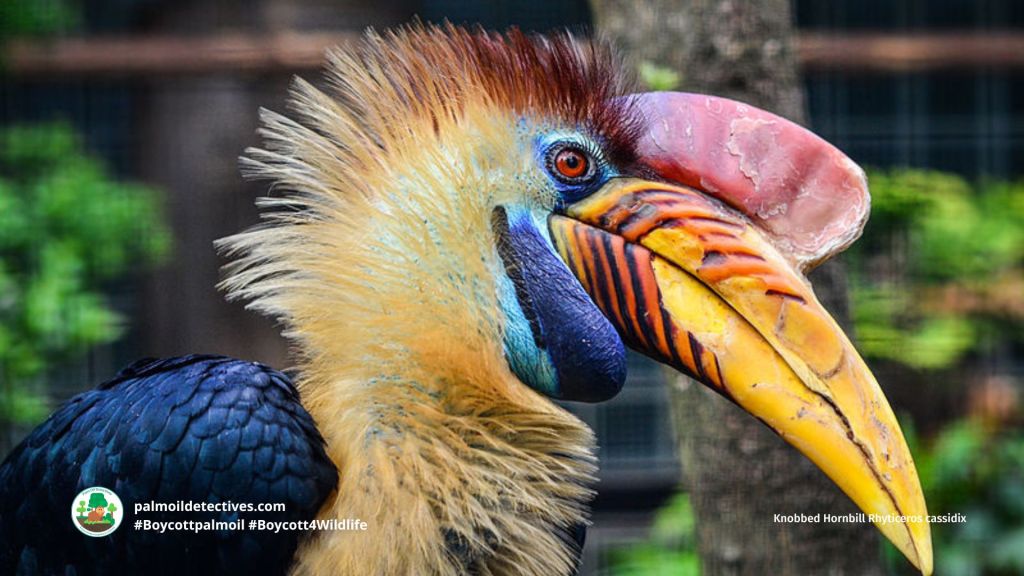
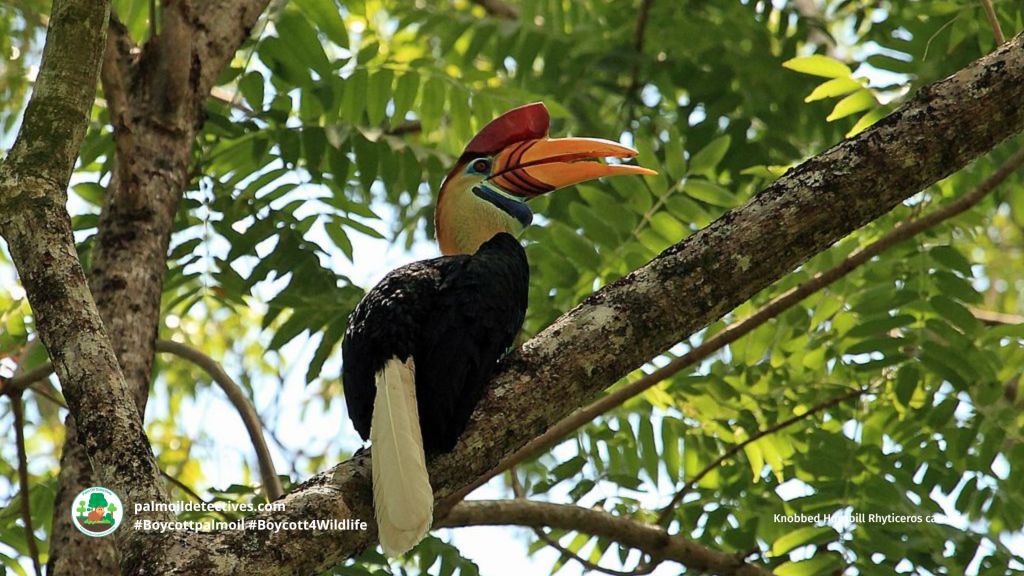
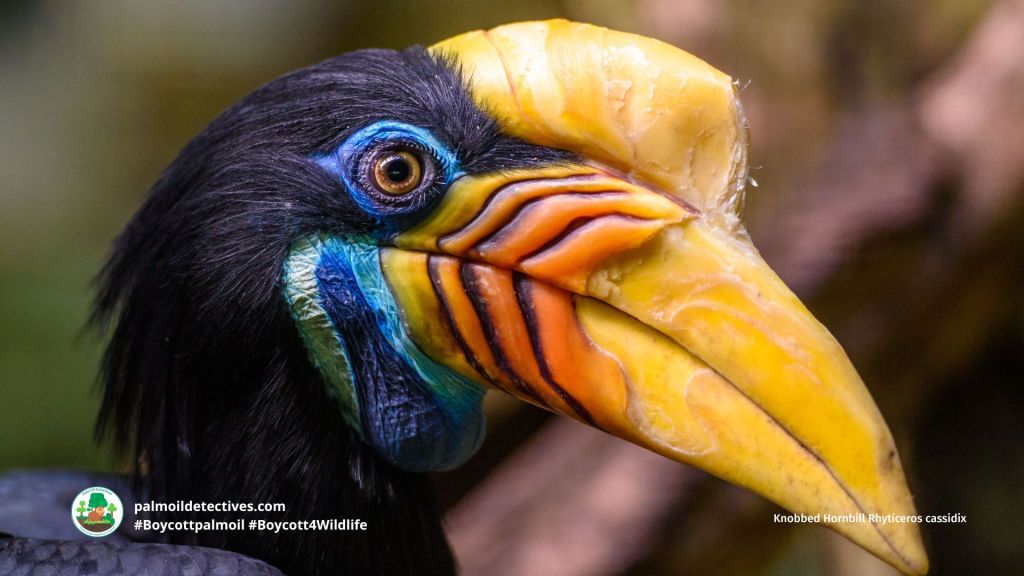
Strikingly adorned with a large casque and vivid red-orange bill, the Knobbed Hornbill is unmistakable. Males have a prominent casque or ‘knob’ atop their bill and an unfeathered blue throat, while females sport an all-black plumage with a pale blue throat and lack the enlarged casque. Their broad wings and swooping flight pattern make them a spectacular sight to behold against the dense forest canopy.
These hornbills are highly vocal, using deep guttural calls to communicate across the forest. Pairs form long-term monogamous bonds and are typically seen together or in small family groups. Knobbed Hornbills are known for their territoriality and their habit of chasing off other birds and primates at fruiting trees, underlining their dominance within the rainforest canopy. Their daily routine includes long flights to feeding sites, often crossing fragmented landscapes to reach fruiting trees.

Diet
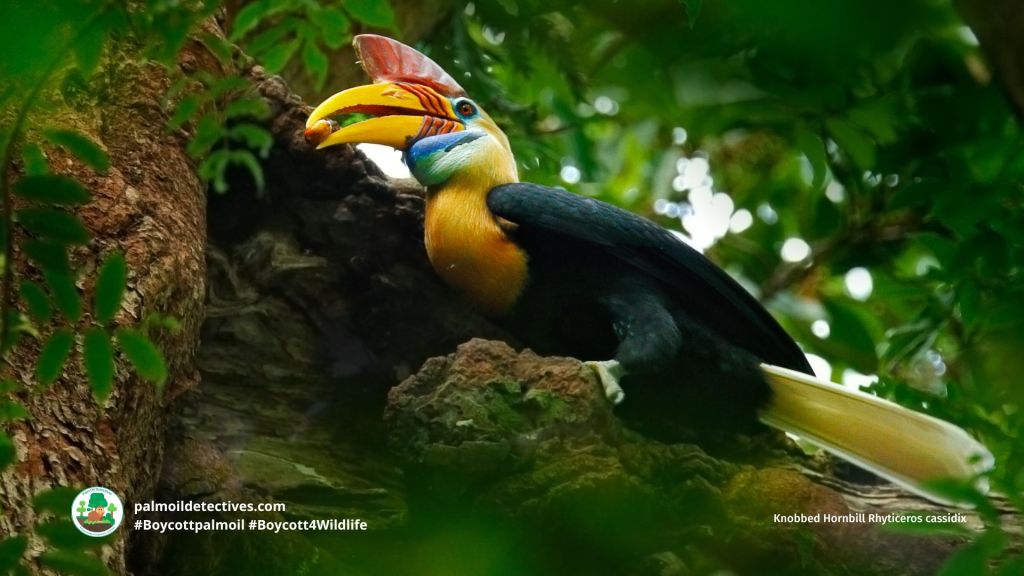
Primarily frugivorous, Knobbed Hornbills play a vital role in seed dispersal across Sulawesi’s ecosystems. They are particularly reliant on fig trees (Ficus spp.), which are a keystone food source for many tropical species. In addition to figs, they consume a wide variety of fruits, and are known to supplement their diet with insects, small reptiles, bird eggs, and even nestlings. Their foraging involves both perching and in-flight plucking of fruit, often from the upper canopy.
Their dependence on large-fruiting trees ties them ecologically to primary rainforest, making them especially vulnerable to habitat disturbance and deforestation. The decline of fig populations through forest clearing and degradation directly threatens their long-term food security.
Reproduction and Mating
Knobbed Hornbills nest in natural tree cavities high in the forest canopy, typically between 13 and 53 metres above ground level. Breeding depends on the availability of very large, old-growth trees—many of which are targeted for logging. The female seals herself inside the nest cavity with mud and regurgitated food, leaving only a small slit through which the male passes food during the entire incubation and chick-rearing period.
This remarkable nesting behaviour, while effective in predator avoidance, renders the female and chick completely reliant on the male’s continued presence and food provisioning. Any disturbance or death of the male during this time is likely to result in nest failure. Following hatching, the female remains sealed for several more weeks before emerging with the young chick.
Geographic Range
This species is endemic to Sulawesi and nearby islands including Lembeh, Togian, Muna and Butung in Indonesia. Historically widespread across Sulawesi’s forests, the Knobbed Hornbill is now increasingly confined to fragmented tracts of habitat due to extensive logging and agricultural conversion.
Although still described as locally common in less-disturbed areas, population declines of these hornbills have been recorded across its entire range. Many protected areas are poorly enforced, and forests in lowland Sulawesi have experienced staggering losses. Between 1985 and 1997, 89% of lowland forests were lost, and forest loss has only accelerated since then (FWI/GFW, 2002; Holmes, 2002).
Threats
Recent analysis has suggested that the Knobbed Hornbill may be declining at a rate approaching 40% over three generations based on recent and ongoing rates of habitat loss on Sulawesi (D. Holmes in litt. 1999, Kinnaird and O’Brien 2007).
IUCN red list
Palm Oil Deforestation
Sulawesi’s forests have been devastated by large-scale agricultural expansion, especially for oil palm and rice fields. Between 1997–2001 alone, forest loss accelerated to 36.1% per decade, wiping out vital hornbill habitat (Kinnaird & O’Brien, 2007). The hornbill’s strong dependency on large trees for nesting makes them acutely vulnerable to such losses.
Commercial Logging and Mining
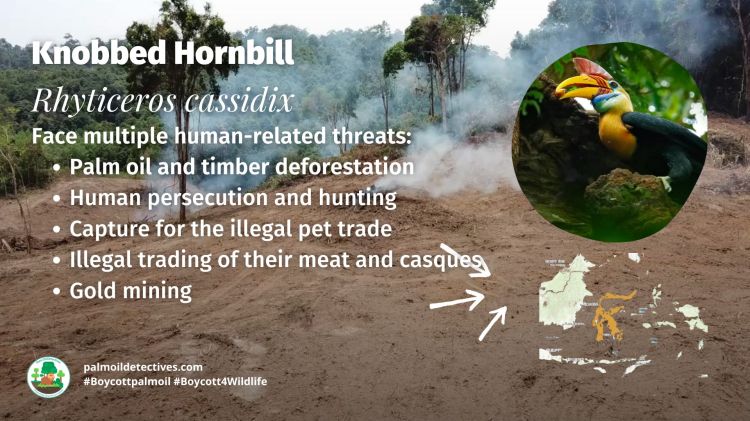
Logging, both legal and illegal, has fragmented their habitat, making nesting success increasingly difficult. Additionally, gold mining operations in regions like Buton have destroyed critical tracts of primary forest, adding chemical and noise pollution to the ecosystem (Hamzah et al., 2023).
Fire and Climate Impacts
Severe fires, such as those in 1997, have reduced breeding success in subsequent years by decimating fig-bearing trees and altering microclimates within the forest (del Hoyo et al., 2001). Increasing climate instability will likely worsen fire frequency and intensity in coming decades.
Illegal Hunting for Bushmeat and their Casques
Hornbills are hunted for bushmeat and their casques are sometimes sold as ornaments. Although technically protected, enforcement is weak and hunting continues even within protected forests, especially near roads and settlements (Winarni & Jones, 2011).
Take Action!
Protecting the Knobbed Hornbill means safeguarding Sulawesi’s last remaining primary forests. You can help:
- Boycott palm oil and use your wallet as a weapon every time you shop.
- Support indigenous-led conservation on Sulawesi that focuses on protecting forest corridors and nesting trees.
- Pressure governments and companies to halt destructive mining and logging activities in Sulawesi.
- Make sure you don’t purchase goods made from hornbill and campaign against the deeply cruel illegal wildlife trade.
- Advocate for hornbill-safe agroecology and forest-friendly livelihoods in Indonesia.
FAQs
How many Knobbed Hornbills are left in the wild?
While no definitive census exists, the population is believed to be rapidly declining across Sulawesi, with many formerly common areas now devoid of breeding pairs. Fragmentation has isolated populations and reduced breeding success due to lack of nesting trees (Winarni & Jones, 2011).
How long do Knobbed Hornbills live?
In the wild, hornbills can live up to 30 years, with some individuals in captivity recorded beyond that. However, successful reproduction in the wild depends on stable territory, availability of fig trees, and access to nesting sites—conditions that are increasingly rare in Sulawesi’s degraded forests (Kinnaird & O’Brien, 2005).
Why are hornbills important to the rainforest?
Knobbed Hornbills are critical seed dispersers. Their diet of large fruits like figs means they spread the seeds of keystone species far and wide. Without hornbills, seed dispersal and rainforest regeneration slows, threatening the entire ecosystem (Kitamura et al., 2011).
What role does palm oil play in their decline?
Palm oil plantations are one of the biggest drivers of forest loss in Sulawesi. These monocultures replace biodiverse ecosystems with sterile landscapes, eliminating food sources, nesting trees, and pushing hornbills toward extinction. Avoiding palm oil is essential to saving this species.
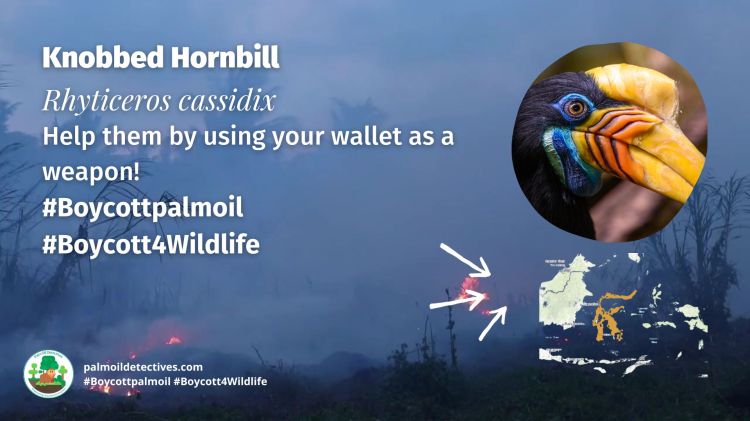
You can support this beautiful animal
There are no known conservation activities for this animal. Share out this post to social media and join the #BoycottPalmOil #Boycott4Wildlife on social media to raise awareness
Further Information

BirdLife International. 2017. Rhyticeros cassidix (amended version of 2016 assessment). The IUCN Red List of Threatened Species 2017: e.T22682525A117182222. https://dx.doi.org/10.2305/IUCN.UK.2017-3.RLTS.T22682525A117182222.en. Downloaded on 08 June 2021.
Hamzah, A. S., Nasri, N., & Ardiansyah, A. (2023). Status, diversity, and feeding guilds of avifauna in the mining area. IOP Conference Series: Earth and Environmental Science, 1277, 012036. https://doi.org/10.1088/1755-1315/1277/1/012036
Martin, T. E., & Blackburn, G. A. (2010). Impacts of tropical forest disturbance upon avifauna on a small island with high endemism: implications for conservation. Conservation and Society, 8(2), 127–139. https://doi.org/10.4103/0972-4923.68914
Viseshakul, N., Charoennitikul, W., Kitamura, S., Kemp, A., Thong-aree, S., Surapunpitak, Y., Poonswad, P., & Ponglikitmongkol, M. (2011). A phylogeny of frugivorous hornbills linked to the evolution of Indian plants within Asian rainforests. Journal of Evolutionary Biology, 24(7), 1533–1545. https://doi.org/10.1111/j.1420-9101.2011.02285.x
Winarni, N. L., & Jones, M. (2011). Effect of anthropogenic disturbance on the abundance and habitat occupancy of two endemic hornbill species in Buton Island, Sulawesi. Bird Conservation International, 21(1), 28–36. https://doi.org/10.1017/S0959270911000141


How can I help the #Boycott4Wildlife?
Take Action in Five Ways
1. Join the #Boycott4Wildlife on social media and subscribe to stay in the loop: Share posts from this website to your own network on Twitter, Mastadon, Instagram, Facebook and Youtube using the hashtags #Boycottpalmoil #Boycott4Wildlife.
2. Contribute stories: Academics, conservationists, scientists, indigenous rights advocates and animal rights advocates working to expose the corruption of the palm oil industry or to save animals can contribute stories to the website.





3. Supermarket sleuthing: Next time you’re in the supermarket, take photos of products containing palm oil. Share these to social media along with the hashtags to call out the greenwashing and ecocide of the brands who use palm oil. You can also take photos of palm oil free products and congratulate brands when they go palm oil free.
4. Take to the streets: Get in touch with Palm Oil Detectives to find out more.
5. Donate: Make a one-off or monthly donation to Palm Oil Detectives as a way of saying thank you and to help pay for ongoing running costs of the website and social media campaigns. Donate here
Discover more from Palm Oil Detectives
Subscribe to get the latest posts sent to your email.
 Palm Oil Detectives