
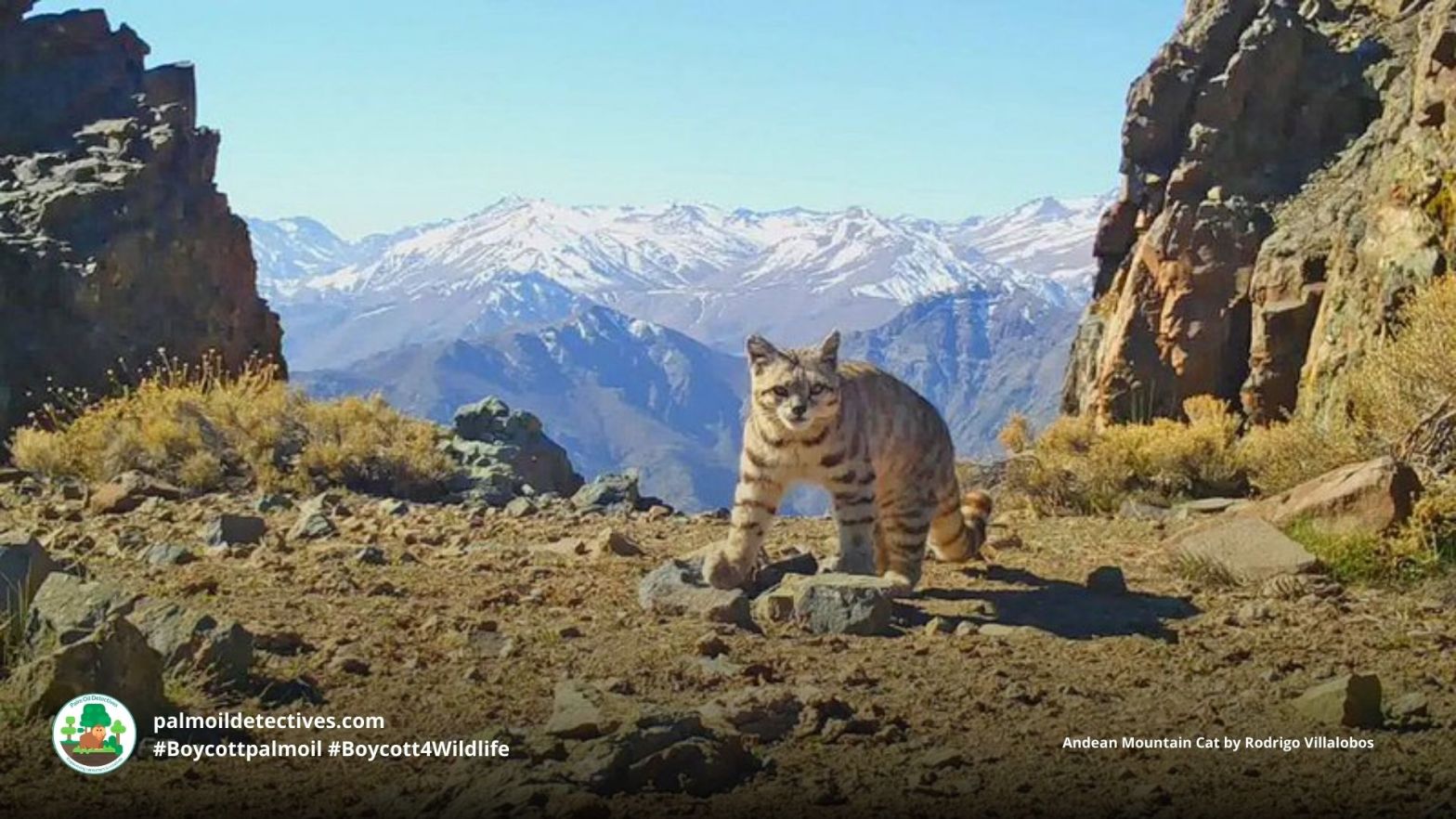
Andean Mountain Cat Leopardus jacobita
Red List classification: Endangered
Extant (resident): Argentina; Bolivia; Chile; Peru
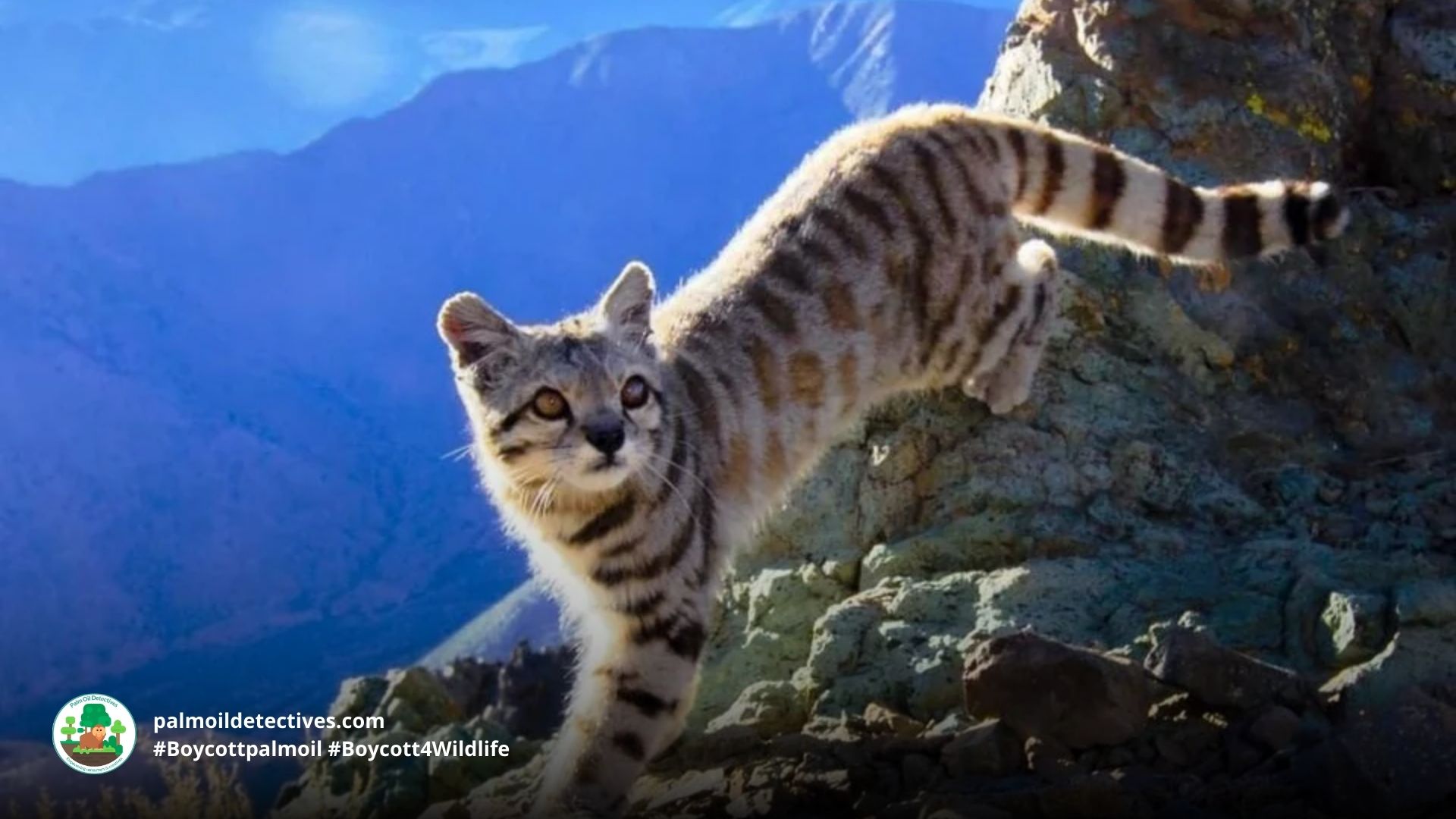
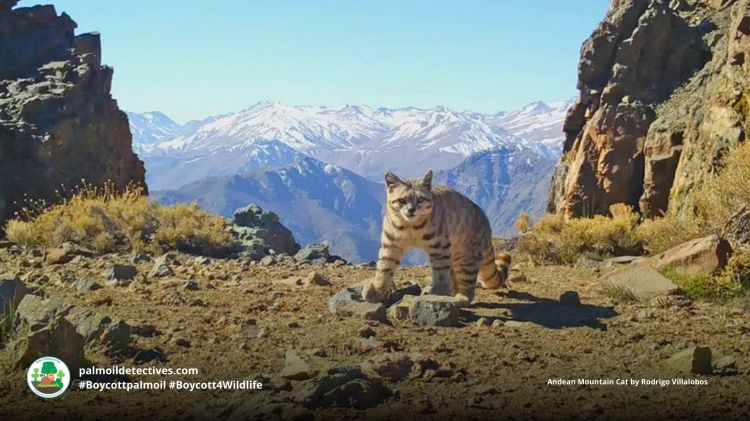
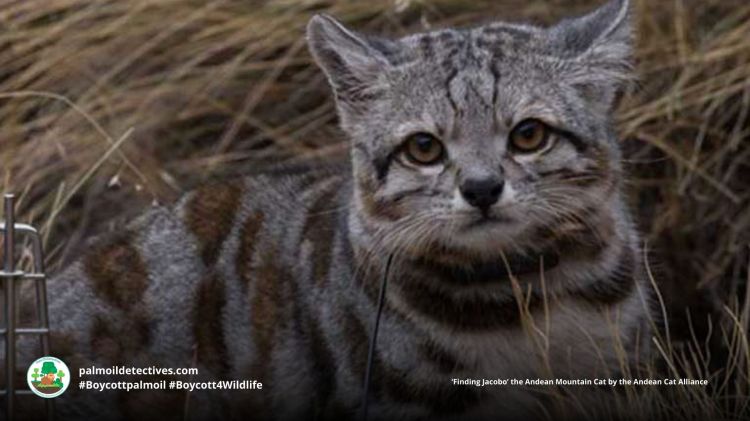
Known affectionately as ‘huana titi’ which translates to ‘the cat from dry places’ by locals, the Andean mountain cat captivates with their mystery and elegance. This cat boasts an exceptional sense of hearing, attributed to their well-developed eardrums. These allow them to detect prey with precision. They skillfully use their long tail, which makes up 70% of their body length, for balance during the swift and unpredictable chases of their prey.Unlike their larger feline counterparts, Andean mountain cats cannot roar due to the close and hardened structure of the bones in their throats, opting instead for mewls, growls, and screams. Remarkably, they can purr continuously, breathing in and out, showcasing a unique aspect of their vocal repertoire. Together we can protect these magnificent cats and their precious rainforest world. Use your wallet as a weapon and #BoycottMeat, #BoycottPalmOil, and #Boycott4Wildlife every time you shop!
#Endangered Andean 🇵🇪 Mountain #Cats 🐱🐈 are elusive #wildcats of #SouthAmerica. They are unique as they can purr continuously 🎶 They face #extinction from #deforestation. Help them to survive, be #vegan #Boycottpalmoil #Boycott4Wildlife @palmoildetect https://wp.me/pcFhgU-7iL
The ultra fluffy and elusive Andean Mountain #Cat 🐱 hunts by the light of the full moon 🌕🌙 They’re #endangered from multiple threats including #agriculture and #mining. Fight for them every time you shop #Boycottpalmoil #Boycott4Wildlife @palmoildetect https://wp.me/pcFhgU-7iL
Appearance & Behaviour
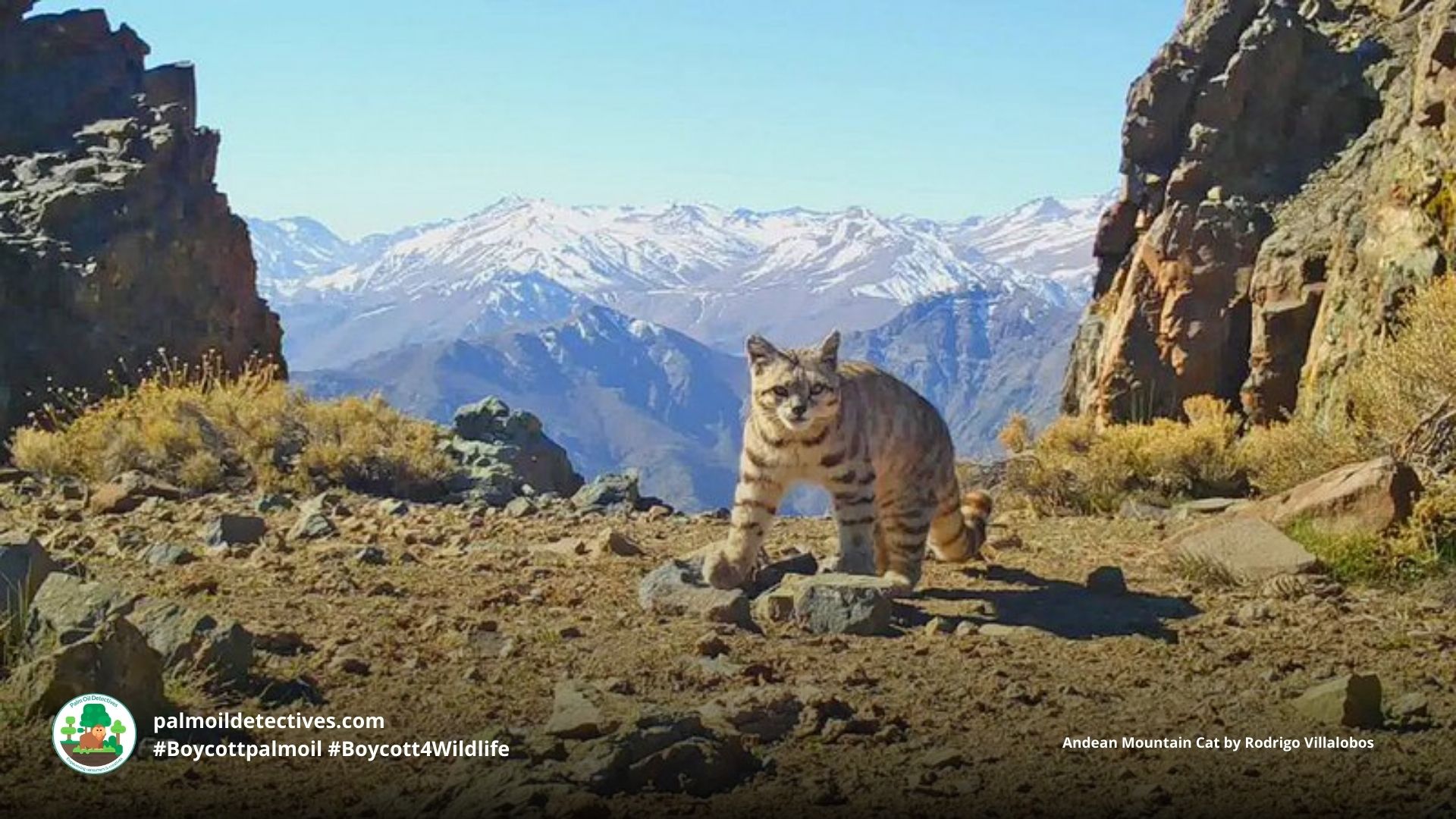
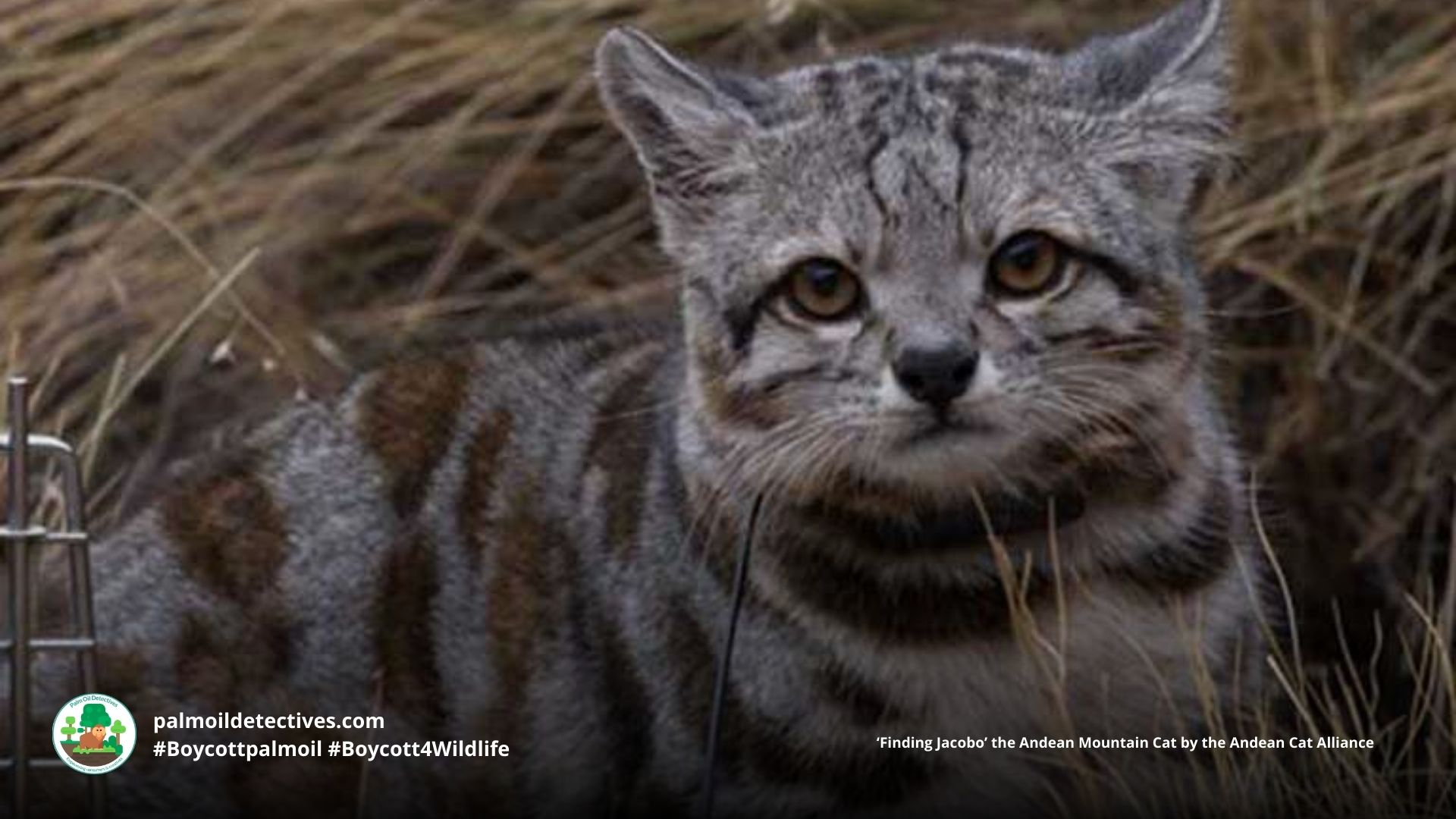
Perched high in the Andes, where the earth touches the sky, the Andean Cat roams with a silent grace.
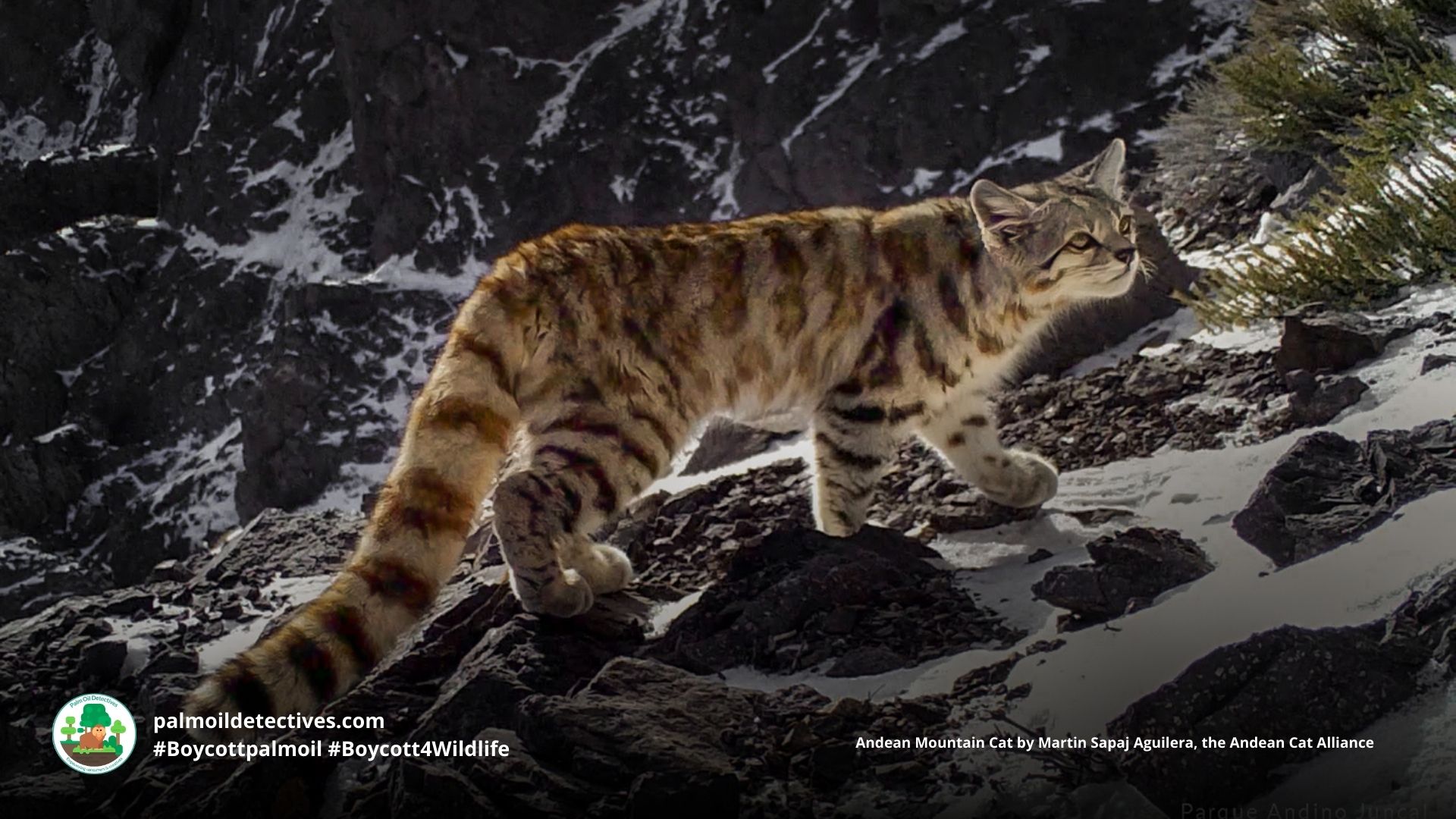
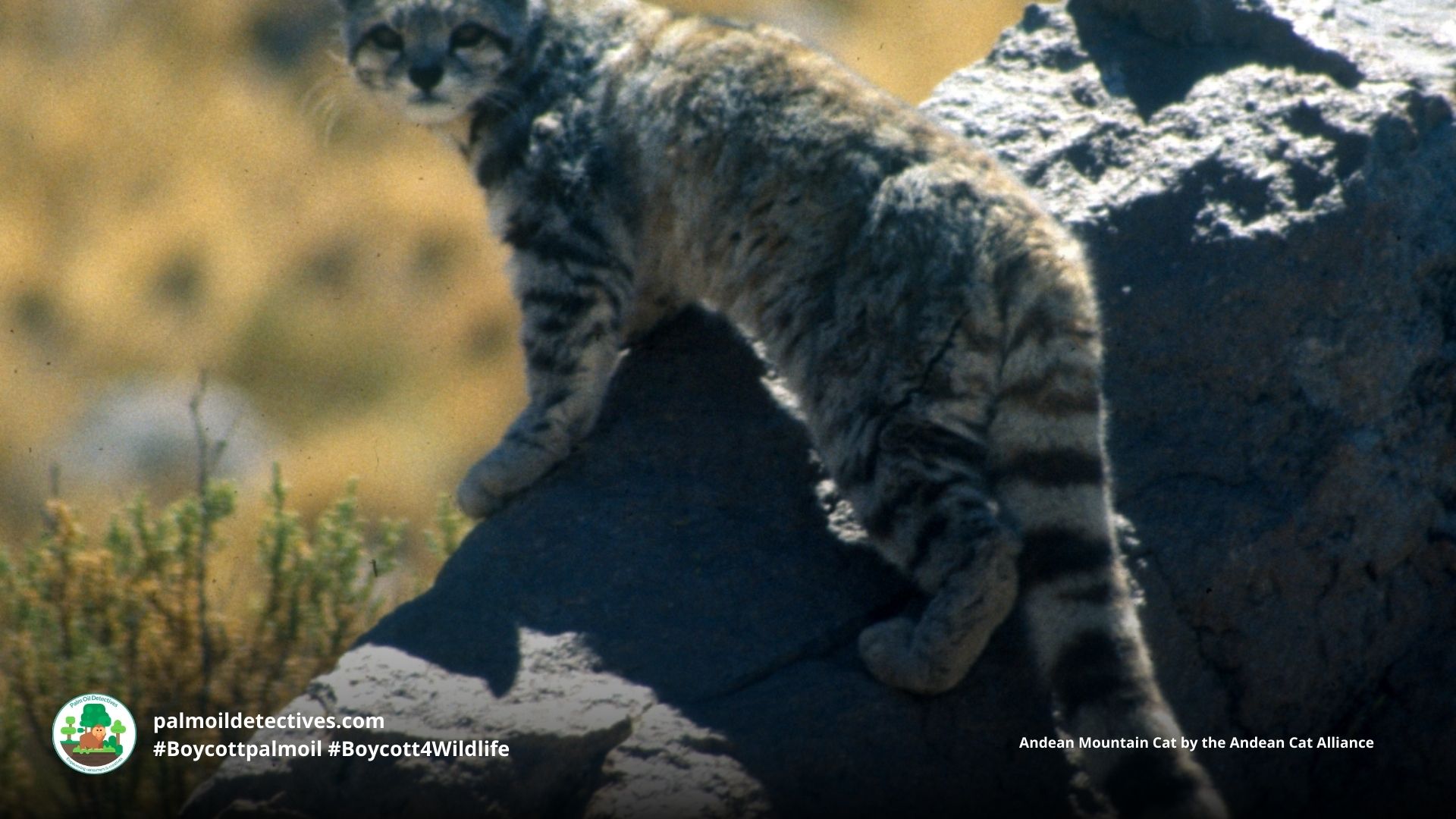
Cloaked in ash grey fur, adorned with subtle stripes and a bushy tail ringed in mystery, they embody the spirit of their stark, majestic surroundings. This feline is not just an animal; they are whispers of the wild, navigating the rugged terrain with a poise that belies the harshness of their environment. They lead mostly solitary lives except for the times when they come together during mating seasons or when nurturing their young. These elusive felines are most active during the quieter hours of dusk, night, and dawn, aligning their movements with the shadows of the Andean nights and lunar cycles.

Threats
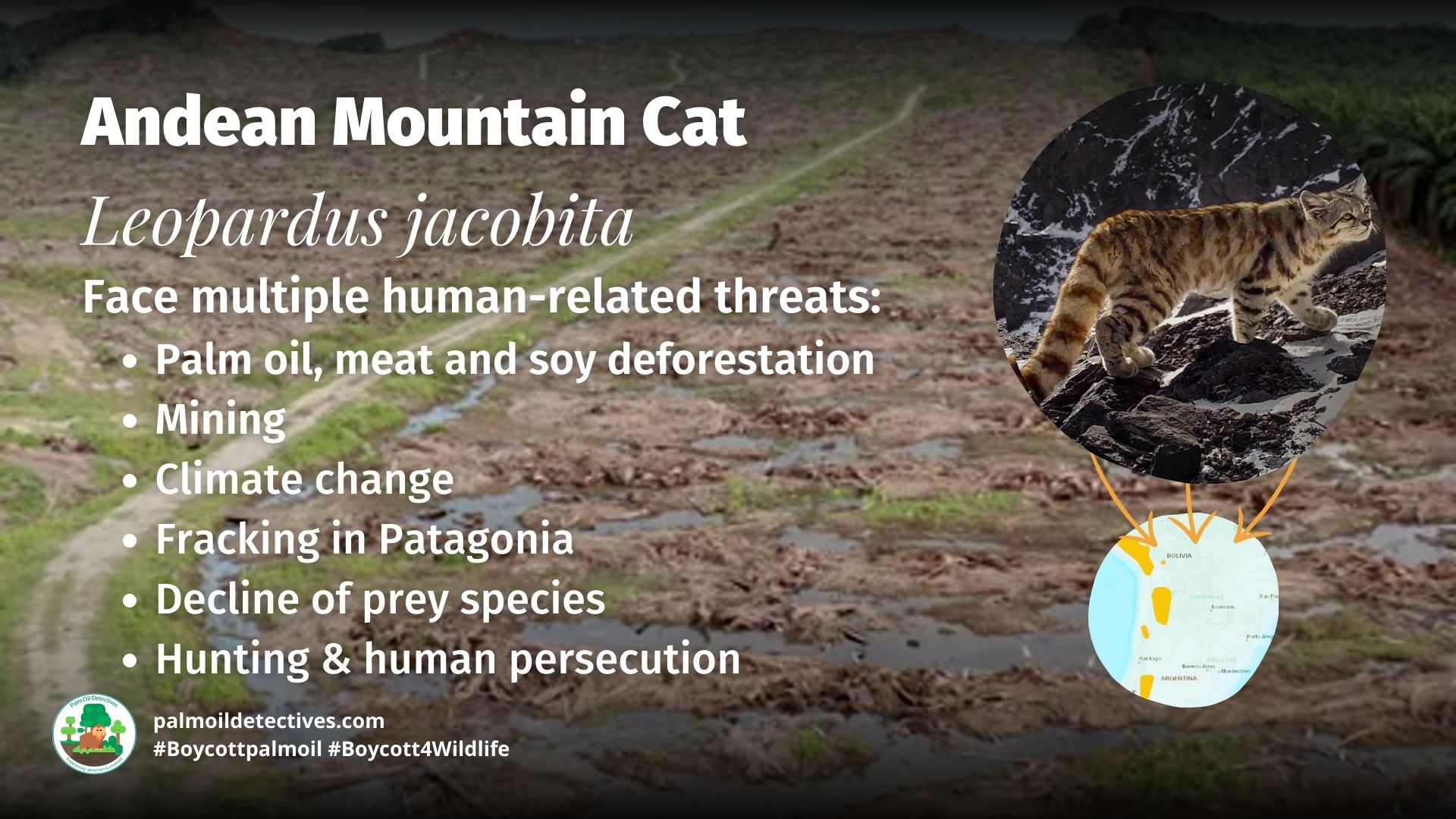
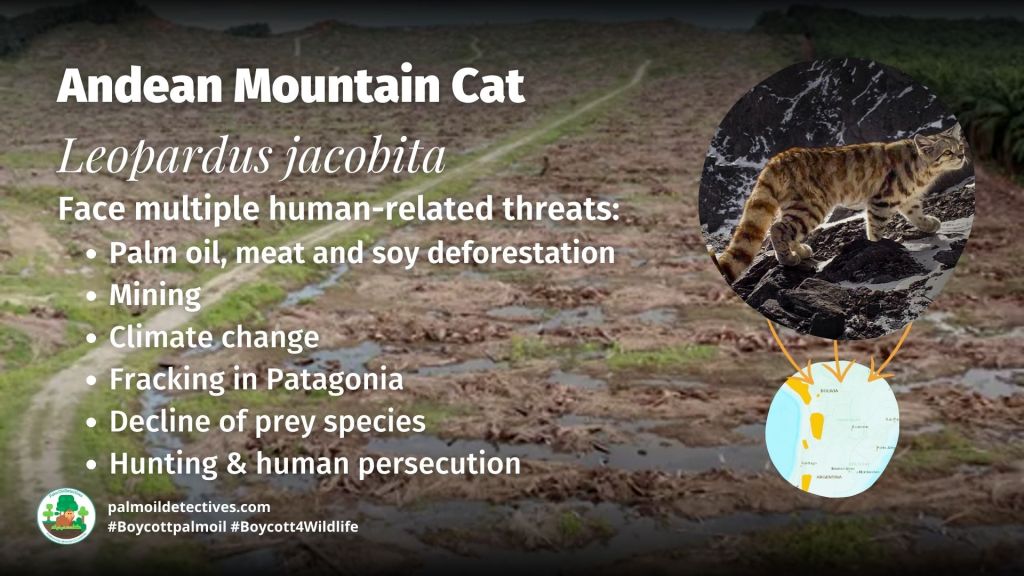
- Hunting Practices: Initially seen as the primary threat, hunting is now secondary to habitat concerns but remains significant.
- Agricultural expansion: Expansion of palm oil, meat and soy agriculture, poor livestock management, and water extraction for industry drive the Andean Cat into much smaller range and threaten their ongoing survival.
- Climate and Fracking: Climate change and fracking in Patagonia pose new, serious risks by shrinking their habitat.
- Local Conflicts: Andean Cats are killed by locals and their dogs in Argentina, Chile, and Peru to protect livestock.
- Cultural Hunting: Sacred in some cultures, Andean Cats are still hunted for traditional ceremonies, posing a unique threat.
- Prey Decline: The loss of major prey species like the Short-tailed Chinchilla and the Mountain Vizcacha impacts their diet and survival.
- Food Competition: They face competition from similar predators for limited food sources, stressing their population.
To safeguard the Andean Cat and their environment from further harm, take a stand against the primary drivers of their decline. By choosing to #BoycottMeat and #BoycottPalmOil, you are resisting the agricultural expansion that threatens their habitat. Join the #Boycott4Wildlife movement and become part of a global community committed to making dietary and consumer choices that protect the Andean Cat and all other animals in their ecosystem.
To safeguard the Andean Cat and their environment from further harm, take a stand against the primary drivers of their decline.

Habitat
Living high above the world in the Andean foothills and the Patagonian steppe, the Andean Cat finds solace in the steep, arid, and sparsely vegetated expanses. These areas, marked by extreme weather conditions and minimal rainfall, support a unique ecosystem of adapted plants and crucial wetlands that provide for both wildlife and local communities. It’s within these challenging conditions that they have carved out a niche for themselves, demonstrating remarkable resilience.
Diet
The Andean Cat’s diet is highly specialised and is primarily made up of mountain vizcacha. This particular prey is crucial due to their large size and the substantial amount of energy they provide.
Aside from the mountain vizcacha, these cats diversify their diet with a variety of smaller prey mammals like the tuco-tuco, reptiles, rodents and birds to supplement their nutritional needs.

Mating and breeding
The mating behavior of the Andean Cat is observed primarily between July and August, although there is evidence to suggest that this period could extend into later months, possibly through November or December. This extension is inferred from sightings of kittens and couples outside the expected mating season, indicating a broader reproductive window. Typically, the Andean Cat produces one to two kittens per litter, with births timed to coincide with spring and summer. This timing aligns with increased food availability, enhancing the survival prospects of the offspring. The reproductive habits of the Andean Cat, including their seasonal mating patterns and the care provided to their young, are adapted to the environmental conditions of their high-altitude habitats, ensuring the continuity of the species.
Support the Andean Mountain Cat by going vegan and boycotting palm oil in the supermarket, it’s the #Boycott4Wildlife
Alliance Gato Andino: a conservation organisation that protects and monitors the Andean Mountain Cat.
Further Information
Villalba, L., Lucherini, M., Walker, S., Lagos, N., Cossios, D., Bennett, M. & Huaranca, J. 2016. Leopardus jacobita. The IUCN Red List of Threatened Species 2016: e.T15452A50657407. https://dx.doi.org/10.2305/IUCN.UK.2016-1.RLTS.T15452A50657407.en. Accessed on 28 February 2024.
Andean Mountain Cat Wikipedia article: https://en.wikipedia.org/wiki/Andean_mountain_cat
Andean Mountain Cat on Animalia.bio: https://animalia.bio/andean-mountain-cat
(2017, February). Field notes: Finding Jacobo, an Andean cat captivates conservationists. Mongabay. https://news.mongabay.com/2017/02/field-notes-finding-jacobo-an-andean-cat-captivates-conservationists/

How can I help the #Boycott4Wildlife?
Take Action in Five Ways
1. Join the #Boycott4Wildlife on social media and subscribe to stay in the loop: Share posts from this website to your own network on Twitter, Mastadon, Instagram, Facebook and Youtube using the hashtags #Boycottpalmoil #Boycott4Wildlife.
2. Contribute stories: Academics, conservationists, scientists, indigenous rights advocates and animal rights advocates working to expose the corruption of the palm oil industry or to save animals can contribute stories to the website.






3. Supermarket sleuthing: Next time you’re in the supermarket, take photos of products containing palm oil. Share these to social media along with the hashtags to call out the greenwashing and ecocide of the brands who use palm oil. You can also take photos of palm oil free products and congratulate brands when they go palm oil free.
4. Take to the streets: Get in touch with Palm Oil Detectives to find out more.
5. Donate: Make a one-off or monthly donation to Palm Oil Detectives as a way of saying thank you and to help pay for ongoing running costs of the website and social media campaigns. Donate here
Learn about other animals endangered by palm oil and other agriculture
Learn about “sustainable” palm oil greenwashing
Read more about RSPO greenwashing
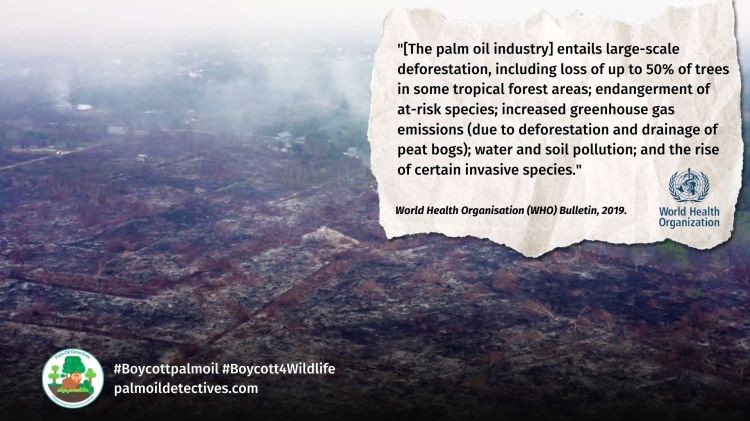
A 2019 World Health Organisation (WHO) report into the palm oil industry and RSPO finds extensive greenwashing of palm oil deforestation and the murder of endangered animals (i.e. biodiversity loss)




Discover more from Palm Oil Detectives
Subscribe to get the latest posts sent to your email.
 Palm Oil Detectives
Thanks so much Ned for sharing 🙂
LikeLike