
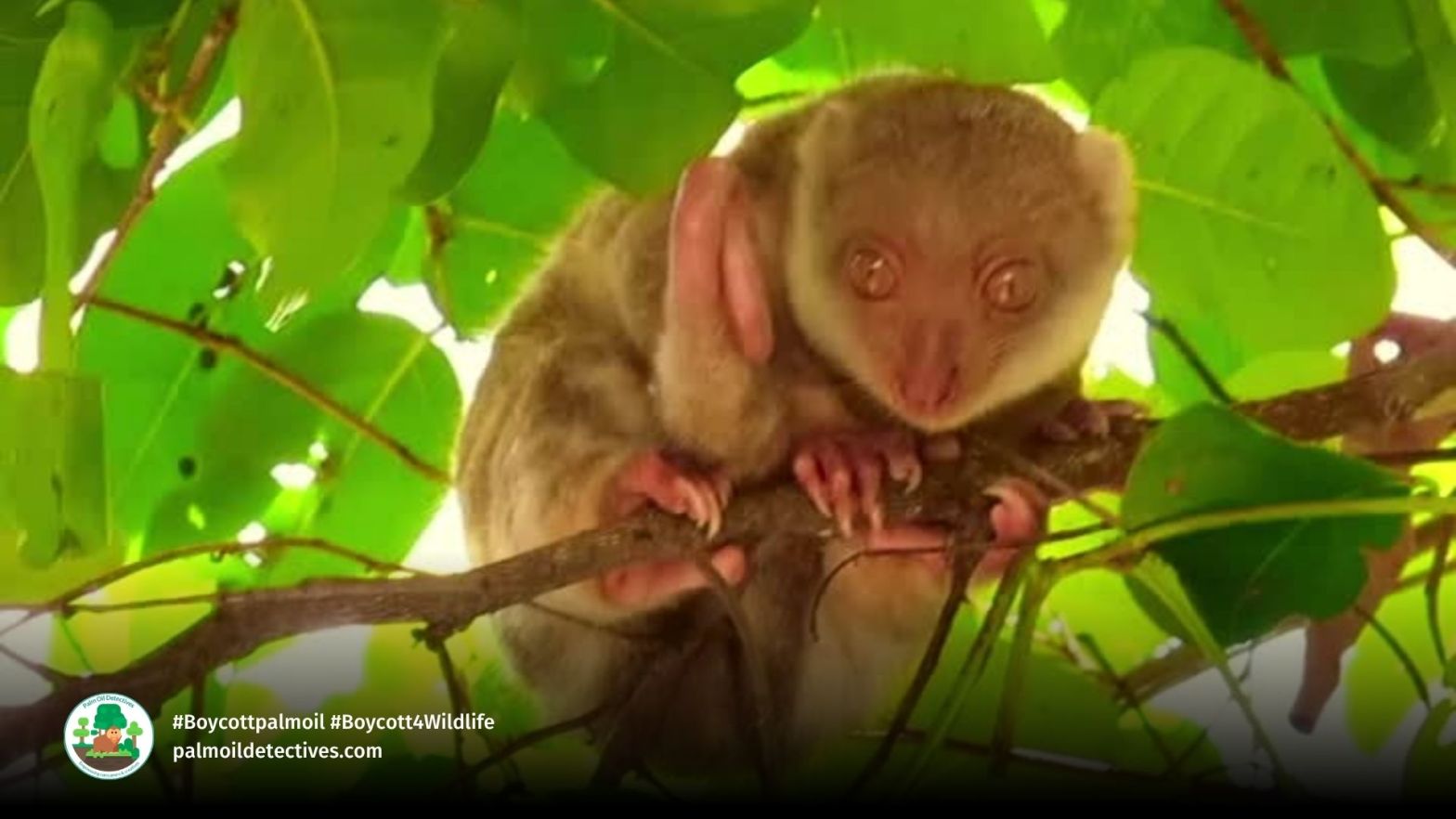
Woodlark Cuscus Phalanger lullulae
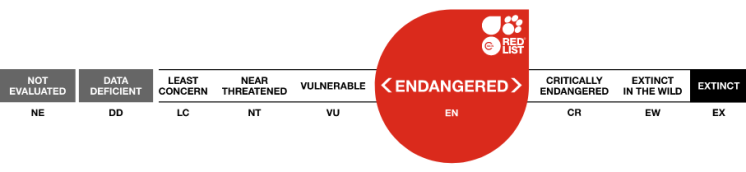
Red List Status: Endangered
Locations: Papua New Guinea: Woodlark Island, Madau Island, Alcester Island (Milne Bay Province). The Woodlark Cuscus inhabits the mosaic of dry lowland forest, secondary regrowth, and epiphyte-laden trees.
The Woodlark #Cuscus is a nocturnal marsupial found nowhere else but the forests of Woodlark, Madau, and Alcester islands. By day, the Woodlark Cuscus curls into tree hollows or buries themselves in tangles of epiphytes; by night, they move silently through the canopy, their marbled fur blending with the shifting shadows. The Woodlark Cuscus faces imminent extinction as palm oil plantations, logging, and gold mining threaten to erase the last forests of their island home. With all individual cuscuses known from less than 1,300 km² and new clearances looming, the Woodlark Cuscus’s world is shrinking fast. Stand with indigenous Melanesian sovereignty and safeguard these islands. Use your wallet as a weapon and #BoycottPalmOil #Boycott4Wildlife.
The Woodlark #Cuscus 🦫🐻 is a fuzzy #endangered #marsupial of #PapuaNewGuinea 🇵🇬 living on remote Woodlark island. They’re at risk from #palmoil #ecocide. Protect them and #BoycottPalmOil 🌴🩸☠️🤢🚜🔥❌ #Boycott4Wildlife when you shop! @palmoildetect https://palmoildetectives.com/2021/01/31/woodlark-cuscus-phalanger-lullulae/
The major threat to the Woodlark Cuscus, and indeed the current way of life for humans on the island, is a proposal by a Malaysian timber company to log almost half of the rainforest on the island. In addition a goldmine is planned for the island, and this has the potential to degrade habitat for the species. The Woodlark Cuscus is occasionally hunted for food by local people, but they are not a preferred food item (unlike pigs and fish), and hunting appears to have little impact on population abundance. Listed as Endangered because they live in an area less than 1,300 km², all individuals are known from two (possibly 3) locations, and there is an imminent risk (=projected decline) to their remaining habitat due to plans for logging and mine development on Woodlark Island.
The major threat to the Woodlark Cuscus, and indeed the current way of life for humans on the island, is a proposal by a Malaysian timber company to log almost half of the rainforest on the island.
IUCN Red List
Appearance and Behaviour
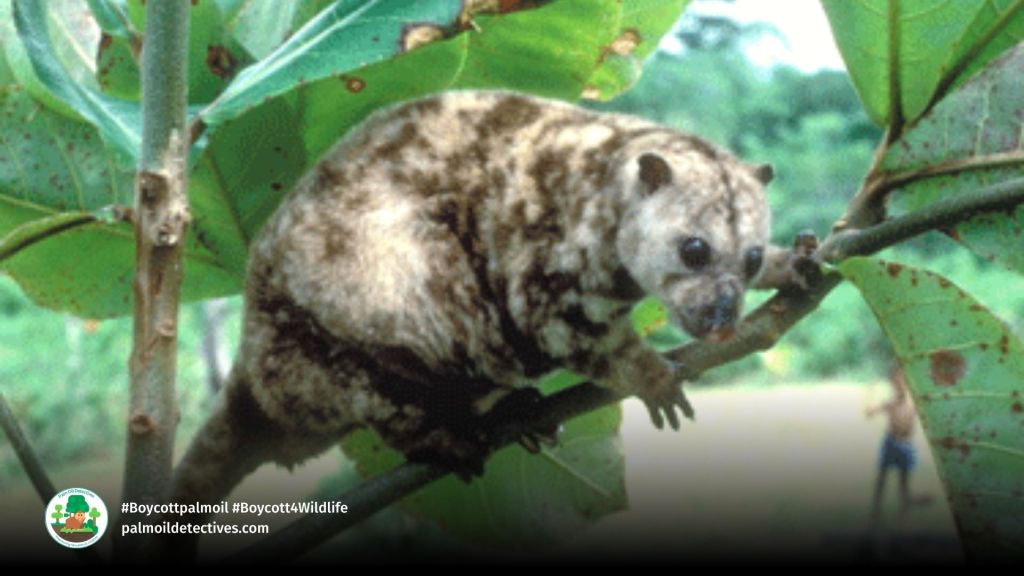
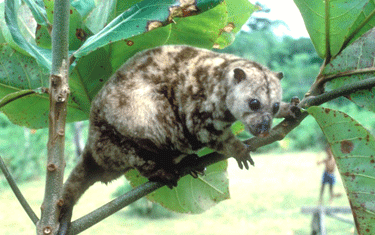
The Woodlark Cuscus is a medium-sized, solitary marsupial, with females slightly larger than males. Their short, woolly coat is a marbled patchwork of ochre, brown, and white, with each animal displaying a unique pattern. The Woodlark Cuscus has a black face, a pink nose, and pale flashes on their ears. Their long, prehensile tail is naked at the tip, acting like a fifth limb to grip branches as they climb. The Woodlark Cuscus’s hands and feet are highly adapted for arboreal life, with opposable digits and syndactyly on the hind feet. They move with deliberate grace, rarely descending from the canopy. Radio tracking studies reveal that the Woodlark Cuscus spends most of their time near a few favoured sleeping trees, emerging after dark to forage. The Woodlark Cuscus is mostly solitary, and encounters between individuals can be aggressive.
Threats
Palm oil, logging, and mining deforestation
The Red List lists the Woodlark Cuscus as Endangered because their entire population is confined to less than 1,300 km², and all known locations are threatened by imminent habitat destruction. A Malaysian timber company has proposed logging nearly half of Woodlark Island’s rainforest to make way for palm oil plantations, which would obliterate the cuscus’s habitat and the ecological web of the island. Gold mining projects also threaten to pollute and fragment the remaining forest. As bulldozers advance, the Woodlark Cuscus loses the shelter of epiphyte-laden trees and the nectar-rich vines that sustain them. Even secondary regrowth, which locals say provides the Woodlark Cuscus’s favourite foods, is at risk.
The Woodlark Cuscus cannot survive in plantations or open ground and is extremely vulnerable to local extinction as the forest is cleared. This threat is compounded by the lack of protected areas and the absence of any formal conservation action. The Woodlark Cuscus’s entire way of life—solitary, arboreal, and dependent on a living forest—is under direct assault from industrial expansion and land grabs (Flannery, 1995; Mongabay, 2020).
Fragmentation and population collapse
The Woodlark Cuscus’s range is now fragmented into isolated forest patches. Satellite imagery and field surveys confirm that the Woodlark Cuscus is more abundant in the dry lowland forests of eastern Woodlark Island, where secondary regrowth provides shelter and food, than in the dense western jungles. However, as logging, mining, and plantations advance, these patches shrink and become isolated. The Woodlark Cuscus is highly adapted to arboreal life and rarely crosses open ground, making recolonisation of lost habitat nearly impossible. Fragmentation increases the risk of inbreeding and local extinction, especially as the Woodlark Cuscus is already confined to a handful of sites. Without urgent action to halt forest loss and restore corridors, the Woodlark Cuscus faces a future of genetic decline and population collapse (Norris, 1999; Mongabay, 2020).
Diet
The Woodlark Cuscus is a nocturnal forager, feeding on nectar from vines and the fast-growing tree Rhus taitensis, which flourishes in old gardens and secondary regrowth. Local knowledge suggests the Woodlark Cuscus also eats the leaves and fruits of several vine species, though the exact plants are not yet identified. Like other cuscuses, the Woodlark Cuscus may occasionally eat fruit or even meat, but nectar and soft plant matter are thought to be their staples. Their foraging helps pollinate vines and disperse seeds, supporting the forest’s renewal after disturbance (Flannery, 1995).
Reproduction and Mating
Researchers have not directly observed the Woodlark Cuscus’s courtship or mating, but studies of captured females reveal that breeding is likely spread over a long period, with births occurring throughout the year. Females give birth to a single young, which remains in the pouch before graduating to riding on the mother’s back as they mature. The composition of the mother’s milk changes as the young grows, starting as a dilute, sugar-rich fluid and becoming more concentrated with protein and fat over time. This gradual transition from pouch to back is typical of metatherians. The Woodlark Cuscus’s solitary nature means that mothers raise their young alone, teaching them to forage and climb until they are independent (Flannery, 1995; Norris, 1999).
Geographic Range
The Woodlark Cuscus is endemic to Papua New Guinea and found only on Woodlark Island, Madau Island, and Alcester Island in Milne Bay Province. Within these islands, the Woodlark Cuscus prefers dry lowland forest and secondary regrowth, especially on the eastern side of Woodlark Island. The Woodlark Cuscus is absent from the dense rainforests of the west and is rarely seen outside tree hollows or dense epiphyte tangles during the day. Their range has contracted dramatically as logging and mining projects have advanced, and the species is now absent from large areas where they once thrived (Flannery, 1995; Norris, 1999).
FAQs
How many Woodlark Cuscuses remain alive in the wild?
Precise numbers are unknown, but all Woodlark Cuscuses are confined to less than 1,300 km² across three islands. Surveys suggest the Woodlark Cuscus is moderately abundant in the eastern forests of Woodlark Island and on Alcester Island, but their population is declining rapidly as habitat disappears. The Red List classifies the Woodlark Cuscus as Endangered, and the species could vanish within a generation if logging and mining proceed unchecked (Flannery, 1995).
What makes the Woodlark Cuscus so vulnerable to extinction?
The Woodlark Cuscus is highly specialised for life in the forest canopy and cannot survive in plantations or open ground. Their entire population is confined to a handful of islands, and all known habitat is under threat from palm oil, logging, and mining. The Woodlark Cuscus’s reluctance to cross open ground makes them especially vulnerable to fragmentation, and their solitary habits mean that recolonisation of lost patches is unlikely. Without urgent protection of remaining forests and indigenous-led agroecology, the Woodlark Cuscus faces extinction (Mongabay, 2020; Norris, 1999).
Do Woodlark Cuscuses make good pets?
Absolutely not! The Woodlark Cuscus is a solitary, nocturnal animal with highly specific needs for shelter, diet, and space. In captivity, the Woodlark Cuscus suffers extreme stress, loneliness, and early death. The pet trade rips families of these rare marsupials apart and fuels their extinction. Keeping the Woodlark Cuscus as a pet is illegal and unethical.
Take Action!
Use your wallet as a weapon and #BoycottPalmOil #Boycott4Wildlife. Support indigenous-led sovereignty and agroecology on Woodlark Island. Reject products linked to logging and mining. Fight for the Woodlark Cuscus’s survival every time you shop.
Further Information
Flannery, Tim. (1995). Mammals of New Guinea Chatswood, NSW. Reed Books. Australian Museum
Leary, T., Singadan, R., Menzies, J., Helgen, K., Wright, D., Allison, A. & Hamilton, S. 2016. Phalanger lullulae. The IUCN Red List of Threatened Species 2016: e.T16846A21951419. https://dx.doi.org/10.2305/IUCN.UK.2016-2.RLTS.T16846A21951419.en. Downloaded on 31 January 2021.
Mongabay. (2020, October 1). Land grab, logging, mining threaten biodiversity haven of Woodlark Island. https://news.mongabay.com/2020/10/land-grab-logging-mining-threaten-biodiversity-haven-of-woodlark-island/
Norris, C. A. (1999). The ecology and behaviour of the Woodlark cuscus, Phalanger lullulae. The American Society of Mammologists.
Wikipedia contributors. (n.d.). Woodlark cuscus. Wikipedia. https://en.wikipedia.org/wiki/Woodlark_cuscus
You can support this beautiful animal
There are no known conservation activities for this animal. Share out this post to social media and join the #BoycottPalmOil #Boycott4Wildlife on social media to raise awareness

How can I help the #Boycott4Wildlife?
Take Action in Five Ways
1. Join the #Boycott4Wildlife on social media and subscribe to stay in the loop: Share posts from this website to your own network on Twitter, Mastadon, Instagram, Facebook and Youtube using the hashtags #Boycottpalmoil #Boycott4Wildlife.
2. Contribute stories: Academics, conservationists, scientists, indigenous rights advocates and animal rights advocates working to expose the corruption of the palm oil industry or to save animals can contribute stories to the website.






3. Supermarket sleuthing: Next time you’re in the supermarket, take photos of products containing palm oil. Share these to social media along with the hashtags to call out the greenwashing and ecocide of the brands who use palm oil. You can also take photos of palm oil free products and congratulate brands when they go palm oil free.
4. Take to the streets: Get in touch with Palm Oil Detectives to find out more.
5. Donate: Make a one-off or monthly donation to Palm Oil Detectives as a way of saying thank you and to help pay for ongoing running costs of the website and social media campaigns. Donate here
Discover more from Palm Oil Detectives
Subscribe to get the latest posts sent to your email.
 Palm Oil Detectives