
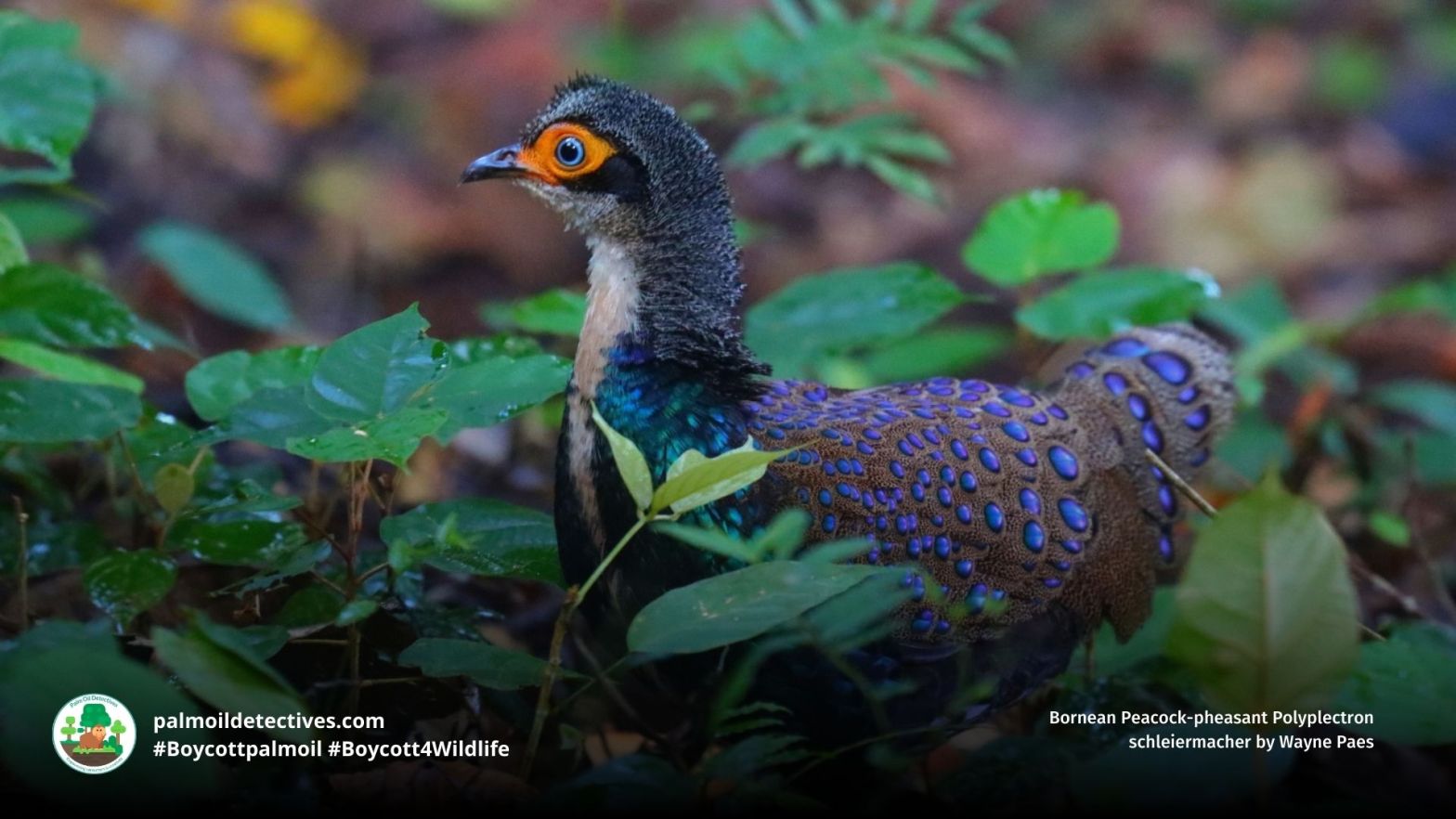
Bornean Peacock-pheasant Polyplectron schleiermacheri
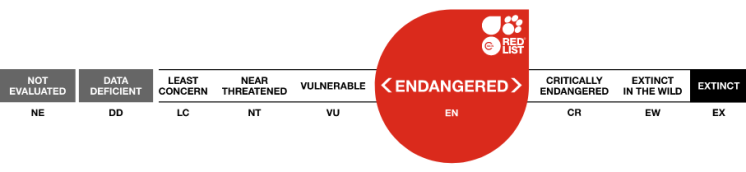
IUCN Status: Endangered
Location: Endemic to the island of Borneo, specifically in Central Kalimantan, Indonesia, with potential populations in Sarawak and Sabah, Malaysia.
Bornean #Peacock #Pheasants are famous for their purple, emerald 💜💚🦜 feathers and secretive natures. Living in #Indonesia and #Malaysia, #palmoil #deforestation is a major threat. Help these #birds! #BoycottPalmOil 🌴⛔️ #Boycott4Wildlife @palmoildetect https://wp.me/pcFhgU-wV
In central Kalimantan, habitat loss, degradation and fragmentation as a result of large-scale commercial logging (deliberately targeting all remaining stands of valuable timber including those inside protected areas), widespread clearance for plantations of rubber and oil-palm, and hunting with snares, are the main threats.
IUCN Red list
The Bornean Peacock-Pheasant is a rare and elusive #bird found only in #Borneo’s tropical rainforests in #Indonesia and Malaysia. They are known for their intricate iridescent plumage and secretive nature. This species faces a grave threat from out-of-control #palmoil plantations, timber logging, the illegal #pettrade and habitat destruction. #Deforestation has wiped out vast areas of their habitat, pushing this bird toward #extinction. Without urgent conservation action, the Bornean Peacock-Pheasant may soon vanish forever. Take action everytime you shop and #BoycottPalmOil #Boycott4Wildlife to help protect this species.
Appearance and Behaviour
This species is a small, ground-dwelling bird with an extraordinary pattern of shimmering blue-green ‘eye-spots’ across its wings and tail. Males perform elaborate courtship displays, fanning their tails to attract mates. Their dark brown plumage, speckled with emerald and sapphire hues, allows them to blend into the dense forest undergrowth.
Naturally shy, these birds spend most of their time hidden in thick vegetation, foraging on the forest floor for food. They are largely solitary or found in pairs, relying on camouflage and silence to avoid predators. They are known for their soft calls but can produce loud alarm calls when threatened.


Threats
Palm Oil and Rubber Plantation Deforestation
The uncontrolled expansion of palm oil and rubber plantations is the primary driver of this species’ decline. Between 1985 and 1997, nearly 25% of Borneo’s evergreen forest was lost. Lowland dipterocarp forests, the Bornean Peacock-Pheasant’s primary habitat, are among the most heavily logged ecosystems in the world. As multinational corporations destroy rainforests to make way for palm oil and timber plantations, these birds are left with nowhere to live, breed, or find food.
Illegal Logging and Habitat Fragmentation
Almost all remaining lowland forests in Central Kalimantan have been allocated as logging concessions, meaning that even the last viable populations of the Bornean Peacock-Pheasant are at risk. Habitat fragmentation isolates populations, making survival even more difficult.
Hunting and Illegal Wildlife Trade
Despite their rarity, Bornean Peacock-Pheasants have been documented in the illegal pet trade. In 1998, TRAFFIC recorded at least six individuals being smuggled to Singapore for sale. As deforestation forces them into smaller, more exposed areas, they become easier targets for poachers.
Climate Change and Increasing Wildfires
Massive fires in Borneo, worsened by climate change and deforestation, continue to destroy critical habitat. The devastating 1997–1998 fires wiped out large portions of the species’ range, and these fires have only increased in frequency and severity since then.
Diet
Bornean Peacock-Pheasants are omnivorous, feeding on insects, seeds, fallen fruits, and small invertebrates. They forage by scratching through leaf litter, searching for hidden insects and worms. They depend on dense rainforest undergrowth, which is disappearing due to palm oil plantations and logging.
Reproduction and Mating
Little is known about their breeding ecology, but like other peacock-pheasants, they are believed to be monogamous. Males perform intricate displays, fanning out their eye-spotted tails while calling softly to attract a mate. Nesting likely occurs in dense undergrowth, with the female incubating a small clutch of one to two eggs.
Geographic Range
The Bornean Peacock-Pheasant is found only on the island of Borneo, particularly in Central Kalimantan (Indonesia), with unconfirmed sightings in Sarawak and Sabah (Malaysia). Its range is highly fragmented, with populations struggling to survive as habitat destruction accelerates.
FAQ
What is the rarest peacock-pheasant?
The Bornean Peacock-Pheasant is considered one of the rarest and most elusive birds in Borneo. Due to their small population size and habitat loss, sightings of this species are extremely rare.
Are peacock-pheasants loud?
Peacock-pheasants are generally quiet birds, relying on their camouflage to stay hidden. However, they can produce loud alarm calls when startled or threatened.
What is the meaning of peacock-pheasant?
The name “peacock-pheasant” comes from the male’s tail feathers, which are adorned with iridescent eye-spots similar to those of true peacocks. These tail feathers are used in elaborate courtship displays.
Do Bornean Peacock-Pheasants Make Good Pets?
No, Bornean Peacock-Pheasants (Polyplectron schleiermacheri) should never be kept as pets. These birds are wild, highly sensitive, and critically dependent on their rainforest habitat for survival. Capturing them for the pet trade contributes directly to their population decline, pushing them closer to extinction.
Unlike domesticated birds, Bornean Peacock-Pheasants have complex social structures, specialised diets, and require vast, undisturbed forest territories. Removing them from the wild causes immense stress, often leading to premature death. Many individuals die in transit or in captivity due to improper care, lack of appropriate food, or extreme distress.
Furthermore, the illegal pet trade is a serious conservation threat, often linked to habitat destruction, deforestation for palm oil, and poaching. The 1998 TRAFFIC report documented these birds being smuggled out of Kalimantan into the international market, highlighting the grim reality of wildlife trafficking (Shepherd, 2000).
If you care about Bornean Peacock-Pheasants, the best way to help is by boycotting palm oil, opposing wildlife trafficking, and supporting conservation efforts to protect their natural rainforest habitat. Every purchase you make is a vote for or against the destruction of their home. Use your wallet as a weapon and #BoycottPalmOil #Boycott4Wildlife.
Take Action!
The Bornean Peacock-Pheasant is on the brink of extinction due to habitat destruction driven by the palm oil industry. Every time you shop, you have the power to make a difference. Use your wallet as a weapon and #BoycottPalmOil #Boycott4Wildlife to protect Borneo’s last remaining forests. Without urgent action, this species may disappear forever. Support indigenous-led conservation and advocate for the protection of Borneo’s rainforests before it’s too late.

Support the conservation of this species
This animal has no protections in place. Read about other forgotten species here. Create art to support this forgotten animal or raise awareness about them by sharing this post and using the #Boycottpalmoil #Boycott4Wildlife hashtags on social media. Also you can boycott palm oil in the supermarket.
Further Information
BirdLife International. 2016. Polyplectron schleiermacheri. The IUCN Red List of Threatened Species 2016: e.T22679393A84694321. https://dx.doi.org/10.2305/IUCN.UK.2016-3.RLTS.T22679393A84694321.en. Downloaded on 05 February 2021.
Chng et. al (2000). TRAFFIC report on the trade of Bornean Peacock-Pheasants in Southeast Asia. TRAFFIC Southeast Asia. https://www.traffic.org/site/assets/files/2466/market_for_extinction_jakarta.pdf
Corder, J., & Davison, G. (2021). Captive breeding challenges posed by Malaysian and Bornean Peacock-Pheasants (Polyplectron malacense and P. schleiermacheri). Zoo Biology, 40(4), 346-351. https://doi.org/10.1002/zoo.21600
Wikipedia contributors. (n.d.). Bornean peacock-pheasant. Wikipedia, The Free Encyclopedia. Retrieved 7 February 2025, from https://en.wikipedia.org/wiki/Bornean_peacock-pheasant


How can I help the #Boycott4Wildlife?
Take Action in Five Ways
1. Join the #Boycott4Wildlife on social media and subscribe to stay in the loop: Share posts from this website to your own network on Twitter, Mastadon, Instagram, Facebook and Youtube using the hashtags #Boycottpalmoil #Boycott4Wildlife.
2. Contribute stories: Academics, conservationists, scientists, indigenous rights advocates and animal rights advocates working to expose the corruption of the palm oil industry or to save animals can contribute stories to the website.





3. Supermarket sleuthing: Next time you’re in the supermarket, take photos of products containing palm oil. Share these to social media along with the hashtags to call out the greenwashing and ecocide of the brands who use palm oil. You can also take photos of palm oil free products and congratulate brands when they go palm oil free.
4. Take to the streets: Get in touch with Palm Oil Detectives to find out more.
5. Donate: Make a one-off or monthly donation to Palm Oil Detectives as a way of saying thank you and to help pay for ongoing running costs of the website and social media campaigns. Donate here
Discover more from Palm Oil Detectives
Subscribe to get the latest posts sent to your email.
 Palm Oil Detectives