
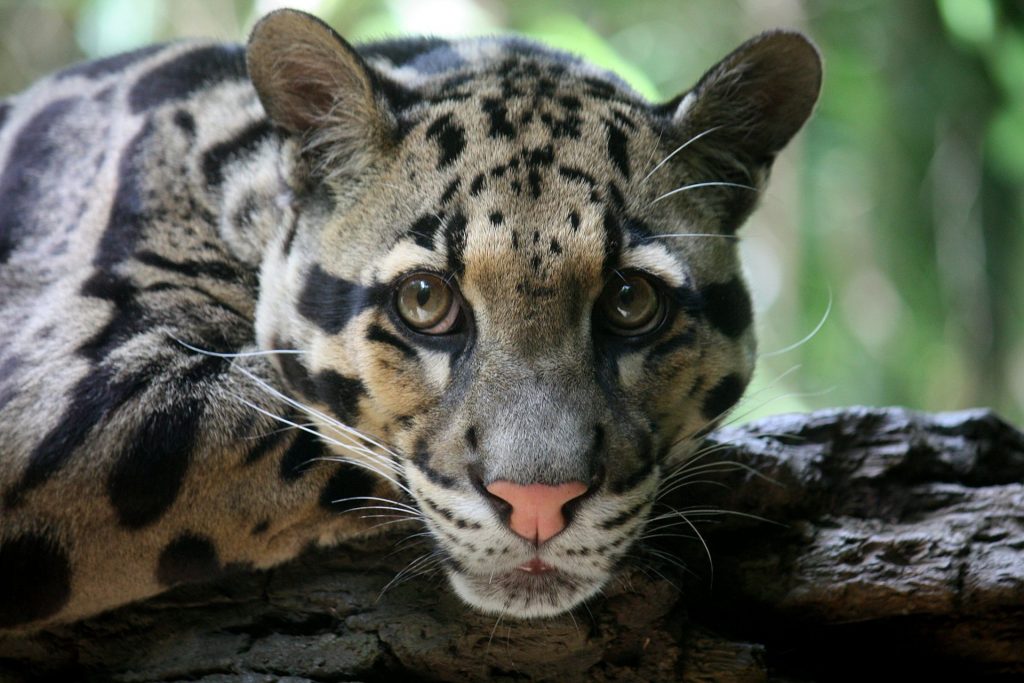
Beautiful and unique Clouded Leopards are #endangered by #palmoil, #meat #mining #deforestation and human persecution across their range. Help them every time you shop and be #vegan, #Boycottpalmoil and #Boycott4wildlife
The Stealth and Beauty of the Clouded #Leopard 🌧️🦁🐆 These beautiful beings face #extinction from #palmoil #deforestation 🌴🩸☠️🔥🚜⛔️ Help them to survive and be #vegan #Boycottpalmoil #Boycott4Wildlife @palmoildetect https://palmoildetectives.com/2021/03/08/the-stealth-and-beauty-of-the-clouded-leopard/
Found in the forests of Asia, this secretive midsized cat is almost as mysterious today as it was nearly 200 years ago when it was first described. We do know, however, that it has a taste for the treetops. This wonderfully agile feline is an incredible arboreal hunter, capable of catching monkeys, civets and even birds in the trees, balancing itself with the longest tail, in relation to body size, of any cat. In fact, the clouded leopard is probably the most talented climber in the whole cat family.
It is one of just two species of feline that can rotate its flexible ankles backwards (the other is the margay from South America), which allows it to climb down a tree headfirst with squirrel-like ease, move along horizontal branches while hanging beneath them like a sloth, and even dangle from a branch using just its hind feet. Its Malayan name is harimau-dahan, which means ‘branch tiger’.
With regard to the clouded leopard’s name, although it does have beautiful cloud-like markings on its body, it is not a leopard. It isn’t even part of the Panthera genus of ‘big cats’, where true leopards – along with lions, tigers and jaguars – sit. Originally, there was just one species of clouded leopard, but scientists ‘split’ the species in 2006 because of genetic differences between those found on mainland Asia and those found on the islands of Borneo and Sumatra. The images in this article are of the clouded leopard; the second, more recently recognised species, which tends to be darker in colour and has smaller cloud markings, is now known as the Sunda clouded leopard.
Relative to its size, the clouded leopard has the longest upper canine teeth of any predator. At 5 cm long, they’re not much shorter than those of a tiger, even though a tiger can be up to 10 times larger in body size. It seems as though the clouded leopard is the closest living species we have to the extinct sabre-toothed cats.

How can I help the #Boycott4Wildlife?
Take Action in Five Ways
1. Join the #Boycott4Wildlife on social media and subscribe to stay in the loop: Share posts from this website to your own network on Twitter, Mastadon, Instagram, Facebook and Youtube using the hashtags #Boycottpalmoil #Boycott4Wildlife.
2. Contribute stories: Academics, conservationists, scientists, indigenous rights advocates and animal rights advocates working to expose the corruption of the palm oil industry or to save animals can contribute stories to the website.



3. Supermarket sleuthing: Next time you’re in the supermarket, take photos of products containing palm oil. Share these to social media along with the hashtags to call out the greenwashing and ecocide of the brands who use palm oil. You can also take photos of palm oil free products and congratulate brands when they go palm oil free.
4. Take to the streets: Get in touch with Palm Oil Detectives to find out more.
5. Donate: Make a one-off or monthly donation to Palm Oil Detectives as a way of saying thank you and to help pay for ongoing running costs of the website and social media campaigns. Donate here
Discover more from Palm Oil Detectives
Subscribe to get the latest posts sent to your email.
 Palm Oil Detectives
How wonderful!
LikeLiked by 1 person
They are just stunning they have grace & beauty
LikeLiked by 1 person