
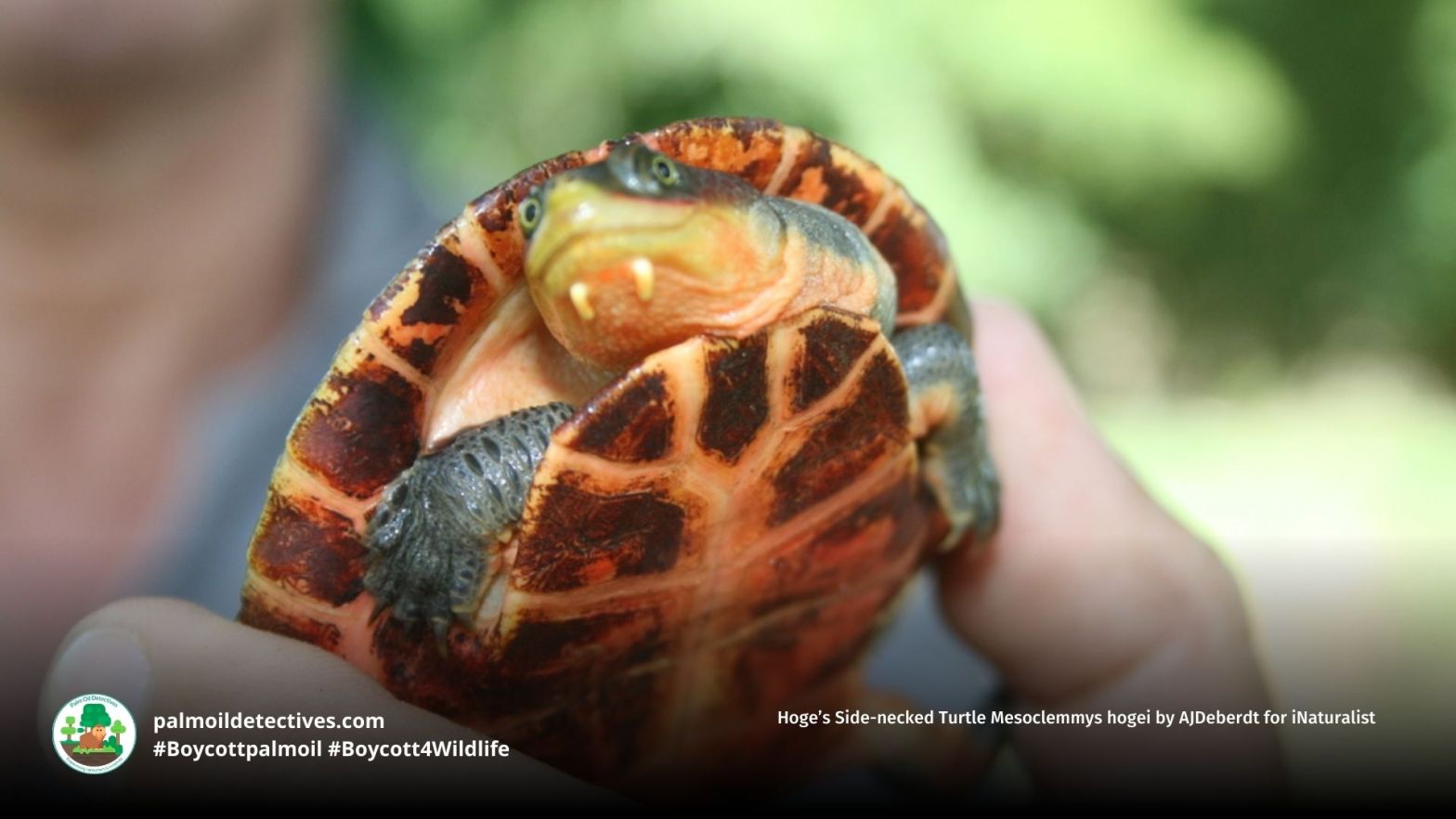
Hoge’s Side-necked Turtle Mesoclemmys hogei
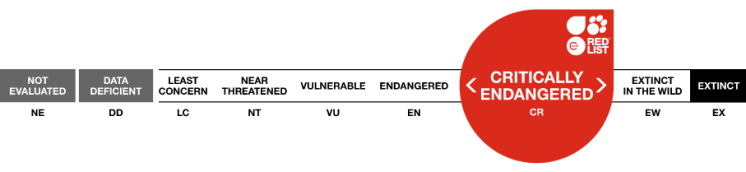
IUCN Red List Status: Critically Endangered
Location: Brazil
Found in southeastern Brazil, this freshwater turtle is endemic to the Atlantic Forest, with confirmed records across the states of Minas Gerais, Rio de Janeiro, and Espírito Santo, especially within the Paraíba do Sul, Itabapoana, and Itapemirim river basins.
The Hoge’s Side-necked Turtle Ranacephala hogei—also known as Hoge’s Toadhead Turtle—is one of #Brazil’s rarest and most endangered reptiles. Having diverged from other turtles some 80 million years ago, they are evolutionary survivors now on the brink. With fewer than 2,000 individuals thought to remain, their populations have plummeted due to #palmoil #soy and #meat #deforestation, damming, water pollution, and incidental deaths in fisheries. Once feared lost from parts of their range, new research using citizen science and extensive fieldwork has rediscovered them in previously unknown areas, sparking renewed hope. But the threats remain. Help them every time you shop and #BoycottPalmOil #Boycott4Wildlife, be #Vegan and #BoycottMeat
For 80 million years Hoges Side-Necked 🐢💚#Turtles 💚🐢 have lived in #Brazil 🇧🇷. Now rampant #deforestation for #soy #palmoil #meat and hydroelectric dams threaten their survival, be #vegan and #BoycottPalmOil 🌴🩸🚜🔥⛔️ #Boycott4Wildlife @palmoildetect https://palmoildetectives.com/2021/03/11/hoges-side-necked-turtle-mesoclemmys-hogei/
Fewer than 2000 Hoges Side-Necked 🐢💚#Turtles 💚🐢 remain alive in #Brazil 🇧🇷. Widepsread #deforestation for #soy #palmoil #meat and roads threaten their survival, be #vegan and #BoycottPalmOil 🌴🩸🚜🔥⛔️ #Boycott4Wildlife @palmoildetect https://palmoildetectives.com/2021/03/11/hoges-side-necked-turtle-mesoclemmys-hogei/
Appearance and Behaviour
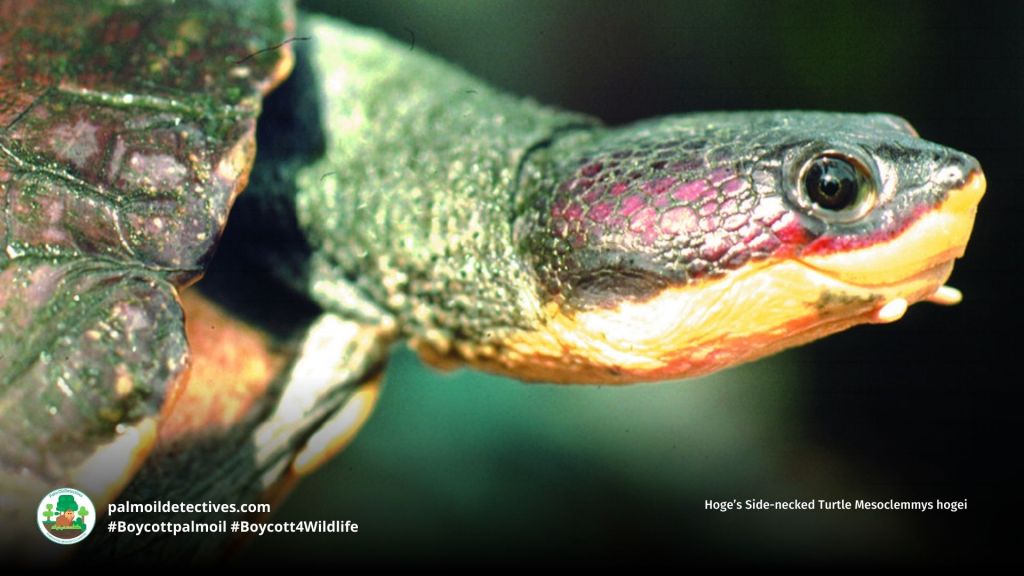
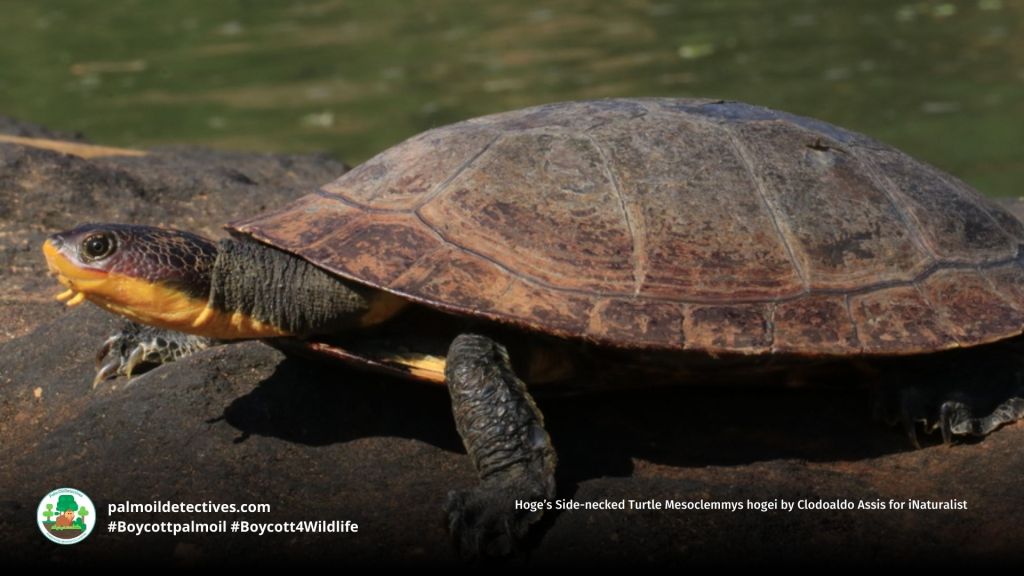
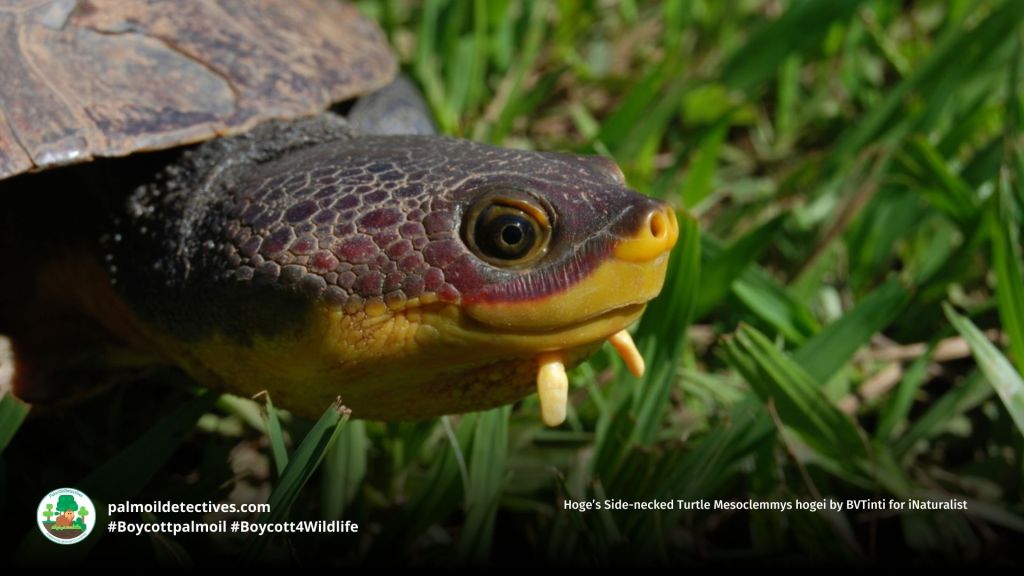
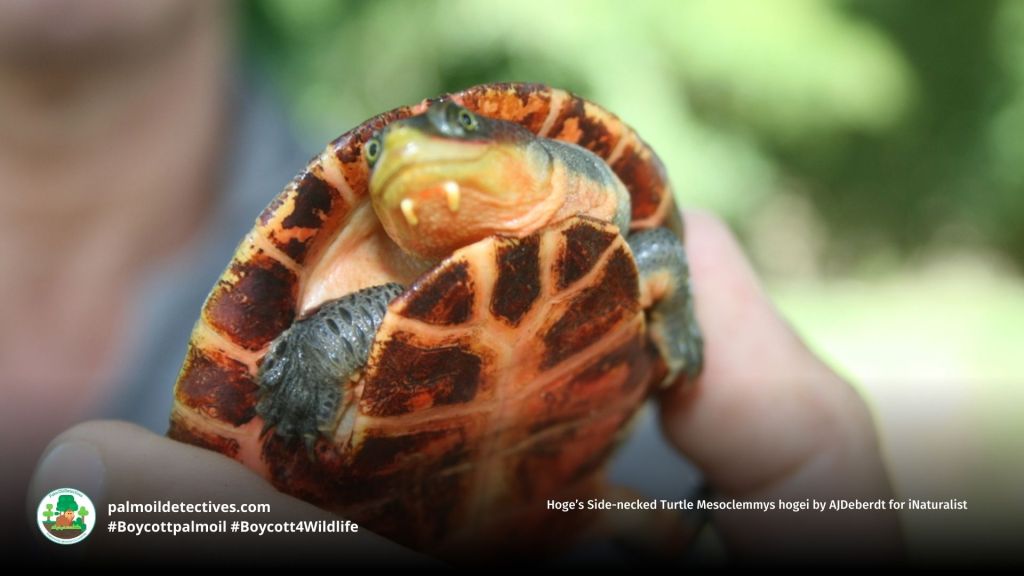
These unique turtles are members of the Chelidae family, or side-necked turtles, distinguished by the sideways tucking of their long necks rather than retracting straight back. Adult turtles can reach up to 38 cm in shell length and possess broad, flattened heads that lend them the nickname ‘toadhead turtle’. They are highly aquatic, preferring slow-flowing forest rivers and lakes with dense canopy cover. Adults are rarely seen on land outside the nesting season, while juveniles have also been spotted in small forest streams.

Diet
While little is known about their specific diet, Hoge’s Side-necked Turtle is likely omnivorous like others in their family, feeding on aquatic plants, insects, molluscs, fish, and amphibians. Their broad, muscular jaws suggest they are well-equipped to crush hard-shelled prey.
Reproduction and Mating
Nesting occurs between January and April. Females lay clutches of 5 to 11 eggs, likely on sandy or forested riverbanks. Population studies show a concerning lack of juveniles, suggesting high mortality among hatchlings. Egg predation, water pollution, or reduced fertility due to environmental stress may be contributing to this failure.
Geographic Range
Endemic to the Atlantic Forest, Hoge’s Side-necked Turtle has been confirmed in the states of Minas Gerais, Rio de Janeiro, and Espírito Santo. New research in 2024 expanded its known range by 144%, including findings in the Itabapoana, Lagoa Feia, Itapemirim, and São Salvador basins. The turtle is most frequently found in the Paraíba do Sul River system, though populations remain highly fragmented. Its historical presence in São Paulo remains uncertain.
Threats

Of 18 known subpopulations, 10 have been lost in the past 40 years, corresponding to roughly a 60% loss of sites during an estimated two turtle generations (generation time conservatively estimated as c. 20 years). Habitat destruction is the principal cause of population declines in this species (Moreira 1994, Drummond and Molina 2008, Drummond and Coutinho 2015).
IUCN RED LIST
• Severe habitat destruction from palm oil, soy and meat deforestation, agriculture, and urban expansion.
• Water pollution from sewage, industry, and agricultural runoff.
• Damming of rivers alters habitat and disrupts breeding cycles.
• High juvenile mortality possibly due to egg predation and environmental toxicity.
• Incidental capture and drowning on fishing hooks in freshwater fisheries.
• Critically low genetic diversity reduces resilience to disease and climate stress.
Take Action!
Protecting Hoge’s Side-necked Turtle and other endangered reptiles means safeguarding one of the Atlantic Forest’s rarest and most ancient inhabitants. Boycott palm oil and meat products driving deforestation in Brazil. Support agroecology and forest restoration efforts. Push for stronger protections of Brazil’s freshwater systems and speak out against illegal fishing and deforestation for palm oil, meat and soy. #BoycottPalmOil #Boycott4Wildlife #Vegan #BoycottMeat
FAQs
How many Hoge’s Side-necked Turtles are left in the wild?
The most documented population in the Carangola River is estimated to number fewer than 2,000 individuals. Many subpopulations have declined by over 80% in the past three generations (Drummond et al., 2016), and their distribution remains extremely limited and fragmented.
Why is the Hoge’s Side-Necked Turtle so endangered?
A combination of threats—including water pollution, damming, habitat loss, and by-catch in fishing gear—has driven dramatic declines for this turtle. Its nesting habitat depends on intact rainforest reaching the river’s edge, yet much of this has been cleared for agriculture. Extremely low genetic diversity also increases the species’ vulnerability to environmental changes and disease.
Has the turtle’s range changed over time?
Yes. For many years, R. hogei was thought to be limited to the Carangola and Paraíba do Sul rivers. However, a 2024 study confirmed its presence across five major basins, with 44 confirmed occurrence points, including four protected areas and multiple new localities thanks to citizen science. This expands conservation possibilities and highlights the species’ resilience in overlooked rural areas (Assis et al., 2024).
What is being done to save Hoge’s Side-necked Turtle?
No-fishing zones and awareness campaigns have also been introduced. Despite these efforts, much more needs to be done, especially to protect water quality, restore forested buffers, and mitigate egg predation.
Support the conservation of this species
Further Information
Assis, C. L., et al. (2024). Extensive sampling and citizen science expand the distribution of the threatened freshwater turtle Ranacephala hogei (Mertens, 1967). Anais da Academia Brasileira de Ciências, 96(suppl 1). https://doi.org/10.1590/0001-3765202420240484
Drummond, G.M., Coutinho, M.E. & Vogt, R.C. 2016. Mesoclemmys hogei. The IUCN Red List of Threatened Species 2016: e.T17081A1316719. https://dx.doi.org/10.2305/IUCN.UK.2016-1.RLTS.T17081A1316719.en. Downloaded on 05 March 2021.
EDGE of Existence. (2024). Hoge’s Toadhead Turtle (Mesoclemmys hogei). Zoological Society of London. Retrieved March 22, 2025, from https://www.edgeofexistence.org/species/hoges-toadhead-turtle/
Wikipedia contributors. (n.d.). Hoge’s side-necked turtle. In Wikipedia, The Free Encyclopedia. Retrieved March 22, 2025, from https://en.wikipedia.org/wiki/Hoge%27s_side-necked_turtle

How can I help the #Boycott4Wildlife?
Take Action in Five Ways
1. Join the #Boycott4Wildlife on social media and subscribe to stay in the loop: Share posts from this website to your own network on Twitter, Mastadon, Instagram, Facebook and Youtube using the hashtags #Boycottpalmoil #Boycott4Wildlife.
2. Contribute stories: Academics, conservationists, scientists, indigenous rights advocates and animal rights advocates working to expose the corruption of the palm oil industry or to save animals can contribute stories to the website.



3. Supermarket sleuthing: Next time you’re in the supermarket, take photos of products containing palm oil. Share these to social media along with the hashtags to call out the greenwashing and ecocide of the brands who use palm oil. You can also take photos of palm oil free products and congratulate brands when they go palm oil free.
4. Take to the streets: Get in touch with Palm Oil Detectives to find out more.
5. Donate: Make a one-off or monthly donation to Palm Oil Detectives as a way of saying thank you and to help pay for ongoing running costs of the website and social media campaigns. Donate here
Discover more from Palm Oil Detectives
Subscribe to get the latest posts sent to your email.
 Palm Oil Detectives