

Pygmy Marmoset Cebuella niveiventris and Cebuella pygmaea
Red List Status:
- Western pygmy marmoset (Cebuella pygmaea): Vulnerable (IUCN Red List, 2021)
- Eastern pygmy marmoset (Cebuella niveiventris): Not formally assessed as a separate species by the Red List, but likely faces similar threats.
Locations:
- Western pygmy marmoset: Northwestern Amazon Basin, including Colombia, Ecuador, Peru, Brazil (north of the Solimões/Amazon River)
- Eastern pygmy marmoset: Southwestern Amazon Basin, including northeastern Peru, western Brazil (states of Amazonas and Acre), eastern Bolivia, and confirmed in Ecuador north of the Marañón River
The petite pygmy #marmoset, the world’s tiniest true #monkey, boasts a mix of brownish-gold, grey, and tawny fur. These little wonders, weighing just around 100 grams, communicate uniquely using chemical, vocal, and visual cues to ensure group safety and harmony. Although these #marmosets prefer river-edge forests and can adapt to secondary forests, their homes are under serious threat. Rampant #deforestation for #meat, #goldmining, and #palmoil cultivation are eroding their habitats, pushing the subspecies Cebuella niveiventris towards a “Vulnerable” status. The situation is dire, with an estimated 30% reduction in their population in just 18 years. Protect these delicate creatures and their home – use your wallet as a weapon, be #vegan, #BoycottPalmOil, and #Boycott4Wildlife.🌳🐒
Pygmy Marmosets are the world’s smallest monkeys and arguably one of the cutest 😍🧐🤓🐒🐵 #Vulnerable from #deforestation for #palmoil, rubber, timber and #meat. Resist and be #vegan #BoycottPalmOil #Boycott4Wildlife @palmoildetect https://palmoildetectives.com/2021/09/25/pygmy-marmoset-cebuella-niveiventris-and-cebuella-pygmaea/
Pygmy Marmosets pack a lot of personality into a tiny #monkey 🐒🐵! They’re #vulnerable from #palmoil #mining and #meat #deforestation in #SouthAmerica 😿 Help them survive be #vegan 🥕🍆🫑 #Boycottpalmoil 🌴☠️⛔️ #Boycott4Wildlife @palmoildetect https://palmoildetectives.com/2021/09/25/pygmy-marmoset-cebuella-niveiventris-and-cebuella-pygmaea/

Appearance and Behaviour
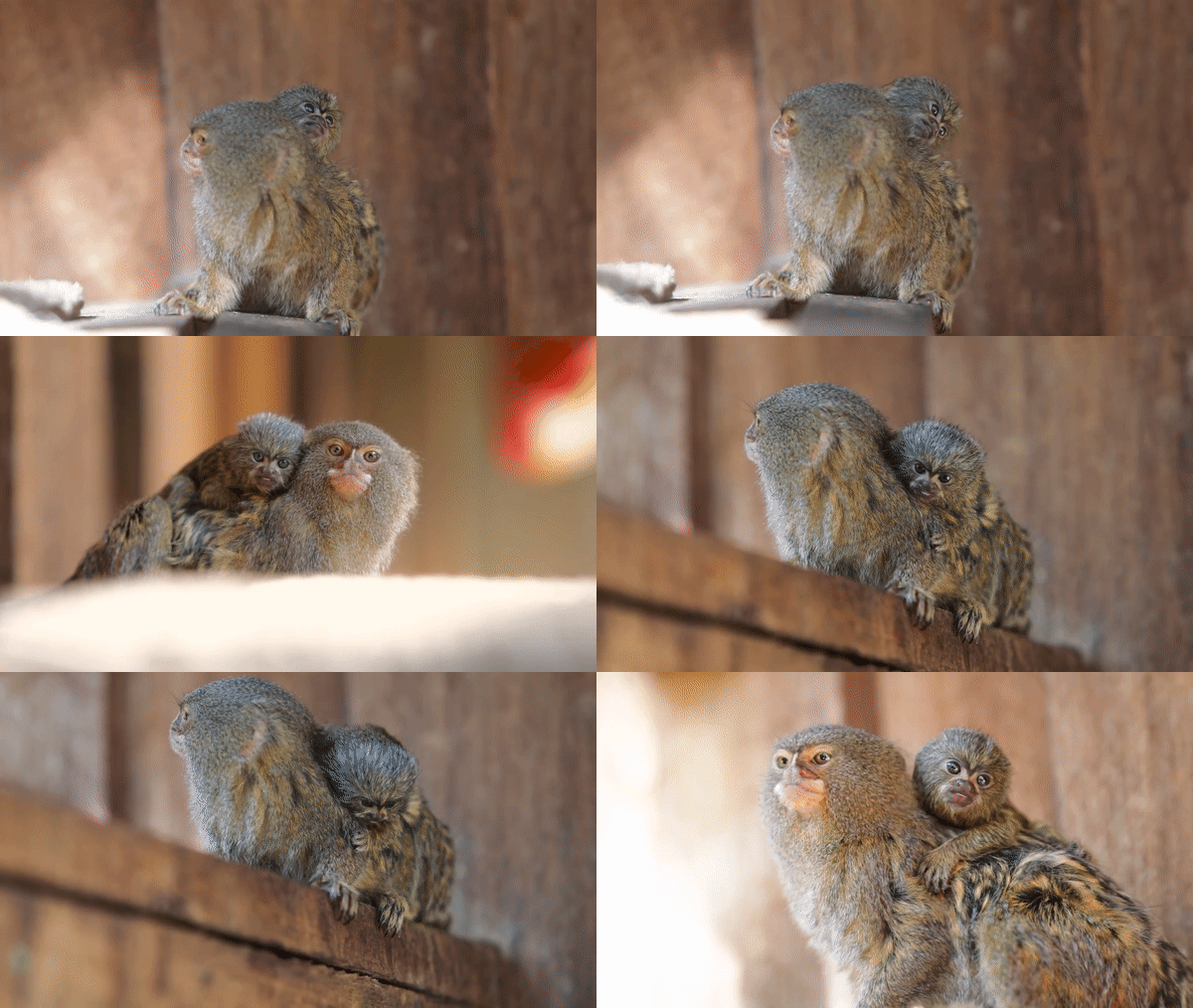
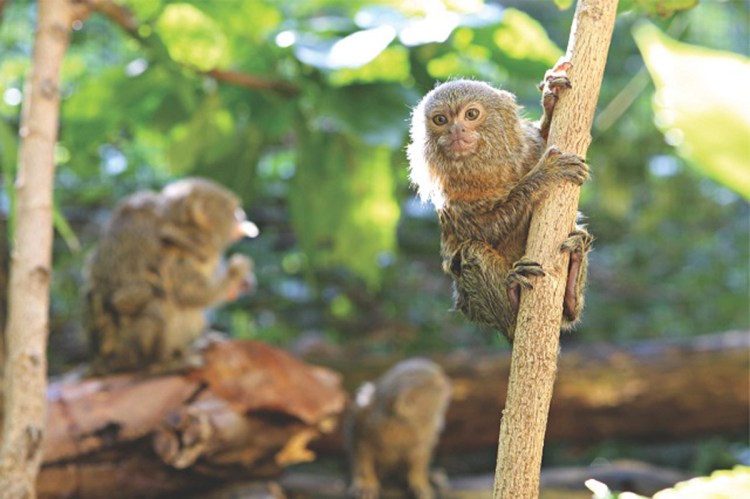
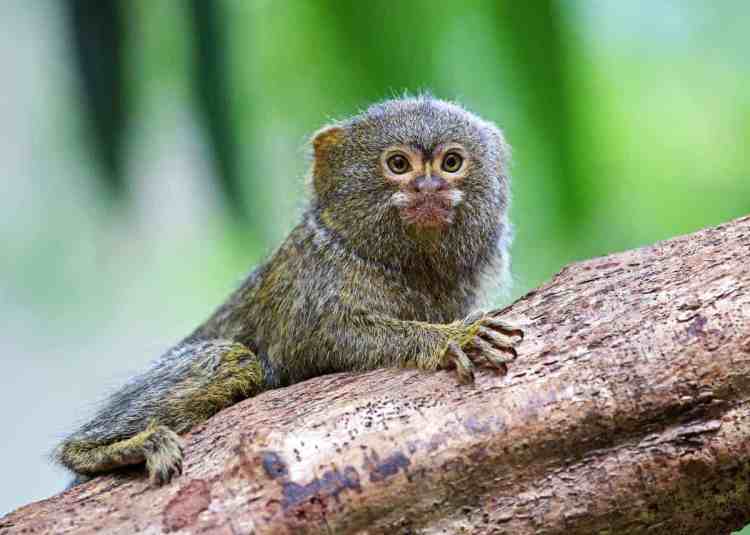
The pygmy marmoset is world’s smallest true monkey, with a head-body length ranging from 117 to 152 mm and a tail of 172 to 229 mm. The average adult body weight is just over 100 grams, with the only sexual dimorphism of females being a little heavier. Their fur colour is a mixture of brownish-gold, grey, and black on their backs and head and yellow, orange, and tawny on their underparts. Pygmy marmosets use special types of communication to give alerts and warning their family members. These include chemical, vocal, and visual types of communication. This is believed to serve to promote group cohesion and avoidance of other family groups.
Pygmy marmosets are highly social, living in small family groups of two to nine individuals, usually a monogamous breeding pair and their offspring. Their days are spent foraging, grooming, and communicating through a complex system of calls, gestures, and scent marking. The pygmy marmoset’s most distinctive behaviour is their gum-feeding: using sharp, chisel-like incisors, they gnaw holes in the bark of trees to stimulate the flow of sap, which they lap up with their agile tongues. This adaptation makes them one of the few primates specialised for a diet of tree exudates.
Threats
Pygmy Marmosets have undergone a population reduction suspected to be >30% over a three-generation period (18 years) due to a continuing decline in area, extent and quality of habitat from deforestation, mining, oil palm cultivation, settlements and other anthropogenic threats, and from hunting.
IUCN red list
Palm oil, meat, and soy deforestation
The western pygmy marmoset is classified as Vulnerable on the Red List, with habitat loss the primary threat to both species. Across the Amazon Basin, forests are being cleared for palm oil plantations, cattle ranching, and soy cultivation, especially in Brazil and Peru. These industrial-scale operations strip away the dense, multi-layered vegetation that pygmy marmosets depend on for food and shelter. The once-continuous canopy is reduced to isolated patches, forcing marmosets into ever-smaller territories and increasing competition for resources.
Logging and habitat fragmentation
Logging operations further fragment the remaining forest habitat of pygmy marmosets. Roads and clearings cut through the forest, severing the connections that marmosets rely on for movement and foraging. Fragmentation isolates populations, reducing genetic diversity and increasing vulnerability to disease and environmental change. In many areas, only small, isolated groups of marmosets remain, cut off from neighbouring populations by expanses of cleared land.
Hunting and capture for the illegal pet trade
Hunting for the illegal pet trade is a persistent threat to pygmy marmosets. Their small size and appealing appearance make them attractive targets for wildlife traffickers. Capturing marmosets often involves killing adult animals to obtain infants, tearing families apart and leaving young marmosets to suffer in captivity. The pet trade is a relentless pressure, fuelled by demand for exotic pets and the ongoing destruction of their natural habitat.
Gold mining and associated water and soil pollution
Gold mining operations in the Amazon release toxic mercury into rivers and soil, poisoning the rainforest and its non-human and human inhabitants. Gold mining exacts a devastating toll on ecosystems, indigenous peoples and wild animals for decades after it has taken place.
Climate change and associated food source shortages
Climate change adds further pressure, altering rainfall patterns and the availability of food resources and shelter. The pygmy marmoset’s world is becoming hotter, drier, and less predictable, with the forests they depend on shrinking year by year. Extreme weather events, such as floods and droughts, can destroy habitat and isolate populations even further.
Diet
Pygmy marmosets are gum-feeding specialists, or “gummivores,” with tree sap and gum making up the majority of their diet. Using their sharp, chisel-like incisors, they gnaw holes in the bark of trees to stimulate the flow of sap, which they lap up with their agile tongues. This adaptation allows them to exploit a food source that few other animals can access. In addition to tree exudates, pygmy marmosets also eat insects, nectar, and occasionally fruit, but these make up a much smaller part of their diet. Their feeding habits are closely tied to the health of the forest, and the loss of tree cover threatens their ability to find enough to eat.
Reproduction and Mating
Pygmy marmosets are monogamous, forming lifelong pair bonds within their family groups. Only the dominant female in the group breeds, typically producing twins twice a year after a gestation period of about four and a half months. The mother is the primary caregiver, nursing and grooming her young, while the father and other group members help carry and protect the infants. This cooperative parenting is essential for the survival of the young, as the forest is full of predators and other dangers. Offspring remain with their parents until they reach maturity, learning the skills they need to survive in the wild.
Geographic Range
The western pygmy marmoset (Cebuella pygmaea) is found in the northwestern Amazon Basin, including Colombia, Ecuador, Peru, and Brazil (north of the Solimões/Amazon River). The eastern pygmy marmoset (Cebuella niveiventris) inhabits the southwestern Amazon Basin, including northeastern Peru, western Brazil (states of Amazonas and Acre), eastern Bolivia, and has recently been confirmed in Ecuador north of the Marañón River. Both species prefer river-edge forests and dense undergrowth, rarely venturing more than 18 metres above the ground. Their historical range has contracted due to deforestation and human encroachment, and they are now restricted to the few remaining patches of suitable habitat.
FAQs
How many pygmy marmosets are left?
There are no precise population estimates for the eastern or western pygmy marmoset, but both species are believed to be declining due to habitat loss, hunting, and the illegal pet trade. The western pygmy marmoset is classified as Vulnerable on the Red List, with a population reduction of more than 30% projected over three generations. The eastern pygmy marmoset likely faces similar threats, though it has not been formally assessed as a separate species.
What are the characteristics of the pygmy marmoset?
Pygmy marmosets are the smallest monkeys in the world, with adults measuring just 12 to 16 centimetres in body length and weighing between 110 and 122 grams. They have soft, dense fur, sharp claws for climbing, and specialised incisors for gnawing tree bark to access sap. Pygmy marmosets are highly social, living in small family groups, and communicate through a complex system of calls, gestures, and scent marking. Their most distinctive behaviour is their gum-feeding, which makes them unique among primates.
Where do pygmy marmosets live?
Pygmy marmosets are found in the Amazon Basin of South America. The western pygmy marmoset inhabits the northwestern Amazon, including Colombia, Ecuador, Peru, and Brazil (north of the Solimões/Amazon River). The eastern pygmy marmoset lives in the southwestern Amazon, including northeastern Peru, western Brazil (states of Amazonas and Acre), eastern Bolivia, and has been confirmed in Ecuador north of the Marañón River. Both species prefer river-edge forests and dense undergrowth.
What are the threats to the survival of the pygmy marmoset?
The main threats to the survival of pygmy marmosets are habitat loss from palm oil plantations, cattle ranching, soy cultivation, and logging, as well as hunting for the illegal pet trade. Deforestation and fragmentation isolate populations, reducing genetic diversity and increasing vulnerability to disease and environmental change. Mining and climate change add further pressure, altering the availability of food and shelter. The pet trade is a persistent threat, fuelled by demand for exotic pets and the ongoing destruction of their natural habitat.
Do pygmy marmosets make good pets?
Pygmy marmosets do not make good pets. Captivity causes extreme stress, loneliness, and early death for these highly social, intelligent animals. The pet trade rips families apart and fuels extinction, as infants are stolen from their mothers and forced into unnatural, impoverished conditions. Protecting pygmy marmosets means rejecting the illegal pet trade and supporting their right to live wild and free in their forest home.
What is the lifespan of a pygmy marmoset?
Pygmy marmosets have an average lifespan of about 12 years in the wild, though this can be much shorter in captivity due to stress and inadequate care. Their survival is closely tied to the health of their forest home and the strength of their social bonds. The loss of habitat and the pressures of the pet trade make it increasingly difficult for pygmy marmosets to reach old age.
Take Action!
Use your wallet as a weapon and #BoycottPalmOil #Boycott4Wildlife. Support indigenous-led conservation and agroecology. Reject products linked to deforestation, mining, and the illegal wildlife trade. Adopt a #vegan lifestyle and #BoycottMeat to protect wild and farmed animals alike. Every choice matters—stand with the pygmy marmoset and defend the forests of the Amazon.
You can support this beautiful animal
There are no known conservation activities for this animal. Share out this post to social media and join the #BoycottPalmOil #Boycott4Wildlife on social media to raise awareness
Further Information
Merazonia wildlife rescue and sanctuary rehabilitate tamarins, some of the most trafficked animals in the world. Donate to them here

Bossano, D., Sanmiguel, R., & de la Torre, S. (2024). Severe population decline of southern pygmy marmosets (Cebuella niveiventris) in a protected forest in Ecuador. Primate Conservation, 38, 15–21. https://research.usfq.edu.ec/en/publications/severe-population-decline-of-southern-pygmy-marmosets-cebuella-ni
de la Torre, S., Calouro, A.M., Wallace, R.B., Mollinedo, J.M., Messias, M.R. & Valença-Montenegro, M.M. 2021. Cebuella niveiventris (amended version of 2020 assessment). The IUCN Red List of Threatened Species 2021: e.T136865A191707236. https://dx.doi.org/10.2305/IUCN.UK.2021-1.RLTS.T136865A191707236.en. Downloaded on 06 June 2021.
de la Torre, S., Shanee, S., Palacios, E., Calouro, A.M., Messias, M.R. & Valença-Montenegro, M.M. 2021. Cebuella pygmaea (amended version of 2020 assessment). The IUCN Red List of Threatened Species 2021: e.T136926A191707442. https://dx.doi.org/10.2305/IUCN.UK.2021-1.RLTS.T136926A191707442.en. Downloaded on 06 June 2021.
Hawkins, E., & Papworth, S. (2022). Little evidence to support the risk–disturbance hypothesis as an explanation for responses to anthropogenic noise by pygmy marmosets (Cebuella niveiventris) at a tourism site in the Peruvian Amazon. International Journal of Primatology, 43(6), 1110–1132. https://www.ncbi.nlm.nih.gov/pmc/articles/PMC9438364/
International Union for Conservation of Nature (IUCN). (2021). Cebuella pygmaea. The IUCN Red List of Threatened Species 2021: e.T136926A200203263. https://dx.doi.org/10.2305/IUCN.UK.2021-2.RLTS.T136926A200203263.en
Wikipedia. (n.d.). Pygmy marmoset. https://en.wikipedia.org/wiki/Pygmy_marmoset
Wikipedia. (n.d.). Eastern pygmy marmoset. https://en.wikipedia.org/wiki/Eastern_pygmy_marmoset

How can I help the #Boycott4Wildlife?
Take Action in Five Ways
1. Join the #Boycott4Wildlife on social media and subscribe to stay in the loop: Share posts from this website to your own network on Twitter, Mastadon, Instagram, Facebook and Youtube using the hashtags #Boycottpalmoil #Boycott4Wildlife.
2. Contribute stories: Academics, conservationists, scientists, indigenous rights advocates and animal rights advocates working to expose the corruption of the palm oil industry or to save animals can contribute stories to the website.





3. Supermarket sleuthing: Next time you’re in the supermarket, take photos of products containing palm oil. Share these to social media along with the hashtags to call out the greenwashing and ecocide of the brands who use palm oil. You can also take photos of palm oil free products and congratulate brands when they go palm oil free.
4. Take to the streets: Get in touch with Palm Oil Detectives to find out more.
5. Donate: Make a one-off or monthly donation to Palm Oil Detectives as a way of saying thank you and to help pay for ongoing running costs of the website and social media campaigns. Donate here
Discover more from Palm Oil Detectives
Subscribe to get the latest posts sent to your email.
 Palm Oil Detectives
One thought on “Pygmy Marmoset Cebuella niveiventris and Cebuella pygmaea”