

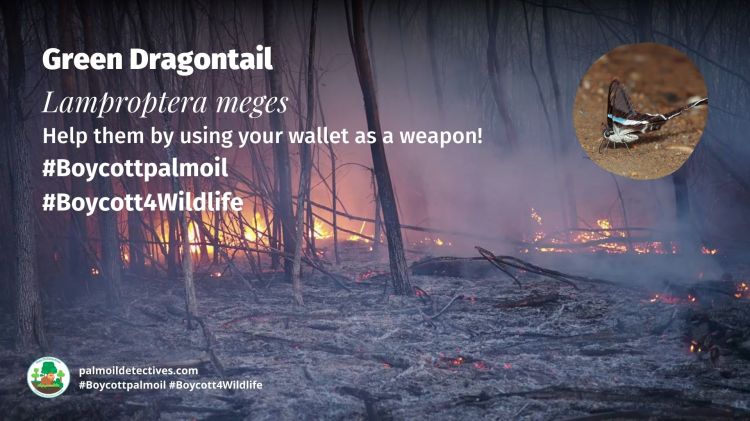
Green Dragontail Lamproptera meges
Vulnerable
Shimmering and transparent Green Dragontails 🐛🦋🪞 are forest-dwelling butterflies of SE Asia, fighting to survive due to #palmoil #deforestation 🌴🔥 help them by going #vegan 🍇🌽🍓 #Boycottpalmoil #Boycott4Wildlife in the supermarket @palmoildetect https://palmoildetectives.com/2024/01/14/green-dragontail-lamproptera-meges/
Green Dragontails could be called the most exquisite and beautiful #butterflies alive 😻🤟🦋They are #vulnerable due to #palmoil 🌴🪔🚫 and other #deforestation. Help them to survive! Be #vegan and #Boycottpalmoil #Boycott4Wildlife @palmoildetect https://palmoildetectives.com/2024/01/14/green-dragontail-lamproptera-meges/
Extant (resident)
Thailand, Myanmar, Vietnam, Laos, Cambodia, south China, Brunei, eastern Malaysia, Philippines, Brunei, Indonesian archipelago (Nias, Java, Sulawesi, Java, and Bangka) and northeastern India (Arunachal Pradesh, Nagaland, Assam, Manipur)
Green Dragontails could arguably be called the most exquisite and beautiful butterflies alive.
They flutter through sunlit patches of leaves near to streams and rivers in Indonesia, Malaysia, Thailand, Myanmar, the Philippines, and northeastern India.
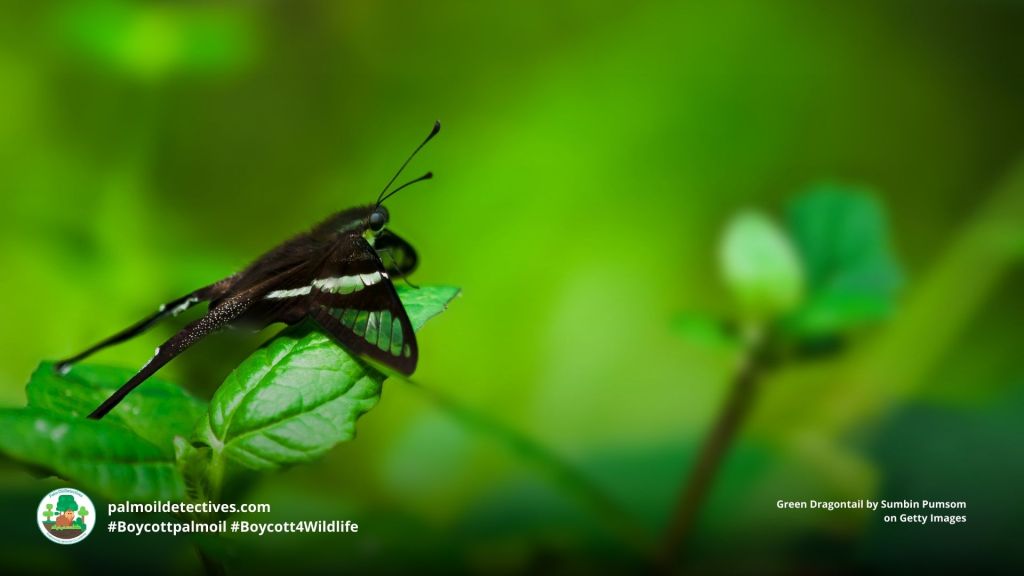
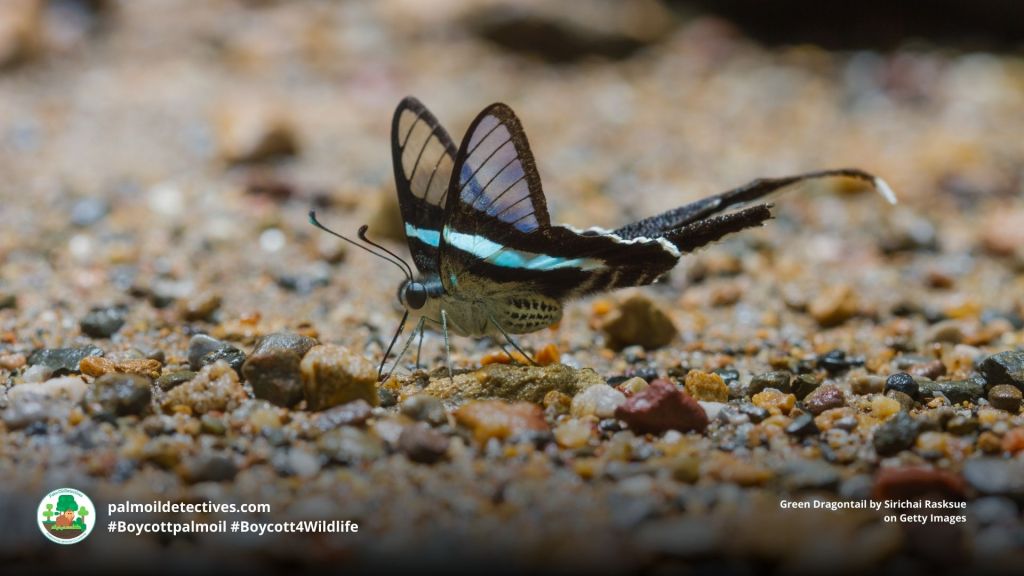
They are mostly black and white with a bright turquoise or light green band running roughly parallel to their abdomens.
Their forewings feature a stunning glass-like transparent triangle known as a hyaline. Their tail features a star-like galaxy pattern that glints in sunlight.
It has been over a decade since they were last surveyed, their range overlaps significantly with areas already cleared for palm oil. Help their survival and use your wallet as a weapon! #Boycottpalmoil #Boycott4Wildlife
Green Dragontails belong to the swallowtail butterfly family, endemic to South and Southeast Asia. They are mostly black and white with a bright turquoise or light green band running roughly parallel to their abdomens.
The smallest of the dragontail butterflies, adult green dragontails have an average wingspan of only 40-55mm. They flutter through sunlit patches of leaves near to streams and rivers and are typically found in groups of two to three individuals.
Their forewings feature a stunning glass-like transparent triangle known as a hyaline. Their tail features a star-like galaxy pattern that glints in sunlight.
Dragontail butterflies fly in a unique way, flapping their wings extremely rapidly similar to a hummingbird or dragonfly. They use their long ribbon-like tails as rudders for balance while in flight.
Males appear differently to females, with the latter of a more dull coloured appearance. As caterpillars they have a dark green body spotted in black.
Green Dragontail sub-species
- Lamproptera meges meges Sumatra, Java, Borneo
- Lamproptera meges ennius (C. & R. Felder, 1865) northern Sulawesi, central Sulawesi
- Lamproptera meges akirai Tsukada & Nishiyama, 1980 southern Sulawesi
- Lamproptera meges virescens (Butler, [1870]) Burma, Vietnam, Thailand, Peninsular Malaysia, Hainan
- Lamproptera meges annamiticus (Fruhstorfer, 1909) eastern Thailand, southern Vietnam
- Lamproptera meges pallidus (Fruhstorfer, 1909) northern Vietnam
- Lamproptera meges niasicus (Fruhstorfer, 1909) Nias
- Lamproptera meges decius (C. & R. Felder, 1862) Philippines
- Lamproptera meges pessimus Fruhstorfer, 1909 Philippines (Palawan, Balabac, Dumaran)
- Lamproptera meges amplifascia Tytler, 1939 Yunnan, Burma

Threats
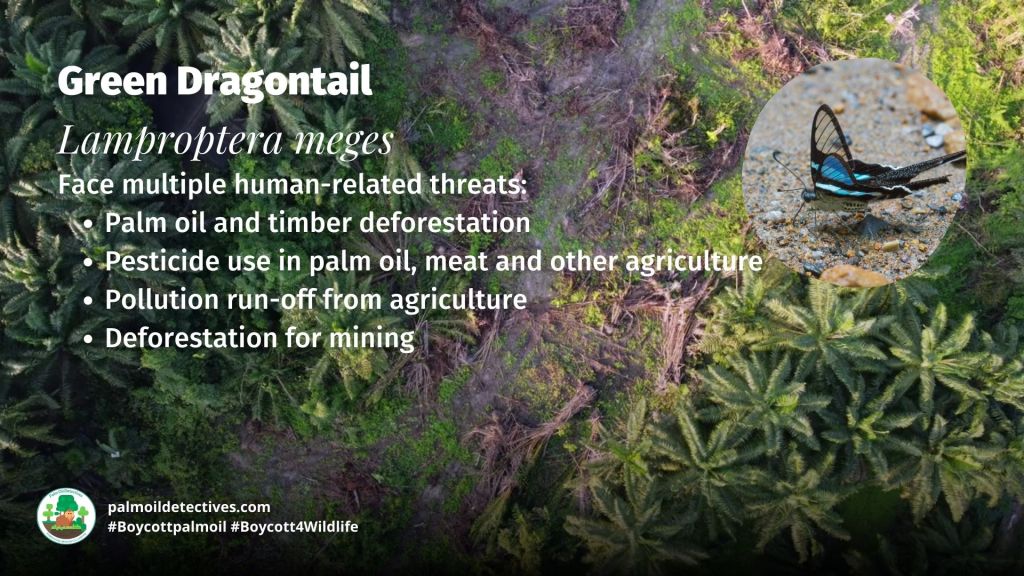
The green dragontail is considered vulnerable and in need of protection in peninsular Malaysia. Although they have not been recently assessed by conservationists, their range overlaps significantly with forests already cleared for palm oil, rubber, timber and other agriculture.
A 2004 study of swallowtails in Assam, India finds they were already extremely rare there
In a study of swallowtail assemblages in Rani-Garbhanga Reserve Forest in Assam in 2003 and 2004, dragontails (Lamproptera species) were found to have one of the lowest mean abundances; both L. meges and L. curius being found in gaps (open patches) as well as in closed forest.[5]
A 2004 report had earlier suggested that the status of the green dragontail in Garbhanga Reserve Forest was “very rare”; later a total of 108 butterflies of genus Lamproptera were seen during the 2003 and 2004 survey, the species-wise breakdown not being published.[
Habitat
Green Dragontails are found in tropical and sub-tropical rain forests in riverine settings like streams, waterfalls, and rivers as well as in leaf litter.
Their range includes northeast India including the states of Arunachal, Assam, Pradesh, Manipur and Nagaland. They are also found in SE Asia in the countries of Thailand, Myanmar, Laos, Vietnam, China, Cambodia, Malaysia, Indonesia and the Philippines. In 2006 they were reportedly found on the islands of Java, Kalimanta, Sulawesi, Nias and Bangka.
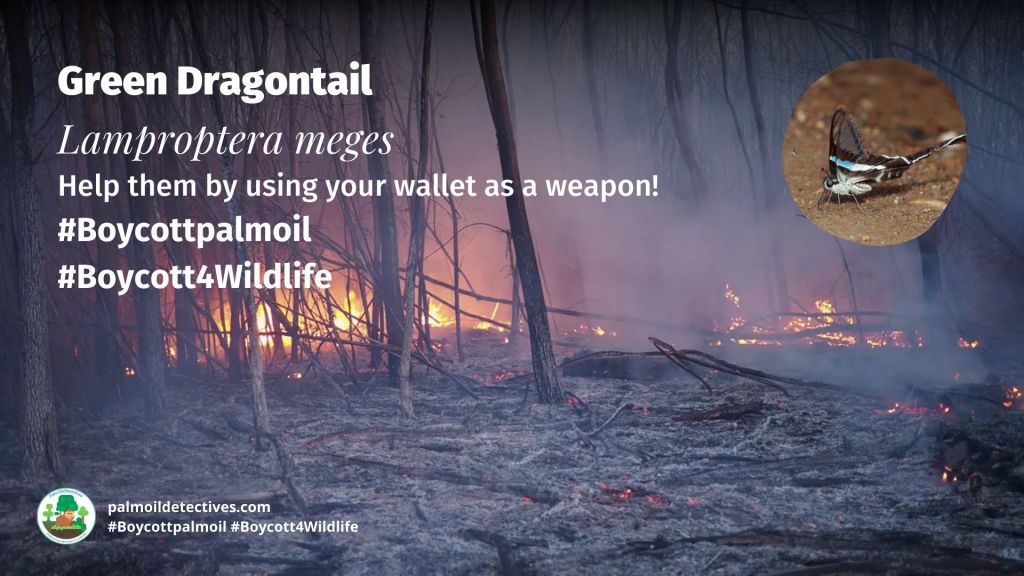
However, in the decades since they were surveyed, their range has been cleared significantly for palm oil in SE Asia. Therefore, it is highly likely that these butterflies have now either gone extinct in these regions or are approaching extinction. Efforts to expand the growth of palm oil in the Assam region of India would also be a serious threat to this butterfly species.
Diet
Because of their straw-like mouthparts, butterflies are mainly restricted to a liquid diet. Butterflies use their proboscis to drink sweet nectar from flowers. The green dragontail has been observed eating from various tropical flowering plants including the family Hernandiaceae.
Mating and breeding
This butterfly’s beauty is ephemeral and shortlived – they have a typical lifespan of between 7 to 12 days. Their eggs are spherical, smooth and pale green. As caterpillars, they are dark green and spotted with black.
Support Green Dragontails by going vegan and boycotting palm oil in the supermarket, it’s the #Boycott4Wildlife
Support the conservation of this species
This animal has no protections in place. Read about other forgotten species here. Create art to support this forgotten animal or raise awareness about them by sharing this post and using the #Boycottpalmoil #Boycott4Wildlife hashtags on social media. Also you can boycott palm oil in the supermarket.
Further Information
Green Dragontail on Butterfly Identification

How can I help the #Boycott4Wildlife?
Take Action in Five Ways
1. Join the #Boycott4Wildlife on social media and subscribe to stay in the loop: Share posts from this website to your own network on Twitter, Mastadon, Instagram, Facebook and Youtube using the hashtags #Boycottpalmoil #Boycott4Wildlife.
2. Contribute stories: Academics, conservationists, scientists, indigenous rights advocates and animal rights advocates working to expose the corruption of the palm oil industry or to save animals can contribute stories to the website.





3. Supermarket sleuthing: Next time you’re in the supermarket, take photos of products containing palm oil. Share these to social media along with the hashtags to call out the greenwashing and ecocide of the brands who use palm oil. You can also take photos of palm oil free products and congratulate brands when they go palm oil free.
4. Take to the streets: Get in touch with Palm Oil Detectives to find out more.
5. Donate: Make a one-off or monthly donation to Palm Oil Detectives as a way of saying thank you and to help pay for ongoing running costs of the website and social media campaigns. Donate here
Discover more from Palm Oil Detectives
Subscribe to get the latest posts sent to your email.
 Palm Oil Detectives