
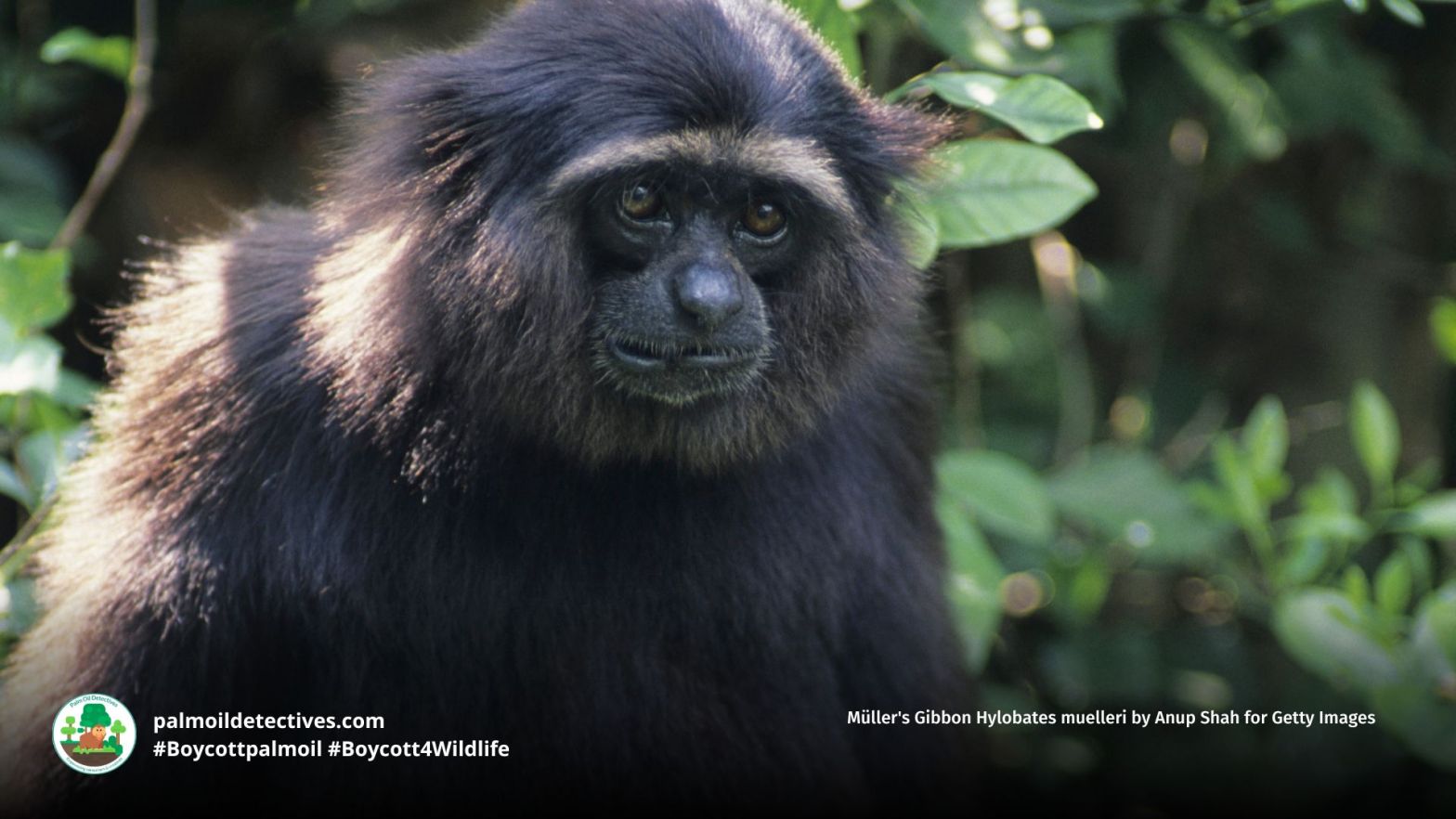
Müller’s gibbon Hylobates muelleri
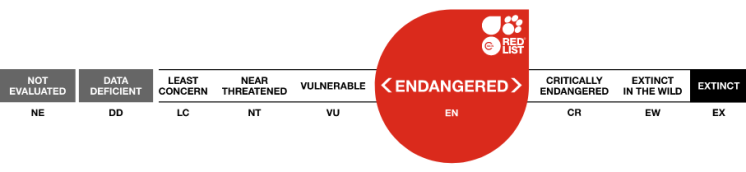
Endangered
Borneo
IUCN Red List Status: Endangered
Location: Indonesia (Kalimantan, Borneo)
The Müller’s Gibbon also known as the Bornean Gibbon or the Southern Grey Gibbon is endemic to the southeastern lowland and hill rainforests of Kalimantan, Indonesia, found between the Mahakam and Barito Rivers. This area has been heavily logged for timber and palm oil.
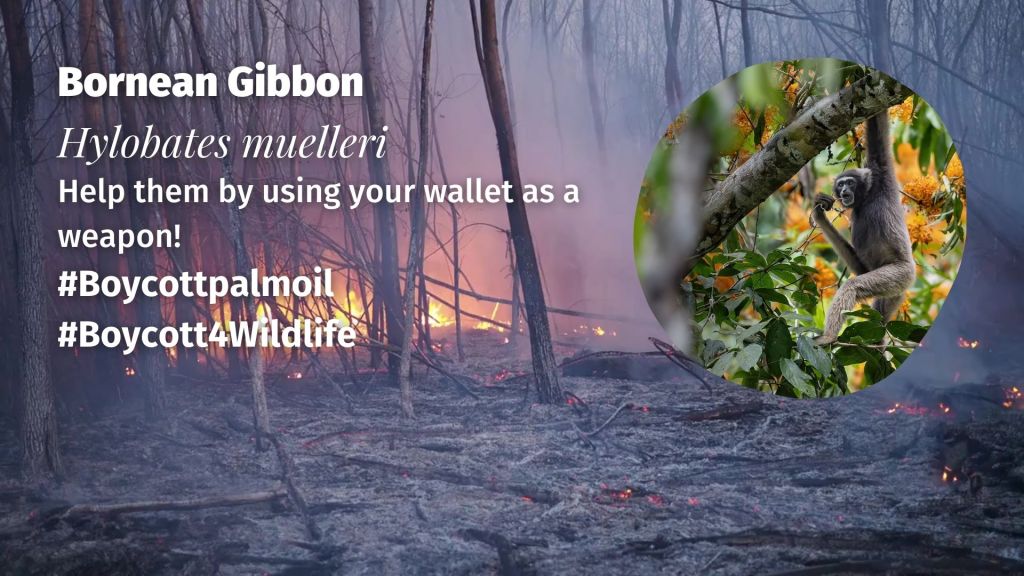
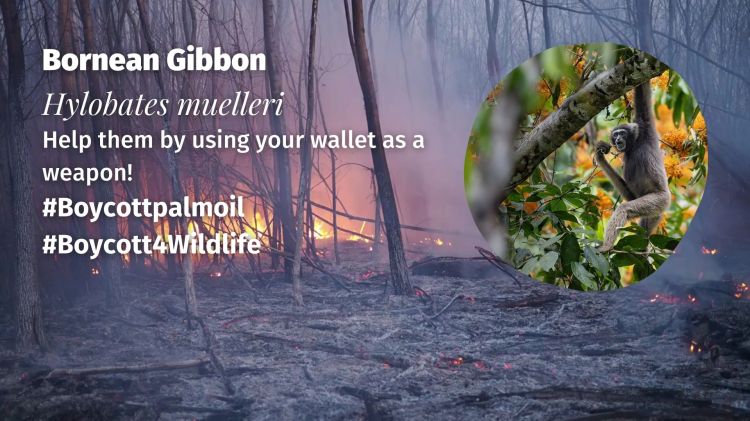
The Müller’s Gibbon Hylobates muelleri, also known as Müller’s #gibbon or the Southern Grey Gibbon, is a master of the treetops and a celebrated forest singer. Their haunting duets echo across the rainforest canopy, keeping family bonds strong and warning intruders away. But these calls are growing rarer. The Müller’s gibbon is listed as #Endangered due to relentless forest loss caused by logging, #palmoil expansion, #fire, and #hunting. Their future depends on the survival of Borneo’s rainforests. Take action and use your wallet as a weapon! #BoycottPalmOil #Boycott4Wildlife be #Vegan and #BoycottMeat
DYK Müller’s #Gibbons recognise each other’s calls with 95% accuracy? 🎵🪇📢This reflects deep social bonds and intelligence 🐵🐒🤎 #Endangered by #palmoil and hunting, help them survive! 🌴🩸🔥🚫 #BoycottPalmOil for them #Boycott4Wildlife @palmoildetect https://palmoildetectives.com/2021/02/06/bornean-gibbon-hylobates-muelleri/
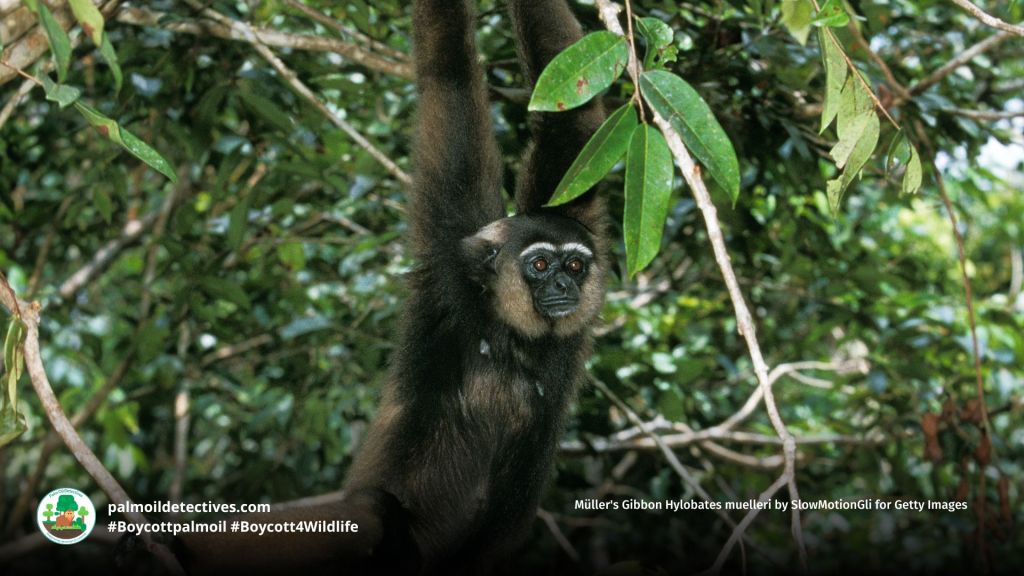
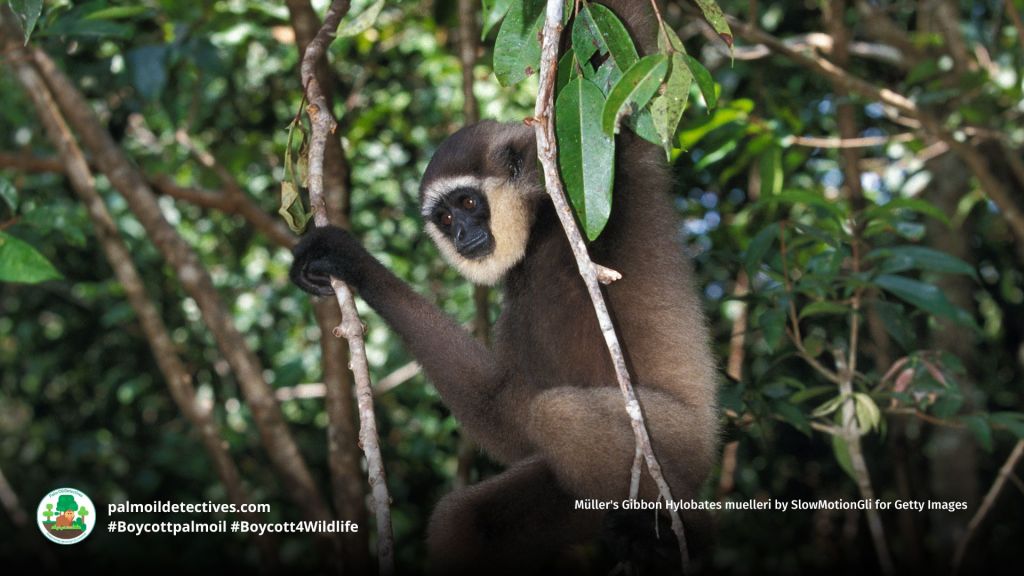
Müller’s Gibbons AKA Southern Grey Gibbons have ash grey fur and a contrasting facial ring. They sing in powerful dawn duets 🐒🐵📢🎶🎷 to mark territory. Don’t let the forest of #Borneo 🇮🇩 go silent! #BoycottPalmOil 🌴⛔️ #Boycott4Wildlife @palmoildetect https://palmoildetectives.com/2021/02/06/bornean-gibbon-hylobates-muelleri/
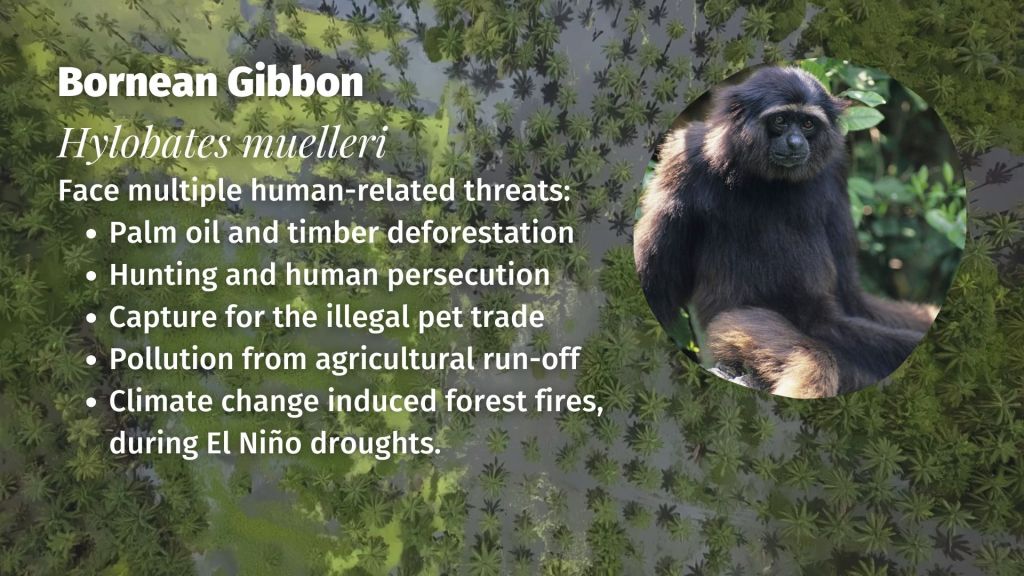
The Müller’s Gibbon is threatened by habitat loss due the expansion of agricultural palm oil plantations, clear-felling for timber and, to a lesser extent, selective logging, all of which are exacerbated by forest fires associated with El Niño events (Bartlett 2007, Campbell et al. 2008, Cheyne et al. 2016). Illegal hunting and live capture for the pet trade pose additional threats (Nijman and Menken 2005).
IUCN Red List
Appearance and Behaviour
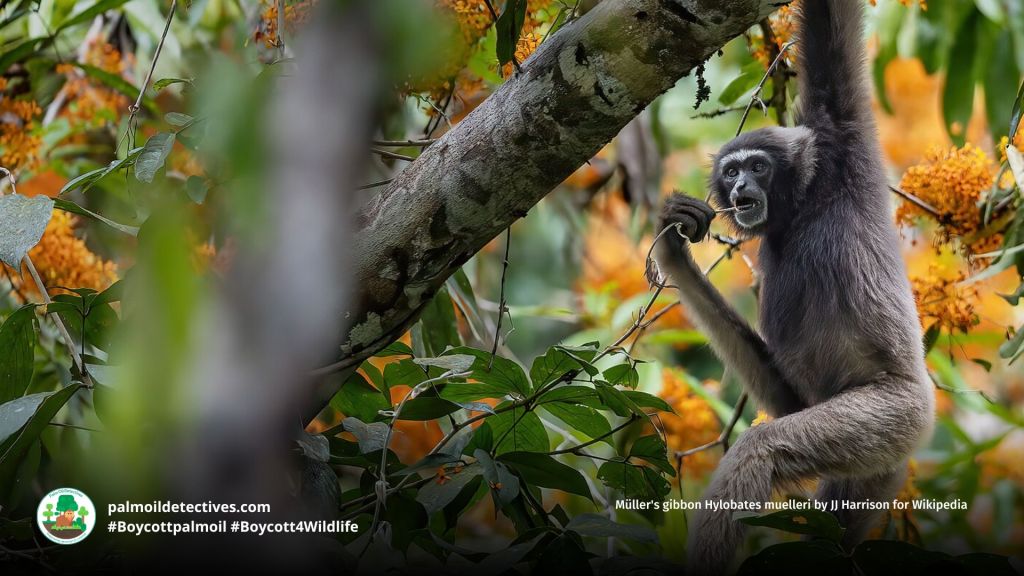
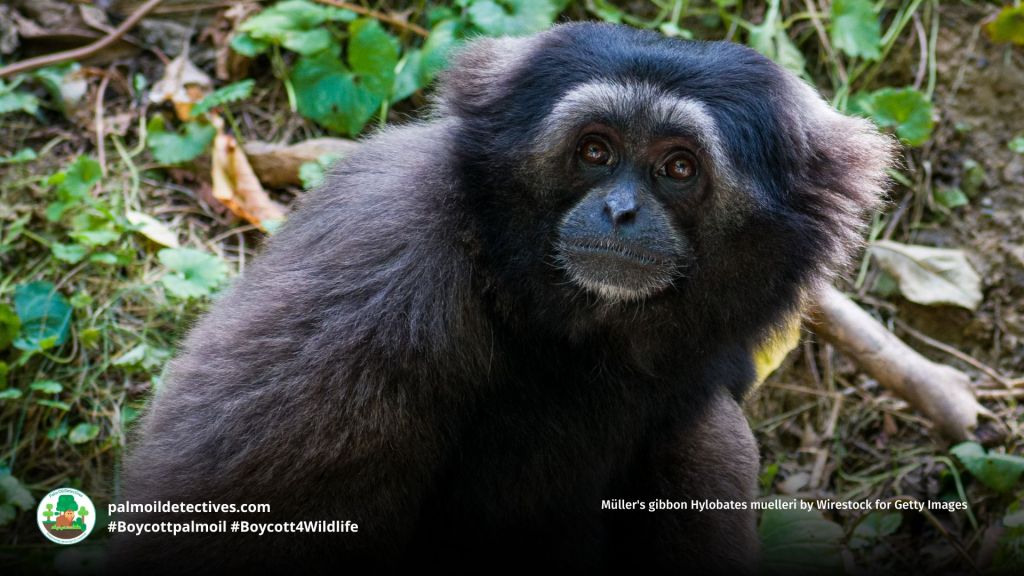
Unlike many gibbon species, male and female Müller’s Gibbons look alike, both clad in ash-grey or brown fur with a bright, contrasting face ring. Some individuals also have a dark cap on their heads. Weighing just 4 to 8 kg, they are nimble and fast-moving, swinging effortlessly through the forest canopy. They live in monogamous family groups and sing long, powerful duets at dawn to mark their territory. Each female has a distinct vocal signature, identifiable by other gibbons with near-perfect accuracy, reflecting deep social bonds and individuality.

Diet
Primarily frugivorous, Müller’s Gibbons prefer soft, pulpy fruits—especially those that are yellow, juicy, and available in large quantities. When fruit is scarce, they supplement their diet with leaves, flowers, and insects. They tend to favour fruit with few or no seeds and have been observed selecting based on traits like colour and size, showing clear preferences when food is plentiful.
Reproduction and Mating
These gibbons form lifelong pair bonds and are thought to follow a reproductive cycle similar to other Hylobates species. Females likely give birth to a single infant every two to three years after a gestation period of about seven months. Pair bonding is maintained through vocal duets and possibly through copulation calls, which some females sing near territorial boundaries—possibly to guard mates and strengthen relationships.
Geographic Range
Hylobates muelleri is found only in southeastern Borneo, Indonesia, south of the Mahakam River and east of the Barito River. These intelligent gibbons inhabit lowland dipterocarp forests and hill rainforests, including protected areas like the Danum Valley Conservation Area. Once more widespread, their range has been dramatically reduced and fragmented by logging, plantations, and fires.
Threats
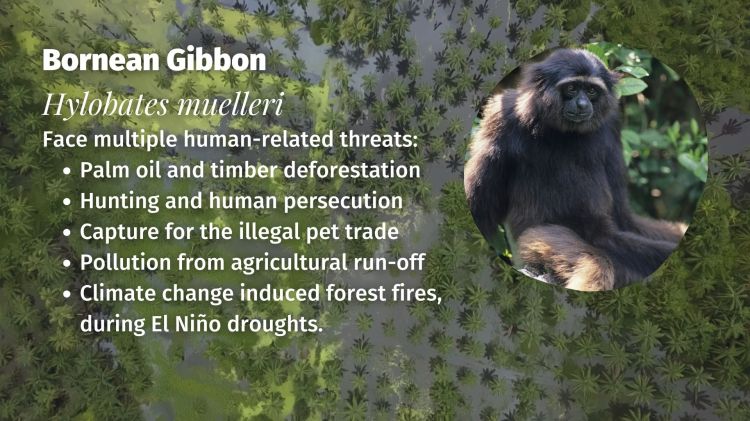
• Industrial logging and clear-felling for timber.
• Out-of-control palm oil plantations replacing native rainforest.
• Climate change induced forest fires, particularly during El Niño droughts.
• Habitat fragmentation reducing connectivity between populations.
• Illegal hunting and capture for the exotic pet trade.
Take Action!
Protect Müller’s Gibbons by boycotting palm oil, demanding deforestation-free products, and supporting indigenous-led conservation across Borneo. Help amplify their songs by defending the forests they depend on. Push governments and companies to end destructive logging and land grabs. Every forest saved keeps a gibbon family singing. Help them every time you shop and #BoycottPalmOil #Boycott4Wildlife be #Vegan and #BoycottMeat
FAQs
How many Müller’s Gibbons are left?
Precise population numbers of these gibbons are unknown, but they are declining rapidly. Habitat loss across Kalimantan has been severe, and the IUCN estimates that nearly 50% of suitable habitat may be lost over three generations (45 years) if current trends continue (Marshall et al., 2020).
What makes the singing of Müller’s Gibbons unique?
Müller’s Gibbons are famous for their haunting morning duets. Each female has a unique vocal signature, and recent studies have shown that other gibbons can identify individual callers with over 95% accuracy (Clink et al., 2017). These calls help maintain pair bonds, defend territories, and possibly even deter rivals from encroaching.
How does palm oil threaten Müller’s Gibbons?
The expansion of palm oil plantations is one of the biggest drivers of deforestation in Borneo. Entire forests have been cleared, pushing gibbon families into isolated fragments. This not only reduces access to food but makes it harder to find mates or escape poachers. There is no such thing as sustainable palm oil—boycott it entirely to protect forest wildlife.
Are Mueller’s Gibbons hunted or captured?
Yes. Despite legal protections, Müller’s Gibbons are sometimes hunted or caught for the pet trade. Young gibbons are especially vulnerable, and capturing them often involves killing the mother. This cruel trade contributes directly to population declines and family disruption.
Further Information
Clink, D. J., Bernard, H., Crofoot, M. C., & Marshall, A. J. (2017). Investigating individual vocal signatures and small-scale patterns of geographic variation in female Bornean gibbon (Hylobates muelleri) great calls. International Journal of Primatology, 38(4), 656–671. https://doi.org/10.1007/s10764-017-9972-y
Inoue, Y., Sinun, W., & Okanoya, K. (2019). Copulation calls in wild Mueller’s gibbons (Hylobates muelleri): A case study. Interaction Studies, 20(2), 362–374. https://doi.org/10.1075/is.16018.ino
Marshall, A.J., Nijman, V. & Cheyne, S.M. 2020. Hylobates muelleri. The IUCN Red List of Threatened Species 2020: e.T39888A17990934. https://dx.doi.org/10.2305/IUCN.UK.2020-2.RLTS.T39888A17990934.en. Downloaded on 05 February 2021.
McConkey, K. R., Aldy, F., Ario, A., & Chivers, D. J. (2002). Selection of fruit by gibbons (Hylobates muelleri × agilis) in the rain forests of Central Borneo. International Journal of Primatology, 23(1), 123–145. https://doi.org/10.1023/A:1013253909046
Wikipedia contributors. (n.d). Müller’s gibbon. In Wikipedia, The Free Encyclopedia. Retrieved March 22, 2025, from https://en.wikipedia.org/wiki/M%C3%BCller%27s_gibbon


How can I help the #Boycott4Wildlife?
Take Action in Five Ways
1. Join the #Boycott4Wildlife on social media and subscribe to stay in the loop: Share posts from this website to your own network on Twitter, Mastadon, Instagram, Facebook and Youtube using the hashtags #Boycottpalmoil #Boycott4Wildlife.
2. Contribute stories: Academics, conservationists, scientists, indigenous rights advocates and animal rights advocates working to expose the corruption of the palm oil industry or to save animals can contribute stories to the website.






3. Supermarket sleuthing: Next time you’re in the supermarket, take photos of products containing palm oil. Share these to social media along with the hashtags to call out the greenwashing and ecocide of the brands who use palm oil. You can also take photos of palm oil free products and congratulate brands when they go palm oil free.
4. Take to the streets: Get in touch with Palm Oil Detectives to find out more.
5. Donate: Make a one-off or monthly donation to Palm Oil Detectives as a way of saying thank you and to help pay for ongoing running costs of the website and social media campaigns. Donate here
Discover more from Palm Oil Detectives
Subscribe to get the latest posts sent to your email.
 Palm Oil Detectives
One thought on “Müller’s gibbon Hylobates muelleri”