

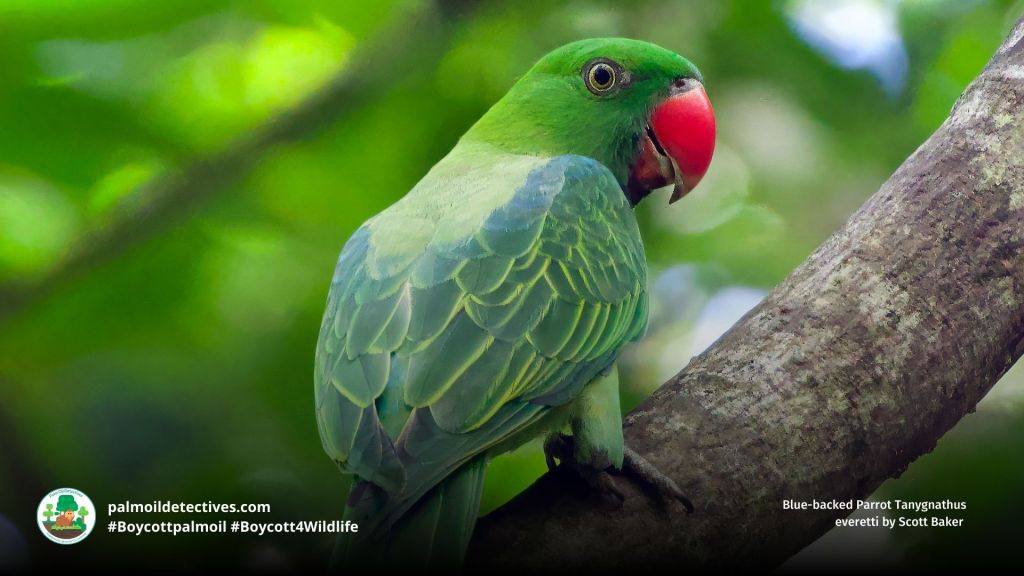
Blue-backed Parrot Tanygnathus everetti
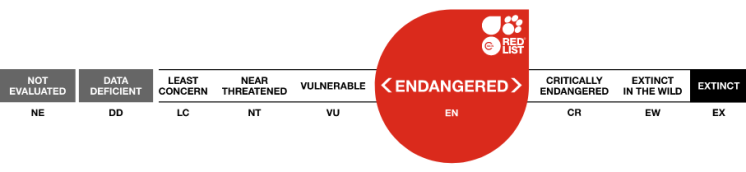
Status: Endangered
Location: The Blue-backed Parrot is endemic to the Philippines, where it is found on islands including Mindanao, Samar, Leyte, Bohol, Dinagat, and Basilan. It primarily inhabits lowland tropical rainforests, coastal forests, and cultivated areas up to 800 metres in elevation.
The Blue-backed #Parrot, also known as Müller’s Parrot or Burbridge’s Parrot, is a striking yet elusive #bird native to the #Philippines. Their shimmering blue and green plumage allows them to blend seamlessly into the forest canopy, making sightings of this rare species increasingly difficult. Despite once being common, the relentless destruction of their rainforest home and rampant #poaching for the #pettrade have pushed this parrot to the brink. They are now classified as #Endangered, they face ongoing population declines, with some local populations feared to be extinct. Without urgent conservation efforts, this vibrant parrot may vanish forever. Help them every time you shop and #BoycottPalmOil #Boycott4Wildlife
The Blue-backed Parrot 🦜 of the #Philippines 🇵🇭 is #endangered due to massive #deforestation for #palmoil 🌴🪔🥩🔥⛔️ and #meat #agriculture. Support their survival in the supermarket, be #vegan and #BoycottPalmOil 🫶 #Boycott4Wildlife @palmoildetect https://palmoildetectives.com/2021/01/21/blue-backed-parrot-tanygnathus-everetti/
Spectacular green parrot 🦜🦜💚of the #Philippines, the Blue-Backed #Parrot is now #endangered from #poaching 🫢⚖️ and #palmoil #deforestation 🌴🔥⛔️ Fight for their survival, use your wallet as a weapon #BoycottPalmOil #Boycott4Wildlife @palmoildetect https://palmoildetectives.com/2021/01/21/blue-backed-parrot-tanygnathus-everetti/



Appearance and Behaviour
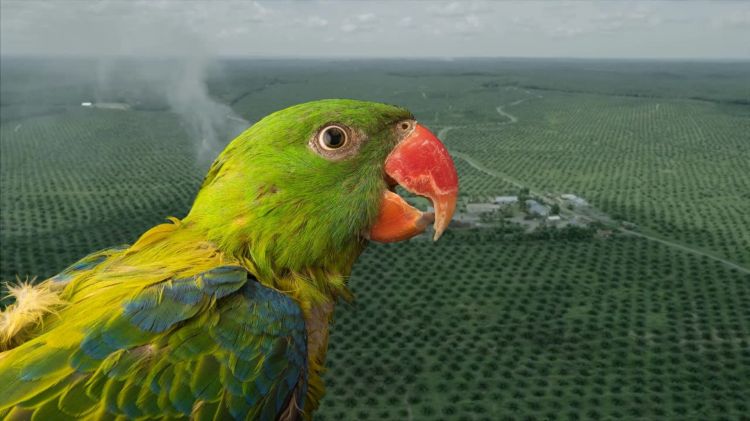
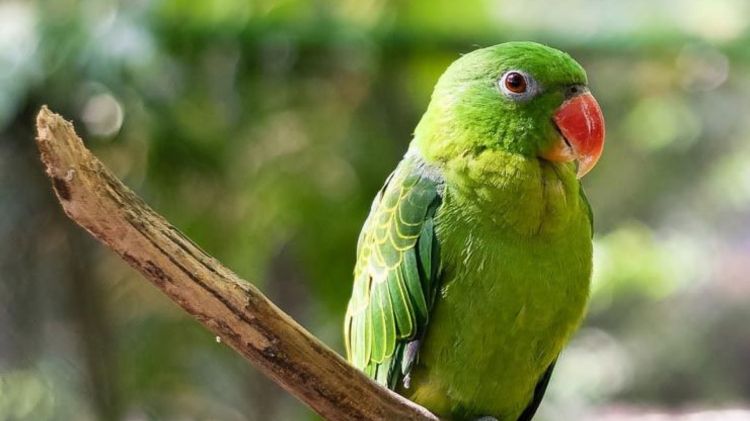
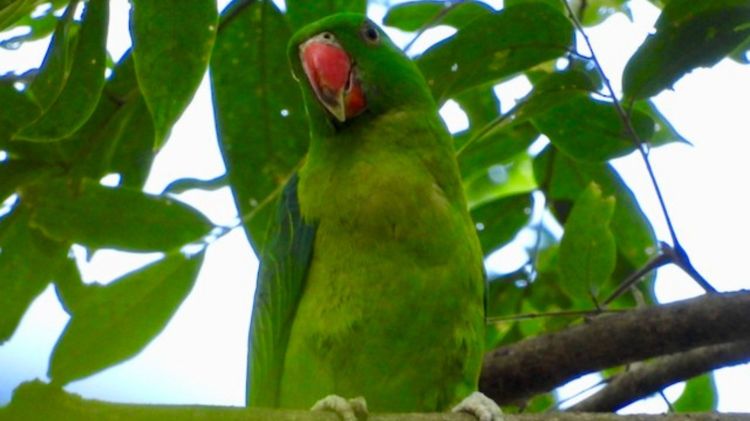
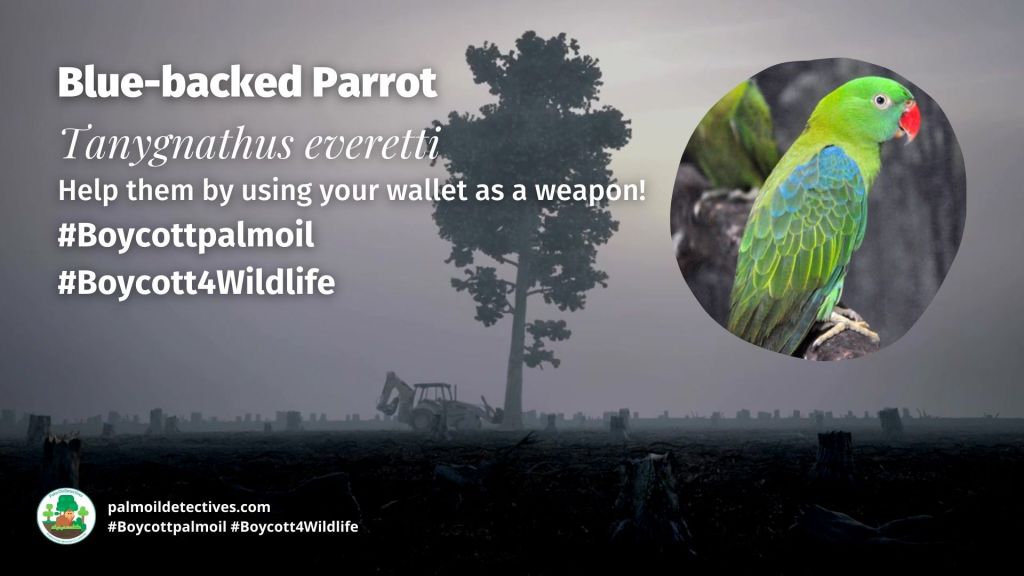
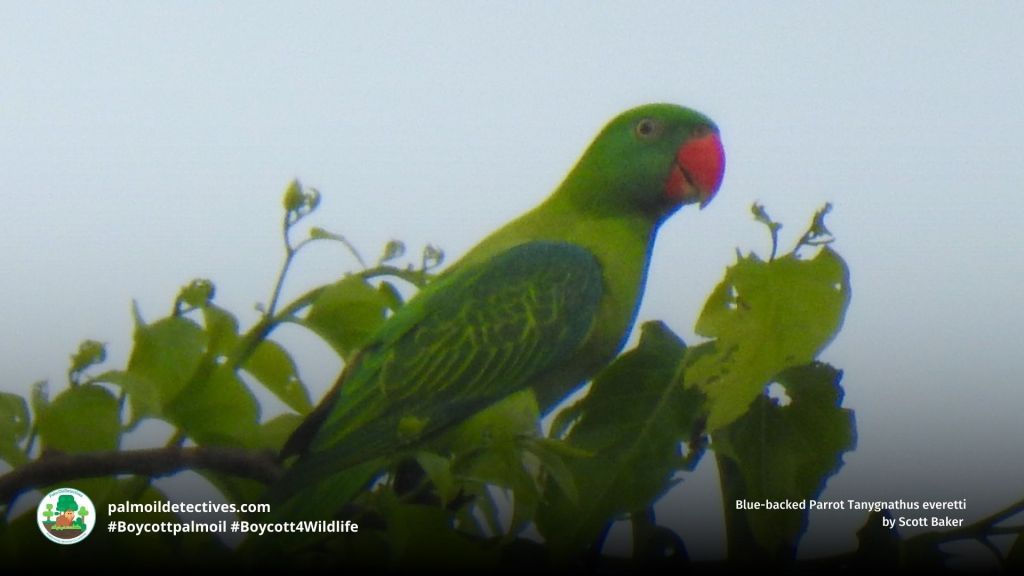
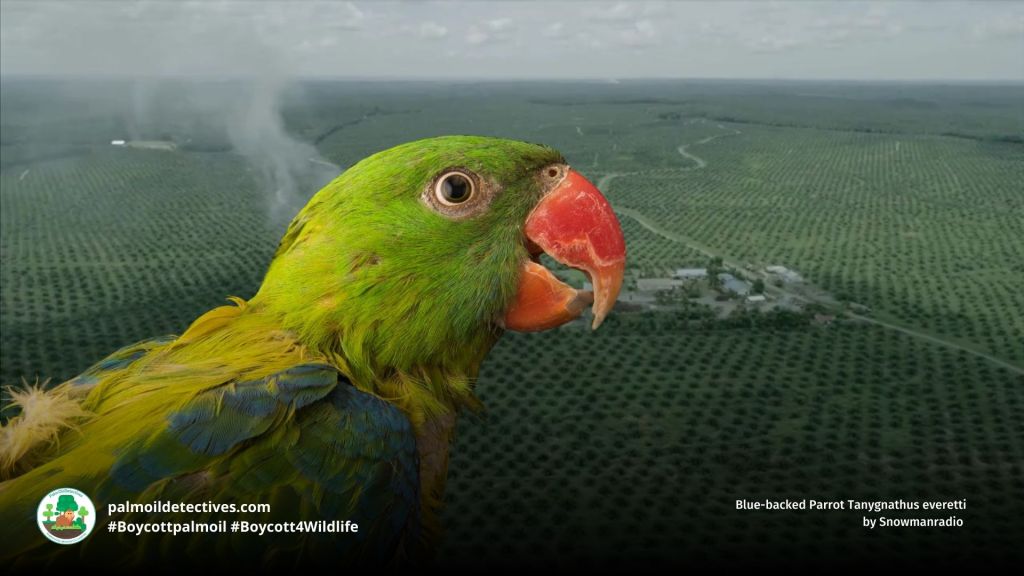
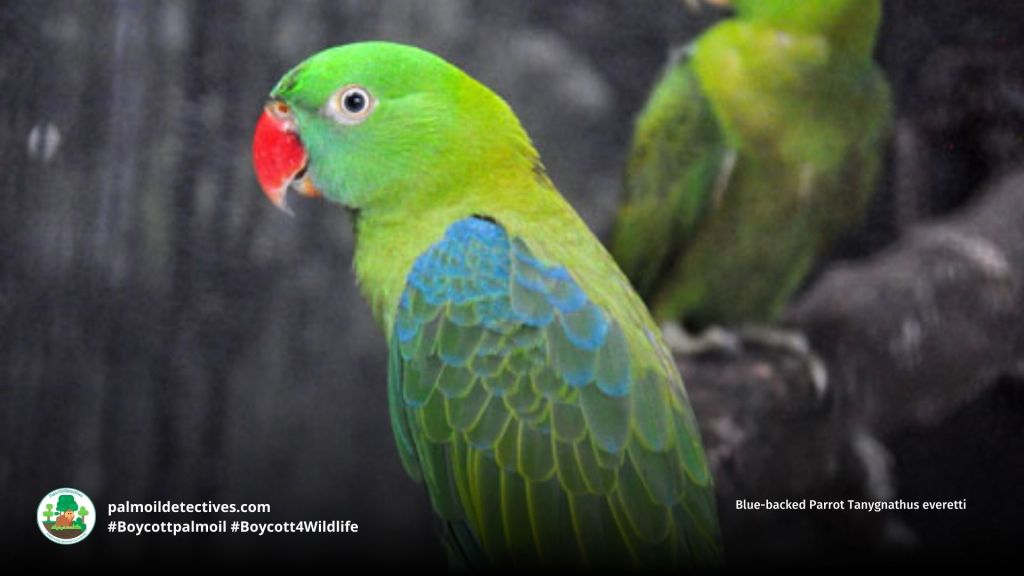
The Blue-backed Parrot is a medium-sized bird, measuring approximately 31 cm in length. Their deep blue rump and wing bends contrast beautifully against their green body, making them one of the most visually striking parrots in the Philippines. The head, mantle, wings, and tail are a darker shade of green, while the collar and belly are lighter green. They have a robust, golden-yellow beak, which they use to crack open hard seeds and nuts.
This species is highly arboreal, spending most of their time in the dense forest canopy. They are known for their swift, powerful flight and loud, squawking calls, which echo through the rainforest. Typically seen in pairs or small groups, these parrots are social but wary of human presence, making them difficult to observe in the wild.
Threats
There is also some level of forest loss across the species’ range (Global Forest Watch 2020). Mining activities also continue to reduce habitats across Tawi-Tawi (D. Allen in litt. 2020).
IUCN Red List
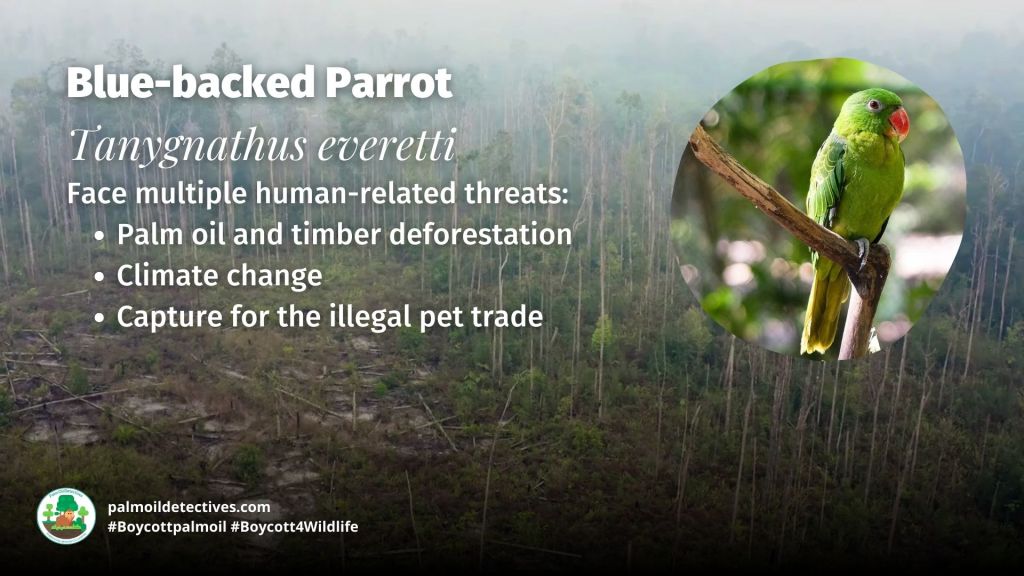
The Blue-backed Parrot faces two primary threats: habitat destruction and illegal poaching for the pet trade.
Coconut, rice, corn and palm oil deforestation
Widespread deforestation is rapidly erasing the forests this species depends on. Land is being cleared for palm oil plantations, logging, and agriculture, particularly for coconut, rice, and corn. The loss of old-growth trees also means fewer suitable nesting sites, making successful breeding increasingly difficult.
The illegal pet trade
The pet trade is equally devastating. These parrots are highly sought after due to their striking appearance and rarity, with many captured illegally and smuggled into both local and international markets. Poachers often raid nests by cutting down entire trees, killing parents and leaving chicks traumatised or dead. The few that survive endure brutal conditions in captivity, often succumbing to stress or starvation.
The trapping of adults and nestlings for the cagebird and pet trade are the most significant threats, with heavy trapping particularly extensive in the early 2000’s Scarcity of captured birds in markets suggests the genuine rarity of the species.
Climate change
Climate change poses an additional serious challenge, with increasingly severe typhoons and rising temperatures threatening already fragile populations.
Diet
The Blue-backed Parrot is primarily frugivorous, relying on a diet rich in fruits, nuts, and seeds. They favour wild rainforest fruits but will also feed on berries, flower nectar, and cultivated crops such as coconuts and corn. Their strong beaks allow them to break open hard shells, giving them access to nutrient-rich seeds. In areas where food is scarce, they may venture into farmland, leading to occasional conflict with farmers.
Reproduction and Mating
Like other members of the Tanygnathus genus, the Blue-backed Parrot is monogamous, forming lifelong pair bonds. They nest in tree hollows, preferring large, mature rainforest trees. The female lays two to three eggs, which she incubates while the male provides food. Chicks hatch blind and featherless, relying entirely on their parents for survival. They fledge after several weeks but may remain dependent on their parents for some time.
Breeding is believed to occur in April, coinciding with the dry season when food is most abundant. However, the destruction of nesting trees is making successful reproduction increasingly difficult.
Geographic Range
The Blue-backed Parrot is endemic to the Philippines, with populations found on Mindanao, Samar, Leyte, Bohol, Dinagat, and Basilan. They primarily inhabits lowland tropical rainforests, coastal forests, and occasionally cultivated areas. While they were once widespread, habitat loss and poaching have caused drastic declines, and it is now feared to be locally extinct in some parts of their range.
FAQ
What is the Blue-backed Parrot’s status?
The Blue-backed Parrot is classified as Endangered by the IUCN due to rapid population declines. They have become increasingly rare, and in some areas, it is feared to be locally extinct. Without immediate conservation action, their status may soon worsen.
What are the main threats to the Blue-backed Parrot?
The biggest threats are deforestation and the illegal pet trade. The expansion of palm oil plantations, logging, and agriculture has destroyed much of their habitat. Meanwhile, poachers raid nests to supply the pet trade, often cutting down entire trees to capture chicks. Many parrots die in transport due to stress and injury.
What is the Blue-backed Parrot’s habitat?
This species thrives in tropical lowland rainforests, coastal forests, and occasionally, cultivated areas up to 800 metres in elevation. However, they cannot survive in highly degraded landscapes, making deforestation a major concern.
What does the Blue-backed Parrot look like?
They have a medium-sized parrot with a striking blue rump and wing bends. The head, mantle, wings, and tail are a darker shade of green, while the belly and collar are a lighter green. They have a powerful, golden-yellow beak, which they uses to crack open hard seeds and nuts.
What does the Blue-backed Parrot eat?
Their diet consists mainly of wild rainforest fruits, nuts, seeds, and berries. They also consume flower nectar and may forage in coconut plantations or farms when food is scarce.
How does the Blue-backed Parrot breed?
They nest in tree hollows and is monogamous, with pairs forming lifelong bonds. The female lays two to three eggs, incubating them while the male provides food. Chicks are dependent on their parents until they fledge.
Is the Blue-backed Parrot known by any other names?
Yes, alternative names include the Müller’s Parrot and Burbridge’s Parrot.
How can I help protect the Blue-backed Parrot?
The best way to help is by refusing to support industries that destroy their habitat and by raising awareness about the devastating impact of the pet trade. Avoid products linked to deforestation, such as palm oil, and support conservation efforts working to protect these birds.
Take Action!
The Blue-backed Parrot is at serious risk of extinction— but you can help. Refuse to buy products that destroy their habitat and speak out against the illegal wildlife trade. Fight for their survival every time you shop! #BoycottPalmOil #Boycott4Wildlife
Further Information
BirdLife International. 2020. Tanygnathus everetti. The IUCN Red List of Threatened Species 2020: e.T181753148A181756316. https://dx.doi.org/10.2305/IUCN.UK.2020-3.RLTS.T181753148A181756316.en. Downloaded on 21 January 2021.
Forshaw, J. M. (2021). Parrots of the World: An Identification Guide. Princeton University Press. https://www.academia.edu/12338820/Parrots_of_the_World_An_Identification_Guide
Philippine Biodiversity Conservation Foundation. (2023). Blue-backed Parrot Conservation Efforts. Philippine Biodiversity Database. https://www.parrots.org/encyclopedia/blue-backed-parrot.
Sheldon, F. H., Lim, H. C., & Moyle, R. G. (2019). The taxonomy of Tanygnathus sumatranus: New insights and implications for conservation. Bulletin of the British Ornithologists’ Club, 139(4), 456–467. https://bioone.org/journals/Bulletin-of-the-British-Ornithologists-Club/volume-139/issue-4/bboc.v139i4.2019.a8/The-taxonomy-of-Tanygnathus-sumatranus/10.25226/bboc.v139i4.2019.a8.pdf.
Support the conservation of this species
This animal has no protections in place. Read about other forgotten species here. Create art to support this forgotten animal or raise awareness about them by sharing this post and using the #Boycottpalmoil #Boycott4Wildlife hashtags on social media. Also you can boycott palm oil in the supermarket.


How can I help the #Boycott4Wildlife?
Take Action in Five Ways
1. Join the #Boycott4Wildlife on social media and subscribe to stay in the loop: Share posts from this website to your own network on Twitter, Mastadon, Instagram, Facebook and Youtube using the hashtags #Boycottpalmoil #Boycott4Wildlife.
2. Contribute stories: Academics, conservationists, scientists, indigenous rights advocates and animal rights advocates working to expose the corruption of the palm oil industry or to save animals can contribute stories to the website.






3. Supermarket sleuthing: Next time you’re in the supermarket, take photos of products containing palm oil. Share these to social media along with the hashtags to call out the greenwashing and ecocide of the brands who use palm oil. You can also take photos of palm oil free products and congratulate brands when they go palm oil free.
4. Take to the streets: Get in touch with Palm Oil Detectives to find out more.
5. Donate: Make a one-off or monthly donation to Palm Oil Detectives as a way of saying thank you and to help pay for ongoing running costs of the website and social media campaigns. Donate here
Discover more from Palm Oil Detectives
Subscribe to get the latest posts sent to your email.
 Palm Oil Detectives