

Agile Gibbon Hylobates agilis
Endangered
Locations: Indonesia (Sumatra), Malaysia (Peninsular Malaysia), Thailand (southern regions)
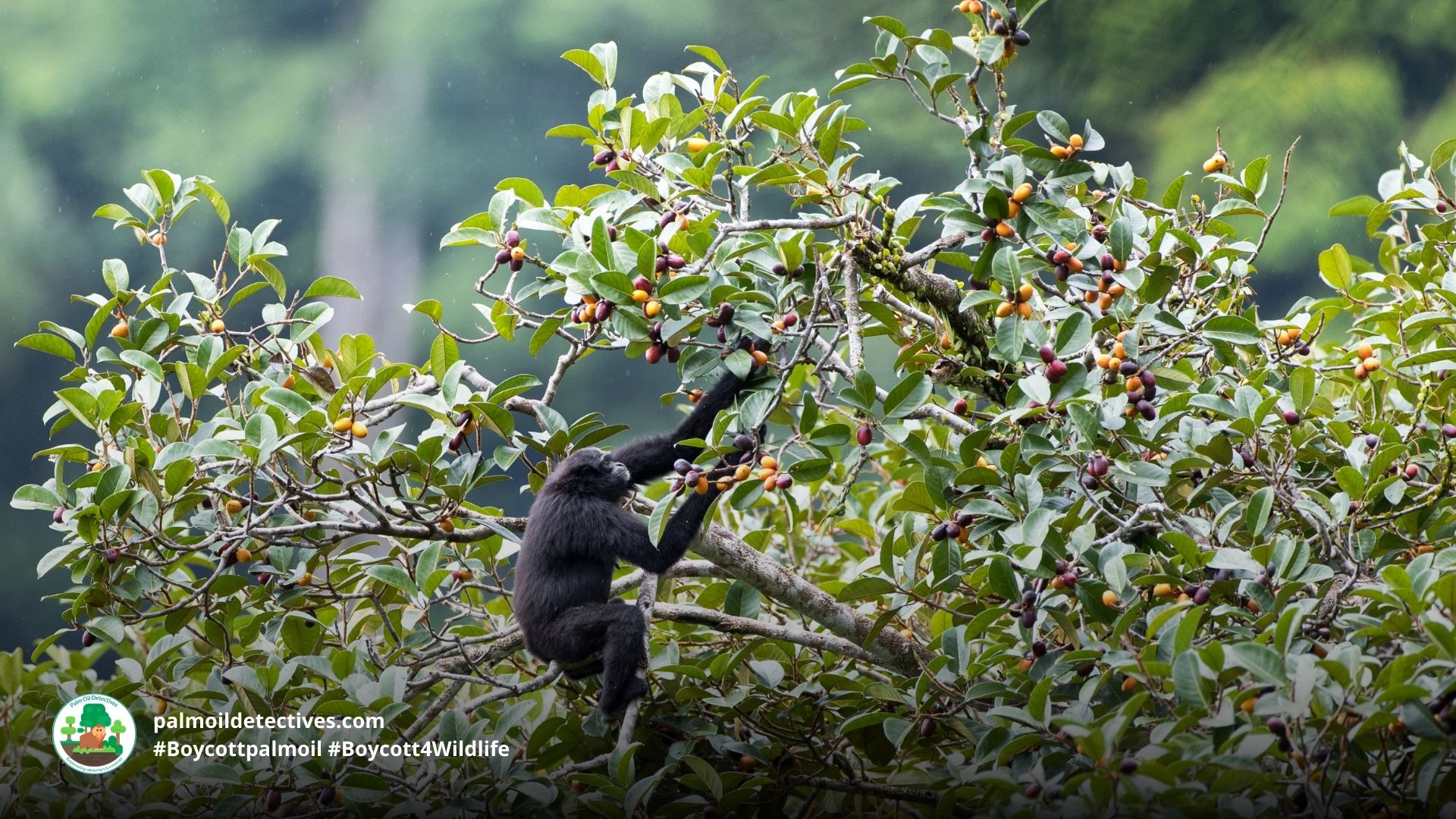
The Agile Gibbon, also known as the Black-handed Gibbon, is a small arboreal ape native to the tropical rainforests of Southeast Asia. Renowned for their remarkable brachiation skills, they can swing through trees with incredible speed and agility. Their melodious calls resonate through the forest, serving as both territorial markers and bonding rituals.
Unfortunately, habitat destruction and fragmentation, primarily due to palm oil and timber logging, have led to significant population declines. To protect the Agile Gibbon use your wallet as a weapon to fight for their survival each time you shop. #BoycottPalmOil #Boycott4Wildlife
Agile Gibbons sing in local accents, have strong family bonds, monogamous partnerships. They’re #endangered in #Indonesia #Thailand and #Malaysia by #palmoil #deforestation and other threats. Take action #Boycottpalmoil #Boycott4Wildlife https://palmoildetectives.com/2021/01/25/agile-gibbon-hylobates-agilis/ @palmoildetect
Appearance and Behaviour
Agile Gibbons exhibit fur colouration ranging from black to reddish-brown, with a distinctive white brow. Males can be identified by their white or light-grey cheeks. Both sexes weigh between 4 to 6 kg and measure up to 65 cm in body length. Their long arms and hook-shaped hands are perfectly adapted for brachiation, allowing them to swing effortlessly between trees.
These gibbons are diurnal and highly territorial, living in small family groups consisting of a monogamous pair and their offspring. Their complex vocalisations, often referred to as “songs,” are used to strengthen pair bonds and communicate territorial boundaries.
Geographic Range
The Agile Gibbon inhabits the tropical rainforests of Sumatra in Indonesia, Peninsular Malaysia, and southern Thailand. They prefer primary and secondary forests, ranging from lowland dipterocarp forests to montane regions. However, their habitat is increasingly fragmented due to human activities, leading to isolated populations.
Diet
Primarily frugivorous, Agile Gibbons have a diet that consists mainly of ripe fruits, supplemented by young leaves, flowers, and insects. Their role as seed dispersers is crucial for maintaining the health and diversity of their forest ecosystems.
Reproduction and Mating
Agile Gibbons form monogamous pairs that mate for life. Females give birth to a single offspring after a gestation period of about seven months. The young are weaned by two years of age but may remain with the family group until they reach sexual maturity, around eight years old. Parental care is shared between both parents, with the father often taking an active role in grooming and protecting the offspring.
Threats
The Agile Gibbon is listed as Endangered on the IUCN Red List, with populations continuing to decline due to ongoing threats. Conservation efforts include habitat protection, anti-poaching measures, and rehabilitation programmes for rescued individuals. Recent studies have highlighted the importance of degraded forests for Agile Gibbons, suggesting that these areas can serve as viable habitats and should be included in conservation strategies.
IUCN Status: Endangered
- Habitat Loss: Deforestation for timber extraction, palm oil agricultural expansion, and infrastructure development has led to significant habitat loss and threat for these gibbons.
- Illegal Wildlife Trade: Agile Gibbons are often captured for the pet trade, despite legal protections. This practice not only reduces wild populations but also disrupts social structures, as capturing a juvenile typically involves killing the protective parents.
- Hunting: In some regions, gibbons are hunted for their meat or for use in traditional medicine, further threatening their survival.
Take Action!
Protect the Agile Gibbon by boycotting products linked to deforestation, such as palm oil. Use your wallet as a weapon to support ethical and eco-friendly choices. Share their story and fight for their survival with #BoycottPalmOil and #Boycott4Wildlife.
On Sumatra, this species is threatened by forest conversion.
IUCN Red List
Further Information

Geissmann, T., Nijman, V., Boonratana, R., Brockelman, W, Roos, C. & Nowak, M.G. 2020. Hylobates agilis. The IUCN Red List of Threatened Species 2020: e.T10543A17967655. https://dx.doi.org/10.2305/IUCN.UK.2020-2.RLTS.T10543A17967655.en. Downloaded on 25 January 2021.
New England Primate Conservancy. (n.d.). Agile Gibbon. Retrieved from NE Primate Conservancy
Wikipedia contributors. (n.d.). Agile Gibbon. Retrieved from Wikipedia
Lee, D. C., Powell, V. J., & Lindsell, J. A. (2015). The conservation value of degraded forests for Agile Gibbons (Hylobates agilis). American Journal of Primatology, 77(1), 76-85. Retrieved from ResearchGate

How can I help the #Boycott4Wildlife?
Take Action in Five Ways
1. Join the #Boycott4Wildlife on social media and subscribe to stay in the loop: Share posts from this website to your own network on Twitter, Mastadon, Instagram, Facebook and Youtube using the hashtags #Boycottpalmoil #Boycott4Wildlife.
2. Contribute stories: Academics, conservationists, scientists, indigenous rights advocates and animal rights advocates working to expose the corruption of the palm oil industry or to save animals can contribute stories to the website.





3. Supermarket sleuthing: Next time you’re in the supermarket, take photos of products containing palm oil. Share these to social media along with the hashtags to call out the greenwashing and ecocide of the brands who use palm oil. You can also take photos of palm oil free products and congratulate brands when they go palm oil free.
4. Take to the streets: Get in touch with Palm Oil Detectives to find out more.
5. Donate: Make a one-off or monthly donation to Palm Oil Detectives as a way of saying thank you and to help pay for ongoing running costs of the website and social media campaigns. Donate here
Discover more from Palm Oil Detectives
Subscribe to get the latest posts sent to your email.
 Palm Oil Detectives