

Bangka Slow Loris Nycticebus bancanus
IUCN Status: Critically Endangered
Extant (resident): Indonesia (Sumatera)
Shy and elusive tiny #primates, Bangka Slow Lorises were last reported from the wild in 1937. If the Bangka Slow Loris is still alive then the burning of their habitat and conversion to agriculture (especially palm oil plantations) is their greatest threat.
These diminuitive and sweet-faced primates are critically endangered due to #palmoil #deforestation and the illegal pet trade. Just 20% of their rainforest remains on Bangka island, #Indonesia. Help them every time you shop, be #vegan #Boycottpalmoil #Boycott4Wildlife
Tiny #primates 🐒 Bangka #Slowloris are critically endangered by #palmoil #deforestation, only 20% of their rainforest remains on Bangka island, #Indonesia. Help them when you shop and #Boycottpalmoil 🌴🔥🩸☠️🧐⛔️ #Boycott4Wildlife @palmoildetect https://palmoildetectives.com/2022/12/11/bangka-slow-loris-nycticebus-bancanus/
The 🐒 Bangka #Slowloris is a rare fluffy #primate with a toxic bite 🤯 Rampant #ecocide of #palmoil #deforestation is a major threat along with #poaching in #Indonesia 🇮🇩 Fight for them and #Boycottpalmoil 🌴🔥🩸☠️🧐⛔️ #Boycott4Wildlife @palmoildetect https://palmoildetectives.com/2022/12/11/bangka-slow-loris-nycticebus-bancanus/
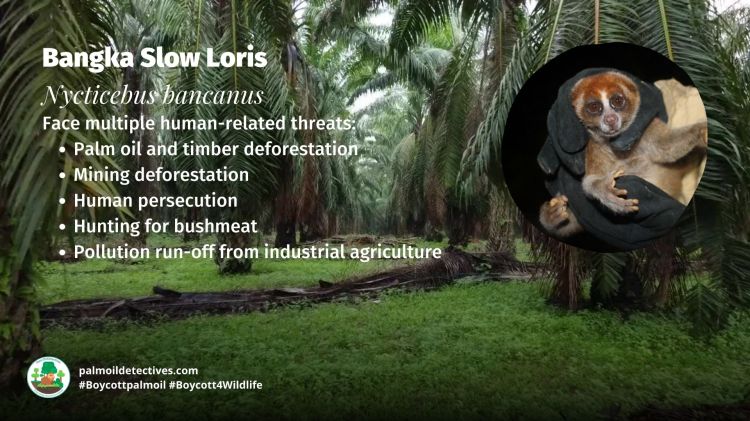
Threats
Bangka slow lorises are also threatened by exploitation and the illegal wildlife trade. However, this risk will be less since Bangka is relatively isolated from other Indonesian islands.
Slow lorises are often caught during forest conversion due to their tendency to cling to trees rather than flee (Nekaris and Starr, 2015), meaning that they may still be traded illegally for their body parts or for the illegal pet trade. A lack of law enforcement further threatens slow loris species across their range (Nijman et al. 2014).
Appearance
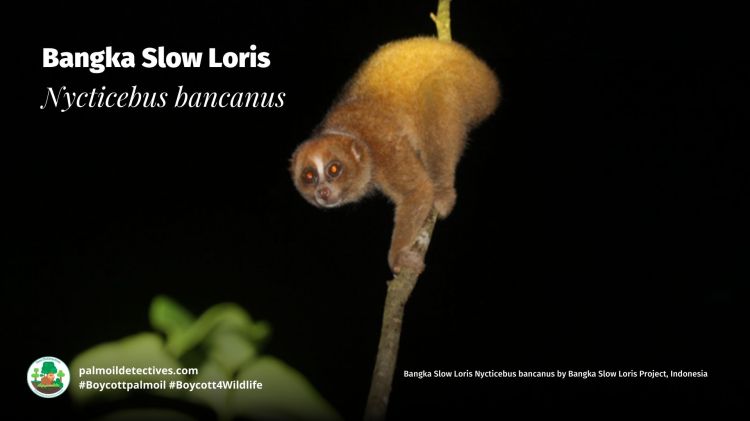
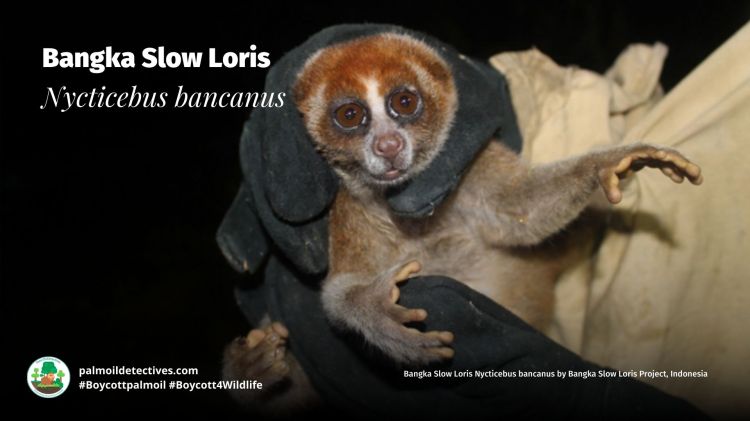
The Bangka Slow Loris, just like other slow lorises Nycticebus spp. are nocturnal and arboreal. They are found in a range of habitats from heavily degraded to pristine rainforest, plantations, and lowland and montane forests and thus they should also still live in forest patches on the island (Nekaris, 2014).
Diet
They primarily eat tree gum, nectar, and fruit and insects. A potential deterrent to would-be predators is their toxic bite. They have a gland on the inside of their arms that secretes a noxious oil. When threatened, they lick this gland, making their bite venomous.
Habitat
In 2018 a study was conducted into a population of Bangka Slow Lorises on the island of Bangka in southwestern Borneo – the only location where they are found.
They were originally considered to be a sub-species of the Bornean slow loris. However, they were given full species status in 2013 when a study showed that they have distinctive facial markings.
If the Bangka Slow Loris is alive they are likely to be rapidly declining due to a loss of habitat, largely due to oil palm plantations, leaving Bangka with less than 20% of its forest cover.
IUCN
Take Action!
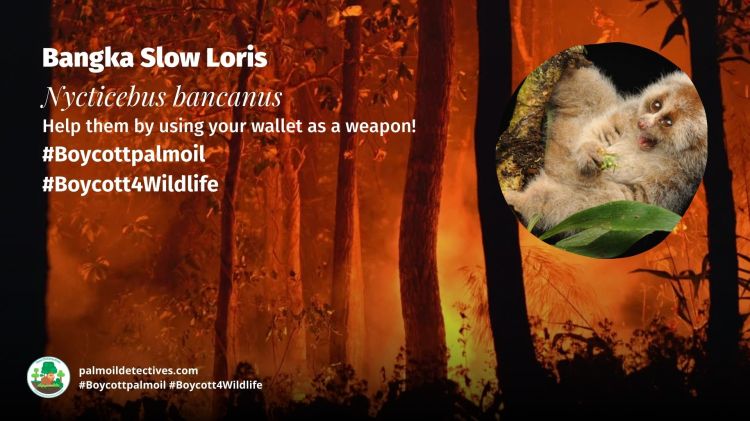
Protecting the Bangka Slow Loris would also protect many other plant and animal species throughout Asia. Help them every time you shop and #BoycottPalmOil #Boycott4Wildlife
You can support this beautiful animal
Further Information
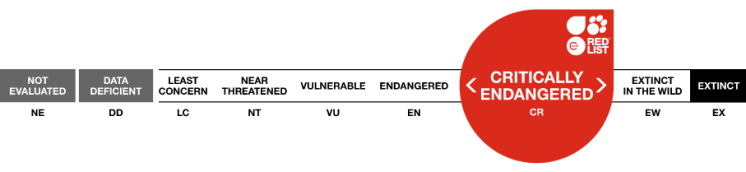
Nekaris, K.A.I. & Marsh, C. 2020. Nycticebus bancanus. The IUCN Red List of Threatened Species 2020: e.T163015864A163015867. https://dx.doi.org/10.2305/IUCN.UK.2020-2.RLTS.T163015864A163015867.en. Accessed on 07 September 2022.

How can I help the #Boycott4Wildlife?
Take Action in Five Ways
1. Join the #Boycott4Wildlife on social media and subscribe to stay in the loop: Share posts from this website to your own network on Twitter, Mastadon, Instagram, Facebook and Youtube using the hashtags #Boycottpalmoil #Boycott4Wildlife.
2. Contribute stories: Academics, conservationists, scientists, indigenous rights advocates and animal rights advocates working to expose the corruption of the palm oil industry or to save animals can contribute stories to the website.



3. Supermarket sleuthing: Next time you’re in the supermarket, take photos of products containing palm oil. Share these to social media along with the hashtags to call out the greenwashing and ecocide of the brands who use palm oil. You can also take photos of palm oil free products and congratulate brands when they go palm oil free.
4. Take to the streets: Get in touch with Palm Oil Detectives to find out more.
5. Donate: Make a one-off or monthly donation to Palm Oil Detectives as a way of saying thank you and to help pay for ongoing running costs of the website and social media campaigns. Donate here
Discover more from Palm Oil Detectives
Subscribe to get the latest posts sent to your email.
 Palm Oil Detectives
Thank you so much my dear friend for your support in sharing my stuff I really appreciate it. Much love and merry Christmas
LikeLike